

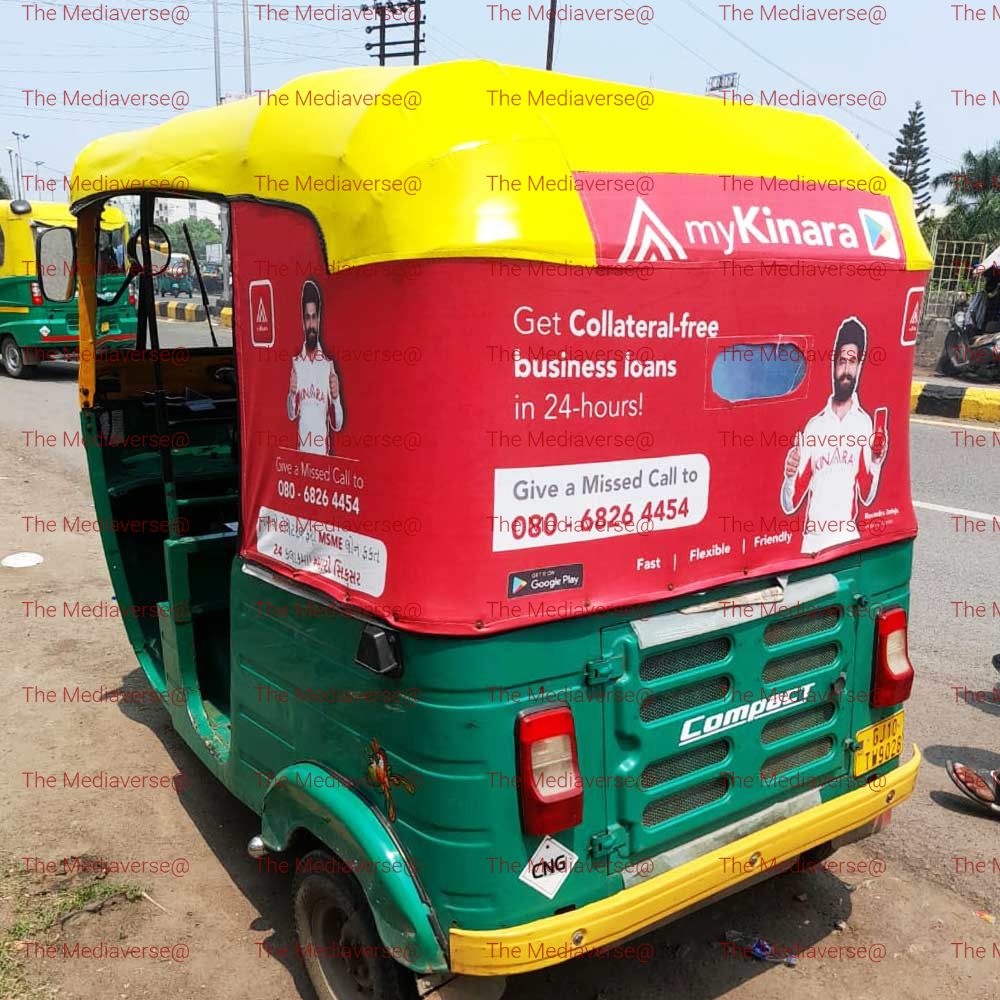
When a client tells us they have a tight budget but need to be seen everywhere locally, the first format we reach for is auto-rickshaw branding, and it rarely disappoints. For what a single prime hoarding costs, we can put a brand on a sizeable fleet of autos that move through the city all day, threading through markets, colonies, main roads, and the side streets no fixed site ever touches. It is the quiet workhorse of Indian outdoor advertising: unglamorous on one vehicle, formidable as a fleet, and the most cost-effective way we know to saturate a local area. This complete guide sets out what auto branding is and why it works, the formats and what each costs, how to think about reach, how to size and target a fleet, how to design and run a campaign, how to measure it, and where to go for city-level detail, so you can use the format as effectively as it deserves.
What is auto-rickshaw branding, and why does it work?
Auto-rickshaw branding applies a brand's advertisement to auto-rickshaws, on the hood, the full body, or the panels, so each vehicle becomes a small moving billboard, and a fleet becomes a citywide, all-day presence. Its effectiveness comes from a combination a fixed format cannot match: movement, density, frequency, and a low cost per contact. The autos go where the audience is, through residential colonies, busy markets, and last-mile streets, rather than waiting for the audience to pass one spot, and because there are many of them, the same people see the brand repeatedly, which builds familiarity. Crucially, all of this comes at a low cost per person reached, because a single auto is inexpensive to brand and runs all day. That is why, for a business whose goal is broad, repeated local awareness rather than a single prestige statement, auto branding delivers more presence per rupee than almost any other outdoor format.
Auto branding formats: hood, full wrap, and panels
Auto branding comes in several formats, differing in coverage, cost, and impact. The table sets out the main options so you can match the format to your goal and budget.
Auto-rickshaw branding formats (2026)
| Coverage and cost | Best for | |
|---|---|---|
| Hood branding | Rear hood panel; most affordable | Broad reach, fleet saturation, tight budgets |
| Full wrap (full body) | Entire auto; premium | Maximum impact, hero vehicles, premium brands |
| Back panel | Rear panel; affordable | Visibility to following traffic and at signals |
| Side panels / stickers | Side surfaces; budget add-on | Extra surface, quick low-cost presence |
2026 rates: hood ₹650/auto (300-499 autos) or ₹630/auto (500+), one-time, GST extra; back-panel stickers ₹140-₹270. Hood branding is the value workhorse; full wraps maximise impact and are quoted per campaign.
How much does auto-rickshaw branding cost?
Auto branding is among the lowest-cost outdoor formats. Hood branding is a one-time charge per auto: ₹650 per auto for fleets of 300 to 499 and ₹630 per auto at 500 or more, GST extra, with 300 autos the practical minimum. Back-panel stickers run ₹140 to ₹270 per auto, and a full wrap costs more per vehicle because it covers the whole body, so it is quoted per campaign. The total is therefore the per-auto rate times the fleet size, and the crucial point is the cost per contact: because each auto moves all day and is seen by many people, the cost of reaching each person is low, which is why a fleet can give broad citywide coverage for roughly what a single premium hoarding costs. For a tight budget, a starter fleet of hood-branded autos is the efficient entry point. Size the fleet to your goal and budget rather than to a round number, and the full rate card below shows exactly what each option costs.
The 2026 rate card: what a fleet actually costs
Here is the rate card we publish for 2026, the same rates quoted on our city guides. A full hood costs ₹650 per auto at a fleet size of 300 to 499 autos, and ₹630 per auto at 500 autos or more. Both are one-time charges covering material, printing, and mounting, with GST extra, and 300 autos is the practical minimum for a hood campaign. Back-panel stickers run ₹140 to ₹270 per auto depending on size and material, which is why they sit at the budget end of the format table above. Full wraps are quoted per campaign, because coverage varies with the vehicle and the creative. Two things follow from these numbers. First, the entry cost is genuinely modest: a 300-auto hood campaign comes in under ₹2 lakh before GST. Second, because the hood charge is one-time rather than monthly, every extra month the material stays on the road lowers the effective cost of the campaign.
Auto-rickshaw branding rate card (2026)
| 2026 rate (per auto) | Billing | Typical life | |
|---|---|---|---|
| Hood branding, 300-499 autos | ₹650, GST extra | One-time | About 6 months |
| Hood branding, 500+ autos | ₹630, GST extra | One-time | About 6 months |
| Back-panel stickers | ₹140 to ₹270 | One-time | 2 to 3 months |
| Full wrap | Quoted per campaign | Per campaign | Campaign duration |
One-time charges cover material, printing, and mounting; minimum 300 autos for hood campaigns. Source: The Mediaverse 2026 vendor rate card.
The cost per contact math
To see why these rates make the format so efficient, run the arithmetic from our field data. A branded auto typically covers 100 to 150 km a day and generates roughly 8,000 to 12,000 eyeball impressions from the traffic and pedestrians around it. Take the conservative end: one auto at 8,000 impressions a day over a 90-day stretch is about 7,20,000 impressions, against a one-time hood cost of ₹630 to ₹650. That works out to a cost per thousand impressions (CPM) of roughly ₹0.90, and the CPM only falls further over the hood's full six-month life. Hold that number against any other medium you are comparing: print, radio, and static hoardings in the same city routinely cost many multiples of it for equivalent exposure. This arithmetic, not any mystique about the format, is why auto branding keeps winning hyperlocal budgets.
How long the material lasts, and why it matters
The two formats also age differently, and that changes the real cost more than the sticker price does. A hood typically runs 6 to 12 months and is worth planning at six; back-panel stickers typically stay intact for 4 to 6 months. Neither is a guaranteed life. Because both are one-time charges, the longer-lived hood keeps earning impressions long after a sticker campaign has faded, so its effective cost per month is often lower even though its upfront price is higher. Plan replacements into a long campaign: a year of continuous presence means roughly two hood cycles or two to three sticker cycles, and budgeting that honestly avoids the mid-campaign surprise of a faded fleet. When you compare quotes, always ask whether the rate is one-time or recurring and what life the provider typically sees and what happens if a unit fails early, because a cheap rate on a short-lived material is not a saving. We work that arithmetic out in full, at every fleet size and duration, in our guide to how long an auto branding campaign should run.
Three questions to ask before you sign
A note on what the rate should include: material, printing, mounting, the owner's consent, and the provider's execution proof. Ask three questions before you sign. Is the rate one-time or recurring, and what happens if material is damaged mid-campaign? What fleet-size slab does the quote assume, since crossing the 500-auto threshold drops the per-auto rate from ₹650 to ₹630? And how will deployment be evidenced, because a rate card only pays off if the fleet actually runs in your zones, which is where the GPS logs and photo verification covered in the measurement section come in. A provider that answers all three crisply is usually one whose fleet you can trust; a provider that will not commit a rate to paper is telling you something too.
Reach and frequency: thinking in fleet terms
The right way to think about auto branding's reach is in fleet terms, not as a single number. One auto is modest; a fleet, over a month, is substantial, because each vehicle moves through its area all day, seen by the traffic and pedestrians around it, and the fleet multiplies that across many zones. So reach scales with three things: the number of autos, the zones they cover, and the duration. More autos in more zones for longer reach more people more often. And unlike a hoarding, which reaches whoever passes one fixed spot, a fleet reaches different people across the city and the same people repeatedly, which builds the frequency and familiarity that turn awareness into preference. This is the core of the format's value: broad, repeated, mobile exposure at a low cost per contact. When planning, decide the reach you need, then size the fleet and choose the zones to deliver it, rather than judging the format by how one auto looks.
Fleet tiers: from a starter fleet to citywide
Fleets scale to the goal and budget. The table sets out three broad tiers and what each suits.
Auto branding fleet tiers and their reach role
| Reach role | Best for | |
|---|---|---|
| Starter fleet (small) | Saturate one area or a few zones | Local shops, single-area focus, tight budgets |
| Growth fleet (medium) | Cover multiple zones across the city | Multi-area brands, growing reach |
| City fleet (large) | Citywide saturation | Brands wanting maximum local presence |
Start with the fleet that covers your catchment and scale up as the return justifies it. Confirm per-auto rates and zone coverage for your city.
Zones and targeting: making the fleet hyperlocal
Although individual autos move around, a fleet can be allocated to operate primarily in chosen zones, routes, or parts of a city, which makes auto branding genuinely hyperlocal rather than random. A business can weight its fleet toward the neighbourhoods, markets, and corridors where its customers live and travel, concentrating the impressions where they matter. For a single-location shop, that means saturating the immediate catchment; for a multi-area brand, spreading the fleet across the priority zones; for a launch, focusing on the area around the new store and the routes leading to it. This targeting, combined with the format's low cost, is what makes a fleet so efficient: you reach more of the right area for less. When planning, give your provider your priority zones so the fleet is deployed deliberately, rather than letting it operate evenly by default, and the same budget will work harder by concentrating on the audiences that count.
When is auto-rickshaw branding the right choice?
Auto branding is the right choice whenever broad, affordable, repeated local reach is the goal. It suits tight budgets, because a fleet starts at a modest monthly outlay; local saturation, because the moving fleet builds familiarity across many areas; last-mile and residential reach, because autos go where fixed sites cannot; and quick, flexible campaigns, because the format can be deployed and scaled readily. It is especially strong for small and local businesses, launches, offers, and any brand that wants to feel present everywhere locally. It is not the format for a single prestige statement at a landmark, where a hoarding fits, nor for a large immersive creative, where a full wrap or van suits better, nor for a purely online audience, where digital reaches further. In a layered local plan, auto branding is the broad, cost-efficient reach base that other, more targeted or higher-impact formats build on top of.
Designing for a small moving panel
An auto panel is small and moving, seen briefly and often in traffic, so the design rules are strict and different from a large static format. Lead with one clear idea: the brand and a single message or offer, large and bold, rather than crowding the panel with detail no one can read in passing. Use high contrast so the panel reads at a glance from a following vehicle or the roadside, keep the logo and the key message dominant, and make any call to action, a phone number, a short web address, or a QR code, simple and prominent. On a hood, design for the rear viewing angle; on a full wrap, use the larger canvas for a bolder, more immersive treatment while keeping the core message instantly legible. Consistency across the fleet matters too: the same creative on every auto compounds recognition. The test is simple, can someone who sees the auto for two seconds in traffic come away with your brand and one thing to remember? Design to pass that test and the fleet works; clutter it and even a large fleet underdelivers.
How to run an auto branding campaign: step by step
The process below takes an auto campaign from goal to measured result. Work through it in order.
Define the goal and target zones
Decide what the campaign should achieve, awareness, local saturation, a launch, or an offer, and which zones, neighbourhoods, and corridors your customers are in. The goal and the geography determine the format, the fleet size, and where the autos operate, so settle them first. A clear goal also gives you something to measure the campaign against.
Choose the format for goal and budget
Pick the auto format that fits: hood branding for affordable broad reach, a full wrap for maximum impact on hero vehicles, back panels for following-traffic visibility, or side panels and stickers as budget add-ons. Most reach-driven campaigns lead with hood branding, adding a few full wraps for impact where the budget allows. The format shapes both the cost per auto and the impression, so choose deliberately.
Set the fleet size and allocate to zones
Size the fleet to the reach you need and the budget you have, from a starter fleet that saturates one area to a city fleet for maximum presence, and allocate it to your priority zones and routes rather than letting it spread evenly. Concentrating the fleet where your audience is, is what makes the campaign efficient. Decide whether to cover the whole catchment or focus on the strongest zones first.
Design the panel for a moving vehicle
Design a bold, high-contrast panel with one clear message, the brand and an offer or call to action, legible at a glance in traffic, and keep the creative consistent across the fleet. Design for the viewing angle of the chosen format, the rear for a hood, the whole body for a wrap, and include a simple, prominent response mechanism such as a number or QR code.
Add tracking and coordinate with other formats
Build in measurement from the start: GPS or fleet logs for coverage, and a coupon code, QR, or dedicated number on the panel for response. Coordinate the auto campaign with your other formats so it reinforces a single message, the same offer on an insert, the same theme on a shop board, so the fleet amplifies a campaign rather than acting alone.
Run, track, and reinvest
Run the campaign to the plan, track coverage with the GPS or fleet logs to confirm the autos operated in the target zones, and measure response through the coupon, QR, or number, reading it alongside any footfall lift. Then reinvest the next budget into the zones and formats that delivered, and scale the fleet where it worked, so each campaign improves on the last.
How do you measure an auto branding campaign?
Auto branding is more measurable than its reputation suggests. Measure two things: coverage and response. Coverage, where and how much the fleet operated, is tracked through GPS or fleet logs, confirming the autos ran in the target zones as planned, which is valuable accountability on its own. Response is measured by attaching a coupon code, QR, or dedicated number to the panel and counting what it drives, and because auto branding is primarily an awareness and reach format, much of its value also shows up as a lift in overall footfall and enquiries during and after the campaign rather than as direct coupon redemptions, so read both signals together. Vary the tracking by zone where useful to see which areas converted. Combining GPS coverage with a response mechanism turns a fleet from a visible-but-vague presence into a measurable channel you can manage, compare, and improve over successive campaigns.
Auto-rickshaw branding by city
Rates, zones, and fleet considerations vary by city, so the local detail matters. We have published in-depth city guides covering the rates, the best zones, and the fleet data for auto branding in major cities, including Delhi, Chennai, Hyderabad, Pune, Kolkata, Ahmedabad, Jaipur, Lucknow, Mumbai, and others. If your city is covered, start with its guide for the specifics, then use this pillar for the framework, the formats, the reach math, the fleet and zone approach, the design rules, and the measurement. If your city is not listed, the principles here still apply: choose the format for your goal and budget, size and target the fleet to your zones, design boldly for a moving panel, and measure coverage and response. Either way, the core of a good auto campaign is the same, a fleet deployed deliberately where your audience is, with a clear creative and a way to measure what it delivers.
Which auto branding format is best?
It depends on your goal and budget. Hood branding is the best all-round choice for most campaigns: it is the most affordable per auto, the hood is a high-visibility spot, and it delivers broad reach efficiently, which is why it is the workhorse for fleet saturation. A full wrap is best when you want maximum impact per vehicle for a premium brand or hero autos, at a higher cost, while back panels add following-traffic visibility and side panels or stickers are budget add-ons. For most reach-driven local campaigns, lead with hoods across the fleet and add a few wraps only if the budget allows.
Can you target auto-rickshaw branding to specific areas?
Yes. While individual autos move around, a fleet can be allocated to operate primarily in chosen zones, routes, or parts of a city, so a campaign concentrates on the areas that matter rather than spreading at random. That makes auto branding genuinely hyperlocal: a business can weight its fleet toward the neighbourhoods, markets, and corridors where its customers live and travel, and reach more of the right area for less. Give your provider your priority zones so the fleet is deployed deliberately and the impressions land where they count.
How big an auto fleet do I need?
Size the fleet to the reach you need and the budget you have. A small starter fleet can saturate one area or a few zones, which suits a single-location shop or a tight budget; a medium fleet covers multiple zones for a multi-area brand; a large city fleet gives citywide saturation for maximum presence. Start with the fleet that covers your priority catchment, measure what it delivers, and scale into the zones that worked. It is usually better to saturate a focused area with a smaller fleet than to spread thinly citywide, because concentration builds the frequency that makes the format effective.
How is auto-rickshaw branding measured?
By coverage and response. Coverage, where and how much the fleet operated, is tracked through GPS or fleet logs, confirming the autos ran in your target zones. Response is measured by putting a coupon code, QR, or dedicated number on the panel and counting what it generates, and since auto branding is mainly an awareness and reach format, much of its value also appears as a lift in footfall and enquiries during and after the campaign. Varying the tracking by zone shows which areas converted, so you can compare campaigns and reinvest in the zones and formats that delivered.
Is auto-rickshaw branding allowed, and what permissions are needed?
Auto branding is an established, widely used advertising format, but because it involves advertising on commercial vehicles, a campaign should run with the vehicle owners' consent and in line with any applicable local advertising and transport norms, which can vary by city. In practice the branding provider handles this, arranging the fleet, the owner agreements, and any permissions as part of the service, so the advertiser does not manage it directly. The practical step for a business is to work with a provider that handles the fleet and the compliance properly, and to confirm that when you book.
Should I choose auto branding, a hoarding, or a van?
Match the format to the goal. Choose auto-rickshaw branding for broad, affordable, repeated local reach and saturation, including last-mile areas, which is its core strength and the best value for most local campaigns. Choose a hoarding when prestige or owning a single landmark matters more than spread, and mobile van branding when you need a large, customisable canvas taken to specific events, launches, or catchments. Many strong plans combine them: a fleet of autos as the broad reach base, plus a hoarding for prestige or a van for targeted high impact where a place or event justifies it.
Tags
Quick Answers
What is auto-rickshaw branding and how does it work?
Auto-rickshaw branding places a brand's advertisement on auto-rickshaws, most commonly on the rear hood, the full body (a wrap), or the back and side panels, turning each three-wheeler into a small moving billboard. A fleet of branded autos moves through the city all day, passing markets, colonies, main roads, and the last-mile streets fixed formats never reach, so the brand is seen repeatedly across a wide area. Movement, density, and frequency at a low cost build local familiarity far more cheaply than a single fixed placement, and fleets can be allocated to chosen zones for hyperlocal targeting.
How much does auto-rickshaw branding cost in India?
Auto-rickshaw branding is among the lowest-cost outdoor formats. In 2026, full hood branding costs ₹650 per auto one-time for fleets of 300 to 499 autos and ₹630 per auto at 500 or more, GST extra, while back-panel stickers run ₹140 to ₹270 per auto; a full wrap covers the whole body and is quoted per campaign. Over a hood's roughly six-month life the cost per person reached works out to a CPM under ₹1, and a starter fleet of 300 hood-branded autos delivers strong local reach for under ₹2 lakh before GST.
How much reach does auto-rickshaw branding deliver?
A fleet of branded autos delivers high, repeated reach because each vehicle moves through the city all day and is seen by the traffic and pedestrians around it. Reach depends on fleet size, the zones the autos operate in, and the duration, so think of it in fleet terms: more autos, covering more zones, for longer, reach more people more often. Unlike a fixed hoarding that reaches whoever passes one spot, a fleet reaches different people across the city repeatedly, building the frequency and familiarity that make broad local awareness cheap.
Is auto-rickshaw branding effective and good ROI?
Yes, for broad local reach it is one of the highest-return outdoor formats: it delivers dense, repeated, citywide exposure at a low cost per contact and reaches the residential and last-mile areas where customers live and travel, which makes it especially affordable for small and local businesses. It is also measurable, with coverage tracked through GPS or fleet logs and response through coupons or QR codes. It is not the right tool for a single prestige statement, where a hoarding or full wrap fits better, but for affordable, repeated local presence it delivers strong value per rupee.
Looking for professional Auto Branding services?
The Mediaverse runs end-to-end auto branding campaigns across India with geo-tagged delivery and transparent, all-inclusive pricing.
Explore our Auto Branding solutionsSummarize this guide with AI
Open this article in your favourite AI assistant
Related Guides
- auto rickshaw branding services
- auto hood branding vs full wrap
- auto-rickshaw branding vs hoardings
- why auto-rickshaw branding is the most underrated format
- the complete guide to outdoor advertising in India
- auto rickshaw branding in Delhi
- auto rickshaw branding in Chennai
- how to plan your outdoor advertising budget
Written by

The Mediaverse Team
India's Leading Outdoor Advertising Agency
The Mediaverse is a national-level outdoor advertising and integrated marketing organization that provides complete OOH, ATL, BTL, retail, and transit media solutions across India. With years of experience executing high-performance campaigns for brands in FMCG, Real Estate, E-commerce, EdTech, Automotive, Healthcare, and Retail, The Mediaverse combines creativity, data-driven media planning, and flawless on-ground execution. As a full-stack outdoor advertising provider, The Mediaverse offers Auto Branding, Mobile Van Branding, Newspaper Insertion Advertising, Shop Name Board Branding, In-Store Branding, Hoardings, Transit Media, Kiosks, Mall Media, Activations, and all forms of Below-The-Line marketing. Known for its pan-India network, strategic route planning, premium print quality, and Cheqmate™ GPS-based verification, The Mediaverse ensures 100% transparent and result-oriented campaign delivery. The Mediaverse’s editorial team produces deeply researched, SEO-optimized, and generative-engine-friendly content to help businesses understand the power of outdoor advertising and make informed decisions that maximize brand visibility and ROI across urban, suburban, and rural markets.
Related Articles
Where Branded Autos Actually Stand Still: 35 Percent of the Working Day (2026)
A branded auto spends about a third of its working day parked, and that is when it does its best work. The published dwell averages per stop type, what the 300-auto minimum covers at five Bangalore hubs and three residential pockets, and where the minimum order actually buys dominance.
100-Micron Against 80-Micron: The Auto Branding Material Question to Ask Before You Book (2026)
The material line is the one nobody checks and the only one that decides whether the fleet is still readable in month seven. What our ten city pages publish about 100-micron against 80-micron, the per-city failure windows, and the arithmetic that turns any material quote into one comparable number.
Auto Back Panel Branding in 2026: The Cheapest Auto Campaign You Can Actually Book
The smallest auto order on our card is 500 back panel stickers at Rs.170 each, or Rs.85,000 before GST, which is Rs.1,10,000 below the hood floor. The slab math at 800 autos, the per-square-inch comparison of the two sticker sizes, and what the hood budget buys in panels.