

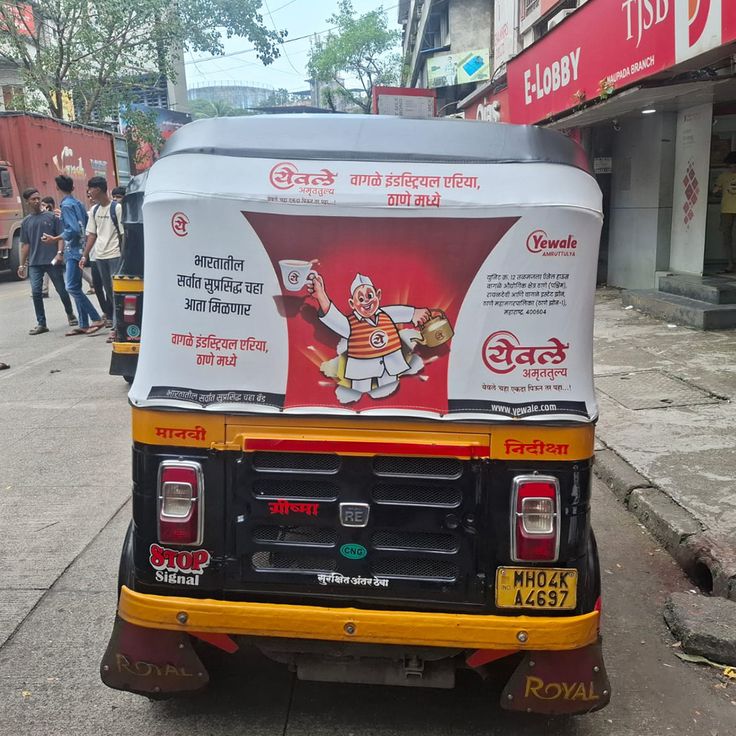
300 branded auto hoods cost ₹1,95,000 one-time on The Mediaverse published 2026 rate card, at ₹650 per auto before GST. One prime city hoarding costs ₹1 to ₹5 lakh per month, and ₹3 to ₹5 lakh in a location like Koramangala, on the market figures our own Bangalore guides use. So a full fleet at our minimum order costs less than a single month of a good hoarding, and the hood typically stays on the road for 6 to 12 months at no further charge. That is the whole decision in one line, and it is why this guide takes a side. Autos and hoardings are both outdoor formats, but they do opposite jobs: the fleet carries a smaller message through the whole city and into residential lanes, while the hoarding parks one large message at one junction and waits for traffic to pass it. Below is the published rate math, the conditions under which each format wins, the cases where neither fits, our recommendation, and a checklist to run before you book.
What does each format actually cost in 2026?
The auto side of this comparison is a published one-time rate card. Hood branding is ₹650 per auto, dropping to ₹630 per auto at 500 autos and above, with a minimum order of 300 autos. Back panel stickers are ₹170 per auto for the 24 by 6 inch size and ₹270 per auto for the 24 by 18 inch size, with a minimum of 500 autos. Every rate covers print and installation, GST is extra, and a few areas add an auto-union fee that is billed separately. The hoarding side is not a Mediaverse rate card, because we do not sell hoardings. The figure we use is the market range our own Bangalore guides quote: ₹1 to ₹5 lakh per month for a static site, and ₹3 to ₹5 lakh per month for a prime location such as Koramangala. Rent is monthly, printing the flex is extra, and the site is one fixed point on one road. The table puts the two side by side on measurable rows only.
Auto-rickshaw branding vs hoardings: the 2026 numbers
| Auto-rickshaw branding | Hoardings (billboards) | |
|---|---|---|
| Published 2026 rate | ₹650 per auto hood, ₹630 at 500 autos and above; stickers ₹170 or ₹270 per auto | ₹1 to ₹5 lakh per month per site (market range, not our rate card) |
| Minimum booking | 300 autos for hoods, 500 for stickers | One site, rented month by month |
| Entry ticket before GST | ₹1,95,000 for 300 hoods | ₹1 to ₹5 lakh for the first month |
| Typical life or term | Hood typically 6 to 12 months, sticker 4 to 6, one-time cost | As long as the rent is paid; reprint to change the creative |
| Cost per month of presence | About ₹32,500 on a six-month hood plan | ₹1 to ₹5 lakh |
| Where the message travels | Every route the fleet drives, including residential lanes and market streets | One junction or stretch, seen by passing traffic |
| Change or scale mid-campaign | Add autos, shift zones, reprint hoods | Fixed site; moving means a new booking |
| Best for | Local saturation, catchment reach, tight budgets | Owning one landmark, launches that need size, arterial-road drivers |
Auto rates are The Mediaverse published 2026 rate card, one-time, GST extra. Hoarding rent is the market range quoted in our Bangalore guides; The Mediaverse does not sell hoardings.
How long does each format keep working?
The second number that decides this comparison is life. A hood cover typically runs 6 to 12 months on the road in Indian conditions, and six months is the figure to plan a campaign on; back panel stickers typically stay intact for 4 to 6 months, because a rear panel takes more knocks, washing and handling than a roof does. Neither is a guaranteed service life. These are typical ranges from our own campaigns, and sun, parking, washing and plain luck move them in both directions, which is why every fleet campaign we run includes a monthly photo audit. A hoarding has no life of its own: it stays up for exactly as many months as you pay rent for, and the moment the booking ends the site goes to the next advertiser. That asymmetry, a one-time fleet that typically outlives its six-month plan against a site that restarts its bill every month, is what the worked example below turns into rupees.
What does ₹1,95,000 buy: 300 autos or one hoarding month?
Run the arithmetic at the published rates and the gap is not close. Our minimum hood order is 300 autos, so the entry ticket is 300 times ₹650, which is ₹1,95,000 before GST and ₹2,30,100 with 18 percent GST added. That fleet is a one-time spend. At 500 autos the rate steps down to ₹630, so a 500-auto fleet costs ₹3,15,000 before GST and ₹3,71,700 landed. Now put a hoarding beside it. One prime site at ₹3 lakh per month costs ₹18 lakh over the same six months the hood is planned on, and even a modest site at ₹1 lakh per month costs ₹6 lakh over six months, before printing. The 300-auto fleet, spread over its planned six months, is about ₹32,500 a month of presence, and if the hoods run the full twelve months they typically can, the figure halves to roughly ₹16,250. The table shows the same maths at the fleet sizes people actually book.
Six months of presence: 300 hoods vs 500 hoods vs one hoarding
| 300 auto hoods | 500 auto hoods | One hoarding, 6 months | |
|---|---|---|---|
| Rate used | ₹650 per auto, one-time | ₹630 per auto, one-time | ₹1 to ₹5 lakh per month |
| Total before GST | ₹1,95,000 | ₹3,15,000 | ₹6 lakh to ₹30 lakh |
| Landed with 18 percent GST | ₹2,30,100 | ₹3,71,700 | Rent plus GST, plus flex printing |
| Months of presence bought | Typically 6 to 12, no further charge | Typically 6 to 12, no further charge | 6, then the rent restarts |
| Cost per month on a six-month plan | About ₹32,500 | About ₹52,500 | ₹1 to ₹5 lakh |
Auto figures are the published one-time hood rates. Vinyl life is a typical range from our own campaigns, not a guarantee. Hoarding rent is a market range; confirm the exact site quote before comparing.
When does auto-rickshaw branding win?
Autos win in four situations that describe most local campaigns. The first is a budget under ₹5 lakh, where a single prime hoarding would consume the entire spend in one or two months while 300 autos at ₹1,95,000 leave room for creative, a second format and contingency. The second is catchment reach: a fleet passes through the residential lanes, market streets and school gates where a local business's customers actually live, whereas a hoarding reaches the stretch of road it stands on and nothing else. The third is frequency; the same auto passes the same corners several times a day for months, which builds the familiarity a shop, clinic, coaching centre or showroom depends on. The fourth is control after launch: you can add autos, shift the fleet to zones that are responding, or reprint hoods with a new offer, none of which a rented site allows without a fresh booking. If your goal is to be seen often by the people within a few kilometres of your door, the fleet is the efficient buy.
When does a hoarding win?
A hoarding wins when the job is one location, one moment or one audience of drivers. If there is a single junction that your buyers pass every day, a market entrance, a highway exit before your showroom, or the road outside a competitor, owning that spot for a month or two does something a moving fleet cannot: it plants a large, unmissable marker at the exact point of decision. Size itself is sometimes the message; a launch for a real estate project or a premium brand may need a display that reads as established from 100 metres away, and a hood cover is a small format by design. A hoarding also suits an audience that only sees the city from a car on an arterial road, where autos are less present than in the inner lanes. In those cases the ₹1 to ₹5 lakh monthly rent is buying something specific, and the only question is whether that site is worth it for the number of months you need.
When does neither fit?
Two kinds of brief call for a different format altogether. If the audience is households at their own gates, for example a builder launching a project or a school opening admissions in three specific colonies, a no-parking board run at ₹45 per board, ₹35 at 5,000 boards and above, sits on the gate for months and reaches each home more precisely than either an auto or a hoarding. If the message needs a crowd, a demonstration or samples, a mobile van with a crew does the day's work that a static site and a passing auto cannot. And if the budget is below ₹2 lakh including GST, the 300-auto hood minimum is out of reach; a sticker run at ₹170 per auto on 500 autos comes to ₹85,000 before GST, or a board run may be the better first campaign. Neither of the two formats in this guide is right for every brief, and saying so keeps the money on the format that will actually work.
Our recommendation
Book the autos first. At ₹1,95,000 for 300 hoods, one-time, a local business gets a citywide fleet that typically stays visible for 6 to 12 months, and the per-month figure of about ₹32,500 is a fraction of the ₹1 to ₹5 lakh a single hoarding rents for. Then ask one question about a hoarding: is there a specific site whose rent for the months you need is worth more to you than a second fleet? If a junction outside your store is quoted at ₹1 lakh a month and you need it for two months, that ₹2 lakh could instead lift the fleet towards 600 autos at ₹630 each. Sometimes the site wins that comparison, for a launch or a premium brand that needs presence at one address; usually it does not. Combining both is a real option above ₹5 lakh, with the fleet for frequency and one site for size, run on the same creative so the two reinforce each other. Below ₹5 lakh, the fleet alone is the recommendation.
Decision checklist: seven questions before you book
Answer these in order. One, what is the total budget including 18 percent GST, and does it clear ₹2,30,100 for the 300-auto minimum? Two, do your customers come from a catchment of a few kilometres, or from one road? Catchment means autos, one road means a hoarding. Three, is there a single site you can name that your buyers pass daily, and what is its monthly quote? Four, does the campaign need to run for six months or more? A one-time hood outlasts month-by-month rent. Five, will the offer change mid-campaign? Reprinting hoods is cheaper than re-renting and re-printing a site. Six, is size the message, as with a project launch or a premium brand? Seven, is the audience households at their gates rather than people on the move, in which case no-parking boards belong on the shortlist instead? If your answers point both ways and the budget is above ₹5 lakh, combine; otherwise book the format your answers favour and measure it with a campaign phone number or QR code.
How many autos equal one hoarding in reach?
There is no honest conversion, because the two reach people differently: a hoarding shows one message to whoever passes one spot, while a fleet shows it to different people across many areas, repeatedly. The rupee comparison is cleaner. One month of a prime site at ₹3 lakh funds about 460 auto hoods at ₹650, and those hoods typically keep working for 6 to 12 months after the hoarding month has ended. Decide on the pattern you need, coverage of an area or ownership of a point, rather than trying to express one format in units of the other.
Are hoardings worth the cost for a small business?
Rarely as a first campaign. A small business usually needs affordable, repeated visibility across its catchment, and ₹1,95,000 for 300 hoods buys that for a typical 6 to 12 months, while ₹1 to ₹5 lakh buys a single site for a single month. A hoarding earns its rent for a small business only when one exact spot matters, for example the junction outside the store during an opening month. Start with the fleet, and add a site only when you can name the location and justify its monthly quote.
Which is easier to scale or change, autos or hoardings?
Autos, comfortably. You can add autos to the fleet, shift coverage to the zones that are responding, or reprint hoods with a new offer, and each of those is a per-auto cost rather than a new site contract. A hoarding is a fixed booking: the location cannot move, the term is set, and a new creative means reprinting and remounting the flex on the same site. If you expect the campaign to evolve, the fleet is the adaptable format.
Which works better for a new store launch?
Usually the fleet, with one nearby site as the optional upgrade. Autos spread the opening message through the residential areas the store will draw from, and at ₹650 per auto one-time they keep working for months after the launch week. A hoarding on the approach road adds size and a landmark for directions during the opening month, at ₹1 to ₹5 lakh for that month. On a launch budget under ₹5 lakh, book the fleet and put the balance into creative and a measurable offer; above it, add the site.
Does The Mediaverse sell hoardings?
No. The Mediaverse sells auto-rickshaw branding, mobile van branding, no-parking boards, shop name boards and newspaper insertion. The hoarding figures in this guide are market ranges quoted in our own Bangalore guides, ₹1 to ₹5 lakh per month and ₹3 to ₹5 lakh for a prime site, not a rate card we control. We will say plainly when a hoarding is the better buy for a brief, because the fleet only earns its recommendation where it genuinely wins.
Tags
Quick Answers
Which is cheaper, auto-rickshaw branding or hoardings?
Auto-rickshaw branding, by a wide margin at the published rates. Hood branding is ₹650 per auto one-time, ₹630 at 500 autos and above, so the 300-auto minimum order costs ₹1,95,000 before GST and ₹2,30,100 landed, and the hood typically stays on the road 6 to 12 months at no further charge. A single prime hoarding rents for ₹1 to ₹5 lakh every month, ₹3 to ₹5 lakh in a location like Koramangala, plus printing. One month of a good site therefore costs more than a whole fleet for its entire life.
Which gives better ROI for a local business, autos or hoardings?
For most local businesses, autos, because the spend buys reach across the whole catchment for months at a one-time cost. Spread over the six months a hood is planned on, 300 autos cost about ₹32,500 per month of presence, against ₹1 to ₹5 lakh per month for one fixed site. A hoarding can still return more when the goal is a single address, a launch that needs size, or drivers on one arterial road. Match the format to whether you need coverage of an area or ownership of a point, and measure either with a campaign phone number or QR code.
When should you choose a hoarding over auto-rickshaw branding?
Choose a hoarding when one specific site is the campaign: a junction your buyers pass daily, the road outside your showroom, or a launch that needs a display readable from 100 metres. Its ₹1 to ₹5 lakh monthly rent buys ownership of that point and a scale no hood cover can match. Before booking, compare the site quote for the months you need against the fleet it could fund instead. ₹3 lakh, one month of a prime site, buys about 460 auto hoods at ₹650 that typically run 6 to 12 months.
Can you combine auto-rickshaw branding and hoardings?
Yes, and above roughly ₹5 lakh it is often the strongest plan. The fleet, from ₹1,95,000 for 300 hoods, supplies frequency across the catchment for 6 to 12 months; one site at ₹1 to ₹5 lakh a month supplies size at a single landmark for the launch window. Run the same creative on both so each sighting reinforces the other. Below ₹5 lakh, a hoarding would take most of the budget for one or two months of one location, so lead with the fleet and add a site later if one address proves worth owning.
Looking for professional Auto Branding services?
The Mediaverse runs end-to-end auto branding campaigns across India with geo-tagged delivery and transparent, all-inclusive pricing.
Explore our Auto Branding solutionsSummarize this guide with AI
Open this article in your favourite AI assistant
Related Guides
- auto rickshaw branding services
- the complete guide to outdoor advertising in India
- auto rickshaw branding in Delhi
- the operator's take on which format fits your business
- mobile van branding services
- how to measure outdoor advertising ROI
- how long an auto branding campaign should run
- auto branding ROI in Bangalore
Written by

The Mediaverse Team
India's Leading Outdoor Advertising Agency
The Mediaverse is a national-level outdoor advertising and integrated marketing organization that provides complete OOH, ATL, BTL, retail, and transit media solutions across India. With years of experience executing high-performance campaigns for brands in FMCG, Real Estate, E-commerce, EdTech, Automotive, Healthcare, and Retail, The Mediaverse combines creativity, data-driven media planning, and flawless on-ground execution. As a full-stack outdoor advertising provider, The Mediaverse offers Auto Branding, Mobile Van Branding, Newspaper Insertion Advertising, Shop Name Board Branding, In-Store Branding, Hoardings, Transit Media, Kiosks, Mall Media, Activations, and all forms of Below-The-Line marketing. Known for its pan-India network, strategic route planning, premium print quality, and Cheqmate™ GPS-based verification, The Mediaverse ensures 100% transparent and result-oriented campaign delivery. The Mediaverse’s editorial team produces deeply researched, SEO-optimized, and generative-engine-friendly content to help businesses understand the power of outdoor advertising and make informed decisions that maximize brand visibility and ROI across urban, suburban, and rural markets.
Related Articles
Where Branded Autos Actually Stand Still: 35 Percent of the Working Day (2026)
A branded auto spends about a third of its working day parked, and that is when it does its best work. The published dwell averages per stop type, what the 300-auto minimum covers at five Bangalore hubs and three residential pockets, and where the minimum order actually buys dominance.
100-Micron Against 80-Micron: The Auto Branding Material Question to Ask Before You Book (2026)
The material line is the one nobody checks and the only one that decides whether the fleet is still readable in month seven. What our ten city pages publish about 100-micron against 80-micron, the per-city failure windows, and the arithmetic that turns any material quote into one comparable number.
Auto Back Panel Branding in 2026: The Cheapest Auto Campaign You Can Actually Book
The smallest auto order on our card is 500 back panel stickers at Rs.170 each, or Rs.85,000 before GST, which is Rs.1,10,000 below the hood floor. The slab math at 800 autos, the per-square-inch comparison of the two sticker sizes, and what the hood budget buys in panels.