

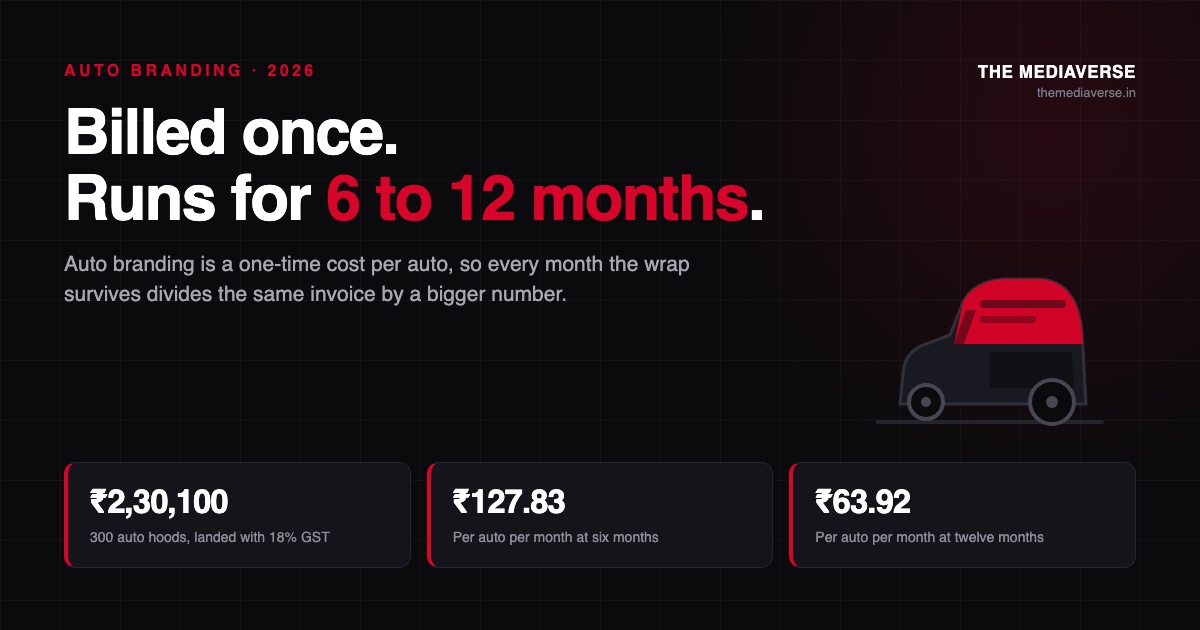
Most auto branding briefs arrive with a monthly budget attached, and that is the wrong shape for the format. Auto hood branding is billed one time per auto, ₹650 for a fleet of 300 to 499 autos and ₹630 from 500 up, with print and installation included. Three hundred hoods is therefore ₹1,95,000, or ₹2,30,100 once 18 percent GST is added, and nothing further is billed in month two. The published life of the vinyl is 6 to 12 months. So the real question is not how long you can afford to run, it is how long the wrap and the creative stay alive, because every extra month divides the same invoice by a bigger number.
This is written for the person who has to defend an outdoor line item to a finance team that thinks in monthly rates. It covers what the run-length decision actually controls, the per-auto-per-month arithmetic at 3, 6 and 12 months for hood and back panel fleets, the six things to settle before artwork goes to print, and the one number we do not publish and you should not let anyone invent for you.
Does a longer auto branding campaign cost more?
No, and it is the single most useful thing to know before planning. Both auto formats are quoted one time per auto, covering print and installation, with no monthly rental afterwards. Hood branding is ₹650 per auto for a fleet of 300 to 499 and ₹630 per auto from 500 up, against a published minimum order of 300 autos. Back panel stickers are ₹170 per auto for the 24 by 6 inch size and ₹270 for the 24 by 18 inch, falling to ₹140 and ₹240 at 800 autos or more, against a minimum order of 500. GST at 18 percent is extra on all of it, and some areas charge an auto-union fee that is billed separately. Nothing in that rate card contains a duration. You are buying a wrap, not airtime, and the calendar afterwards is free.
That mismatch is where most internal arguments start. Finance reviews outdoor next to a media plan billed monthly and asks for a monthly rate, and the honest answer is that there is not one. The nearest equivalent is the landed invoice divided by the months the wrap survives, which is a figure that improves after the money is spent rather than a rate you can be quoted at booking. Put both numbers in the approval note: the one-time landed cost, which is what leaves the account, and the per-auto-per-month cost at six months, which is what the spend looks like once the campaign has run its published material life.
How long does auto branding vinyl actually last?
It depends which format you bought, and the difference is big enough to change the plan. A hood cover typically runs 6 to 12 months in Indian climate conditions, on UV-resistant, waterproof vinyl tested for heat resistance and monsoon durability. Back panel stickers typically stay intact for 4 to 6 months, because a sticker on a rear panel takes more knocks, more washing and more direct handling than a hood cover does. Neither figure is a guarantee. We publish typical ranges from our own campaigns and we do not warrant a service life, because routes, parking, washing and plain luck move it in both directions. An auto parked in open sun through a Jaipur afternoon ages its hood faster than one working a shaded route, and a hood scrubbed daily with detergent loses gloss faster than one wiped down. Plan a hood campaign on six months and treat every month past that as earned, at no additional cost.
What ageing looks like in practice is worth knowing before the first audit lands, because not every kind of wear ends a campaign. Edge lift at the corners of a hood cover and general loss of gloss are cosmetic and the wrap keeps doing its job. Colour shift on a brand colour, cracking across the print, and any tear that cuts through a word or a phone number are different: at that point the auto is carrying an advertisement that no longer reads, which is worse than carrying nothing. When you review audit photos, sort them by whether the message is still legible from a few metres away rather than by how new the vinyl looks.
What one branded auto costs per month, by how long the wrap survives
| Landed per auto, GST included | At 3 months | At 6 months | At 12 months | |
|---|---|---|---|---|
| Auto hood, 300 to 499 autos (₹650) | ₹767.00 | ₹255.67 | ₹127.83 | ₹63.92 |
| Auto hood, 500 autos or more (₹630) | ₹743.40 | ₹247.80 | ₹123.90 | ₹61.95 |
| Back panel 24 by 18 inch, 500 to 799 (₹270) | ₹318.60 | ₹106.20 | ₹53.10 | ₹26.55 |
| Back panel 24 by 18 inch, 800 or more (₹240) | ₹283.20 | ₹94.40 | ₹47.20 | ₹23.60 |
| Back panel 24 by 6 inch, 500 to 799 (₹170) | ₹200.60 | ₹66.87 | ₹33.43 | ₹16.72 |
| Back panel 24 by 6 inch, 800 or more (₹140) | ₹165.20 | ₹55.07 | ₹27.53 | ₹13.77 |
Published one-time rates plus 18 percent GST, divided by the number of months the wrap stays on the road. The rate is charged once at booking; the monthly figures are what that single charge works out to, not a recurring bill. Auto-union fees, where an area charges them, are extra.
Read that table as arithmetic at each duration, not as a life we are promising you. The three and six month columns are realistic for both formats. The twelve month column belongs to the hood alone, because a sticker that typically runs 4 to 6 months will rarely be legible at month twelve. That is the shape of the choice: the sticker is the cheaper way to buy a season, and the hood is the only auto format that plausibly buys a year. Settle the expected life in writing at booking and check it against your own audit photos rather than against a brochure.
What does a whole fleet cost per month at six and twelve months?
Scale it to fleets you can actually book. Three hundred hoods, the published minimum order, is ₹1,95,000 before tax and ₹2,30,100 landed. Held for six months that is ₹38,350 a month for a 300-auto fleet, and held for twelve it is ₹19,175. Five hundred hoods at the ₹630 tier is ₹3,15,000 before tax and ₹3,71,700 landed, which is ₹61,950 a month across six months and ₹30,975 across twelve. The 500-auto fleet costs about 62 percent more than the 300-auto fleet while putting 67 percent more autos on the road, which is why clearing the 500-auto tier break is worth doing whenever the catchment can absorb the extra vehicles without spreading them thin.
The tier break is worth looking at directly. Moving from 499 autos to 500 drops the rate on the whole fleet from ₹650 to ₹630, so the fleet price falls from ₹3,24,350 to ₹3,15,000 before tax even though you added an auto. In other words the 500th hood is not merely free, it takes ₹9,350 off the bill and adds a vehicle to the road. The same shape repeats on back panel stickers at 800 autos, where 24 by 18 inch drops from ₹270 to ₹240 and 24 by 6 inch from ₹170 to ₹140. If a plan lands within a few dozen autos of either threshold, the arithmetic almost always says cross it.
Three bookable fleets, priced once and spread over the wrap's life
300 auto hoods
The published minimum order for hood branding, and the smallest hood campaign that can be booked.
- ₹650 per auto, print and installation included
- ₹767 per auto landed with 18 percent GST
- ₹38,350 per month if the wrap lasts six months
- ₹19,175 per month if it lasts twelve
500 auto hoods
Clears the volume tier, so every auto in the fleet is billed at the lower rate.
- ₹630 per auto at the 500-plus tier
- ₹743.40 per auto landed with 18 percent GST
- ₹61,950 per month across six months
- ₹30,975 per month across twelve
500 back panels, 24 by 18 inch
The lowest entry cost of the three at the published 500-auto minimum. Stickers typically run 4 to 6 months against 6 to 12 for a hood, so read the six month column as the realistic end and the twelve month column as arithmetic.
- ₹270 per auto at the 500 to 799 tier
- ₹318.60 per auto landed with 18 percent GST
- ₹26,550 per month across six months
- ₹13,275 per month across twelve
What actually ends an auto branding campaign?
Four things end it, and only one of them is the vinyl. The first is creative expiry: a launch offer, a season, a date or a phone number that stops being true. The second is material failure, the 6 to 12 month window, which arrives fleet-wide rather than on one day. The third is fleet attrition, autos that leave the route, change hands, get repainted or go off the road, which is invisible unless somebody is auditing. The fourth is a brand decision, a repositioning or a new identity that makes an old wrap a liability. Notice that three of the four are within your control at the artwork stage, and only the second is a property of the material you bought.
This is why the run-length conversation belongs before the print file is approved, not in month five. The cheapest month of an auto branding campaign is always the last one, and the decisions that let you reach it are all made early.
How do you set the run length before you print?
Write the retirement date on the brief, before the artwork
Pick the date the campaign is meant to stop working and put it on the brief in writing. Everything downstream, creative, fleet size, audit cadence, is judged against it. Why it matters: a campaign with no end date is really a campaign with an end date of whenever somebody notices, which is usually the month the wraps already looked tired. Common mistake: setting the date from a marketing calendar rather than from the 6 to 12 month material window, then being surprised that month 14 looks bad.
Strip every expiry date out of the creative
Remove dated offers, season names, launch language and any number you might change. Keep the brand, the category cue, one benefit line and a contact route you will still own in a year. Why it matters: the vinyl can last twelve months, and creative is the only reason most campaigns retire at eight weeks. Common mistake: a tracked phone number chosen for one quarter's reporting, which forces a reprint on the whole fleet when the number is retired. Choose a tracked number you can keep live for the full material life.
Size the fleet to the catchment, not to a monthly budget
Decide how many autos it takes to feel saturated in the zones you actually sell in, then check that number against the published minimums, 300 autos for hoods and 500 for back panel stickers. Why it matters: a one-time charge means fleet size, not duration, is the only real budget lever. Common mistake: dividing an annual budget by twelve and buying the fleet that fits one month of it, which produces a fleet too thin to register anywhere.
Fix the audit cadence in the booking, in writing
Agree at booking that you receive the monthly photo audit and GPS route tracking on selected autos, and name the months you expect them. Why it matters: the per-auto-per-month figure in this post is only true for autos still carrying an intact wrap, and the audit is the only thing that turns that from an assumption into a measurement. Common mistake: accepting installation photos as the whole reporting package, which proves month zero and nothing after it.
Put the mid-life decision in the calendar at month six
Book a review for month six with the audit photos on the table and one question: refresh the creative on this fleet, extend as is, or retire. Why it matters: month six is where the published material window opens, so it is the last point where a decision is cheap and the first where the wraps may need looking at. Common mistake: treating month six as a renewal negotiation. There is nothing to renew, the autos are already paid for, so the only spend on the table is a fresh print run if you want one.
Close the campaign with a rupees-per-auto-per-month number
At retirement, divide the landed invoice by the number of autos still carrying a legible wrap, then by the months they ran. That single figure is what you compare against next year's plan and against every other format. Why it matters: it is built from an invoice and a photograph, both of which you hold. Common mistake: closing on an impression estimate instead, which nobody outside the campaign can verify and which no finance team should accept as a result.
When should you refresh the creative instead of stretching the run?
Refresh when the message has changed, not when the wrap looks slightly older. A reprint on a 300-auto hood fleet is another ₹2,30,100, the same as the original booking, because print and installation are what the rate covers. That is a real decision, not a top-up. It earns its money when the offer, the positioning or the contact route has genuinely moved, or when a second product needs the same fleet. It wastes money when the only argument is freshness, because an auto hood is seen by a different crowd at every signal and repetition is the format working as intended rather than a fault. Stretch the run when the message still holds, and treat the second print run as a new campaign with its own six-month clock.
What does nobody publish about wrap survival?
One number decides whether that twelve-month column is real, and we do not publish it: the share of a fleet still carrying an intact, legible wrap at month 6, 9 and 12. We do not publish it because we do not have a figure we would stand behind across cities, seasons and fleet operators, and a survival rate invented for a proposal is worse than no number at all. What is published, and what you should insist on, is the reporting that lets you build your own: monthly photo audits, GPS route tracking on selected autos, and a post-campaign report with reach and frequency estimates from route analysis. Two audits into your own campaign you will have a survival curve nobody can quote you, and from that point it is the only one worth using.
The same caution applies to impressions. The service page quotes 30,000 to 50,000 daily impressions per branded auto, and that is an opportunity-to-see estimate derived from route analysis, not an audited count. It is useful for sizing a fleet and it is not a currency. Rupees per auto per month survives scrutiny because both halves of it come from documents you hold: an invoice and a photograph.
Frequently asked questions
The duration answer in this post assumes the material survives to the end of the window it is planned for, which is exactly the assumption a cheaper quote breaks. For the specification behind the 6 to 12 month hood life and the 4 to 6 month sticker life, and the per-city failure windows our own pages publish for the 80-micron market standard, read 100-micron against 80-micron.
Can I book auto branding for a single month?
You can run it for a month, but you will pay the same as running it for a year. The rate is one time per auto: ₹650 for a 300 to 499 hood fleet, ₹2,30,100 landed at the 300-auto minimum. Retiring that fleet after four weeks means ₹767 per auto for one month instead of ₹127.83 at six. If the message is genuinely one month long, newspaper insertion or a mobile van day rate fits the calendar better.
What happens if a wrap gets damaged during the campaign?
Raise it with the campaign contact as soon as an audit photo shows it, and agree replacement terms at booking rather than after. Damage on individual autos, from accidents, resale or repainting, is normal fleet attrition across a hood's typical 6 to 12 month run. The practical protection is the monthly photo audit, because it tells you how many autos are affected while there is still campaign left, and it is what your closing per-auto figure should be divided by.
Is it cheaper to run 300 autos for twelve months or 600 autos for six?
Both deliver 3,600 auto-months, and the long run is cheaper. Three hundred hoods at ₹2,30,100 works out to ₹63.92 per auto per month across twelve. Six hundred hoods at the ₹630 tier is ₹4,46,040 landed, which is ₹123.90 per auto per month across six. The bigger fleet buys concentration, useful for a launch window, and the smaller fleet buys duration at roughly half the unit cost.
When should the creative be changed on a running fleet?
When the message changes, not on a schedule. A reprint costs the same as the original booking because the rate covers print and installation, so ₹2,30,100 again on a 300-auto hood fleet. That is worth it for a genuinely new offer, positioning or product, and not worth it for freshness alone, since each signal shows the hood to a different set of people. Treat a reprint as a new campaign with its own six-month clock.
How do I check the wraps are still on the road?
Through the reporting agreed at booking: monthly photo audits, GPS route tracking on selected autos, and a post-campaign report with route-based reach estimates. Ask for the months to be named in the booking rather than left open. Count the autos with intact, legible wraps in each audit, and use that count, not the number you paid for, when you divide the invoice at the end of the campaign.
Tags
Quick Answers
How long should an auto branding campaign run?
As long as the wrap and the creative both hold, because the cost does not repeat. Our published vinyl life is 6 to 12 months in Indian conditions, so six months is the number to plan on and twelve is the number to earn. A 300-auto hood fleet costs ₹2,30,100 landed once. Running it six months makes that ₹127.83 per auto per month, and twelve months makes it ₹63.92.
Does auto branding cost more if the campaign runs longer?
No. Auto hood branding and back panel stickers are billed one time per auto, covering print and installation, with no monthly rental afterwards. Hoods are ₹650 per auto for 300 to 499 and ₹630 from 500 up, with a 300-auto minimum. Back panel stickers are ₹170 or ₹270 depending on size, with a 500-auto minimum. GST at 18 percent is extra, and duration appears nowhere in the rate card.
How long does auto branding vinyl last?
It depends on the format. A hood cover typically runs 6 to 12 months in Indian climate conditions on UV-resistant, waterproof vinyl tested for heat resistance and monsoon durability, and six months is the figure to plan on. Back panel stickers typically stay intact for 4 to 6 months. Neither is a guaranteed service life, because sun exposure, parking, washing and handling all move it, so confirm the real state of your fleet through the monthly photo audit.
What does one branded auto cost per month?
Divide the one-time landed rate by the months the wrap survives. A hood at ₹650 is ₹767 landed with GST, so ₹255.67 per month over three months, ₹127.83 over six and ₹63.92 over twelve. A 24 by 18 inch back panel sticker at ₹270 is ₹318.60 landed, so ₹53.10 per month over six and ₹26.55 over twelve. Nothing recurs, so the figure falls every month the wrap stays legible.
Looking for professional Auto Branding services?
The Mediaverse runs end-to-end auto branding campaigns across India with geo-tagged delivery and transparent, all-inclusive pricing.
Explore our Auto Branding solutionsSummarize this guide with AI
Open this article in your favourite AI assistant
Related Guides
Written by

The Mediaverse Team
India's Leading Outdoor Advertising Agency
The Mediaverse is a national-level outdoor advertising and integrated marketing organization that provides complete OOH, ATL, BTL, retail, and transit media solutions across India. With years of experience executing high-performance campaigns for brands in FMCG, Real Estate, E-commerce, EdTech, Automotive, Healthcare, and Retail, The Mediaverse combines creativity, data-driven media planning, and flawless on-ground execution. As a full-stack outdoor advertising provider, The Mediaverse offers Auto Branding, Mobile Van Branding, Newspaper Insertion Advertising, Shop Name Board Branding, In-Store Branding, Hoardings, Transit Media, Kiosks, Mall Media, Activations, and all forms of Below-The-Line marketing. Known for its pan-India network, strategic route planning, premium print quality, and Cheqmate™ GPS-based verification, The Mediaverse ensures 100% transparent and result-oriented campaign delivery. The Mediaverse’s editorial team produces deeply researched, SEO-optimized, and generative-engine-friendly content to help businesses understand the power of outdoor advertising and make informed decisions that maximize brand visibility and ROI across urban, suburban, and rural markets.
Related Articles
Auto Back Panel Branding in 10 Cities: The 500-Panel Minimum Priced City by City (2026)
All ten city pages publish one back panel card, so 500 panels cost Rs.85,000 everywhere. What the city route-premium notes, the Rs.140 headlines and the fleet sizes change, priced city by city.
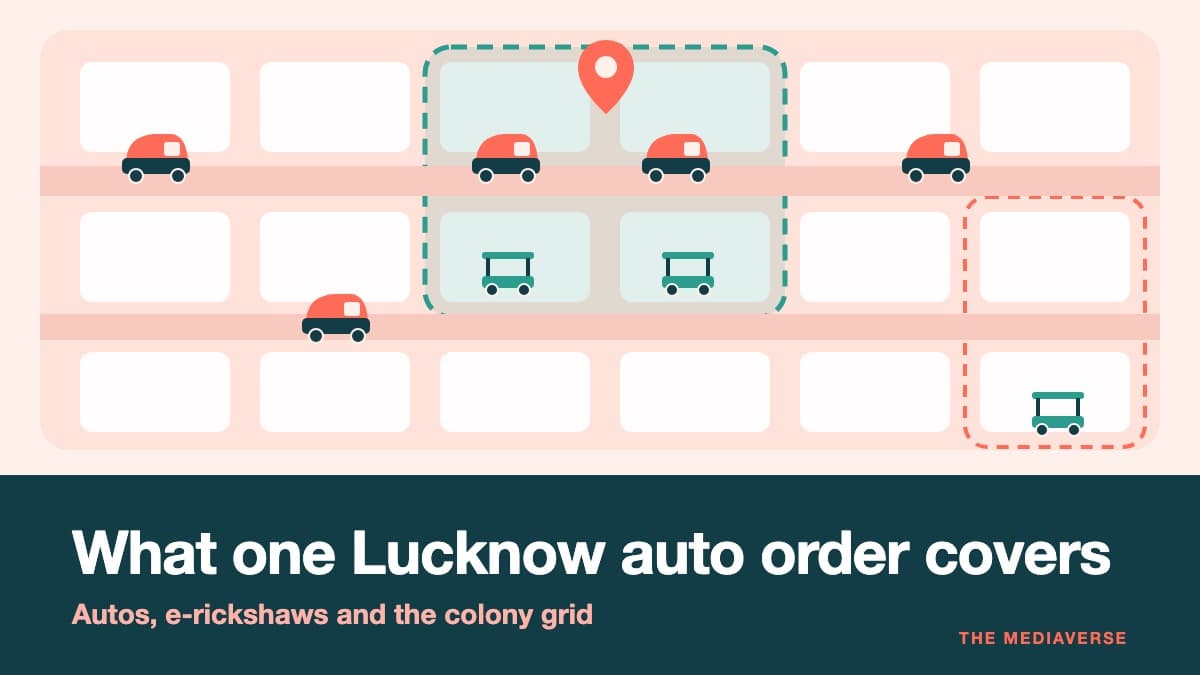
Auto Branding in Lucknow (2026): What the 300-Hood Minimum Covers Across Autos, E-Rickshaws and the Colony Grid
Lucknow prices autos and e-rickshaws on one national card, from Rs.85,000 for 500 panels. What one minimum order means in the page's own colony grids, how much of each zone it takes, and how the fog, monsoon and admission calendar shape the booking.
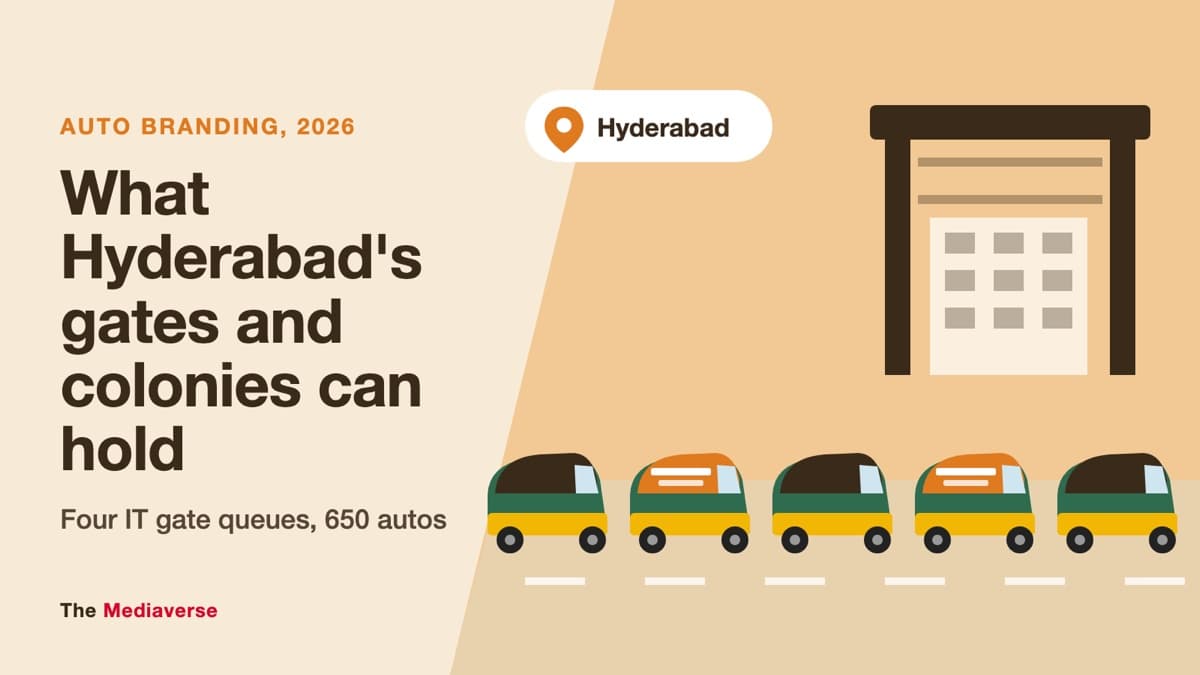
Auto Branding in Hyderabad (2026): What the 85,000-Auto Fleet and the Gate and Zone Map Actually Support
Four Hyderabad IT gate queues, 650 autos, and minimum orders of 300 hoods or 500 panels. What the published fleet and zone counts can actually carry, where the other 400 panels should run, and why 700 panels cost more than 800.