

India has one of the largest and fastest-growing outdoor advertising markets in the world, built not on giant highway hoardings but on the street-level density of its cities: millions of auto-rickshaws, a vast newspaper readership, and crowded retail high streets in every neighbourhood. For a brand, that density is an opportunity most digital channels cannot match, because outdoor advertising cannot be skipped, blocked, or scrolled past. But outdoor is not one thing. It is auto rickshaw branding, mobile van branding, newspaper insertion, and shop name boards, four very different formats with different costs, strengths, and rules. This guide is the complete 2026 breakdown: what each format is, what it costs, who regulates it, how the festive calendar moves it, and a clear framework to choose the right one for your goal and budget.
What is outdoor advertising (OOH) in India?
Outdoor advertising, also called out-of-home or OOH advertising, is any brand message a consumer encounters outside the home: on the street, on vehicles, in the newspaper that lands at their door, or above a shopfront. Traditional OOH means hoardings, billboards, and transit-station media. But in India, the highest-growth and most cost-effective segment is hyperlocal OOH: formats that put a brand directly into a specific neighbourhood rather than on an expensive arterial hoarding. The four that dominate are auto rickshaw branding, mobile van branding, newspaper insertion, and shop name boards.
The appeal is simple. A single hoarding on a city's main road can cost more for one month than dozens of branded autos circulating the same area, and the autos go where hoardings cannot, deep into residential lanes, market clusters, and college zones. Hyperlocal outdoor is therefore the natural choice for local retail, real estate, education, healthcare, and FMCG brands that need to dominate a defined catchment rather than buy thin citywide presence. It is also unblockable in a way digital is not: a branded auto in traffic or an insert in the morning paper reaches the consumer without a skip button.
The main outdoor advertising formats in India
Each format solves a different problem. Understanding what each one is best at is the foundation of every good outdoor plan.
Auto rickshaw branding
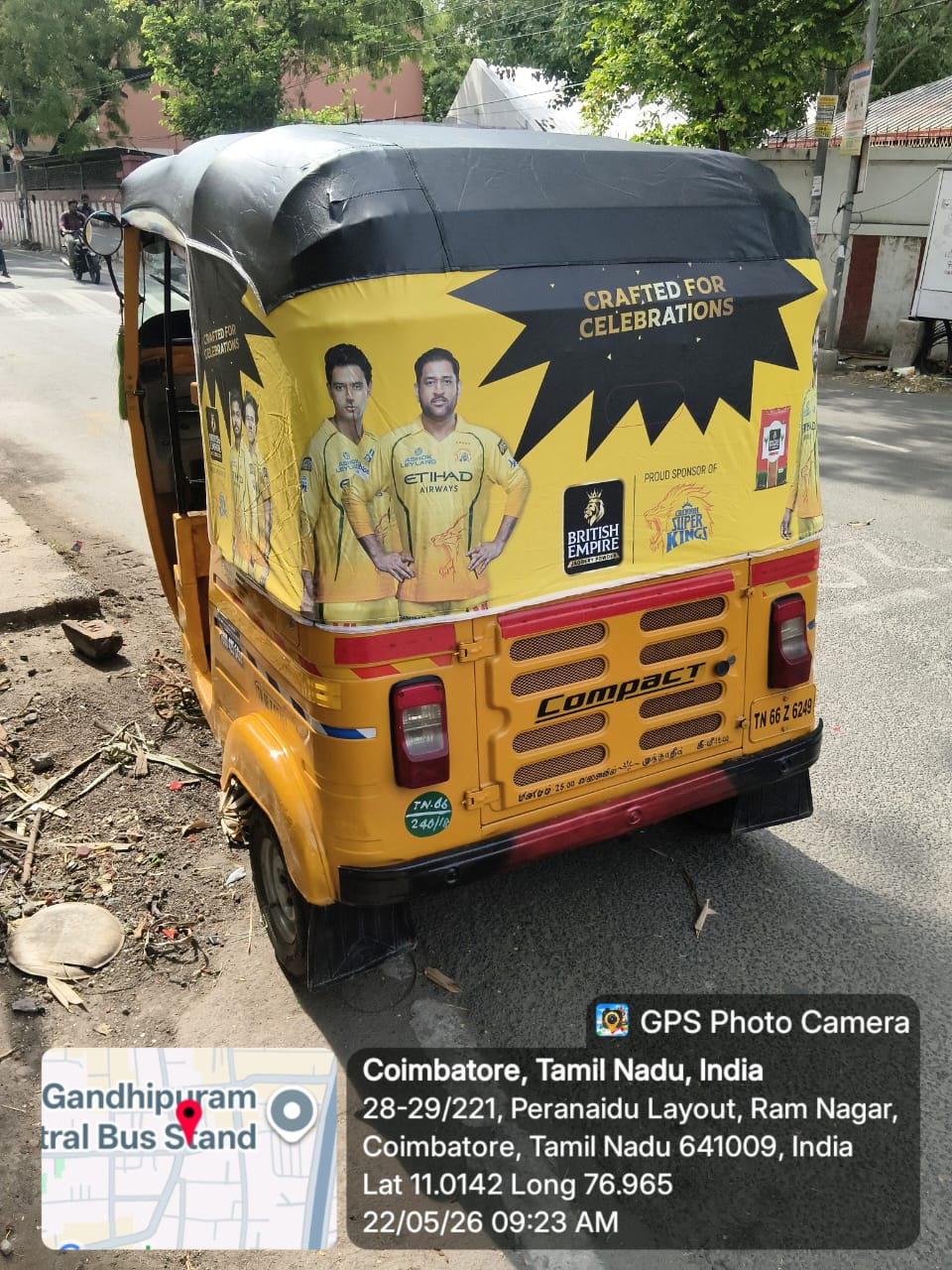
Auto rickshaw branding places your brand on the hood, back panel, or full body of auto-rickshaws that circulate a city all day. It is the most prompt and versatile outdoor format and the cheapest on a cost-per-impression basis. Hood branding (a rexine wrap over the auto roof) sits at eye level for pedestrians and two-wheeler riders and runs Rs 500 to 650 per auto per month; back-panel stickers are the budget entry at Rs 150 to 180; a full wrap maximises impact at Rs 2,000 to 2,400. A single branded auto generates an estimated 20,000 to 40,000 daily impressions. Auto branding is the default base layer for always-on local awareness, and the format of choice for almost any quick campaign or limited budget.
Mobile van branding
Mobile van branding turns a vehicle into a moving billboard that you route on demand, parking at high-footfall spots or circulating chosen corridors. Formats range from T-shape and L-shape display vans to canters and LED vans, costing Rs 3,000 to 9,000 per van per day. LED vans, the premium option, are self-illuminated and especially effective at night and at events. Mobile vans are the format for launches, high-impact bursts, experiential activations, and categories that want a customised, design-led presence, schools, fashion, furniture, and interiors in particular. Where auto branding gives sustained low-cost frequency, the van gives concentrated, controllable impact.
Newspaper insertion
Newspaper insertion places a printed leaflet, pamphlet, or catalogue inside the daily newspaper, delivered with the morning paper to chosen pincodes. It costs Rs 0.50 to 1.20 per pamphlet depending on the city and daily, and it is the most precisely targetable outdoor format: you can drop only in the localities that matter. It is ideal for offers, coupons, product sampling, and real estate. A practitioner tip for real estate especially: an A2 insert printed on the same newsprint stock and size as the paper reads as part of the newspaper rather than a discardable flyer, which lifts trust and readership. India's exceptionally high newspaper readership, particularly in the Hindi belt and regional-language markets, makes insertion unusually effective here.
Shop name boards
A shop name board is the permanent signage above a storefront, the one outdoor format that is a one-time investment rather than a recurring spend. Materials range from ACP and acrylic to glow sign and LED, costing Rs 180 to 400 per square foot installed. A well-made board is the single highest-return piece of local advertising a shop owns, working every hour the shop is visible. Illuminated boards (LED or glow sign) are the standout choice for the festive season, when a lit storefront stands out through Navratri, Diwali, and the wedding months. Shop boards are governed by municipal signage rules, including local-language requirements and, in heritage zones, strict restrictions.
How much does outdoor advertising cost in India? 2026 price guide
Outdoor costs vary by format, city, and scale, but the 2026 benchmarks below anchor any plan. The most important number is not the headline rate but the cost-per-thousand impressions, where hyperlocal transit formats decisively beat hoardings and digital display.
Outdoor advertising in India 2026: format, cost and best use
| 2026 starting cost | Best for | |
|---|---|---|
| Auto rickshaw branding | Hood Rs 500 to 650/auto/month; back-panel Rs 150 to 180; full wrap Rs 2,000 to 2,400 | Always-on local frequency on any budget |
| Mobile van branding | Rs 3,000 to 9,000 per van/day (T-shape, canter, LED) | Launches, high-impact bursts, experiential, night events |
| Newspaper insertion | Rs 0.50 to 1.20 per pamphlet | Pincode-level offers, coupons, catalogues, real estate |
| Shop name board | Rs 180 to 400 per sq ft (one-time) | Permanent storefront visibility and footfall |
Costs are 2026 starting points and vary by city, volume, material and season. Auto branding has the lowest cost-per-thousand impressions (about Rs 3 to 8). Request a free quote for an exact plan.
To put the cost-per-thousand in context: a single branded auto generating 20,000 to 40,000 daily impressions for around Rs 550 a month works out to roughly Rs 3 to 8 per thousand impressions, a fraction of what a hoarding or a digital display campaign costs for the same reach. A focused single-city auto campaign can start under Rs 20,000 a month, scaling up as you layer in vans for impact and inserts for offers. This efficiency is why hyperlocal outdoor is the backbone of local marketing in India.
Which outdoor advertising format should you choose? A decision framework
Start from your goal, not the format. If you want always-on awareness in a defined area on a limited budget, lead with auto branding, the cheapest and most flexible base layer. If you are launching a product or store, or running an experiential or night-time activation, add a mobile van, with an LED van where impact and after-dark visibility matter. If your objective is a specific offer, coupon, or catalogue delivered to chosen localities, use newspaper insertion, and for real estate, the native-feel A2 insert. If you run a physical store, a quality shop name board is a permanent asset that should anchor everything else.
Most effective campaigns are not single-format. A typical strong local plan runs an auto base for sustained frequency, a van or two for a launch or seasonal burst, newspaper inserts to push a time-bound offer, and a refreshed illuminated shop board so the store itself converts the awareness into walk-ins. Budget then dictates the weighting: a Rs 50,000 month might be all autos in one catchment; a Rs 5 lakh festive campaign blends all four. The constant across every budget is concentration, saturating one catchment with frequency beats spreading thin across a whole city.
Outdoor advertising rules and regulations in India
Outdoor advertising in India is regulated city by city by municipal bodies, MCGM in Mumbai, BBMP in Bangalore, GHMC in Hyderabad, the Greater Chennai Corporation, and their equivalents elsewhere, each with its own norms for signage, hoardings, and vehicle branding. Three rules matter most across formats. First, vehicle advertising (autos and vans) requires the consent of the owner and driver, and the branding must not obstruct the registration plate, permit, fare card, or the driver's visibility. Second, many states and corporations enforce local-language prominence on commercial artwork, Marathi in Maharashtra, Tamil in Tamil Nadu, Kannada in Karnataka, and so on, which is also a conversion advantage, not just compliance. Third, heritage zones restrict fixed signage: Jaipur's walled Pink City, for instance, limits hoardings and permanent media, which is exactly where mobile formats like branded autos become valuable.
A reputable vendor handles consent, route compliance, and signage permits, and confirms them in writing before a campaign starts, because non-compliant placement can see autos pulled off the road or signage taken down mid-campaign. There is no national rate ceiling on these formats, so pricing is set by the market, which makes choosing an experienced, compliant partner as important as the rate itself.
When does outdoor advertising peak? The festive calendar
Outdoor demand in India is strongly seasonal, and planning around the calendar is one of the biggest levers on both cost and results. The festive run from September to November, Ganesh Chaturthi, Navratri and Dussehra, then Diwali, is the peak window for hyperlocal outdoor, when pedestrian footfall, retail buying, and advertising demand all surge. The November to February wedding season follows, especially for jewellery, apparel, and event brands. During these windows, prime auto fleets, mobile vans, and routes book out six to eight weeks ahead, and rates firm up. The practical implication is to book early: a festival or wedding-season campaign should be locked one to two months before the event, not in the week before.
Climate shapes the plan too. The June to September monsoon in Mumbai, Pune, and the west coast demands hot-laminate vinyl or artwork peels; coastal-humid cities like Chennai accelerate adhesive failure; and dry, high-UV markets like Jaipur and much of the north fade cheap inks. Specifying UV-stable inks with hot-laminate is a small line item that protects the whole campaign, and it matters most exactly when visibility is highest, during the festive season.
How do you measure outdoor advertising ROI?
Outdoor is a frequency-and-recall medium, so measure it accordingly rather than expecting last-click attribution. The proven approach is to put a campaign-specific phone number or WhatsApp line and a QR-linked landing page on the artwork, add a simple in-store question (where did you hear about us) for the campaign window, and benchmark against the cost-per-thousand. Because recall in outdoor builds over weeks, judge a campaign across a 60 to 90 day window, not a single month, single-month campaigns almost always under-read their true effect. For a store, the cleanest signal is the walk-in or enquiry lift in the catchment you saturated versus the spend, tracked over the full run.
Outdoor advertising in India rewards a clear plan more than a big budget. Pick the format that matches your goal, concentrate it in one catchment, brief local-language creative, specify the right vinyl for your climate, book ahead of the festive peaks, and measure over a real recall window. Do that and even a modest spend on branded autos, a van, inserts, or a fresh shop board can outperform far costlier media on the metric that matters, customers through the door.
What is the cheapest form of outdoor advertising in India?
Auto rickshaw branding is the cheapest outdoor advertising in India on a cost-per-impression basis. Hood branding starts at Rs 500 to 650 per auto per month, and back-panel stickers at just Rs 150 to 180, while a single branded auto generates an estimated 20,000 to 40,000 daily impressions. That works out to roughly Rs 3 to 8 per thousand impressions, well below hoardings, transit media, or digital display. For a small business or a tight budget, a focused auto campaign in one catchment is the highest-value entry point into outdoor advertising, and it can start for under Rs 20,000 a month.
Is outdoor advertising better than digital advertising in India?
They do different jobs, and the best plans use both, but hyperlocal outdoor has clear advantages for local businesses. It cannot be skipped, blocked, or scrolled past, it builds neighbourhood-level familiarity that digital struggles to, and on a cost-per-thousand basis formats like auto branding are far cheaper than digital display. Digital wins on precise targeting, retargeting, and measurable clicks. For a local retailer, clinic, school, or real-estate project targeting a defined catchment, a concentrated outdoor campaign often delivers more walk-ins per rupee than digital, especially when paired with a simple offer and local-language creative.
How do I choose between auto branding, mobile vans, and newspaper inserts?
Match each to its job. Auto branding is for always-on, low-cost frequency across a catchment, the default base layer. Mobile vans are for high-impact bursts, launches, experiential activations, and night events, with LED vans for after-dark visibility. Newspaper inserts are for delivering a specific offer, coupon, or catalogue to chosen pincodes, and are especially strong for real estate and FMCG. If you only pick one, choose auto branding for sustained awareness or inserts for a one-off offer. If budget allows, layer an auto base with a van for impact and inserts for the offer.
Do I need local-language creative for outdoor advertising in India?
In most cities, yes, and it is one of the highest-impact decisions you make. Many states and municipal corporations enforce local-language prominence on commercial artwork (Marathi, Tamil, Kannada, Telugu, Gujarati, Hindi), so it is partly a compliance requirement. Beyond compliance, local-language or bilingual creative simply converts better with the everyday buyer across residential and mass-market catchments. The common and costly mistake out-of-state advertisers make is running a single English creative nationwide; lead in the local language, and keep English secondary except for premium or corporate audiences.
When should I book an outdoor advertising campaign in India?
For a normal campaign, two to three weeks ahead is usually enough. But for the festive and wedding seasons, book six to eight weeks ahead, because Ganesh Chaturthi, Navratri, Dussehra, Diwali, and the November to February wedding months are when prime auto fleets, mobile vans, and routes sell out and rates firm up. A festival campaign locked one to two months in advance secures the best fleet, the strongest routes, and standard rates; a last-minute booking pays a premium for leftover capacity. Align the booking with your climate and creative timelines too, so artwork and the right vinyl are ready before launch.
Tags
Quick Answers
What is outdoor advertising in India?
Outdoor advertising, or out-of-home (OOH) advertising, is any branding a consumer sees outside the home, on the street, on vehicles, in print drops, or at storefronts. In India, the most cost-effective and fast-growing forms are hyperlocal: auto rickshaw branding, mobile van branding, newspaper insertion, and shop name boards. These reach consumers in their own neighbourhoods at a fraction of the cost of large hoardings, and unlike digital ads they cannot be skipped, blocked, or scrolled past. They are especially effective for local retail, real estate, education, healthcare, and FMCG brands targeting a defined catchment.
How much does outdoor advertising cost in India in 2026?
It depends on the format. Auto rickshaw hood branding costs Rs 500 to 650 per auto per month, mobile van branding Rs 3,000 to 9,000 per van per day, newspaper insertion Rs 0.50 to 1.20 per pamphlet, and shop name boards Rs 180 to 400 per square foot as a one-time install. On a cost-per-thousand-impressions basis, auto branding is the cheapest outdoor medium in India at roughly Rs 3 to 8, well below hoardings or digital display. A focused single-city campaign can start from under Rs 20,000 a month for autos, scaling up with vans and inserts.
Which outdoor advertising format is best for my business?
Match the format to your goal. For always-on local awareness on a tight budget, choose auto branding. For a high-impact launch or a route-specific burst, choose mobile vans. For a pincode-level offer, coupon, or catalogue drop, choose newspaper insertion. For permanent storefront visibility and footfall, invest in a shop name board. Most strong campaigns layer two or more: an auto base for frequency, a van for impact, inserts for the offer, and signage for the store. The right city, local language, and season then sharpen the plan.
Is outdoor advertising effective in India?
Yes, particularly hyperlocal outdoor advertising. India's dense streets, high two-wheeler and pedestrian traffic, and strong local-language culture make transit and print formats highly visible and trusted. Auto branding alone generates an estimated 20,000 to 40,000 daily impressions per vehicle at a cost-per-thousand far below digital, and it cannot be ad-blocked. The key to effectiveness is concentration: saturate one catchment with enough frequency, use local-language creative, and run long enough (60 to 90 days) for recall to build, rather than spreading a thin campaign citywide.
Looking for professional Transit Advertising services?
The Mediaverse runs end-to-end transit advertising campaigns across India with geo-tagged delivery and transparent, all-inclusive pricing.
Explore our Transit Advertising solutionsSummarize this guide with AI
Open this article in your favourite AI assistant
Related Guides
Written by

The Mediaverse Team
India's Leading Outdoor Advertising Agency
The Mediaverse is a national-level outdoor advertising and integrated marketing organization that provides complete OOH, ATL, BTL, retail, and transit media solutions across India. With years of experience executing high-performance campaigns for brands in FMCG, Real Estate, E-commerce, EdTech, Automotive, Healthcare, and Retail, The Mediaverse combines creativity, data-driven media planning, and flawless on-ground execution. As a full-stack outdoor advertising provider, The Mediaverse offers Auto Branding, Mobile Van Branding, Newspaper Insertion Advertising, Shop Name Board Branding, In-Store Branding, Hoardings, Transit Media, Kiosks, Mall Media, Activations, and all forms of Below-The-Line marketing. Known for its pan-India network, strategic route planning, premium print quality, and Cheqmate™ GPS-based verification, The Mediaverse ensures 100% transparent and result-oriented campaign delivery. The Mediaverse’s editorial team produces deeply researched, SEO-optimized, and generative-engine-friendly content to help businesses understand the power of outdoor advertising and make informed decisions that maximize brand visibility and ROI across urban, suburban, and rural markets.
Related Articles
Which Outdoor Formats Charge a Festival Premium, and Which Hold Flat All Year (2026)
We checked every published rate card for seasonal pricing. There is one surcharge on the whole site, and it is smaller than the rush fee most buyers pay without noticing. What rises, what holds flat, and how to plan an October campaign backwards from the published lead times.
Do Our Outdoor Rates Differ by City? The Auto and Van Cards Side by Side (2026)
We read all ten published city pages side by side. Auto branding is one national price everywhere. Mobile vans and shop name boards are the city-priced formats, the LED rate varies by 36 percent, and the fabrication line moves a short booking more than the day rate does.
What Outdoor Advertising Costs After GST: Landed Totals for 2026
Every outdoor rate card on this site is quoted before tax. Landed 18% GST totals for all five formats, the entry ticket ladder from Rs.1,003 to Rs.2,30,100, what a tax-inclusive budget really buys, and when you get the tax back.