

We get this question every other week from a Bangalore brand: which auto branding format gives the best return. The honest answer is that the format ranking changes based on the campaign goal. There is no universal winner. There are three formats with different cost structures and different audience capture mechanics, and picking the right one requires you to first answer what you are buying.
This is the spec-table version of what we tell brands when they ask us to recommend.
Apples-to-apples spec table on a Bangalore fleet
Hood branding
- Per-vehicle rate: ₹650 one-time (₹630 for 500+ autos), minimum order 300 autos, 18% GST extra
- Surface area: front-facing hood, typically 3 ft × 1.5 ft, single creative
- Audience: oncoming traffic, pedestrians at signals, fares boarding from front
- Audited daily impressions per vehicle on dense corridors: 8,500 to 12,000 (vehicle and pedestrian eyeballs combined, Koramangala/HSR/Whitefield, 2025 averages)
- Cost per impression: ₹650 one-time against 2.5 to 3.6 lakh impressions in the first 30 days works out to under ₹3 per thousand
- Best for: broad awareness at fleet scale; the 300-auto minimum order costs ₹1.95 lakh plus GST
Full-wrap branding (custom quote, rarely offered)
- Per-vehicle rate: custom quote only; full-wrap is not on the standard Bangalore rate card and is rarely offered
- Surface area: ~24 sq ft total across four faces
- Audience: 360-degree exposure (front, sides, back) for everyone within visual range
- Audited daily impressions per vehicle: 14,000 to 20,000 on dense corridors (1.5 to 1.8x hood)
- Cost per impression: depends entirely on the quoted price, and it lands consistently higher than hood
- Best for: hyperlocal saturation in a 3-4 sq km radius (single neighbourhood domination)
Back-panel branding
- Per-vehicle rate: ₹170 one-time for a 24 x 6 inch sticker or ₹270 for 24 x 18 inch (₹140 and ₹240 at 500+ autos), minimum order 500 autos, 18% GST extra
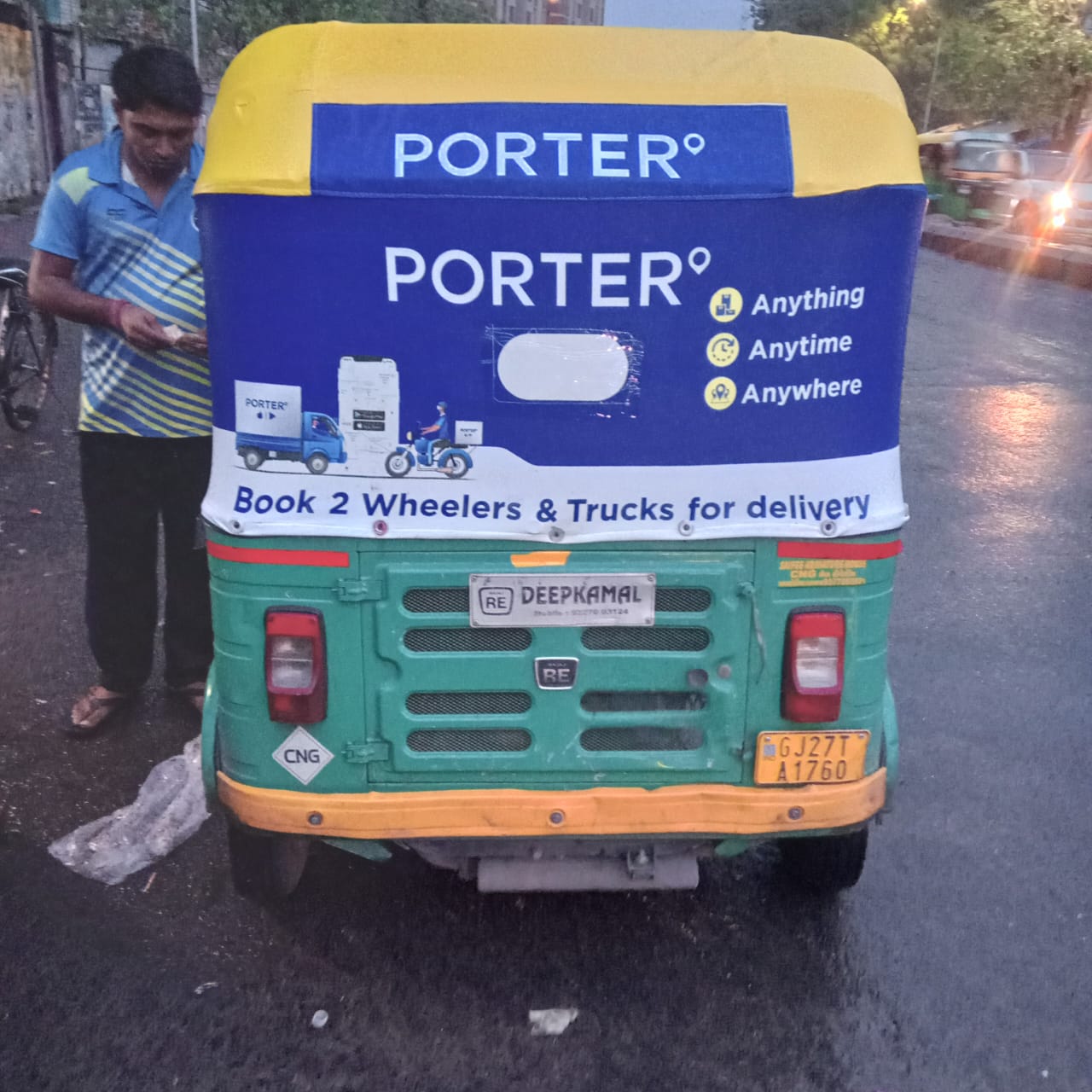
- Surface area: rear panel sticker, 24 x 6 inch or 24 x 18 inch
- Audience: vehicles directly behind, signal-stopped traffic
- Audited daily impressions per vehicle: 3,500 to 5,500 (35-45 percent of hood)
- Cost per impression: ₹170 to ₹270 one-time against 1 to 1.6 lakh impressions in the first 30 days works out to roughly ₹1 to ₹2.6 per thousand
- Best for: trapped-audience signal exposure where dwell time is the trigger
Bangalore auto branding formats and rates (2026)
| Format | Rate per auto (one-time) | Minimum order | Audited daily impressions per auto | |
|---|---|---|---|---|
| Hood (front) | ₹650 (₹630 for 500+) | 300 autos | 8,500 to 12,000 | |
| Back-panel sticker 24 x 6 inch | ₹170 (₹140 for 500+) | 500 autos | 3,500 to 5,500 | |
| Back-panel sticker 24 x 18 inch | ₹270 (₹240 for 500+) | 500 autos | 3,500 to 5,500 | |
| Full-wrap | Custom quote, rarely offered | Not on rate card | 14,000 to 20,000 |
Rates are one-time per auto; 18% GST extra.
TL;DR verdict
Pick hood for the lowest cost per impression and broadest awareness across Bangalore corridors. Treat full-wrap as an exception: it is quoted custom, rarely offered, and only makes sense for single-neighbourhood domination. Pick back-panel when you have a category-defense play at signal-stops and need to be seen by the audience directly behind, like a fintech app facing a competitor's hood-branded auto at Silk Board. Mixing formats inside one campaign rarely outperforms picking one format and committing.
When hood wins
If your goal is the cheapest cost per impression in Bangalore on a 30-day awareness window, hood is mathematically the right pick. The minimum order of 300 hood-branded autos costs ₹1.95 lakh plus GST at ₹650 per auto, and at 8,500 audited daily impressions per vehicle it delivers roughly 7.6 crore impressions in the first month alone. No custom-quoted full-wrap fleet at a comparable spend gets close on raw count. We have run this exact math comparison for two D2C launches in 2025 and the hood-only campaigns outperformed mixed-format on aided recall measured at week four post-launch.
When full-wrap wins
Full-wrap is not a rate-card product in Bangalore: we quote it custom per campaign and rarely offer it. When it does make sense, it stops being a cost-per-impression play and becomes a saturation play. If you are launching a new restaurant in Indiranagar or a clinic in Jayanagar, the goal is not maximum eyeballs across Bangalore. The goal is residents in a 3 km radius to feel like the brand is everywhere. 80 fully-wrapped autos circulating one neighbourhood for 30 days deliver that emotional saturation at a level no hood-only fleet can match. Full-wrap autos also pull more user-generated photos because the visual mass is harder to ignore. Three of our 2025 hyperlocal campaigns saw 40 to 60 organic Instagram tags from full-wrap fleets versus 8 to 14 from hood-only fleets at the same vehicle count.
When back-panel wins
Back-panel works for one specific scenario: signal-stop dwell time matters more than total reach. If you are a fintech, a food-delivery app, or a quick-commerce brand defending against a heavily-marketed competitor, having your back-panel staring at the trapped audience behind you for 60 to 90 seconds at every signal in BTM, Marathahalli, or Whitefield is a category-defense play. Back-panel costs less per auto than hood (₹170 to ₹270 one-time versus ₹650), but it reaches only 35 to 45 percent of hood's audience, so the trapped audience has to convert at a higher rate to justify it. We do not recommend back-panel as a primary format. We do recommend it as a tactical layer when a brand wants to neutralise a competitor's hood spend at signal stops.
Edge case: the 50-50 mixed campaign
Brands sometimes ask us to split a budget 50-50 between hood and back-panel to hedge. We discourage this in writing. Each format carries its own minimum order (300 autos for hood, 500 for back-panel), so a split budget often fails both minimums, and mixed campaigns dilute the single-format story on the street. Pick one format. Commit. Audit weekly. The mixed approach is a procurement compromise that loses on both dimensions.
Hood, wrap, or back panel: how should Bangalore brands choose?
- Is the budget under ₹1.5 lakh? Back-panel is the entry format: 500 autos at ₹170 run ₹85,000 plus GST, while the 300-auto hood minimum needs ₹1.95 lakh plus GST.
- Is the campaign hyperlocal (under 4 sq km)? Full-wrap can win on saturation feel, but it is custom-quoted and rarely offered; a dense hood fleet is the practical alternative.
- Is the goal category defense at signals against a named competitor? Back-panel is a tactical fit.
- Is the creative complex with multiple visual elements? Only a custom-quoted full-wrap carries it; hood and back-panel need one clean message.
- Is the brand new to Bangalore (no recall yet)? Hood-only at scale beats premium formats at smaller fleets.
- Is the campaign duration under 14 days? Stick to hood. Premium formats need 30-day windows to amortise the higher per-vehicle cost.
Our recommendation
For 80 percent of Bangalore campaigns we see, hood is the right pick on cost-per-impression grounds. For the 15 percent that need hyperlocal saturation, a custom-quoted full-wrap can earn its premium. The 5 percent who need back-panel tend to know they need it before they ask us. If you are unsure which bucket you are in, send us your campaign brief with budget, neighbourhood focus, and competitor names, and we will recommend the format with the math attached.
Can a single Bangalore auto carry hood plus back-panel branding for one brand?
Yes. At rate-card prices the combo costs ₹820 to ₹920 one-time per auto (₹650 hood plus ₹170 or ₹270 back-panel), and each format's minimum order applies (300 autos for hood, 500 for back-panel). The combined audited daily impressions are 12,000 to 17,000. The combo is rarely cost-justified unless the back-panel shows complementary creative (hood says brand name, back-panel says price or QR code), which most brands do not have ready.
Do Bangalore RTOs require permits for full-wrap auto branding?
Karnataka Motor Vehicles Department permits commercial advertising on auto rickshaws subject to driver consent and vehicle owner approval. Full-wrap requires the vehicle to retain the regulation yellow band and registration number visibility, so the wrap design must accommodate these. There is no separate per-wrap permit fee, but vendors who do not respect the visibility rules expose your campaign to traffic-police interception and forced removal mid-campaign.
How does Bangalore monsoon affect format performance?
Pre-monsoon (May to June) is the highest-failure window for cheap vinyl across all three formats. Hood faces the most weather damage because it is on the windshield and exposed to wipers. Full-wrap survives marginally better because the vinyl wraps onto curved surfaces and is laminate-protected on side panels. Back-panel is the most monsoon-resilient format because the rear of the auto sees less direct rain. If your campaign window crosses monsoon, insist on 4 mil hot-laminate vinyl with a 6-month outdoor rating regardless of format.
Tags
Quick Answers
What is the cheapest Bangalore auto branding format on a per-impression basis?
Auto hood branding is the cheapest offered format per impression in Bangalore. At the rate card's ₹650 one-time per auto (₹630 for 500+ autos, 300-auto minimum, 18% GST extra), a hood delivering 8,500 to 12,000 audited daily impressions on dense corridors like Koramangala, HSR, and Whitefield works out to under ₹3 per thousand impressions in the first 30 days alone. Hood wins for awareness campaigns because the front-facing creative gets read at every signal stop.
When is full-wrap auto branding worth the higher Bangalore cost?
Full-wrap is not on the standard Bangalore rate card; it is quoted custom per campaign and rarely offered. The premium only makes sense when the objective is hyperlocal saturation in a 3 to 4 sq km radius rather than corridor reach: a fully-wrapped fleet circulating one neighbourhood delivers repeat exposure at every street, every direction, every angle. For most campaigns, a larger hood fleet at ₹650 one-time per auto achieves broader awareness at a fraction of the cost.
Where does back-panel branding fit in a Bangalore auto campaign?
Back-panel stickers are the cheapest entry into Bangalore auto branding: ₹170 one-time for a 24 x 6 inch sticker or ₹270 for 24 x 18 inch, dropping to ₹140 and ₹240 at 500+ autos, with a 500-auto minimum and 18% GST extra. The trade-off is the audience: mainly the vehicle directly behind, so reach is roughly 35 to 45 percent of hood. Back-panel works for category-defense at signals (the vehicle behind sees your message for 60 to 90 seconds) but loses to hood for general awareness.
Looking for professional Auto Branding services?
The Mediaverse runs end-to-end auto branding campaigns across India with geo-tagged delivery and transparent, all-inclusive pricing.
Explore our Auto Branding solutionsSummarize this guide with AI
Open this article in your favourite AI assistant
Related Guides
Written by

The Mediaverse Team
India's Leading Outdoor Advertising Agency
The Mediaverse is a national-level outdoor advertising and integrated marketing organization that provides complete OOH, ATL, BTL, retail, and transit media solutions across India. With years of experience executing high-performance campaigns for brands in FMCG, Real Estate, E-commerce, EdTech, Automotive, Healthcare, and Retail, The Mediaverse combines creativity, data-driven media planning, and flawless on-ground execution. As a full-stack outdoor advertising provider, The Mediaverse offers Auto Branding, Mobile Van Branding, Newspaper Insertion Advertising, Shop Name Board Branding, In-Store Branding, Hoardings, Transit Media, Kiosks, Mall Media, Activations, and all forms of Below-The-Line marketing. Known for its pan-India network, strategic route planning, premium print quality, and Cheqmate™ GPS-based verification, The Mediaverse ensures 100% transparent and result-oriented campaign delivery. The Mediaverse’s editorial team produces deeply researched, SEO-optimized, and generative-engine-friendly content to help businesses understand the power of outdoor advertising and make informed decisions that maximize brand visibility and ROI across urban, suburban, and rural markets.
Related Articles
100-Micron Against 80-Micron: The Auto Branding Material Question to Ask Before You Book (2026)
The material line is the one nobody checks and the only one that decides whether the fleet is still readable in month seven. What our ten city pages publish about 100-micron against 80-micron, the per-city failure windows, and the arithmetic that turns any material quote into one comparable number.
Auto Back Panel Branding in 2026: The Cheapest Auto Campaign You Can Actually Book
The smallest auto order on our card is 500 back panel stickers at Rs.170 each, or Rs.85,000 before GST, which is Rs.1,10,000 below the hood floor. The slab math at 800 autos, the per-square-inch comparison of the two sticker sizes, and what the hood budget buys in panels.
Minimum Orders Are Per City, Not Per Campaign: What a 10-City Outdoor Rollout Really Floors At (2026)
Every city page publishes its own minimum: 300 autos for hood branding, 500 for back panel stickers, 1,000 no-parking boards, 50,000 insert copies. Multiply by ten cities and a national campaign floors between Rs.4,50,000 and Rs.19,50,000, which decides the shape of the plan before creative does.