

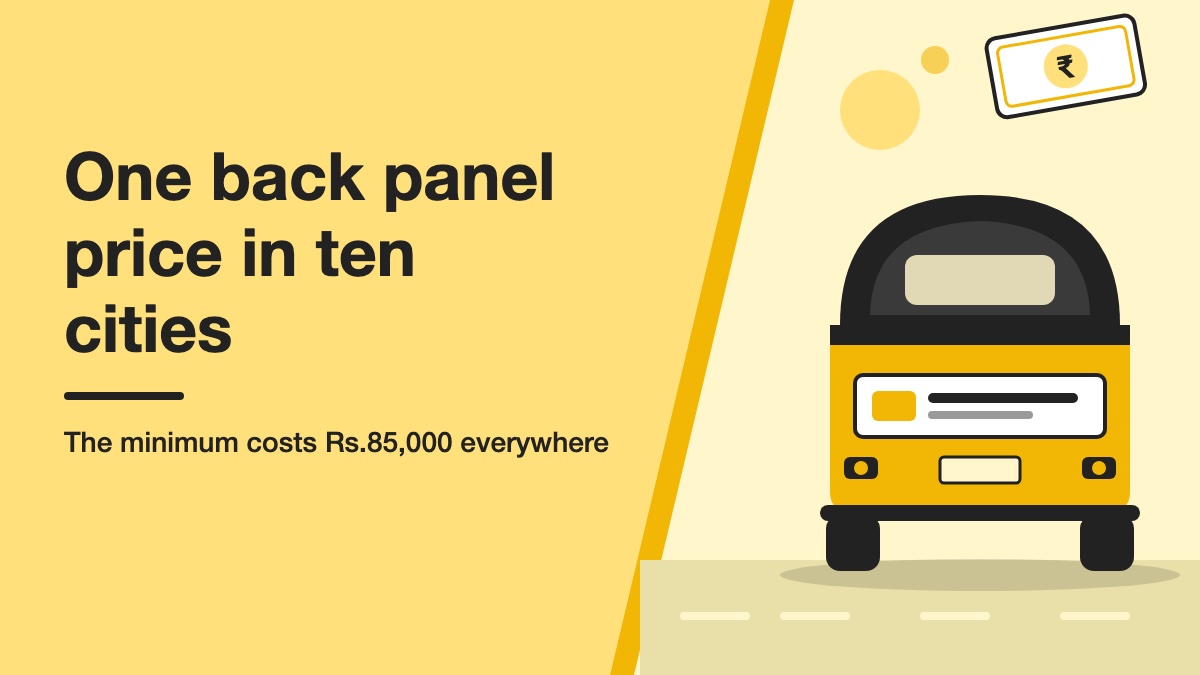
Most people pricing auto back panels across cities expect ten different quotes. Our ten city auto branding pages publish one. In Ahmedabad, Bangalore, Chennai, Delhi, Hyderabad, Jaipur, Kolkata, Lucknow, Mumbai and Pune, the 24 by 6 inch back panel is Rs.170 per auto one-time for 500 to 799 autos and Rs.140 from 800, the 24 by 18 inch panel is Rs.270 and Rs.240 on the same breaks, and the minimum is 500 autos. So the smallest back panel order in every one of the ten cities is 500 panels for Rs.85,000, or Rs.1,00,300 with 18 percent GST. What does differ sits outside the rate table: a city pricing note that names route premiums of 10 to 20 percent in seven cities, the price each page chooses for its headline, and how much of the local fleet 500 panels represent, from 0.11 percent in Mumbai to 1.25 percent in Kolkata. This guide reads all ten pages as published on 2 October 2026 and prices the minimum city by city.
What does the 500-panel minimum cost in each city?
The table takes each city page's own fleet count, its own advice for a first back panel order and its own pricing note, and prices the 500-panel minimum two ways: at the card rate, and with the note's premium applied as a ceiling. The ceiling column is our arithmetic. No page says the premium applies to back panels, and none says it does not.
The 500-panel back panel minimum in ten cities, from each city page (read 2 October 2026)
| City | Published fleet | Page advice for the first 500 panels | Premium routes in the city note | 500 panels with GST, card rate | With the note premium, if it applied | |
|---|---|---|---|---|---|---|
| Ahmedabad | 45,000+ AMC | One zone for 30 days, judge after a month | Navratri garba routes, no figure; SG Highway and CG Road standard | Rs.1,00,300 | No figure to apply | |
| Bangalore | 1,10,000+ BBMP | One target zone | MG Road and Brigade Road, 10 percent | Rs.1,00,300 | Rs.1,10,330 | |
| Chennai | 1,00,000+ Corporation | OMR fixed-route segments | Anna Salai and T. Nagar, 10 percent in festival seasons | Rs.1,00,300 | Rs.1,10,330 | |
| Delhi | 3+ lakh GNCTD | Two metro-exit zones | Connaught Place and South Delhi, 15 to 20 percent | Rs.1,00,300 | Rs.1,15,345 to Rs.1,20,360 | |
| Hyderabad | 85,000+ GHMC | One IT gate-queue, HITEC City first | HITEC City and Banjara Hills, 10 percent | Rs.1,00,300 | Rs.1,10,330 | |
| Jaipur | 55,000+ RTO | One target zone | Hawa Mahal and Amer Road tourist routes, 10 percent October to March | Rs.1,00,300 | Rs.1,10,330 | |
| Kolkata | 40,000+ KMC | One gali zone | None named | Rs.1,00,300 | Rs.1,00,300 | |
| Lucknow | 45,000+ autos and 30,000+ e-rickshaws | One target colony | None named | Rs.1,00,300 | Rs.1,00,300 | |
| Mumbai | 4.5 lakh suburban | Two station zones | South Mumbai and Bandra, 10 to 15 percent | Rs.1,00,300 | Rs.1,10,330 to Rs.1,15,345 | |
| Pune | 60,000+ PMC and PCMC | One zone, FC Road or Kothrud | Hinjewadi and Kharadi IT parks, 10 percent on weekdays | Rs.1,00,300 | Rs.1,10,330 |
Fleets, first-order advice and pricing notes read from the ten live city auto branding pages on 2 October 2026. Card rate: 500 panels at Rs.170 is Rs.85,000, plus 18 percent GST is Rs.1,00,300. The last column is our arithmetic on the note percentage and is a ceiling, not a quote. Auto-union fees, billed at actuals where a stand levies one, are left out because no page publishes an amount.
Is the back panel rate really the same in every city?
Yes, on every page we publish. Each of the ten city pages lists the 24 by 6 inch panel at Rs.170 per auto for 500 to 799 autos and Rs.140 from 800, the 24 by 18 inch panel at Rs.270 and Rs.240, and a 500-auto minimum, one-time per auto with print and installation included and GST at 18 percent extra. That matches the national back panel service page line for line. Kolkata is the one page whose quick-facts list leaves out the 24 by 18 inch row, but its own FAQ publishes the same Rs.270 and Rs.240, so the card is complete there too.
Back panel 24 by 6 in, at the minimum
500 panels: Rs.85,000, or Rs.1,00,300 with GST. The smallest back panel order in any of the ten cities.
Back panel 24 by 6 in, at 800 plus
800 panels: Rs.1,12,000, or Rs.1,32,160 with GST. The lowest order that earns the Rs.140 rate.
Back panel 24 by 18 in
500 panels: Rs.1,35,000, or Rs.1,59,300 with GST. 800 panels: Rs.1,92,000, or Rs.2,26,560 with GST.
The Mediaverse published back panel card, identical on all ten city pages and the national back panel page on 2 October 2026. One-time per auto, print and installation included. GST 18 percent extra; union fees at actuals where a stand levies one. With-GST totals are our arithmetic.
The one break worth knowing before you compare cities is the slab at 800. From 659 panels upward, ordering 800 at Rs.140, Rs.1,12,000, costs less than the exact quantity at Rs.170, because 659 times Rs.170 is already Rs.1,12,030. Our cheapest-campaign guide works through that dead band in detail, and it falls in the same place in all ten cities.
Which cities name a route premium, and does it apply to back panels?
Every one of the ten auto branding pages renders a city pricing note under its rate table. Seven name a percentage: Bangalore 10 percent for central MG Road and Brigade Road routes, Chennai 10 percent for Anna Salai and T. Nagar in the Pongal and Deepavali seasons, Delhi 15 to 20 percent for Connaught Place and South Delhi (GK, Saket, Hauz Khas), Hyderabad 10 percent for HITEC City and Banjara Hills, Jaipur 10 percent on the Hawa Mahal and Amer Road tourist routes from October to March, Mumbai 10 to 15 percent for South Mumbai and Bandra, and Pune 10 percent on the Hinjewadi and Kharadi IT park routes on weekdays. Ahmedabad says premium pricing applies near Navratri garba venues without giving a figure. Kolkata and Lucknow name none.
Two things make these notes hard to price. First, the same note text appears on that city's mobile van and shop name board pages, so it was not written for auto panels. Second, it reads as van guidance: Delhi's note mentions permissions for branded vans, Ahmedabad's mentions vans near garba venues, and Mumbai's mentions weather-resistant LED vans. A route premium makes sense for a van that is driven along a booked route. A back panel rides on an auto that goes wherever the driver's fares take it, so a route premium has nothing obvious to attach to. We therefore treat the card rate as the price and the note as an open question, and the table above shows what that question is worth.
In money it is small but not trivial. A 10 percent premium on 500 panels adds Rs.8,500 before GST and Rs.10,030 after it. Delhi's upper 20 percent adds Rs.17,000 before GST and Rs.20,060 after. On an 800-panel order at Rs.140 the same 20 percent would add Rs.22,400 before GST. One sentence in the purchase order settles it: the back panel rate is the card rate, with no route premium.
Does each city page's recommended first order land on a premium route?
In nine of ten cities, no, which supports reading the notes as van rules. The pages' own advice for a first 500-panel order points at zones their notes call standard or do not name: Ahmedabad's CG Road and Navrangpura belt, which its note explicitly calls standard, Bangalore's BTM and Koramangala example, Chennai's OMR segments, Delhi's Vishwavidyalaya metro exit and Mukherjee Nagar example, Jaipur's Mansarovar and Vaishali Nagar example, Kolkata's gali zone, Lucknow's colony, Mumbai's Andheri West station and Lokhandwala example, and Pune's FC Road or Kothrud.
The exception is Hyderabad. Its page recommends starting at one IT gate-queue with HITEC City named first, and HITEC City is the route its own note puts at 10 percent. If that premium were applied, the page's own recommended starter would cost Rs.93,500 before GST and Rs.1,10,330 after, not Rs.85,000 and Rs.1,00,300. The page also publishes an Ameerpet metro-exit example at the plain Rs.85,000, in a zone the note does not list. Jaipur has a second case: its published 24 by 18 inch Amber Fort, Jal Mahal and Nahargarh example runs November to January on the tourist corridor inside the note's October to March window, Rs.1,35,000 on the card, Rs.1,48,500 with 10 percent, or Rs.1,75,230 once GST is added.
What share of each city's fleet do 500 panels cover?
Because the price is fixed, the honest difference between cities is the denominator. Using each page's own fleet floor, 500 panels are 0.11 percent of Mumbai's 4.5 lakh suburban autos, 0.17 percent of Delhi's 3 lakh, 0.45 percent of Bangalore's 1,10,000, 0.50 percent of Chennai's 1,00,000, 0.59 percent of Hyderabad's 85,000, 0.83 percent of Pune's 60,000, 0.91 percent of Jaipur's 55,000, 1.11 percent of Ahmedabad's and Lucknow's 45,000 autos, and 1.25 percent of Kolkata's 40,000. Lucknow's page also prices its 30,000 plus e-rickshaws on the same card, which takes the share there to 0.67 percent of 75,000 vehicles.
The fleets are published as floors, 45,000 plus or 3 lakh plus, so every share is an upper bound. Share of fleet measures presence, not response: we publish no response rates for back panels and do not estimate one here. The same Rs.85,000 buys eleven times the share of the fleet in Kolkata that it buys in Mumbai, which matters more for a citywide brand than for a coaching centre that only needs the autos around one metro exit. Our Hyderabad guide sets the minimum against the city fleets as one ranked table.
Why do some pages say Rs.140 when the minimum costs Rs.170?
Because Rs.140 is the lowest number on the card, and several pages lead with it. The national back panel page carries Rs.140 per auto in its title, and its six city cards, for Hyderabad, Mumbai, Delhi, Pune, Ahmedabad and Chennai, each say Starting at Rs.140. Chennai's headline facts strip shows Rs.140 per back panel, Pune's shows the range Rs.140 to Rs.170, and Mumbai's opening paragraph says rear panels from Rs.140 even though its own stat chip shows Rs.170. The other seven city pages lead with Rs.170.
Every one of those pages also publishes the slab correctly in its table: Rs.140 begins at 800 panels. The risk is a reader who multiplies the headline by the minimum. 500 panels at Rs.140 would be Rs.70,000, and that order is not on the card. 500 panels are Rs.85,000, and the cheapest order that earns Rs.140 is 800 panels at Rs.1,12,000. Rs.170 is the number to plan a first order on.
Did the published back panel examples price correctly?
Yes, all of them. Across the ten city pages we count 17 published back panel campaign examples, and each one multiplies out on the card. Eleven are the 24 by 6 inch minimum, 500 panels at Rs.170 for Rs.85,000: Ahmedabad's CG Road admission drive, Bangalore's BTM coaching campaign, Chennai's OMR free-trial route, Delhi's Mukherjee Nagar UPSC campaign, Hyderabad's HITEC City gate-queue and Ameerpet coaching campaigns, Jaipur's Mansarovar campaign, Kolkata's Jadavpur gali campaign, Lucknow's Gomti Nagar campaign, Mumbai's Andheri campaign and Pune's FC Road campaign. Four are 800 panels at Rs.140 for Rs.1,12,000: Chennai's Koyambedu admissions, Delhi's NCR app-install run, Lucknow's Gomti Nagar Extension e-rickshaw campaign and Mumbai's Ghatkopar and Thane run. Two are 24 by 18 inch panels at Rs.270 for Rs.1,35,000: Bangalore's food delivery app and Jaipur's Amber Fort hotel campaign. None quotes Rs.140 below 800 panels or any order below 500.
Two examples carry a condition worth noticing. Delhi's 800-panel example spans Rajiv Chowk, Noida Sector 18 and Gurugram's Cyber Hub, and the Delhi page says its volume tiers apply to combined Delhi, Noida and Gurugram deployments, the only page that lets a slab be reached across a region. Lucknow's runs on e-rickshaws, which that page prices at the auto rate. Published durations are 45 or 60 days where stated, while Ahmedabad's written advice is to judge a first order after 30 days. Because the rate is one-time, duration changes nothing in the price.
Which city claims do not match the card?
Two pages make price claims their own tables contradict. Kolkata's page says Kolkata offers the lowest metro auto branding rates in India, and Lucknow's pricing note says rates there run 20 to 30 percent below Tier 1 metros. Both pages then publish the national card, Rs.170 and Rs.140 per panel, identical to Mumbai and Delhi. Plan on the table, not the sentence.
The one cost that genuinely can vary by city, and by stand within a city, is the auto-union fee. All ten pages say some areas charge one and bill it at actuals, and none publishes an amount. Ask for it zone by zone before you sign, because on a Rs.85,000 order it is the only line that is not already fixed.
Where should a first 500-panel order go?
Our recommendation: book the 24 by 6 inch minimum, 500 panels at Rs.85,000, in the zone your city page itself recommends, and get the card rate confirmed in writing with no route premium. In nine of the ten cities that zone is not on a named premium route, so the confirmation costs nothing. In Hyderabad, either confirm that HITEC City panels are at the card rate or start at Ameerpet, which the page also uses as an example and its note does not list.
If your plan needs more than 658 panels in one city, go straight to 800 at Rs.140. If you need a bigger rear canvas for a QR code, the 24 by 18 inch panel is the only size change worth paying for at the minimum: Rs.1,35,000 before GST, Rs.50,000 more than the strip, and both published 24 by 18 inch examples use the space for a QR. To get a written quote at the card rate, use the back panel service page or the city page for your market.
What should you check before signing a back panel order in any city?
Six checks for a back panel purchase order, in any of the ten cities
| Question | What the published card says | What to get in writing | |
|---|---|---|---|
| Is the rate Rs.170 for 500 to 799 panels? | Yes, in all ten cities | Rate, quantity and size on the order | |
| Does any route premium apply? | Not stated for back panels | No route premium on back panels | |
| Is there a union fee in my zones? | Billed at actuals, no amount published | Fee per stand, with a cap | |
| Am I ordering 659 to 799 panels? | 800 at Rs.140 costs less | Round the order up to 800 | |
| Is GST included? | No, 18 percent extra | Total with GST: Rs.1,00,300 for 500 | |
| Which size am I buying? | 24 by 6 in Rs.170, 24 by 18 in Rs.270 | Size and creative file specification |
Checklist built from the published card and the city pricing notes. The 659-panel crossover is our arithmetic: 659 times Rs.170 is Rs.1,12,030, above 800 times Rs.140.
Frequently asked questions
Is auto back panel branding cheaper in Kolkata or Lucknow than in Mumbai or Delhi?
No. Kolkata and Lucknow publish the national card: Rs.170 per 24 by 6 inch panel for 500 to 799 autos and Rs.140 from 800, the same as Mumbai and Delhi. Sentences on those two pages calling their rates the lowest, or 20 to 30 percent lower, contradict their own tables. What differs is fleet size: 500 panels are about 1.25 percent of Kolkata's 40,000 autos and 0.11 percent of Mumbai's 4.5 lakh.
Can I split 500 back panels across two cities?
Not on the published card. Each city page states its own 500-panel minimum, so two cities need 1,000 panels, Rs.1,70,000 before GST. The one regional exception is Delhi, whose page says volume tiers apply to combined Delhi, Noida and Gurugram deployments, and whose 800-panel example spans all three at Rs.140. If you plan an NCR order, confirm in writing whether the split counts as one.
Is GST included in the Rs.85,000 back panel minimum?
No. Rs.85,000 is 500 panels at Rs.170 before tax. GST at 18 percent adds Rs.15,300, so the invoice is Rs.1,00,300. At 800 panels the total is Rs.1,32,160, and 500 of the larger 24 by 18 inch panels come to Rs.1,59,300. Design, printing and installation are inside the rate; an auto-union fee, where a stand charges one, is billed separately at actuals.
Which back panel size should a first campaign use?
Start with the 24 by 6 inch strip at Rs.170 unless the creative needs room for a QR code or an offer. The 24 by 18 inch panel costs Rs.270 at the minimum, Rs.50,000 more on 500 autos, and both published 24 by 18 inch examples on our city pages, a Bangalore food delivery app and a Jaipur hotel, used the space for a QR. Brand names and phone numbers fit the strip.
How long does a back panel last for the one-time price?
Our back panel page says the vinyl stickers typically stay intact for 4 to 6 months, against 6 to 12 months for a full hood cover. The published city examples run 45 or 60 days, so one order usually outlasts its campaign. The price does not change with duration, so write creative that stays true for the sticker's life, or budget a new order when the message changes.
Tags
Quick Answers
How much does auto back panel branding cost per city in 2026?
The same in all ten cities we publish. The 24 by 6 inch back panel is Rs.170 per auto one-time for 500 to 799 autos and Rs.140 from 800, and the 24 by 18 inch panel is Rs.270 or Rs.240, GST 18 percent extra. The minimum is 500 panels, so the smallest order anywhere is Rs.85,000, or Rs.1,00,300 with GST. Only unpublished auto-union fees vary by stand.
Which cities charge a route premium on auto branding?
Seven of our ten city auto pages carry a pricing note naming a route premium: 10 percent in Bangalore, Chennai, Hyderabad, Jaipur and Pune, 10 to 15 percent in Mumbai and 15 to 20 percent in Delhi. The notes are shared with the van and shop board pages and worded for vans, and none says it applies to back panels, so ask for the card rate in writing.
Can you book 500 auto back panels at Rs.140 each?
No. Rs.140 is the 24 by 6 inch rate from 800 panels upward. At 500 to 799 panels the rate is Rs.170, so 500 panels cost Rs.85,000, not the Rs.70,000 that multiplying the advertised starting price suggests. The cheapest order at Rs.140 is 800 panels for Rs.1,12,000, which from 659 panels up is also cheaper than ordering the exact quantity.
Looking for professional Auto Branding services?
The Mediaverse runs end-to-end auto branding campaigns across India with geo-tagged delivery and transparent, all-inclusive pricing.
Explore our Auto Branding solutionsSummarize this guide with AI
Open this article in your favourite AI assistant
Related Guides
Written by

The Mediaverse Team
India's Leading Outdoor Advertising Agency
The Mediaverse is a national-level outdoor advertising and integrated marketing organization that provides complete OOH, ATL, BTL, retail, and transit media solutions across India. With years of experience executing high-performance campaigns for brands in FMCG, Real Estate, E-commerce, EdTech, Automotive, Healthcare, and Retail, The Mediaverse combines creativity, data-driven media planning, and flawless on-ground execution. As a full-stack outdoor advertising provider, The Mediaverse offers Auto Branding, Mobile Van Branding, Newspaper Insertion Advertising, Shop Name Board Branding, In-Store Branding, Hoardings, Transit Media, Kiosks, Mall Media, Activations, and all forms of Below-The-Line marketing. Known for its pan-India network, strategic route planning, premium print quality, and Cheqmate™ GPS-based verification, The Mediaverse ensures 100% transparent and result-oriented campaign delivery. The Mediaverse’s editorial team produces deeply researched, SEO-optimized, and generative-engine-friendly content to help businesses understand the power of outdoor advertising and make informed decisions that maximize brand visibility and ROI across urban, suburban, and rural markets.
Related Articles
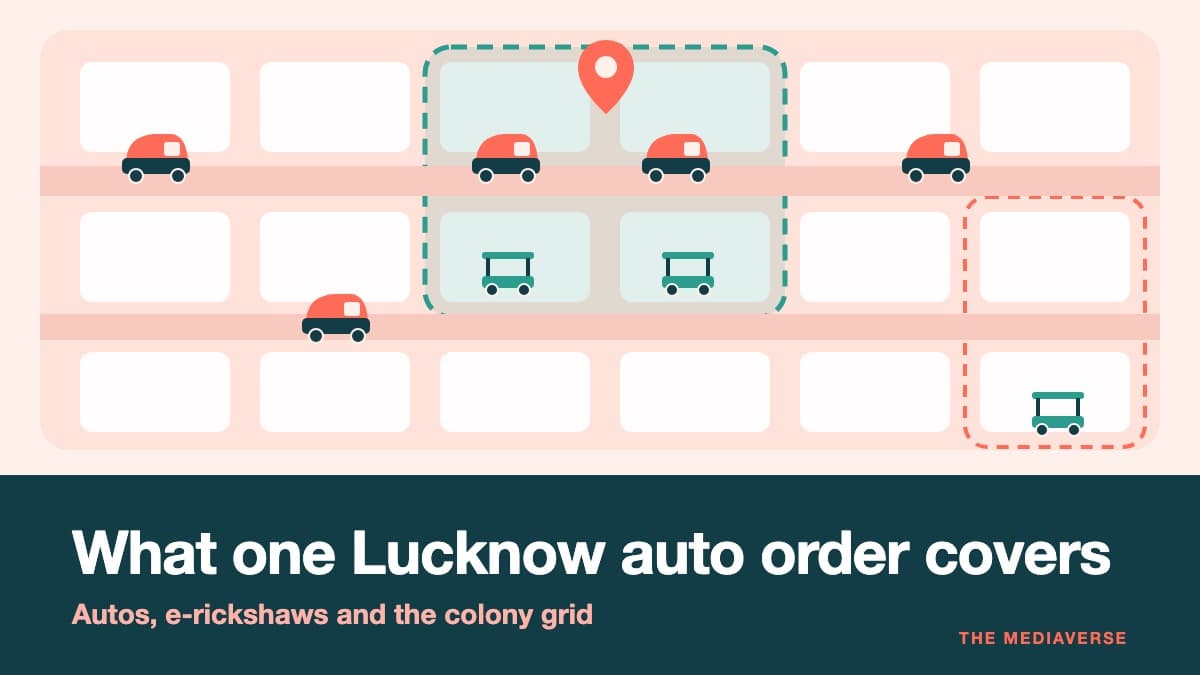
Auto Branding in Lucknow (2026): What the 300-Hood Minimum Covers Across Autos, E-Rickshaws and the Colony Grid
Lucknow prices autos and e-rickshaws on one national card, from Rs.85,000 for 500 panels. What one minimum order means in the page's own colony grids, how much of each zone it takes, and how the fog, monsoon and admission calendar shape the booking.
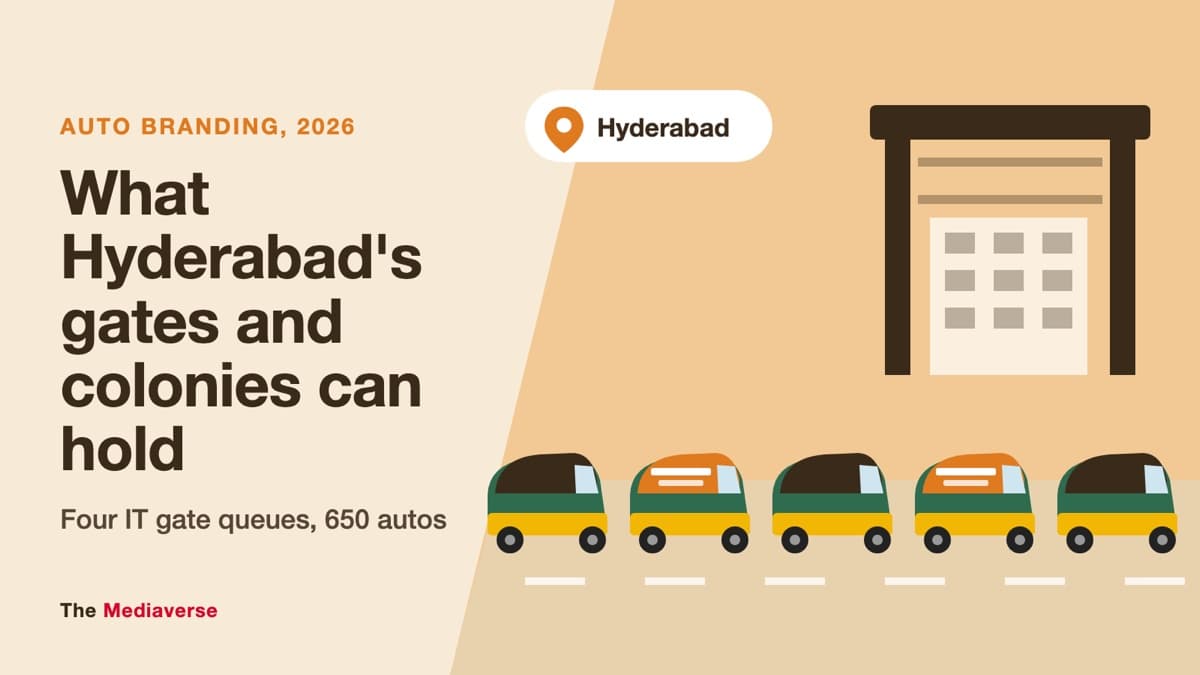
Auto Branding in Hyderabad (2026): What the 85,000-Auto Fleet and the Gate and Zone Map Actually Support
Four Hyderabad IT gate queues, 650 autos, and minimum orders of 300 hoods or 500 panels. What the published fleet and zone counts can actually carry, where the other 400 panels should run, and why 700 panels cost more than 800.
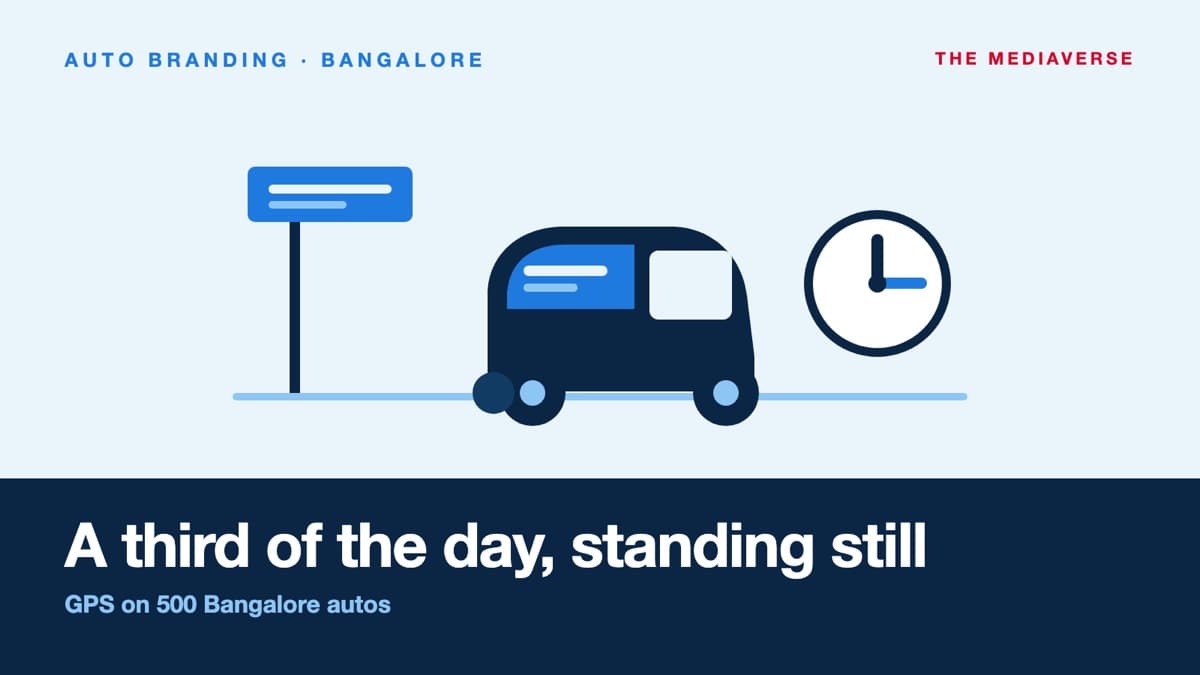
Where Branded Autos Actually Stand Still: 35 Percent of the Working Day (2026)
A branded auto spends about a third of its working day parked, and that is when it does its best work. The published dwell averages per stop type, what the 300-auto minimum covers at five Bangalore hubs and three residential pockets, and where the minimum order actually buys dominance.