

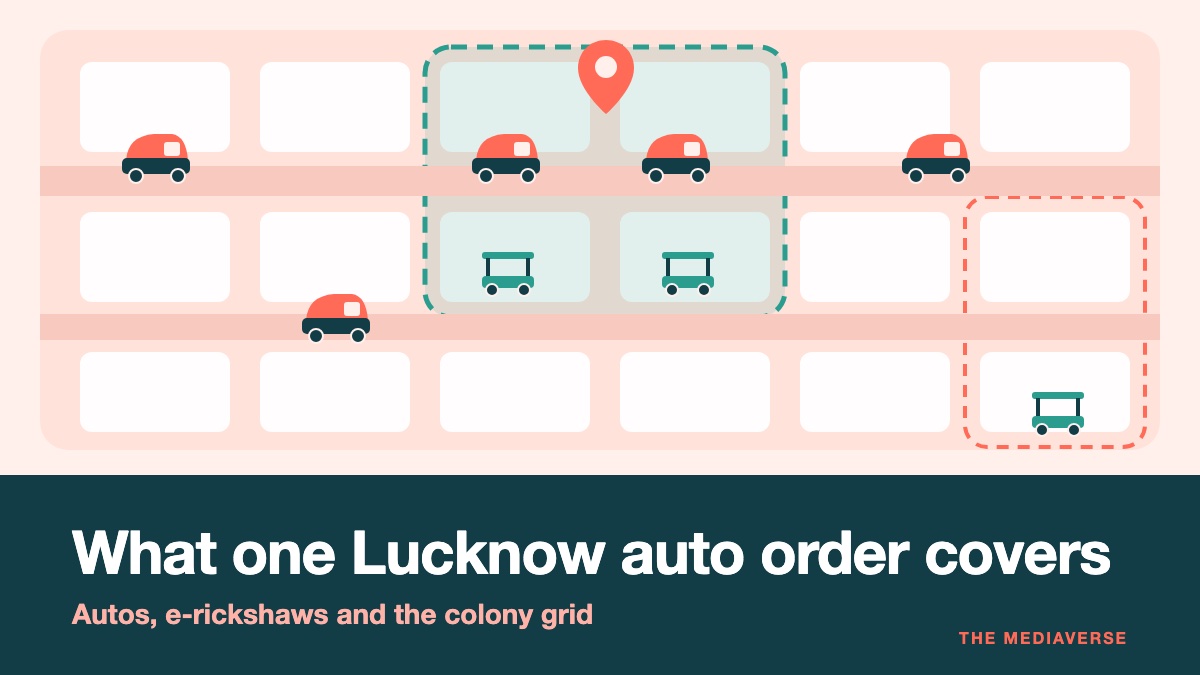
How many Lucknow colonies does the smallest auto branding order have to cover? Our Lucknow auto branding page answers that more precisely than it seems to intend. It counts 45,000 plus RTO-registered autos and an estimated 30,000 plus e-rickshaws, about 75,000 vehicles. It prices both on one card: a full hood at Rs.650 per vehicle for 300 to 499, Rs.630 from 500, with a minimum of 300, and a 24 by 6 inch back panel at Rs.170 for 500 to 799, Rs.140 from 800, with a minimum of 500. Every rate is one-time, not monthly, and GST at 18 percent is extra. So the smallest bookable order is 300 hoods for Rs.1,95,000 or 500 panels for Rs.85,000. The same page plans Lucknow in units far smaller than either: 20 autos per target zone of 2 km radius, and a colony grid of 15 to 30 autos plus 10 to 20 e-rickshaws. One minimum order is therefore 6 to 20 colony grids, not one. This guide works out where those grids can run, what the page's own campaign examples ask of each zone, and how Lucknow's fog, monsoon and admission calendar shape the order.
What does auto branding cost in Lucknow in 2026?
Every rate below is from the live Lucknow page and is a one-time charge per vehicle covering print and installation. The page says the rate includes design, printing, installation, RTO permits, a monthly field audit and free replacement of damaged units during the campaign. Two things sit outside it: GST at 18 percent, and an auto-union fee that some Lucknow stand areas charge, billed at actuals and not published as a figure. The with-GST totals are our arithmetic.
Full hood, 100 micron rexine
MOQ 300: Rs.1,95,000, or Rs.2,30,100 with GST. At 500 hoods, Rs.3,15,000, or Rs.3,71,700 with GST.
Back panel 24 by 6 in, vinyl
MOQ 500: Rs.85,000, or Rs.1,00,300 with GST. At 800 panels, Rs.1,12,000, or Rs.1,32,160 with GST.
Back panel 24 by 18 in, vinyl
MOQ 500: Rs.1,35,000, or Rs.1,59,300 with GST. At 800 panels, Rs.1,92,000, or Rs.2,26,560 with GST.
The Mediaverse published Lucknow auto branding card, read from the live Lucknow page on 1 October 2026. One-time per vehicle, autos and e-rickshaws alike. GST 18 percent extra; union fees in some stand areas billed at actuals. With-GST totals are our arithmetic.
The calendar brief for this guide asked us to check the Lucknow back panel line against the national back panel card before quoting it. It matches. Rs.170 for 500 to 799 panels and Rs.140 from 800 is the national slab, and the "from Rs.140" on our auto back panel service page is simply the 800 plus price. There is no Lucknow discount and no Lucknow premium. The page also publishes no full-wrap rate, so this guide prices none.
One line on the page does not agree with its own card. A pricing note under the Lucknow table says the city offers rates 20 to 30 percent lower than Tier 1 metros. The table above it is the national card, and our Hyderabad, Delhi and Mumbai pages publish exactly the same Rs.650, Rs.170 and Rs.270. The same note goes on to talk about mobile vans, which suggests it was carried over from another page. Plan on the table, not the note.
How many vehicles go into one Lucknow colony grid?
The page describes its own method, the colony grid, in four steps: pick a colony such as Gomti Nagar sectors 5 to 15 within about 3 km, deploy 15 to 30 branded autos from the colony's main-road stands and 10 to 20 branded e-rickshaws from its internal charging points, track the fleet for 7 days, then redistribute vehicles toward under-served blocks. Elsewhere it recommends a minimum of 20 autos per target zone of 2 km radius, and puts a typical citywide plan at 150 plus vehicles across 3 to 4 zones.
Set those planning units against the minimum orders and the arithmetic is short. A grid is 25 to 50 vehicles. A 300 hood order is therefore 6 to 12 grids, and a 500 panel order is 10 to 20. At the 20 autos per zone floor, 300 hoods cover 15 zones and 500 panels cover 25.
Our arithmetic: Lucknow minimum orders measured in the page's own planning units
| Order | Price before GST | Colony grids at 25 to 50 vehicles | Zones at 20 autos each | Share of the 75,000 vehicle fleet | |
|---|---|---|---|---|---|
| 300 hoods (minimum) | Rs.1,95,000 | 6 to 12 | 15 | 0.4 percent | |
| 500 back panels 24 by 6 in (minimum) | Rs.85,000 | 10 to 20 | 25 | 0.67 percent | |
| 800 back panels 24 by 6 in (Rs.140 slab) | Rs.1,12,000 | 16 to 32 | 40 | 1.07 percent | |
| 150 vehicles, the page's typical citywide plan | Not bookable alone | 3 to 6 | 7 or 8 | 0.2 percent |
Grid size from the page's colony-grid method (15 to 30 autos plus 10 to 20 e-rickshaws). Fleet of 75,000 is the page's 45,000 plus autos and 30,000 plus e-rickshaw estimate. Shares and grid counts are our arithmetic.
The last row matters. The page's "150 plus vehicles across 3 to 4 zones" is half the hood minimum and under a third of the panel minimum, so it cannot be bought as written. Read it as the core of a larger order: three or four colonies carried at full grid strength, with the rest of a 300 or 500 vehicle order spread further out. Measured against the whole fleet, even the 800 panel slab is about one Lucknow vehicle in a hundred, so supply is never the limit. Concentration is.
Which Lucknow zones can take a grid, and how much of each zone is it?
The page publishes vehicle counts for five hubs and three residential zones. It adds residents for the residential zones, about 6 lakh in Gomti Nagar and its Extension, 4 lakh in the Indira Nagar and Faizabad Road pocket, and 5 lakh in the Aliganj, Lalbagh and Mahanagar triangle. The table sets one full 50 vehicle grid against each count.
Our arithmetic: one 50 vehicle colony grid as a share of each zone the Lucknow page counts
| Zone | Vehicles (published) | A 50 vehicle grid is | What the page says the zone carries | |
|---|---|---|---|---|
| Charbagh Railway Station | 2,500 plus | 2.0 percent | About 1.5 lakh daily passengers changing from trains to autos and e-rickshaws, every income segment | |
| Gomti Nagar, Vipin Khand hub and sectors | 1,200 plus (about 1,200 in the residential count) | 4.2 percent | New Lucknow's largest residential and commercial hub; IT workers, government officers, families; about 6 lakh residents | |
| Aminabad Market | 1,000 plus | 5.0 percent | Old Lucknow's busiest retail market, about 80,000 plus daily shoppers in narrow bazaar lanes | |
| Aliganj, Lalbagh and Mahanagar | 900 plus autos and e-rickshaws | 5.6 percent | Established family belt, about 5 lakh residents, older profile near hospital clusters | |
| Hazratganj Crossing | 800 plus | 6.3 percent | Premier shopping and office corridor: Sapru Marg, GPO, Mayfair and Capitol junctions | |
| Indira Nagar and Faizabad Road | 800 plus autos | 6.3 percent | Densest government-employee corridor, about 4 lakh residents aged 30 to 55 | |
| Munshi Pulia Metro hub | 600 plus | 8.3 percent | Northern metro interchange feeding Indira Nagar, Faizabad Road and Chinhat |
Vehicle and resident counts from the live Lucknow page. The Gomti Nagar hub and residential counts appear to describe the same vehicles and are not added together. Percentages are our arithmetic.
Three readings follow. First, Charbagh is the one place where a single grid is a small slice, 2 percent of the vehicles, because the station stand is the biggest the page maps. Second, the Gomti Nagar figure appears twice on the page, once as the Vipin Khand hub and once as the residential zone, both at about 1,200, so we count it once. Third, the page's mapped zones add up to at most about 9,000 vehicles, around 12 percent of the 75,000 fleet. Most of a large Lucknow order will run in circulation the page does not map zone by zone, which is a reason to ask for the 7 day tracking report the method promises before the second month.
What do the page's own Lucknow campaign examples ask of each zone?
The Lucknow page publishes three representative campaigns. None names a client or reports a result, so they are planning examples, not case studies. What they do show is how much of a zone a minimum order occupies when it is kept in one belt.
Our arithmetic: the three published Lucknow examples against the page's zone counts
| Example on the page | Order and price | Vehicles the page counts there | Share of those vehicles | |
|---|---|---|---|---|
| Coaching centre, Gomti Nagar and Indira Nagar, 60 days | 500 back panels 24 by 6 in, Rs.85,000 | About 1,200 plus 800, so 2,000 | 25 percent, one vehicle in four | |
| Multi-specialty hospital, Aliganj, Mahanagar and Lalbagh, 90 days | 300 hoods on autos and e-rickshaws, Rs.1,95,000 | 900 plus | About 33 percent, one vehicle in three | |
| Grocery app, Gomti Nagar Extension, Shaheed Path and Jankipuram, 45 days | 800 back panels on e-rickshaws at Rs.140, Rs.1,12,000 | No zone count published | 2.7 percent of the 30,000 plus e-rickshaws citywide |
Examples and prices as published on the Lucknow page, which labels them representative and publishes no client names or outcomes. Shares are our arithmetic on the page's own counts.
The first two examples are concentrated far beyond the colony grid the same page recommends. In Gomti Nagar and Indira Nagar, 500 panels is 10 to 20 grids inside two colonies. In the Aliganj triangle, 300 hoods would put a brand on roughly every third vehicle the page counts. Neither is impossible, since the counts carry a "plus" and vehicles come and go from neighbouring stands, but neither is shown to be achievable either. If you want that density, ask for the stand-by-stand deployment list before you sign. If you want the method the page actually describes, spread the same order across more colonies at 25 to 50 vehicles each.
The third example is the e-rickshaw case, and it is the one that fits most comfortably: 800 panels is under 3 percent of the city's e-rickshaws. It also crosses the 800 panel slab, so the rate drops to Rs.140 and the order costs Rs.1,12,000 rather than Rs.1,36,000 at Rs.170.
Should a Lucknow order go on autos or e-rickshaws?
Lucknow is the only city page we publish that prices e-rickshaws on the same card as autos, and it says every format, hood and both back panel sizes, is available on both at the same one-time rate. The difference is not price. It is where each vehicle goes and how it is booked.
Autos and e-rickshaws on the Lucknow page, side by side
| Question | Autos | E-rickshaws | |
|---|---|---|---|
| How many | 45,000 plus RTO-registered | An estimated 30,000 plus | |
| Where they run | Colony main roads, arterial connectors, transit and market stands | Internal colony lanes too narrow for autos: government quarter blocks, park-side lanes, community centres | |
| How a deployment is organised | Stand by stand: Charbagh and Alambagh transit stands, Aminabad and Kaiserbagh market stands, colony stands in Gomti Nagar, Indira Nagar and Aliganj | Charging point by charging point, clustered in Jankipuram, Chinhat and Gomti Nagar Extension | |
| Share of one colony grid | 15 to 30 | 10 to 20 | |
| Rate | Card rate, one-time | Same card rate, one-time | |
| Extra charges | A union fee in some stand areas, at actuals | None separately published |
From the live Lucknow page. It does not publish separate e-rickshaw panel dimensions; confirm fit on your chosen format before print.
The page's grid puts autos on the sector main roads and e-rickshaws in the lanes behind them, and it says both fleets carry the same brand. For a 500 panel order split at the grid's own ratio, roughly three autos to two e-rickshaws, that is about 300 autos and 200 e-rickshaws. The page publishes no response difference between the two vehicle types, so the split is about where your customers live, not a performance claim.
Stand-level buy-in is the practical point the page makes about autos. Lucknow drivers park in the same order at the same stand every day, each stand has informal leadership, and drivers who agreed to a campaign keep panels clean and report damage. That is why the union fee is quoted up front where it applies, and why e-rickshaw deployments are planned around charging points instead.
How long does Lucknow branding last, and what does that mean per month?
The page's material specification gives hood covers 6 to 12 months and back panel stickers 4 to 6 months in Lucknow conditions: 100 micron rexine with UV lamination for summers past 45 degrees, humidity-resistant adhesive for the July to September monsoon, and a fog-resistant panel surface for the December and January fog. Its FAQ elsewhere says field testing supports 12 months plus. The two do not agree, so we plan on the specification section's shorter figures. Spread over them, the one-time rate becomes a monthly figure that is easy to compare with other media.
Our arithmetic: Lucknow cost per vehicle and per order for each month of published life
| Format | One-time rate | Published life | Per vehicle per month | Minimum order per month | |
|---|---|---|---|---|---|
| Full hood | Rs.650 | 6 to 12 months | Rs.54 to Rs.108 | 300 hoods: Rs.16,250 to Rs.32,500 | |
| Back panel 24 by 6 in | Rs.170 | 4 to 6 months | Rs.28 to Rs.43 | 500 panels: Rs.14,167 to Rs.21,250 | |
| Back panel 24 by 18 in | Rs.270 | 4 to 6 months | Rs.45 to Rs.68 | 500 panels: Rs.22,500 to Rs.33,750 |
Life from the Lucknow page's material specification section. Before GST. Our arithmetic; these are not monthly rates, and the card has none.
The life figures also tell you which Lucknow weather a campaign has to survive, and that depends on the month it goes live. The page names two demand peaks, admission season from June to August and festival season from October to December.
Our arithmetic: what a Lucknow campaign runs through, by launch month
| Live from | Back panels (4 to 6 months) last until | Hoods (6 to 12 months) last until | Lucknow weather the page names along the way | |
|---|---|---|---|---|
| 1 June, admission season | End of September to end of November | End of November to end of May | Monsoon July to September for both; fog December to January and the next summer for a long-lived hood | |
| 1 October, festival season | End of January to end of March | End of March to end of September | Fog December to January for both; summer heat and the monsoon for a long-lived hood | |
| 1 April | End of July to end of September | End of September to end of March | Summer heat past 45 degrees and the monsoon for both |
Seasons and life spans from the live Lucknow page. Dates are our arithmetic.
Two practical points come out of that table. A June back panel campaign will not reach the festival season in good shape at the short end of its life, so a brand that wants both peaks should either book hoods in June or plan a second panel run in October. And a hood booked in October is the order most likely to need the free 48 hour replacement the page promises, because it crosses the fog, then the heat, then the rain.
When should a Lucknow campaign be booked?
The page asks for 7 days of advance booking for campaigns of 100 plus vehicles in its peak seasons, puts the first batch on the road within 48 hours, and says a 300 vehicle rollout normally completes in 5 to 7 days. Every minimum order is above 100 vehicles, so in practice a 300 hood or 500 panel order needs about 12 to 14 days from booking to full fleet. To have a full admission-season fleet running on 1 June, book around 18 May. The page's market overview adds the city's other advertising peaks: Eid, Diwali, the Lucknow Mahotsav and election seasons in India's largest electoral state, when demand for outdoor capacity rises.
How should creative read on a Lucknow auto?
The page's guidance is specific. Write Hindi first, because a back panel is seen for three or four seconds by someone on a scooter behind the auto in Hazratganj traffic, so one Devanagari headline, one offer and a large phone number beat a paragraph. In Old Lucknow runs through Chowk and Nakhas, an Urdu line can carry the brand where it fits. Keep the hood layout symmetrical, because at a stand a hood is read from three angles at once. The page also maps audiences by belt: government colonies such as Rajajipuram, Aliganj and Mahanagar for secretariat, teacher and PSU households that buy on repetition and neighbourhood trust, and coaching corridors around Hazratganj, Alambagh and Kapoorthala for students from across the state.
Which Lucknow figures are estimates rather than facts?
Several numbers on the Lucknow page are estimates, and we do not price anything on them. The 10,000 to 22,000 daily impressions per vehicle and the Rs.1.5 to Rs.4 CPM are labelled tracked estimates from our own fleet data, not audited counts. The claim that over 60 percent of Lucknow's middle class lives in planned colonies carries no source. The "88 monthly exposures" for a commuter from Indira Nagar to Hazratganj is an estimate built from four assumed sightings a day. The Nawabi word-of-mouth multiplier is described from experience and is not measured. The e-rickshaw fleet of 30,000 plus is itself an estimate, while the 45,000 plus autos are RTO-registered. None of these is used in the arithmetic above.
Our own older Lucknow guide, published in June 2026, quoted hood rates of Rs.500 to Rs.600 per auto per month and a fleet of about 40,000. The live page publishes one-time rates of Rs.650 and Rs.630 and a fleet of 45,000 plus autos. Plan on the live page; the June guide is queued for a rewrite against the card.
Lucknow auto branding questions, answered by the numbers
Is auto branding in Lucknow cheaper than in Delhi or Mumbai?
No. The Lucknow card is the national card: Rs.650 per hood for 300 to 499 vehicles, Rs.630 from 500, and Rs.170 or Rs.140 per 24 by 6 inch back panel, all one-time plus 18 percent GST. Our Delhi, Mumbai and Hyderabad pages publish the same rates. A note on the Lucknow page claiming rates 20 to 30 percent below Tier 1 metros contradicts its own table; plan on the table.
Do e-rickshaws cost the same as autos to brand in Lucknow?
Yes. The Lucknow page offers every format on e-rickshaws at the same one-time rates as autos: Rs.650 or Rs.630 per hood and Rs.170 or Rs.140 per 24 by 6 inch panel, with the same 300 and 500 minimums. The difference is placement. Autos work from colony and market stands, while the city's estimated 30,000 plus e-rickshaws are deployed around charging points in Jankipuram, Chinhat and Gomti Nagar Extension.
How many Lucknow colonies does a 500-panel order cover?
On the page's own method, 10 to 20. Its colony grid is 15 to 30 autos plus 10 to 20 e-rickshaws, so 25 to 50 vehicles, and 500 panels at Rs.170, Rs.85,000 before GST, fill 10 grids at full strength or 20 at the lower end. At the page's floor of 20 autos per 2 km zone, the same order covers 25 zones.
How long do auto ads last through Lucknow's fog and monsoon?
The Lucknow page's material specification gives hood covers 6 to 12 months and back panels 4 to 6 months, using 100 micron rexine, humidity-resistant adhesive for the July to September monsoon and a fog-resistant panel surface for December and January. Damaged units are replaced free within 48 hours. Its FAQ says 12 months plus; we plan on the shorter specification figures.
When should I book auto branding for Lucknow's admission season?
About two weeks before the date you want the full fleet running. The page asks for 7 days of advance booking for 100 plus vehicles in peak season and says a 300 vehicle rollout takes 5 to 7 days, with the first batch on the road within 48 hours. For a fleet live on 1 June, book around 18 May. Admission season runs June to August.
Tags
Quick Answers
How much does auto branding cost in Lucknow in 2026?
On our 2026 Lucknow card, a full hood is Rs.650 per vehicle for 300 to 499 and Rs.630 from 500, so the minimum of 300 hoods is Rs.1,95,000, or Rs.2,30,100 with 18 percent GST. A 24 by 6 inch back panel is Rs.170, or Rs.140 from 800, with a minimum of 500: Rs.85,000 before GST. Rates are one-time, not monthly, and apply to autos and e-rickshaws.
How many autos and e-rickshaws are there in Lucknow?
Our Lucknow page counts 45,000 plus RTO-registered autos and an estimated 30,000 plus e-rickshaws, about 75,000 vehicles. Its largest mapped stand is Charbagh Railway Station at 2,500 plus vehicles, followed by Gomti Nagar Vipin Khand at 1,200 plus, Aminabad at 1,000 plus, Hazratganj at 800 plus and Munshi Pulia at 600 plus. A 500 panel order is about 0.67 percent of the whole fleet.
Can I brand fewer than 300 autos in Lucknow?
Not as a standalone order. The Lucknow card has a minimum of 300 vehicles for hoods and 500 for back panels, so the smallest bookings are Rs.1,95,000 and Rs.85,000 before GST. The page's typical citywide plan of 150 plus vehicles across 3 to 4 zones is below both minimums. Treat it as the core colonies inside a larger order rather than an order on its own.
Looking for professional Auto Branding services?
The Mediaverse runs end-to-end auto branding campaigns across India with geo-tagged delivery and transparent, all-inclusive pricing.
Explore our Auto Branding solutionsSummarize this guide with AI
Open this article in your favourite AI assistant
Related Guides
Written by

The Mediaverse Team
India's Leading Outdoor Advertising Agency
The Mediaverse is a national-level outdoor advertising and integrated marketing organization that provides complete OOH, ATL, BTL, retail, and transit media solutions across India. With years of experience executing high-performance campaigns for brands in FMCG, Real Estate, E-commerce, EdTech, Automotive, Healthcare, and Retail, The Mediaverse combines creativity, data-driven media planning, and flawless on-ground execution. As a full-stack outdoor advertising provider, The Mediaverse offers Auto Branding, Mobile Van Branding, Newspaper Insertion Advertising, Shop Name Board Branding, In-Store Branding, Hoardings, Transit Media, Kiosks, Mall Media, Activations, and all forms of Below-The-Line marketing. Known for its pan-India network, strategic route planning, premium print quality, and Cheqmate™ GPS-based verification, The Mediaverse ensures 100% transparent and result-oriented campaign delivery. The Mediaverse’s editorial team produces deeply researched, SEO-optimized, and generative-engine-friendly content to help businesses understand the power of outdoor advertising and make informed decisions that maximize brand visibility and ROI across urban, suburban, and rural markets.
Related Articles
Auto Branding in Hyderabad (2026): What the 85,000-Auto Fleet and the Gate and Zone Map Actually Support
Four Hyderabad IT gate queues, 650 autos, and minimum orders of 300 hoods or 500 panels. What the published fleet and zone counts can actually carry, where the other 400 panels should run, and why 700 panels cost more than 800.
Where Branded Autos Actually Stand Still: 35 Percent of the Working Day (2026)
A branded auto spends about a third of its working day parked, and that is when it does its best work. The published dwell averages per stop type, what the 300-auto minimum covers at five Bangalore hubs and three residential pockets, and where the minimum order actually buys dominance.
100-Micron Against 80-Micron: The Auto Branding Material Question to Ask Before You Book (2026)
The material line is the one nobody checks and the only one that decides whether the fleet is still readable in month seven. What our ten city pages publish about 100-micron against 80-micron, the per-city failure windows, and the arithmetic that turns any material quote into one comparable number.