

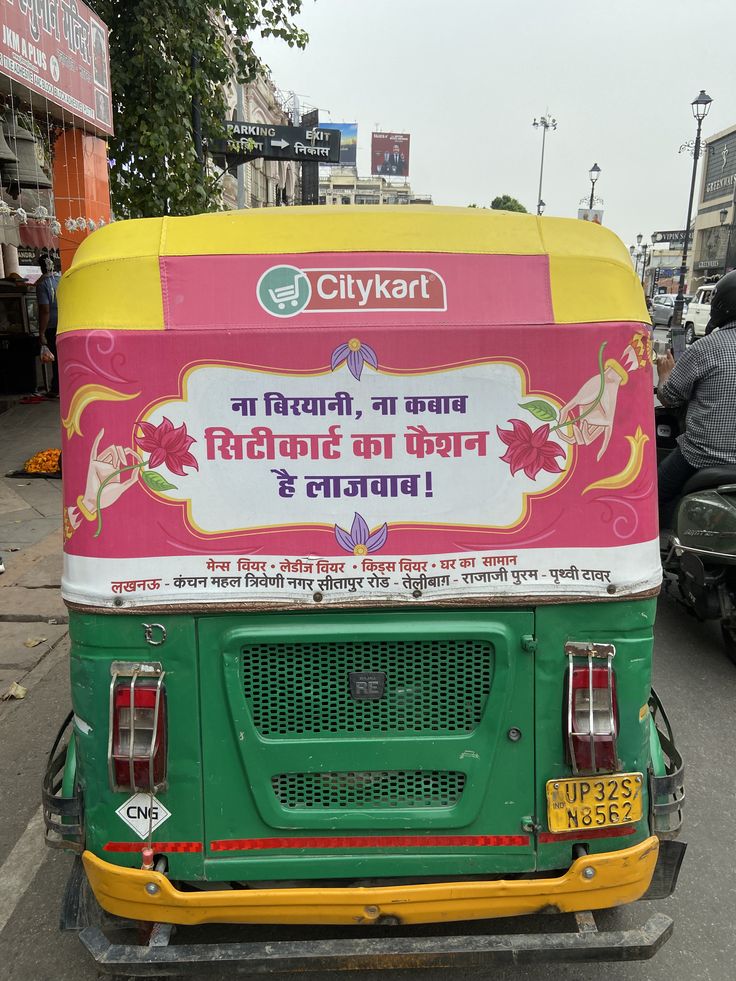
Auto rickshaw branding in Delhi costs ₹600 to ₹700 per auto per month for full hood branding, ₹180 to ₹220 for back-panel stickers, and ₹2,200 to ₹2,800 for a full-body wrap, all inclusive of design, printing, installation, and monthly maintenance. Delhi has approximately 95,000 registered CNG auto-rickshaws. A single branded auto generates an estimated 25,000 to 40,000 daily impressions at a cost-per-thousand of roughly ₹4 to ₹9, the lowest of any outdoor advertising format in the city. The reason it works so well in Delhi specifically: the 390 km Delhi Metro network carries 60 to 65 lakh riders a day, and auto-rickshaws are the dominant last-mile feeder from metro exits, which means a branded auto reaches commuters at the exact transition moment when they are scanning their surroundings. This guide breaks down the rates, the fleet, the zone map, the rules, and the campaign math for 2026.
Delhi auto branding at a glance: the key facts
Seven numbers define the Delhi auto branding opportunity in 2026. Fleet size: approximately 95,000 registered auto-rickshaws. Hood branding rate: ₹600 to ₹700 per auto per month. Back-panel rate: ₹180 to ₹220 per auto per month. Full-wrap rate: ₹2,200 to ₹2,800 per auto per month. Daily impressions per auto: 25,000 to 40,000. Cost-per-thousand impressions: ₹4 to ₹9. Recommended minimum campaign for a single 3 to 5 km catchment: 20 to 30 autos for 30 days. Those seven figures are the starting point for any Delhi auto branding plan, and the rest of this guide explains the drivers behind each.
Fleet size and reach math
Delhi's roughly 95,000 auto-rickshaws operate under a fleet cap that has held near 1 lakh vehicles for years. All are CNG with the standard green-and-yellow livery. For advertisers, the cap has two consequences. First, the addressable fleet is large enough for any campaign size from a 20-auto neighbourhood test to a 1,000-auto citywide push. Second, because the fleet does not grow freely, premium-zone autos (South Delhi, Central Delhi) book out faster during festival and election seasons, so high-demand-window campaigns should be reserved 3 to 4 weeks ahead.
The reach math per auto works as follows. A Delhi auto covers 80 to 120 km a day across its routes, passing through residential lanes, market roads, metro feeders, and arterial stretches. At an estimated 250 to 400 viewers per kilometre in dense Delhi traffic, that produces 25,000 to 40,000 daily impressions per auto. The figure is an estimate based on route density, not a precise count, but it is consistent across The Mediaverse Delhi field data spanning 140 campaigns. Multiply across a 50-auto cluster in one catchment and the campaign generates 12.5 to 20 lakh daily impressions concentrated in a 3 to 8 km radius, which is the kind of frequency that drives recall and walk-ins for a local business.
The metro-feeder dynamic is what makes Delhi different from cities with weaker rail networks. Delhi Metro carries 60 to 65 lakh daily journeys across 250-plus stations, and at the majority of those exits, auto-rickshaws are the primary last-mile option for the final 1 to 4 km. The Mediaverse GPS sampling shows the average branded auto spends 30 to 38 percent of operating hours stationary, much of it queuing at metro-exit stands, market entrances, and auto stands. During those stationary periods the auto functions as a mini-hoarding visible to pedestrians, shoppers, and other commuters at zero additional cost. No other Indian metro concentrates last-mile transition moments as densely as Delhi does through its metro network.
The five-zone Delhi rate and catchment map
South Delhi (Greater Kailash, Saket, Vasant Kunj, Hauz Khas)
South Delhi is the premium catchment: HNI households, private clinics and diagnostic labs, premium coaching and education, boutique retail, and D2C brands targeting affluent buyers. Hood branding here runs at the top of the range, ₹680 to ₹700 per auto per month, reflecting higher-value route density. Best for healthcare, education, premium retail, real estate, and financial services. A branded auto cluster around Saket, GK-I and GK-II, and the Hauz Khas-Green Park belt reaches the South Delhi affluent household at a fraction of the cost of a hoarding on the same roads.
Central Delhi (Connaught Place, Karol Bagh, Lajpat Nagar)
Central Delhi has the densest metro-exit clustering and the highest retail footfall. Karol Bagh, Lajpat Nagar Central Market, Sarojini Nagar, and the Connaught Place radial roads concentrate shoppers and commuters at a scale no other zone matches. Hood rates run ₹640 to ₹680. Best for high-footfall retail, fashion and apparel, jewellery, mobile and electronics, and any offer-led campaign. The Lajpat Nagar and Rajiv Chowk metro-exit auto stands deliver the strongest stationary-visibility value in the city.
West Delhi (Rajouri Garden, Janakpuri, Dwarka, Tilak Nagar)
West Delhi is the family-household and mid-market retail belt. Rajouri Garden retail, Janakpuri residential density, the Dwarka sub-city, and Tilak Nagar commercial roads. Hood rates run ₹600 to ₹640. Best for family-decision categories: schools and coaching, household appliances, FMCG, value retail, restaurants, and two-wheeler dealerships. Dwarka specifically, with its dense apartment-society population and its own metro feeder network, is one of the best single-catchment opportunities in Delhi for residential-targeting campaigns.
East Delhi (Laxmi Nagar, Mayur Vihar, Preet Vihar)
East Delhi is the coaching-institute and value-retail heartland. Laxmi Nagar is one of India's densest coaching-institute clusters, and Mayur Vihar plus Preet Vihar add strong residential density. Hood rates run ₹580 to ₹620, the most economical of the five zones. Best for coaching and education, skill courses, value retail, mobile recharge and finance apps, and local services. For an education brand targeting aspirants, a Laxmi Nagar auto cluster is among the highest-converting auto branding catchments in all of Delhi.
North Delhi (Rohini, Pitampura, Model Town)
North Delhi is residential and education-led. Rohini's planned sectors, Pitampura, and the Model Town-Kamla Nagar belt (with its student population near Delhi University North Campus). Hood rates run ₹590 to ₹630. Best for education, residential real estate, household categories, healthcare, and student-targeting brands. The Kamla Nagar and Rohini metro-feeder stands are the strongest stationary-visibility points in this zone.
Delhi auto branding zone rate map (2026)
| Zone | Hood rate (per auto per month) | Best for | |
|---|---|---|---|
| South Delhi (Greater Kailash, Saket, Vasant Kunj, Hauz Khas) | ₹680 to ₹700 | Healthcare, education, premium retail, real estate | |
| Central Delhi (Connaught Place, Karol Bagh, Lajpat Nagar) | ₹640 to ₹680 | High-footfall retail, fashion, jewellery, electronics | |
| West Delhi (Rajouri Garden, Janakpuri, Dwarka) | ₹600 to ₹640 | Schools, appliances, FMCG, value retail | |
| East Delhi (Laxmi Nagar, Mayur Vihar, Preet Vihar) | ₹580 to ₹620 | Coaching, skill courses, finance apps, local services | |
| North Delhi (Rohini, Pitampura, Model Town) | ₹590 to ₹630 | Education, residential real estate, healthcare |
Back panels ₹180 to ₹220 and full wraps ₹2,200 to ₹2,800 per auto per month.
Hood, back panel, or full wrap: what fits Delhi routes?
Three formats cover almost all Delhi auto branding. Back-panel stickers at ₹180 to ₹220 per auto per month are the entry format: a single-message vinyl on the rear of the auto, visible primarily to the vehicle and pedestrian directly behind. Best for awareness, app installs, and offer codes where one message and a phone number or QR is enough. The lowest cost per auto, so the right choice for maximising fleet size on a fixed budget. Full hood branding at ₹600 to ₹700 wraps the front hood and is visible from the front and both sides with a roughly 270-degree envelope, the best balance of visibility and cost, and the dominant choice for most campaigns. Full-body wrap at ₹2,200 to ₹2,800 covers the entire auto for maximum brand-world impact, justified for launches, premium brands, and campaigns where the auto itself is the showpiece, but rarely the cost-efficient choice for pure reach.
The decision rule: if your budget buys more reach by going back-panel across more autos, and your message is a single offer, go back-panel. If your message needs visibility from multiple angles and your budget supports it, go hood. Reserve full wrap for launches where the creative impact justifies a 3 to 4 times higher per-auto cost. One more Delhi-specific factor: the city's summer heat (up to 45 degrees) and winter fog degrade cheap vinyl fast, so insist on 4 mil hot-laminate vinyl. The Mediaverse durability audit found under 9 percent mid-campaign damage on hot-laminate versus 19 to 24 percent on cheap cold-laminate, which is the difference between a campaign that looks sharp at week six and one that looks abandoned.
Rules, compliance, and the NCR distinction
Auto advertising in Delhi is legal subject to four conditions. The driver and vehicle owner must consent (handled through the operator network). The branding must not obscure the registration plate, permit details, or fare card. It must not cover the windshield or any driver-visibility area. And content must comply with MCD outdoor-advertising norms plus ASCI guidelines, with no political content within 14 days of any election under ECI rules. There is no Delhi-government rate ceiling on auto advertising, which is why rates are set by operator-side cost drivers (vinyl grade, installation logistics, replacement reserve) rather than by regulation. This is also why quotes vary: a ₹550 hood quote almost always cuts the vinyl grade or omits the replacement reserve.
The NCR distinction is the single most important planning point that out-of-Delhi advertisers miss. Gurgaon (Haryana), Noida and Ghaziabad (Uttar Pradesh), and Faridabad (Haryana) each operate separate auto-rickshaw fleets under separate state RTOs. A Delhi auto branding campaign does not automatically cover NCR. Delhi-registered autos largely stay within Delhi boundaries, and NCR autos largely stay within their own jurisdictions. If your catchment spans Delhi plus Gurgaon or Delhi plus Noida, you need a separate fleet booking in each jurisdiction, with separate rate cards (NCR rates typically run 5 to 12 percent different from Delhi). Plan the campaign as multiple city campaigns, not one.
ROI and how to measure an auto branding campaign
Auto branding in Delhi delivers a ₹4 to ₹9 cost-per-thousand impressions, the lowest of any outdoor format in the city, well below hoardings (₹30 to ₹80 CPM on prime Delhi sites) and digital display. But CPM is the input metric, not the outcome. The outcome that matters for a local advertiser is walk-ins or calls per rupee. Three measurement methods work. A unique phone number or missed-call line printed on the auto, so call volume can be attributed to the campaign. A QR code routing to a landing page with UTM tracking, though QR scans from moving vehicles run lower than from static media. And a unique offer code redeemed in store, which directly ties walk-ins to the auto fleet. Use at least two of the three for any campaign above 30 autos, and run a two-week pre-campaign baseline so the lift is measurable.
Where auto branding is the wrong choice in Delhi: pure-digital D2C with no local pickup (the format drives intent but conversion friction on a typed URL is high), ultra-premium luxury where the green-and-yellow auto context does not fit the brand, and citywide brand campaigns better served by a hoarding-plus-auto mix. Where it consistently wins: coaching and education (especially East and North Delhi), healthcare and diagnostics, local and value retail, food delivery and cloud kitchens, real estate within a defined catchment, and any hyperlocal service targeting a 3 to 8 km radius.
A 2026 Delhi auto branding campaign playbook
A coaching institute launching a new centre in Laxmi Nagar, East Delhi. Budget ₹1.5 lakh for a 60-day pre-admission campaign. Target: aspirants and parents within a 5 km radius of the new centre. Step one, zone and format: East Delhi back-panel for maximum fleet reach on the budget, since the message is a single admissions offer plus a phone number. Step two, fleet size: at ₹200 per auto per month, ₹1.5 lakh over 60 days (two months) buys roughly 375 auto-months, or about 185 autos for the full 60 days. Round to a 150-auto cluster concentrated in the Laxmi Nagar, Nirman Vihar, and Preet Vihar belt, leaving budget for design and a missed-call tracking line. Step three, message: course, fee hook, centre address near the metro, and a missed-call number, in Hindi-primary with English support, since the East Delhi coaching audience responds preferentially to Hindi. Step four, measurement: unique missed-call number plus a launch-offer code redeemed at the centre. Step five, timing: launch 6 to 8 weeks before the admission deadline so the frequency builds before the decision window. A 150-auto Laxmi Nagar cluster generates an estimated 28 to 45 lakh daily impressions in the catchment, the kind of saturation that makes a new centre feel established within weeks.
Where does Delhi auto branding land in 2026?
Auto rickshaw branding is Delhi's lowest-cost outdoor format, structurally advantaged by the city's metro-feeder geography. Pick your zone to match your catchment (South for premium, Central for retail footfall, West for family households, East for coaching, North for education and residential). Pick your format to match your message and budget (back-panel for reach, hood for balanced visibility, full wrap for launches). Insist on 4 mil hot-laminate vinyl for Delhi's climate. Treat NCR as separate campaigns. Measure with a phone line plus an offer code. With those disciplines, a Delhi auto branding campaign reaches a hyperlocal catchment at ₹4 to ₹9 per thousand impressions and consistently outperforms digital display on cost-per-walk-in for local and education-led businesses.
How many autos do I need for an effective Delhi campaign?
For a single 3 to 5 km catchment, 20 to 30 autos for 30 days is the practical minimum to build recall-driving frequency, generating an estimated 5 to 12 lakh daily impressions in that catchment. For a full Delhi zone (for example all of South Delhi or all of West Delhi), 80 to 150 autos. For a citywide presence, 300 plus autos. Concentrating autos in one catchment beats spreading the same number thinly across Delhi, because frequency in a defined radius is what drives walk-ins.
Does auto branding in Delhi cover the NCR cities like Gurgaon and Noida?
No. Gurgaon, Noida, Faridabad, and Ghaziabad operate separate auto-rickshaw fleets under separate state RTOs (Haryana and Uttar Pradesh). Delhi-registered autos largely stay within Delhi, and NCR autos within their jurisdictions. To cover Delhi plus any NCR city you need a separate fleet booking in each, with its own rate card. Plan a Delhi-plus-NCR campaign as multiple city campaigns rather than a single booking.
How long does auto branding vinyl last in Delhi conditions?
4 mil hot-laminate vinyl, the grade The Mediaverse uses, holds quality for a full 6-month campaign through Delhi's summer heat (up to 45 degrees) and winter fog, with under 9 percent of units needing mid-campaign replacement. Cheap cold-laminate vinyl degrades far faster, with 19 to 24 percent damage by week six in the same conditions. Always confirm the vinyl mil thickness and lamination type in writing, and confirm a free-replacement clause for damaged units, because in Delhi's climate the vinyl grade is the difference between a sharp campaign and a faded one.
Quick Answers
How much does auto rickshaw branding cost in Delhi in 2026?
Full hood branding costs ₹600 to ₹700 per auto per month in Delhi. Back-panel vinyl stickers cost ₹180 to ₹220 per auto per month. A full-body wrap costs ₹2,200 to ₹2,800 per auto per month. All rates include design, printing, installation, and monthly maintenance. Volume discounts apply: 50 plus autos get roughly 10 percent off, 200 plus autos get roughly 20 percent off. A typical 50-auto back-panel campaign for 30 days lands at ₹9,000 to ₹11,000 before GST.
How many auto rickshaws are there in Delhi?
Delhi has approximately 95,000 registered auto-rickshaws as of 2026, operating under a long-standing fleet cap of around 1 lakh vehicles. All are CNG-powered with the standard green-and-yellow livery. For advertisers, this means a large, addressable fleet, but also that auto availability for branding is finite, so premium-zone autos (South Delhi, Central Delhi) book out faster during festival and election seasons.
Is auto rickshaw advertising worth it in Delhi?
Yes, for hyperlocal and last-mile campaigns. Auto branding in Delhi delivers an estimated cost-per-thousand impressions of ₹4 to ₹9, the lowest of any outdoor format in the city. Because Delhi Metro carries roughly 60 to 65 lakh daily riders and autos are the dominant last-mile feeder from metro exits, branded autos reach commuters at the exact moment they transition between transport modes and scan their surroundings. For coaching institutes, clinics, local retail, food delivery, and D2C brands targeting a 3 to 8 km radius, auto branding consistently outperforms digital display on cost-per-walk-in.
Which Delhi zones are best for auto rickshaw branding?
Five zones deliver the strongest returns. South Delhi (Greater Kailash, Saket, Vasant Kunj, Hauz Khas) for premium retail, clinics, and education. Central Delhi (Connaught Place, Karol Bagh, Lajpat Nagar) for high-footfall retail and the densest metro-exit clustering. West Delhi (Rajouri Garden, Janakpuri, Dwarka) for family-household and mid-market retail. East Delhi (Laxmi Nagar, Mayur Vihar, Preet Vihar) for coaching institutes and value retail. North Delhi (Rohini, Pitampura, Model Town) for residential and education. Zone choice should follow the business catchment, not citywide spread.
What are the rules for auto rickshaw advertising in Delhi?
Auto advertising in Delhi is permitted subject to driver and vehicle-owner consent, Delhi Transport Department vehicle compliance, and MCD outdoor-advertising norms on content. Branding must not obscure the registration plate, permit details, or fare card, and must not cover the windshield or driver visibility area. Political content is restricted within 14 days of any election under ECI rules. There is no Delhi-government rate ceiling on auto advertising, which is why rates are set by operator-side cost drivers (vinyl grade, installation, replacement reserve) rather than regulation.
Looking for professional Auto Branding services?
The Mediaverse runs end-to-end auto branding campaigns across India with geo-tagged delivery and transparent, all-inclusive pricing.
Explore our Auto Branding solutionsSummarize this guide with AI
Open this article in your favourite AI assistant
Related Guides
Written by

The Mediaverse Team
India's Leading Outdoor Advertising Agency
The Mediaverse is a national-level outdoor advertising and integrated marketing organization that provides complete OOH, ATL, BTL, retail, and transit media solutions across India. With years of experience executing high-performance campaigns for brands in FMCG, Real Estate, E-commerce, EdTech, Automotive, Healthcare, and Retail, The Mediaverse combines creativity, data-driven media planning, and flawless on-ground execution. As a full-stack outdoor advertising provider, The Mediaverse offers Auto Branding, Mobile Van Branding, Newspaper Insertion Advertising, Shop Name Board Branding, In-Store Branding, Hoardings, Transit Media, Kiosks, Mall Media, Activations, and all forms of Below-The-Line marketing. Known for its pan-India network, strategic route planning, premium print quality, and Cheqmate™ GPS-based verification, The Mediaverse ensures 100% transparent and result-oriented campaign delivery. The Mediaverse’s editorial team produces deeply researched, SEO-optimized, and generative-engine-friendly content to help businesses understand the power of outdoor advertising and make informed decisions that maximize brand visibility and ROI across urban, suburban, and rural markets.
Related Articles
Auto Branding for Restaurant and Cloud Kitchen Launches: The Delivery-Radius Zone Playbook (2026)
Auto branding is priced and deployed by zone, which makes it the outdoor format that can be pointed at a restaurant or cloud kitchen's own delivery radius. Published rates, worked launch-campaign totals, and a five-step zone mapping process.
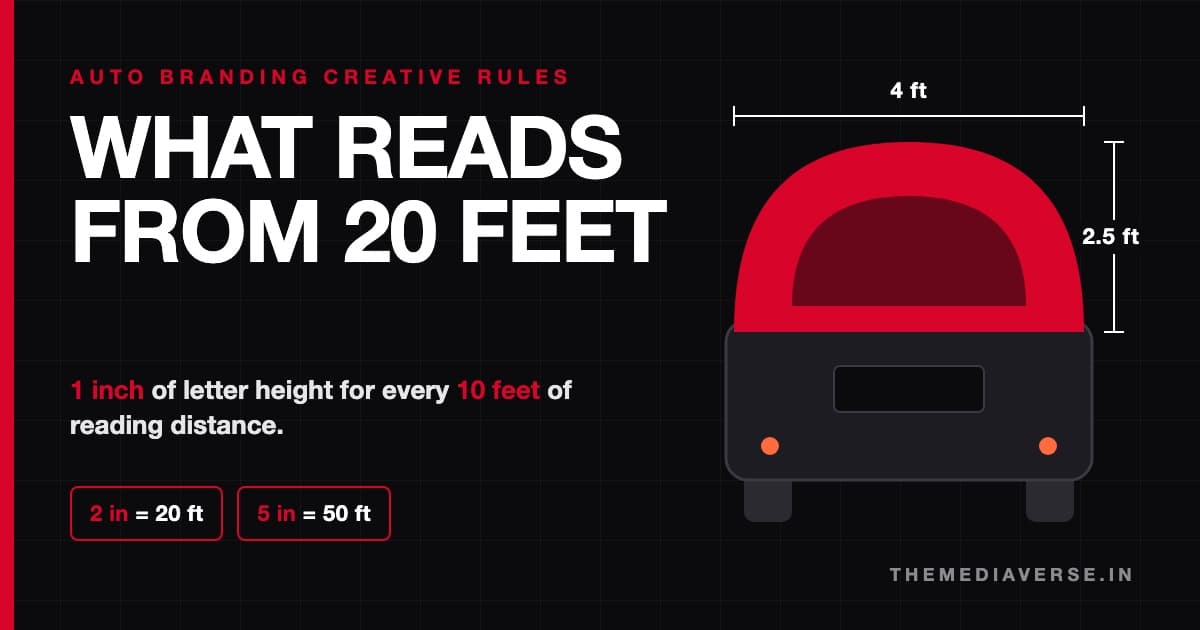
Auto branding creative rules: what actually reads from 20 feet at a signal (2026 playbook)
An auto hood is 4 ft by 2.5 ft and reads at roughly 1 inch of letter height per 10 feet. Eight creative rules ranked by what a reprint on 300 autos costs, plus the paper test to run before the print run.
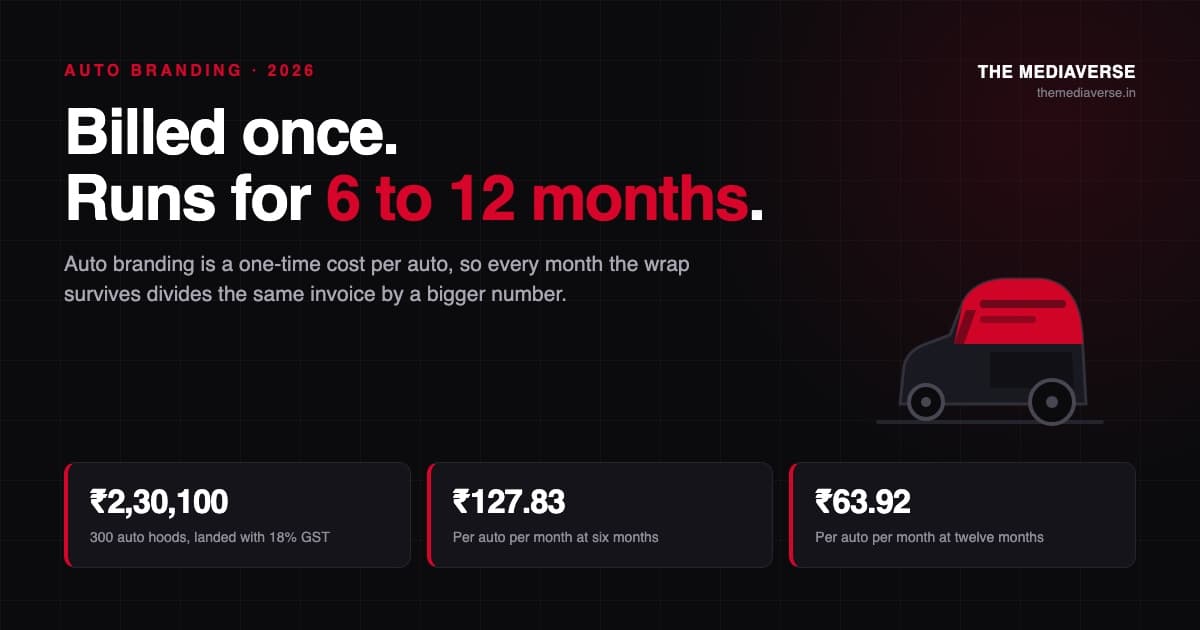
How long should an auto branding campaign run? The material-life math for 2026
Auto branding is billed once per auto, and the published vinyl life is 6 to 12 months. A 300-hood fleet at ₹2,30,100 landed is ₹767 per auto for one month and ₹127.83 per auto per month at six. The full arithmetic, and what really ends a campaign.