

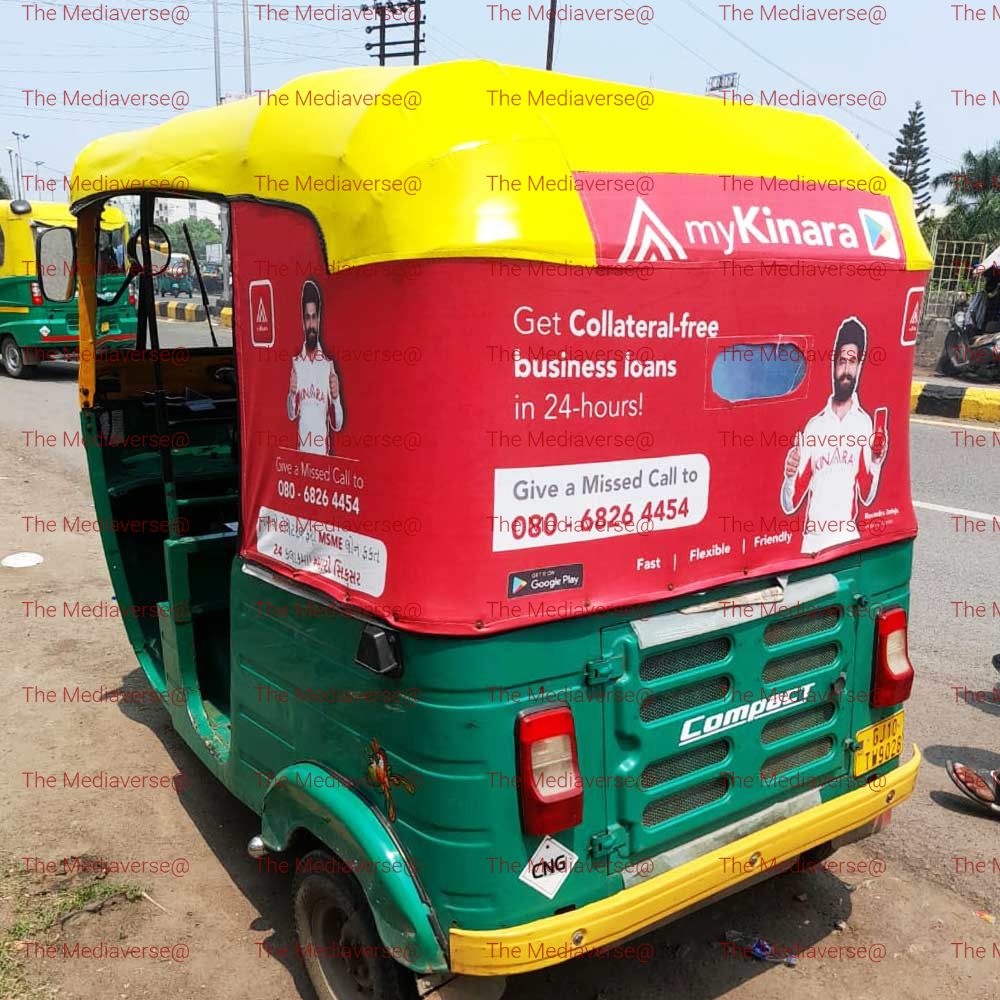
A 300-auto hood campaign costs ₹1,95,000 at the published one-time rate of ₹650 per auto, or ₹2,30,100 once 18% GST is added. That single figure is the numerator of every outdoor ROI calculation you will ever run. The denominator is the number of responses you can actually count, and the only reason most businesses cannot count them is that nobody printed a code, a QR or a dedicated number on the creative before it went to press. Outdoor is not unmeasurable. It is measurable in advance and unmeasurable afterwards. This playbook gives you the real rate card so you can fix the cost side, a six step method to fix the response side, and a worked cost per response grid you can drop your own numbers into.
This is written for the person who signs the cheque at a local business, a clinic, a showroom, a coaching institute, a restaurant group, a builder running a project launch, and who has been told outdoor cannot be measured. You need three things before you start and none of them cost money: the exact campaign total including GST from your quotation, two weeks of baseline footfall and call figures, and your gross margin per customer. If you have those three numbers, everything below is arithmetic you can do on paper.
Can you actually measure outdoor advertising ROI?
Yes, on the response side, and only partly on the awareness side. Be honest about which is which. The cost side is already exact: a 2,000 board no parking campaign is ₹90,000 at ₹45 a board plus ₹16,200 GST, so ₹1,06,200, all inclusive of the board, printing, transport and installation. There is no rental, no monthly renewal and no hidden media cost to estimate. Fifty thousand A5 inserts at ₹1.25 a copy are ₹62,500 plus ₹11,250 GST, so ₹73,750. You know the numerator to the rupee before the campaign starts.
The response side is exact too, as long as the response has somewhere to land. A coupon code, a QR, a dedicated phone or WhatsApp number, or a show this flyer offer are each a countable event tied to one campaign. What genuinely resists measurement is the person who reads your hood at a signal for six weeks, never scans anything, and walks in three months later because your name felt familiar. That value is real and it is not in your coupon count, so read the coupon count next to your overall footfall and enquiry trend rather than instead of it. Everything in this playbook is designed around that split: measure the countable part properly, and stop pretending the rest is zero or infinite.
What does a trackable outdoor campaign cost before you measure anything?
Start here, because half the confusion about outdoor ROI is that people never write down the exact denominator-free number they spent. The rates below are the published ones, they are one-time per unit unless the row says otherwise, and the worked totals are the rate multiplied by a realistic minimum order with 18% GST added. Use the total including GST in your calculation, since that is what actually leaves your bank account.
Outdoor campaign costs from the published rate card (2026)
| Published rate | Worked campaign total, GST included | |
|---|---|---|
| Auto hood branding | ₹650 per auto for 300 to 499, ₹630 for 500 or more. One-time, minimum 300 autos | 300 autos: ₹1,95,000 plus ₹35,100 GST = ₹2,30,100 |
| Auto sticker 24 by 18 inch | ₹270 per auto for 500 to 799, ₹240 for 800 or more. One-time, minimum 500 autos | 500 autos: ₹1,35,000 plus ₹24,300 GST = ₹1,59,300 |
| No parking boards | ₹45 per board under 5,000, ₹35 at 5,000 or more. All inclusive, minimum 1,000 boards | 2,000 boards: ₹90,000 plus ₹16,200 GST = ₹1,06,200 |
| Newspaper insertion, A5 | ₹1.25 per copy at 50,000, ₹1.15 above 50,000. Minimum 50,000 copies | 50,000 copies: ₹62,500 plus ₹11,250 GST = ₹73,750 |
| Mobile van, T-shape | ₹8,000 fabrication plus ₹3,000 per day, falling to ₹2,700 per day at 10 days or more | 10 days: ₹35,000 plus ₹6,300 GST = ₹41,300 |
Rates are from The Mediaverse published rate card and cost calculator. A4 inserts are ₹1.70 per copy at 50,000 and ₹1.50 above it, A2 inserts ₹2.20 and ₹2.00. Final quotations vary by city, permissions and customisation.
How do you calculate cost per response?
Cost per response is the campaign total including GST divided by the number of responses you counted. Nothing more complicated than that, and it is the only outdoor number that survives contact with a sceptical accountant. The grid below runs that division across the four worked campaigns at three response levels. Find the row for your format and read across to whatever response count you actually recorded.
Cost per response at 100, 500 and 1,000 counted responses
| 100 responses | 500 responses | 1,000 responses | |
|---|---|---|---|
| 300 autos, hood (₹2,30,100) | ₹2,301 | ₹460 | ₹230 |
| 2,000 no parking boards (₹1,06,200) | ₹1,062 | ₹212 | ₹106 |
| 50,000 A5 inserts (₹73,750) | ₹738 | ₹148 | ₹74 |
| T-shape van, 10 days (₹41,300) | ₹413 | ₹83 | ₹41 |
This is arithmetic on real campaign costs, not a forecast. The Mediaverse does not publish response rate benchmarks by format, because response depends on your offer, catchment and creative. Measure your own count, then read it off this grid.
Two things to do with that number. First, compare it against your own gross margin per customer, not against somebody else on the internet. Break-even responses equal campaign cost divided by gross margin per customer, so a business making ₹500 gross margin on a customer needs 148 responses to break even on the ₹73,750 insert drop, 213 on the ₹1,06,200 board campaign, and 461 on the ₹2,30,100 auto campaign. If those counts look unreachable for your offer, that is useful information before you spend, not after. Second, compare cost per response between formats and areas that ran in the same window with different codes. That comparison is the entire point, and it is why one code for everything is the most expensive mistake in this playbook.
How do you measure an outdoor campaign in six steps?
Work through these in order, before the artwork goes to print. Steps 1 and 2 take an afternoon. Step 3 runs for the length of the campaign. Steps 4 to 6 take about two hours once it ends.
Write down the exact spend and your baseline
Take the total including 18% GST from the rate card, for example ₹2,30,100 for 300 auto hoods or ₹1,06,200 for 2,000 no parking boards, and write it at the top of a sheet. Under it, record your normal weekly footfall, calls and sales for the two weeks before the campaign. Without that baseline you cannot separate campaign lift from an ordinary good week. Common mistake: recording the pre-GST figure and quietly understating cost per response by 18%.
Put a unique tracking element inside the creative, per format and per area
A coupon code, a QR, a dedicated phone or WhatsApp number, or a show this offer line. Make it unique per format and, where the campaign spans localities, per area or pincode. This is the step with a deadline: once 50,000 flyers are printed or 300 hoods are wrapped, it cannot be added. Common mistake: one code across every format, which tells you the campaign worked but never which half of it did.
Collect the coverage proof your provider already supplies
Auto and van campaigns include GPS tracking and daily photo reports, and no parking board campaigns include geo-tagged installation reporting. Ask for them from day one and file them. Coverage proof answers a different question from response: it tells you whether 2,000 boards actually went up on the gates you paid for, and where the fleet ran. Common mistake: treating a weak response as a creative failure when the coverage log shows half the units never deployed.
Capture every response at the point of contact
Staff note the code on a sheet or in the billing software, the dedicated number logs its own calls, the QR logs its own scans. Make it one line of work at the counter, not a monthly reconstruction from memory. Campaigns go live 48 to 72 hours after approval, so brief the counter staff before then. Common mistake: capturing responses for the first week and losing the habit by week three, which biases the whole result downwards.
Divide, and compare against your own margin
Campaign cost including GST divided by counted responses gives cost per response. Campaign cost divided by gross margin per customer gives the break-even response count. Do both per format and per area where you used different codes. At a ₹500 margin the ₹73,750 insert drop needs 148 responses, the ₹1,06,200 board campaign 213, and the ₹2,30,100 auto campaign 461. Common mistake: judging the result against a benchmark from another industry instead of your own break-even.
Move the next budget, and keep the method identical
Shift spend toward the format and area with the lowest cost per response, then read the footfall and enquiry trend to check you are not cutting an awareness format that is quietly feeding the rest. Run the next campaign with exactly the same measurement method so the two are comparable. Common mistake: changing the offer, the code scheme and the format at once, which makes cycle two uncomparable with cycle one.
How does measurement differ by format?
Each format proves two separate things: that it was delivered, and that it worked. The delivery proof is usually something your provider already supplies and you already paid for. The response proof is always something you had to print. The table splits them so you can see which column you are missing.
Coverage proof and response proof by outdoor format
| How coverage is proved | How response is counted | |
|---|---|---|
| Newspaper insertion | Publisher insertion confirmation against copies booked, minimum 50,000 | Coupon code or QR printed per pincode, redemptions counted against copies dropped in that pincode |
| Auto hood and sticker branding | GPS tracking and daily photo reports across the wrapped fleet | Code, QR or dedicated number on the hood, plus footfall lift over the baseline |
| Mobile van branding | GPS tracking and a daily route report for each day billed | Sign-ups and footfall at activation stops, plus any code on the panel |
| No parking boards | Geo-tagged installation reporting for the gates covered | Dedicated number or code printed on the 1 foot by 1.5 foot board face |
| Shop name board | Installation photographs, since the board is permanent rather than a dated campaign | Footfall and enquiry lift against the pre-installation baseline, plus a launch offer code if you time one with it |
GPS tracking, daily photo reports and geo-tagged board reporting are standard inclusions on The Mediaverse campaigns, so ask for them rather than building your own tracking.
What makes outdoor look unaccountable when it is not?
Five habits, in rough order of how much damage they do. The first is printing without a tracking element, which converts a ₹2,30,100 campaign into an anecdote. The second is one code across every format and area, which leaves you knowing the campaign worked without knowing whether it was the 300 autos or the 2,000 boards. The third is quoting the pre-GST figure in the calculation, which understates true cost per response by 18% and flatters every campaign you run. The fourth is judging an awareness format purely on redemptions while the footfall baseline you recorded in step 1 sits unread. The fifth is changing the method between cycles, which is the same as not measuring, because a number you cannot compare to last time is a number you cannot act on.
What should be in place before the campaign goes live?
Run this checklist the day before artwork goes to print. One, the campaign total including 18% GST is written down, not the pre-GST figure. Two, a unique code, QR or dedicated number exists for each format and each area, and it is inside the artwork. Three, two weeks of baseline footfall, calls and sales are recorded. Four, the counter staff know what to write down and where. Five, you have asked for the GPS tracking, daily photo reports or geo-tagged installation reporting that comes with the format. Six, you know your gross margin per customer, so the break-even response count is calculated before you spend rather than argued about after. Six lines, one afternoon, and the difference between a managed channel and a guess.
Is outdoor advertising ROI as precise as digital?
No, and pretending otherwise is how businesses lose trust in their own numbers. Digital attributes clicks automatically. Outdoor gives you an exact cost, a ₹1,06,200 board campaign is ₹1,06,200 to the rupee, and an exact response count only for the responses that used your code. The awareness effect sits outside both. Treat cost per response as a fair, repeatable comparison between your own campaigns rather than an absolute truth.
How many responses does an outdoor campaign need to break even?
Divide the campaign cost including GST by your gross margin per customer. At a ₹500 gross margin, the ₹73,750 fifty thousand copy A5 insert drop breaks even at 148 responses, the ₹1,06,200 two thousand board campaign at 213, and the ₹2,30,100 three hundred auto campaign at 461. Substitute your real margin before you book anything. If the resulting count looks unreachable for your offer, change the offer or the format.
How do I measure a shop name board, which has no campaign code?
A shop name board is permanent presence, not a dated campaign, so measure the change rather than a redemption count. Record footfall, calls and walk-in enquiries for two weeks before installation, then track the same figures afterwards against that baseline, allowing for season. If you time the new board with a launch offer, put a code on the offer so part of the effect becomes directly countable.
Do I need special software to measure outdoor advertising?
No. A printed code, a dedicated phone or WhatsApp number, a counter sheet and one spreadsheet column for spend and responses will measure a ₹2,30,100 campaign as accurately as any platform. Your provider already supplies the coverage data, GPS tracking and daily photo reports on autos and vans, geo-tagged reporting on boards. The discipline of recording responses at the counter matters far more than the tooling.
Should GST be included in the cost per response calculation?
Yes, include it. GST at 18% is extra on every outdoor rate quoted here, so a ₹1,95,000 auto hood booking actually costs ₹2,30,100 and a ₹90,000 board campaign costs ₹1,06,200. Using the pre-GST figure understates cost per response by 18% across the board and flatters every campaign equally, which quietly corrupts the comparison the whole method exists to make.
Tags
Quick Answers
Can you measure the ROI of outdoor advertising?
Yes on the response side, partly on the awareness side. The cost is exact from the rate card: 300 auto hoods at ₹650 each is ₹1,95,000, or ₹2,30,100 with 18% GST. The response is exact if you printed a coupon code, QR or dedicated number inside the creative before it went live. Divide one by the other for cost per response, then read it next to your footfall trend, because familiarity built at a signal never shows up as a redemption.
What does a trackable outdoor campaign cost in India?
Straight from the published rate card, GST at 18% extra. Auto hood branding is ₹650 per auto for 300 to 499 units and ₹630 for 500 or more, one-time, so 300 autos come to ₹2,30,100 all in. No parking boards are ₹45 each under 5,000 and ₹35 at 5,000 or more, all inclusive, so 2,000 boards are ₹1,06,200. A5 newspaper inserts are ₹1.25 per copy at 50,000, which is ₹73,750 with GST.
How do you calculate cost per response for an outdoor campaign?
Divide the campaign cost including 18% GST by the responses you actually counted. A ₹2,30,100 three hundred auto campaign is ₹2,301 per response at 100 responses, ₹460 at 500 and ₹230 at 1,000. A ₹73,750 insert drop is ₹738, ₹148 and ₹74 at the same counts. Then compare that against your own gross margin per customer rather than an external benchmark, because break-even is the only threshold that matters.
How do you measure response for moving formats like autos and vans?
Two separate proofs. Coverage comes from the GPS tracking and daily photo reports included with auto and van campaigns, which confirm the fleet ran where you paid for it. Response comes from a code, QR or dedicated number on the panel, and for vans from sign-ups and footfall at activation stops. A T-shape van at ₹8,000 fabrication plus ₹2,700 per day for 10 days is ₹41,300, so 500 responses is ₹83 each.
Looking for professional Transit Advertising services?
The Mediaverse runs end-to-end transit advertising campaigns across India with geo-tagged delivery and transparent, all-inclusive pricing.
Explore our Transit Advertising solutionsSummarize this guide with AI
Open this article in your favourite AI assistant
Related Guides
- the complete guide to outdoor advertising in India
- how to plan your outdoor advertising budget
- the newspaper insertion pincode-targeting playbook
- measuring an auto branding campaign in Bangalore
- auto rickshaw branding services
- mobile van branding services
- newspaper insertion services
- no parking board advertising
Written by

The Mediaverse Team
India's Leading Outdoor Advertising Agency
The Mediaverse is a national-level outdoor advertising and integrated marketing organization that provides complete OOH, ATL, BTL, retail, and transit media solutions across India. With years of experience executing high-performance campaigns for brands in FMCG, Real Estate, E-commerce, EdTech, Automotive, Healthcare, and Retail, The Mediaverse combines creativity, data-driven media planning, and flawless on-ground execution. As a full-stack outdoor advertising provider, The Mediaverse offers Auto Branding, Mobile Van Branding, Newspaper Insertion Advertising, Shop Name Board Branding, In-Store Branding, Hoardings, Transit Media, Kiosks, Mall Media, Activations, and all forms of Below-The-Line marketing. Known for its pan-India network, strategic route planning, premium print quality, and Cheqmate™ GPS-based verification, The Mediaverse ensures 100% transparent and result-oriented campaign delivery. The Mediaverse’s editorial team produces deeply researched, SEO-optimized, and generative-engine-friendly content to help businesses understand the power of outdoor advertising and make informed decisions that maximize brand visibility and ROI across urban, suburban, and rural markets.
Related Articles
Which Outdoor Formats Charge a Festival Premium, and Which Hold Flat All Year (2026)
We checked every published rate card for seasonal pricing. There is one surcharge on the whole site, and it is smaller than the rush fee most buyers pay without noticing. What rises, what holds flat, and how to plan an October campaign backwards from the published lead times.
Do Our Outdoor Rates Differ by City? The Auto and Van Cards Side by Side (2026)
We read all ten published city pages side by side. Auto branding is one national price everywhere. Mobile vans and shop name boards are the city-priced formats, the LED rate varies by 36 percent, and the fabrication line moves a short booking more than the day rate does.
What Outdoor Advertising Costs After GST: Landed Totals for 2026
Every outdoor rate card on this site is quoted before tax. Landed 18% GST totals for all five formats, the entry ticket ladder from Rs.1,003 to Rs.2,30,100, what a tax-inclusive budget really buys, and when you get the tax back.