

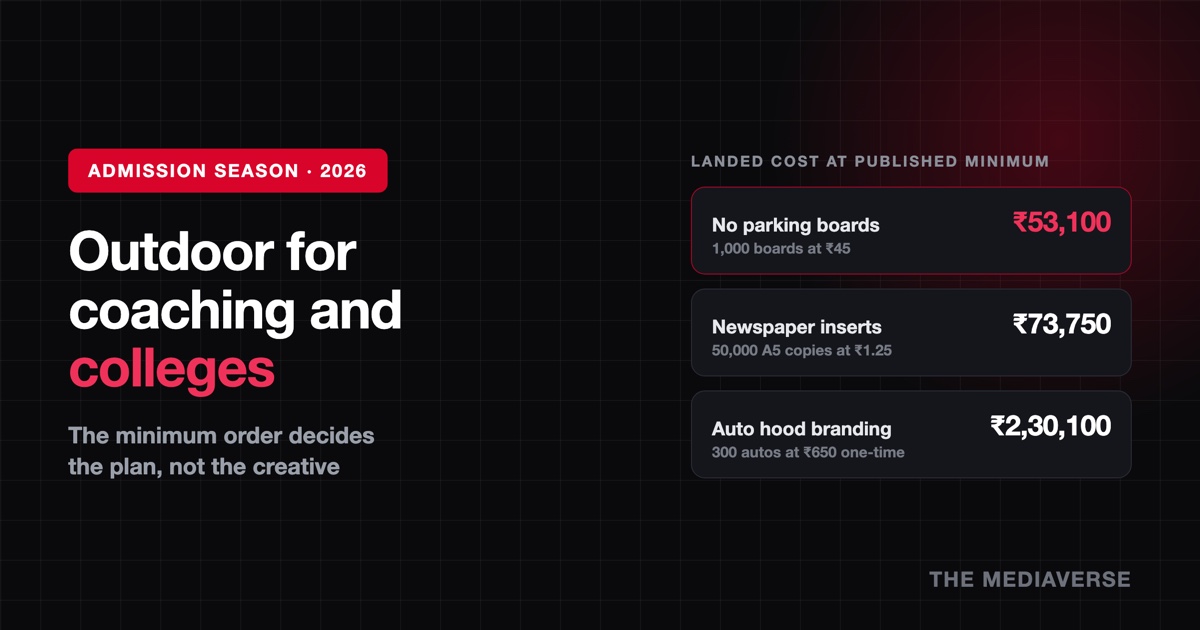
The smallest outdoor campaign a coaching institute can actually book is 1,000 no-parking boards at ₹45 each, which is ₹45,000 plus ₹8,100 GST, so ₹53,100 landed. Auto hood branding cannot be booked below 300 autos, which is ₹1,95,000 at the published ₹650 one-time rate, or ₹2,30,100 with GST. Newspaper insertion cannot be booked below 50,000 copies, so ₹73,750 for A5 and ₹1,00,300 for A4. Those three minimum order quantities, not your creative and not your enthusiasm, decide what your admission-season plan can look like. This playbook works the season backwards from results week using only those published numbers.
This is written for the person approving the spend at a coaching centre, a test-prep chain, a degree college or a university admissions office, in a market where the competition is running the same three formats you are. You need four things before you start, and none of them are creative decisions: your own results week and counselling dates, the pincodes and colonies your students actually come from, the total budget as a landed figure including 18% GST, and a rough idea of what one enrolled student is worth to you across a full course. The last one decides whether any campaign here was worth running, and it is the number most institutes never write down.
What can a coaching institute actually book, and what does it cost?
Start with the minimum order quantities, because they eliminate options before any creative discussion. The booking calculator enforces a floor on every format: 300 autos for hood branding, 500 autos for sticker branding, 1,000 no-parking boards, and 50,000 copies for newspaper insertion. A neighbourhood tuition centre with ₹60,000 to spend does not choose between five formats. It has one, and knowing that on day one saves a fortnight of quotations.
The table below is the published rate card with 18% GST added, priced at each format's own minimum. Note that 500 autos wearing a 24 by 6 inch sticker and 50,000 A4 inserts land at exactly the same number, ₹1,00,300, which makes them a genuine like-for-like choice at that budget.
What each outdoor format costs at its published minimum order
| Minimum order | Published rate | Landed at minimum, GST included | |
|---|---|---|---|
| No parking boards | 1,000 boards | ₹45 each, ₹35 at 5,000 or more, all inclusive | ₹53,100 |
| Mobile van, T-shape | Booked by the day | ₹8,000 fabrication plus ₹2,700 per day at 10 days or more | ₹41,300 for 10 days |
| Newspaper insertion, A5 | 50,000 copies | ₹1.25 per copy, ₹1.15 above 50,000 | ₹73,750 |
| Auto sticker, 24 by 6 inch | 500 autos | ₹170 each, ₹140 at 800 or more, one-time | ₹1,00,300 |
| Newspaper insertion, A4 | 50,000 copies | ₹1.70 per copy, ₹1.50 above 50,000 | ₹1,00,300 |
| Auto sticker, 24 by 18 inch | 500 autos | ₹270 each, ₹240 at 800 or more, one-time | ₹1,59,300 |
| Auto hood branding | 300 autos | ₹650 each, ₹630 at 500 or more, one-time | ₹2,30,100 |
Rates from The Mediaverse published rate card and booking calculator. Auto and board rates are one-time per unit, not monthly. Final quotations vary by city, permissions and customisation.
Which format reaches which part of an admission catchment?
An admission decision is usually made by a parent at home and influenced by a student on the street, and the two are reached by different formats. Boards sit on the gate where the parent parks. Hoods move through the signals the student sits at. Inserts arrive on the doorstep on a chosen morning. Matching the format to where the decision actually happens matters more than the size of the panel.
The format also decides how much you are allowed to say. A no-parking board is 1 foot by 1.5 foot of sunpack sitting on a gate, so it carries a name, one line and a number, and anything more becomes unreadable at walking pace. An auto hood is read in the few seconds the auto is beside someone at a signal, so it holds a name, a category and a number, nothing else. The newspaper insert is the only surface in this list with room for a fee structure, a batch schedule, a counselling date and a map, which is another reason to spend it in the week those details matter rather than at launch. Matching the message length to the surface is not a design preference, it is the difference between being read and being wallpaper.
Format to catchment: where each one lands during admission season
| Where the message lands | The job it does in an admission season | |
|---|---|---|
| No parking boards | Apartment and house gates in the catchment colonies, on a 1 foot by 1.5 foot sunpack board | Parent-facing presence in the residential belt around the centre, held for months at a one-time cost |
| Auto hood branding | Signals, arterial roads and the routes autos work all day across the city | Broad city-wide familiarity built in the weeks before results, from a single one-time spend |
| Auto stickers | The same fleet on a smaller panel, so the same budget covers more autos | Wider fleet coverage when the number of autos matters more than the size of the panel |
| Newspaper insertion | Inside the morning paper, at the doorstep, targetable by pincode | The only format that can carry a dated offer and a counselling date to a chosen locality |
| Mobile van branding | Chosen routes and stops, with GPS tracking and a daily route report | Campus gates, exam centres and counselling venues on the specific days they are crowded |
| Shop name board | The institute's own frontage, permanently | Being findable and credible once a parent has reached the street |
GPS tracking with daily photo reports on auto and van campaigns, and geo-tagged installation reporting on no-parking boards, are standard inclusions and are your proof of delivery.
How do you plan the season backwards from results week?
Fix your results week first, then count backwards. The dates below are relative on purpose: boards, exams and counselling windows differ by state, board and stream, so anchor the calendar to your own dates rather than to a national one. Auto and van campaigns go live 48 to 72 hours after approval, and multi-city or 20-plus van bookings can take 5 to 7 days, so the only genuinely tight steps are the ones near results week.
Ten weeks out: define the catchment and the one ask
Write down the pincodes and colonies you actually draw students from, and the single action the campaign should drive: a demo class, a counselling visit, a call. A campaign asking for three things gets none of them. Common mistake: defining the catchment as the whole city because it feels ambitious, then buying 1,000 boards spread so thin that no colony ever feels saturated.
Eight weeks out: test your budget against the minimums
Put your real number against the floors: ₹53,100 buys the 1,000-board minimum, ₹73,750 the 50,000-copy A5 minimum, ₹2,30,100 the 300-auto hood minimum. If the budget clears only one floor, you have a one-format season and should saturate rather than sample. Common mistake: planning a three-format campaign on a budget that clears one minimum, then buying below minimum quantities nobody will actually book.
Six weeks out: put a unique tracked number in every artwork
Give each format, and where budget allows each locality, its own phone or WhatsApp number or code. This has a hard deadline: once 1,000 boards are printed you cannot add it. Without it you will finish the season knowing enrolments went up and not knowing whether the boards or the hoods did it. Common mistake: one number across everything, which makes the next season a guess again.
Five weeks out: book the auto hoods first
Hood branding is a one-time cost per auto, not a monthly rental, so the earliest booking gets the longest run for the same money. Three hundred autos at ₹650 is ₹2,30,100 landed and it keeps working through results week and counselling without another invoice. Common mistake: treating the fleet as a launch-week format and paying the same one-time price for a fraction of the exposure.
Three weeks out: saturate the catchment colonies with boards
One thousand boards at ₹45 all inclusive covers gates across your chosen colonies for ₹53,100, and the rate improves to ₹35 a board past 5,000, where 5,000 boards land at ₹2,06,500. Ask for the geo-tagged installation report and check it against your colony list. Common mistake: accepting an installation count without the geo-tagged proof, then wondering why half the catchment never saw a board.
Results week minus one: drop the dated insert
Newspaper insertion is the only format here that can carry a specific date, so hold it for the week parents are actively deciding. Fifty thousand A5 copies are ₹73,750 landed and 50,000 A4 copies ₹1,00,300, both targetable by pincode. Put the counselling date, the address and the tracked number on it. Common mistake: dropping the insert at campaign launch, weeks before anyone is ready to act on a date.
Results and counselling week: put the van where the queues are
A T-shape van is ₹8,000 fabrication plus ₹2,700 per day at 10 days or more, so ₹41,300 landed for a ten-day run, and it can be routed to exam centres, result venues and counselling halls on the days they are full. You get a daily route report to verify it went where you paid for. Common mistake: booking the van for the whole season on a route that is only crowded for six days of it.
After counselling closes: count, divide, and write it down
Take the landed cost of each format, divide by the responses its tracked number produced, and record the cost per response next to the colony list. That single sheet is what makes next year's plan an argument from evidence rather than a repeat of this year. Common mistake: closing the season without recording anything, then rebuilding the same guess twelve months later.
What does an admission-season plan cost at three realistic budgets?
Three plans built only from published rates and minimums. Every figure below is the landed number with 18% GST included, and each combination clears every format's minimum order, so all three are actually bookable rather than theoretical.
Three bookable admission-season plans, landed costs with GST
| What it buys | Landed total | |
|---|---|---|
| Single centre, under ₹1,00,000 | 1,000 no-parking boards across the catchment colonies at ₹53,100, plus a T-shape van for the 10 busiest days at ₹41,300 | ₹94,400 |
| Multi-branch institute, under ₹3,00,000 | 300 auto hoods across the city at ₹2,30,100, plus 1,000 boards saturating the strongest catchment at ₹53,100 | ₹2,83,200 |
| College or university, under ₹5,00,000 | 500 auto hoods at the ₹630 volume tier for ₹3,71,700, plus 50,000 A4 inserts by pincode at ₹1,00,300 | ₹4,72,000 |
Each plan clears the published minimum order for every format in it. Swapping the 500-hood tier down to 300 autos moves the top plan from ₹4,72,000 to ₹3,30,400.
One note on the top tier. Crossing 500 autos moves the hood rate from ₹650 to ₹630, so 500 hoods cost ₹3,15,000 before tax while 499 would cost ₹3,24,350. The 500th auto is cheaper than free. The same shape appears on boards at 5,000 units and on stickers at 800, which is why quantity thresholds are worth checking before you settle a number.
If the budget lands between two of these plans, cut in this order. Drop the van first, because it is the only day-rate item and the only one whose cost keeps climbing. Then reduce the auto count rather than the board count, since the boards are the ones sitting in the catchment you actually recruit from. Cut the insert last if your counselling dates are firm, because nothing else can carry a date. What you should not do is buy below a minimum: 800 boards or 200 hoods are not cheaper versions of the plan, they are quantities the booking calculator will not accept.
One cost this playbook deliberately does not put a number on is permissions. City rules for board placement and signage vary, and permissions appear in the published quotation as a variable alongside quantity, city, printing method and duration rather than as a fixed line item. Ask for it to be itemised in writing before you approve, and be wary of any plan that treats it as free. The same applies to your own shop name board or campus signage, which is quoted on size, material and design rather than from a per-unit rate card.
What can you honestly claim, and what should you measure instead?
Nothing published here tells you how many admissions a campaign will produce, and you should be suspicious of anyone who offers that figure. No response rate or enrolment benchmark is published for any of these formats, because the result depends on your fees, your results record, your competition and your offer, none of which a rate card knows. What is published, and what you should therefore hold a vendor to, is delivery: GPS tracking and daily photo reports on autos and vans, a daily route report for every van day billed, and geo-tagged installation reporting on boards. Delivery is the vendor's promise. Response is yours to count.
The counting method is simple arithmetic and it is the same one used across every format: landed campaign cost divided by the responses that format's tracked number produced. A ₹53,100 board campaign that generated 200 tracked calls cost ₹266 per call. The same campaign at 500 calls cost ₹106. Whether ₹266 a call is good depends entirely on what one enrolled student is worth to you over a full course, which is a number only you have. Work that out before the season, not after.
Two practical cautions on reading those numbers. First, an admission season has a decision window rather than a purchase moment, so responses arrive in a cluster around results and counselling and then stop, which means a cost per response measured in week two of an eight-week campaign will look terrible and prove nothing. Wait until counselling closes before you divide. Second, the formats do not work in isolation: a parent who saw the board for six weeks and then received the insert with the date is one response attributed to the insert, and it would be wrong to conclude the boards did nothing. Attribute to the tracked number, but interpret the season as a whole, and keep the board and hood spend in the picture when you plan the next one.
What wastes an admission-season budget?
Five failures, in order of how much money they burn. Spreading a 1,000-board minimum across an entire city so no colony is ever saturated, when the same boards concentrated in three colonies would be unmissable. Booking hoods late in the season and paying a one-time price for a few weeks of a format that would have run for months. Dropping the dated insert at launch instead of the week parents decide, which is the one timing this format exists for. Printing without a tracked number, which converts the whole spend into an anecdote. And quoting pre-GST figures internally, which understates every landed cost by 18% and quietly breaks the budget you approved.
What is the cheapest outdoor campaign a coaching centre can book?
One thousand no-parking boards, which is the published minimum order, at ₹45 each all inclusive. That is ₹45,000 plus ₹8,100 GST, so ₹53,100 landed, covering print, board, transport and installation with no monthly rental afterwards. Every other format sits higher: newspaper insertion starts at ₹73,750 for the 50,000-copy A5 minimum, and auto hood branding at ₹2,30,100 for the 300-auto minimum.
When should an institute book auto hood branding in an admission season?
As early as the budget allows, because hood branding is a one-time cost per auto rather than a monthly rental. Three hundred autos at ₹650 each is ₹2,30,100 landed whether the campaign runs for one month or five, so an earlier booking simply buys more exposure for the same invoice. Campaigns go live 48 to 72 hours after approval, so the constraint is your decision date, not production.
Are newspaper inserts still worth it for admissions?
They are the only format on this list that can put a specific date and address on a parent's doorstep in a chosen pincode, which is exactly what a counselling window needs. Fifty thousand A5 copies land at ₹73,750 and 50,000 A4 copies at ₹1,00,300, both at the published 50,000-copy minimum. Their weakness is timing: dropped early they are wasted, dropped in the deciding week they carry the offer.
How many admissions will an outdoor campaign bring?
Nobody can honestly tell you, and no response or enrolment benchmark is published for these formats. The result depends on your fees, results record, competition and offer. What you can do is put a unique tracked number on each format, count the calls it produces, and divide the landed cost by that count. A ₹53,100 board campaign at 200 tracked calls is ₹266 per call, which you then judge against the lifetime value of one student.
Should a single-branch tuition centre use auto hoods at all?
Usually not first. The published minimum is 300 autos at ₹2,30,100 landed, and those autos work across the whole city rather than your one catchment, so most of the exposure lands outside your draw area. A thousand boards concentrated in your colonies at ₹53,100 puts the same money where students actually come from. Hoods start making sense once you have branches worth covering city-wide.
Do the quoted rates include GST and installation?
Installation yes, GST no. No-parking board rates of ₹45 and ₹35 are all inclusive of board, printing, transportation and installation, and auto hood rates of ₹650 and ₹630 include design, printing and installation. GST at 18% is extra on all of them, which is why every figure in this playbook is quoted landed: ₹45,000 of boards is ₹53,100 to pay, and ₹1,95,000 of hoods is ₹2,30,100.
Tags
Quick Answers
How much does an outdoor advertising campaign cost for a coaching institute?
It starts at the minimum order for each format, with 18% GST extra. One thousand no-parking boards at ₹45 each is ₹53,100 landed and is the cheapest bookable option. Fifty thousand A5 newspaper inserts at ₹1.25 a copy is ₹73,750. Three hundred auto hoods at ₹650 one-time is ₹2,30,100. A single-centre season combining 1,000 boards with a ten-day T-shape van comes to ₹94,400.
Which outdoor format works best for admission season?
It depends where the decision happens. No-parking boards sit on gates in your catchment colonies and reach the parent. Auto hoods move through signals across the city and build familiarity from a one-time spend. Newspaper inserts are the only format that can carry a dated counselling offer to a chosen pincode. A mobile van covers exam centres and counselling venues on the specific days they are crowded.
When should a coaching institute start its admission campaign?
Work backwards from your own results week. Fix the catchment and the single ask about ten weeks out, test the budget against format minimums at eight, get tracked numbers into artwork by six, book auto hoods around five weeks out because they are a one-time cost, install boards at three, and hold the dated newspaper insert for the week before results. Autos and vans go live 48 to 72 hours after approval.
How do you measure an admission-season outdoor campaign?
Put a unique tracked phone or WhatsApp number on each format, count the calls each one produces, and divide the landed cost including GST by that count. A ₹53,100 board campaign generating 200 tracked calls cost ₹266 per call, and ₹106 at 500 calls. Judge that against what one enrolled student is worth across a full course, a figure only your institute has.
Looking for professional Transit Advertising services?
The Mediaverse runs end-to-end transit advertising campaigns across India with geo-tagged delivery and transparent, all-inclusive pricing.
Explore our Transit Advertising solutionsSummarize this guide with AI
Open this article in your favourite AI assistant
Related Guides
Written by

The Mediaverse Team
India's Leading Outdoor Advertising Agency
The Mediaverse is a national-level outdoor advertising and integrated marketing organization that provides complete OOH, ATL, BTL, retail, and transit media solutions across India. With years of experience executing high-performance campaigns for brands in FMCG, Real Estate, E-commerce, EdTech, Automotive, Healthcare, and Retail, The Mediaverse combines creativity, data-driven media planning, and flawless on-ground execution. As a full-stack outdoor advertising provider, The Mediaverse offers Auto Branding, Mobile Van Branding, Newspaper Insertion Advertising, Shop Name Board Branding, In-Store Branding, Hoardings, Transit Media, Kiosks, Mall Media, Activations, and all forms of Below-The-Line marketing. Known for its pan-India network, strategic route planning, premium print quality, and Cheqmate™ GPS-based verification, The Mediaverse ensures 100% transparent and result-oriented campaign delivery. The Mediaverse’s editorial team produces deeply researched, SEO-optimized, and generative-engine-friendly content to help businesses understand the power of outdoor advertising and make informed decisions that maximize brand visibility and ROI across urban, suburban, and rural markets.
Related Articles
The Smallest Order in Every Outdoor Format in Bangalore, Side by Side (2026)
Six outdoor formats, six different floors, one city. Every Bangalore minimum order with GST added, what each one covers against the denominators our own pages publish, and which to buy first.
Which Outdoor Formats Charge a Festival Premium, and Which Hold Flat All Year (2026)
We checked every published rate card for seasonal pricing. There is one surcharge on the whole site, and it is smaller than the rush fee most buyers pay without noticing. What rises, what holds flat, and how to plan an October campaign backwards from the published lead times.
Do Our Outdoor Rates Differ by City? The Auto and Van Cards Side by Side (2026)
We read all ten published city pages side by side. Auto branding is one national price everywhere. Mobile vans and shop name boards are the city-priced formats, the LED rate varies by 36 percent, and the fabrication line moves a short booking more than the day rate does.