

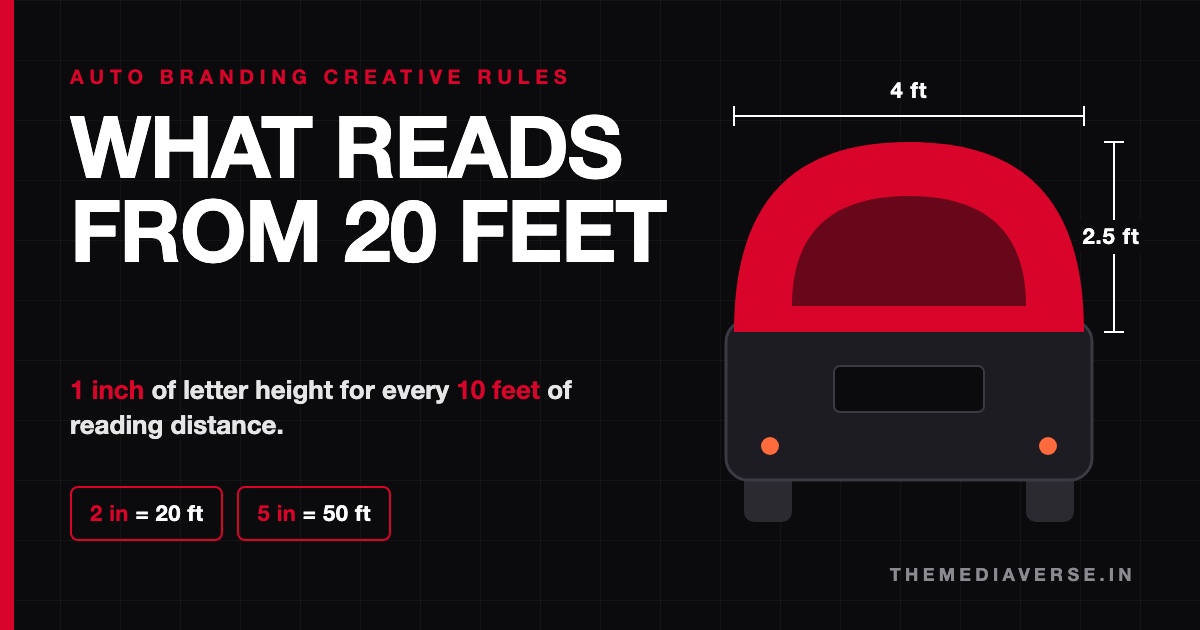
Six in the evening at a four-way signal. The light has just gone red, an auto stops in the near lane, and the car behind it halts about 20 feet from its hood. Two people in the front seats are looking straight at that hood for the length of one red light, and they are the entire audience the creative was made for. The hood is 4 feet wide and 2.5 feet tall, it cost ₹650 one time for print and installation, it is one of 300 in the fleet, and by the sign trade’s rule of thumb of 1 inch of letter height per 10 feet of reading distance, anything on it under 2 inches tall is not being read from that car. If the brand line is 5 inches tall, the car three positions further back, roughly 50 feet away, can read it too. If it is 1.5 inches tall because the agency wanted room for a tagline, nobody at that signal reads anything.
This playbook is for the person approving auto branding artwork: a founder, a marketing manager, or the designer handed a hood template for the first time. It gives you the geometry of the three auto canvases, a letter-height table against reading distance, eight creative rules ranked by what each one costs when it is broken, the reprint arithmetic that makes the ranking matter, and a paper test you can run in an afternoon before 300 hoods go to print. Everything priced here comes from the published one-time rate cards, and the legibility figures are the sign trade’s own rule of thumb rather than a study of auto traffic, which nobody has published and this post does not pretend to have run.
How far away is the person reading an auto hood?
Further than the artwork usually assumes. Three viewing positions matter. At a signal, the vehicle directly behind the auto sits about one car length back, call it 20 feet from bonnet to hood, and holds that position for the whole red phase. In moving traffic the following gap opens to two or three car lengths, so the same hood is being read from 40 to 60 feet by someone whose attention is on the road. At the kerb, a pedestrian waiting to cross is 10 to 15 feet from the near side of the hood, and sees it for a second or two as it passes. Only the first of those three is a stationary read. The other two are glances, and a glance reads a brand name or a logo, never a sentence.
The sign trade has a rule of thumb for this that has held up for decades: every 1 inch of letter height gives about 10 feet of best-impact reading distance for a viewer with ordinary eyesight, and letters stay readable well beyond that in good conditions. The same charts put 3-inch letters at 30 feet for best impact and up to 100 feet readable, 4-inch letters at 40 feet and up to 150, and 8-inch letters at 80 feet and up to 350. Those figures were worked out for static signs read by people standing still or driving past, not for a curved vinyl hood in Indian traffic, so treat the best-impact column as the planning number and the maximum column as a ceiling you should never design to.
Letter height against reading distance, and what each size can do on the three auto canvases
| Best-impact distance (1 in per 10 ft) | On the 48 by 30 in hood | On the 24 by 18 in sticker | On the 24 by 6 in sticker | |
|---|---|---|---|---|
| 2-inch capitals | 20 ft: the car stopped directly behind at a signal | A secondary line or a phone number, about 32 characters wide | A body line under the headline, about 16 characters | The only size that leaves any margin: one line, about 16 characters |
| 3-inch capitals | 30 ft: the same car, read comfortably, plus the kerb | A message line or a 10-digit phone number at about 21 inches wide | The headline, about 10 characters, with one 2-inch line beneath | Fills the sticker edge to edge, no margin |
| 5-inch capitals | 50 ft: two to three car lengths back in moving traffic | The brand line, about 12 to 14 characters, with room for one 3-inch line below | A brand line only, about 6 characters, nothing else fits with it | Does not fit |
| 8-inch capitals | 80 ft: the far side of a junction | A wordmark only, about 8 to 9 characters, and the rest of the hood stays empty | Does not fit | Does not fit |
Distances are the sign trade’s rule of thumb for best-impact legibility, not a measurement of auto traffic. Character counts assume a bold sans-serif with an average character width of about two thirds of the capital height and 2-inch side margins on the hood; condensed faces fit more, wide faces fewer. Hood 4 ft by 2.5 ft and sticker sizes are the published formats.
What do the three auto canvases actually give you to work with?
Less than the templates suggest, and each one is a different job. The hood is the only canvas seen from three sides, and it is curved: the sides fall away from the rear face, so anything within a few inches of the left and right edges is read at an angle by the car behind and head-on only by the kerb. Plan the rear-facing centre, roughly 40 inches of the 48, as the part that has to work, and let the sides carry colour and a repeat of the logo rather than the copy. The two back panel formats are flat and rear-facing only. The 24 by 18 inch sticker is a small poster with room for a brand line, one message and a scannable element. The 24 by 6 inch strip is a single line, and the honest brief for it is a name or a number, not both.
The three auto formats: published size, one-time rate, and what the creative can honestly carry
| Published size | One-time rate per auto | Minimum order | What the creative can carry | |
|---|---|---|---|---|
| Auto hood | 4 ft by 2.5 ft (48 by 30 in), curved, seen from three sides | ₹650 for 300 to 499 autos, ₹630 from 500 | 300 autos | Brand line at 5 in, one message line at 3 in, one contact route at 2 to 3 in, logo repeated on the sides |
| Back panel sticker, large | 24 by 18 in, flat, rear-facing | ₹270 for 500 to 799 autos, ₹240 from 800 | 500 autos | Brand line at 3 to 4 in, one line at 2 in, a QR code or number in a lower corner |
| Back panel sticker, strip | 24 by 6 in, flat, rear-facing | ₹170 for 500 to 799 autos, ₹140 from 800 | 500 autos | One line at 2 to 3 in: the brand name or the phone number, never both |
Rates are one time per auto and include design, printing and installation. GST at 18 percent is extra, and some areas add an auto-union fee billed separately. Vinyl life is published as 6 to 12 months for hoods and 4 to 6 months for back panel stickers, as typical ranges rather than a warranty.
Why does a creative mistake cost the whole campaign again?
Because auto branding is billed once per print, not per month. The published rate is ₹650 per hood for 300 to 499 autos and ₹630 from 500 up, covering design, print and installation, with a 300-auto minimum, so a 300-hood fleet is ₹1,95,000 before tax and ₹2,30,100 with 18 percent GST. There is no rental meter to stop and no partial fix: a hood with a 1.5-inch brand line cannot be patched on the road, it can only be reprinted and reinstalled, and a reprint is a new booking at the same rate. The same logic applies to stickers at their 500-auto minimum. That is why the rules below are ranked by cost. A dull colour choice is a weaker campaign; a brand line nobody can read from 20 feet is a second invoice.
What it costs to replace a creative that failed the 20-foot test, at the published minimums
300 auto hoods
The smallest hood campaign that can be booked, and the full cost of replacing it if the brand line, the palette or the phone number is wrong.
- ₹650 per auto, design, print and installation included
- ₹1,95,000 before GST, ₹2,30,100 with 18 percent added
- Reprint takes the same 3 to 5 working days as the original
- No partial fix exists: the vinyl is replaced, not edited
500 back panels, 24 by 18 in
The large sticker at its published minimum. The most common failure is a QR code too small to scan from the driver’s seat.
- ₹270 per auto at the 500 to 799 tier
- ₹1,35,000 before GST
- Express setup published at 24 hours, so proofing has to happen before, not during
- Sticker life is 4 to 6 months, so a reprint mid-life buys very little
800 back panel strips, 24 by 6 in
The cheapest auto canvas at its volume tier, and the one most often overloaded with a name, a number and a tagline that all shrink below 2 inches.
- ₹140 per auto from 800 autos
- ₹1,12,000 before GST
- One line of copy is the honest capacity
- Cheapest to get wrong, still ₹1,32,160 to get right again
What are the eight creative rules, ranked by what each costs when broken?
The order here is not the order you will design in. It is the order of damage: rule one is the mistake that most often turns a campaign into a reprint, rule eight is the one that costs least if it slips. Run them as a sign-off list against the final artwork, not as a brief for the first draft.
Set the brand line at 5 inches of capital height, and make it the brand
Fix the capital height of the brand line first, at 5 inches on the hood so it reads from 50 feet, and let everything else fit around it. Why it matters: this is the only element every viewing position reads, and it cannot be enlarged after print. Common mistake: shrinking the name to make space for a tagline. At 5 inches a bold sans-serif carries about 12 to 14 characters across the hood’s usable width, so a long brand name goes to a wordmark or a shorter trading name rather than a smaller size. Proof of practice: the published hood rate includes design, and the first thing checked on any hood file is the capital height of the name.
Test the palette against the auto body colour of the city, never against a white screen
Place the artwork on a photograph of the actual auto body it will sit on, yellow, green or black depending on the city, and judge contrast there. Why it matters: a hood is a small panel on a large coloured vehicle, and a design that reads on a white artboard can dissolve into a yellow body or a green one. Common mistake: a brand whose own colour is yellow or orange running it edge to edge on a yellow auto. The fix is a dark or a white field behind the brand line, which costs nothing before print and ₹2,30,100 after it.
Cut the copy to three elements: one brand, one message, one contact route
Strike everything that is not the brand name, a single message line, or one way to respond. Why it matters: the reading window is one red light for the stationary viewer and a glance for everyone else, and the hood has room for one 5-inch line and one 3-inch line before the letters drop below the 20-foot floor. Common mistake: two offers, a website, a phone number and social handles on one hood, all at 1.5 inches, all unread. Proof of practice: a fleet that carries the same three elements on every auto compounds recognition; ten messages across a fleet compound nothing.
Choose a contact route that survives the full vinyl life
Use a phone number, a short web address or a brand handle you will still own in 12 months. Why it matters: the published hood life is 6 to 12 months and the rate is charged once, so a dated offer or a promotional number retires the creative long before the vinyl. Common mistake: a launch-week discount printed on 300 hoods that reads as stale by week five. The one-time billing that makes auto branding cheap per month, which we set out in the campaign-length math, only works if the creative has no expiry date.
Size the phone number for the car behind: 3 inches on the hood, 2 to 2.5 on a sticker
Give a phone number 3-inch digits on the hood, which reads from 30 feet and runs about 21 inches wide across the 48-inch hood. On the 24-inch stickers, drop to 2 or 2.5 inches so the number keeps a margin. Why it matters: a number is the element most likely to be dialled from a stationary car, and at 1.5 inches it reads from about 15 feet, closer than the car behind ever sits. Common mistake: setting the number as a footnote under the offer. Put it on its own line, one line, and never split it across two.
Treat a QR code as a stationary feature, not the call to action
If a QR code goes on, place it in a lower corner of the rear face or the 24 by 18 sticker, keep a plain white field around it, and test it at final size by scanning from the driver’s seat of a car parked behind an auto. Why it matters: a code is only ever scanned by someone stopped within a phone’s reach of the auto, and it steals space from the name that everyone else reads. Common mistake: a QR code as the hero of the hood, with the brand name beside it at 2 inches. Keep the phone number or the web address as the readable route and the code as a bonus.
Keep the copy inside the rear-facing centre of the hood, and repeat the logo on the sides
Hold the brand line, message and contact route within roughly the central 40 inches of the hood’s 48-inch width, and use the curved sides for a colour field and a repeated logo rather than text. Why it matters: the hood wraps, so the outer inches are seen at a steep angle by the car behind and head-on only from the kerb. Common mistake: a full-width headline whose first and last letters vanish round the curve. The kerb-side viewer gets a logo and a colour they recognise from the rear view, which is the right amount of information for a two-second pass.
Print the artwork at final size on paper and read it from 20 and 50 feet before approving
Print the hood face at 48 by 30 inches on plain paper, tape it to an outside wall in daylight, and read it from 20 feet, then 50 feet, then walk past it at the kerb. Do the same for a sticker at 24 by 18 or 24 by 6. Why it matters: setup is published at 3 to 5 working days from design approval, or 48 hours on express, and there is no proofing step inside that window; approval is the last moment the creative can change for free. Common mistake: approving from a phone screen where 1.5-inch letters look enormous. If the name reads at 50 feet and the number at 20, sign it off.
How do you run the 20-foot paper test before 300 autos go to print?
The test in rule eight takes an afternoon and a large-format print shop, and it is the cheapest insurance in outdoor advertising. Print the rear face of the hood at 48 by 30 inches on paper, black and white is fine for the size check, colour if the palette is in doubt. Tape it at roughly hood height, about 3 feet off the ground, on a wall that gets daylight. Measure 20 feet with a tape, stand there, and read the brand line, the message and the number aloud without squinting. Walk back to 50 feet and read the brand line again. Then walk past the sheet at a normal pace from 10 feet and say what you saw. If the 50-foot read fails, the brand line is under 5 inches; if the 20-foot read fails on the number, it is under 2. Photograph the sheet from each distance on a phone, because the photo is the record that gets the artwork signed off and the record that settles any argument later.
Timeline and budget for the whole creative stage: allow 2 to 3 working days for the artwork and the paper test, which is time the campaign calendar rarely includes, and then the published 3 to 5 working days from design approval to installation across the fleet, or 48 hours on express for hoods and 24 hours for back panels. The creative itself is included in the published rate of ₹650 per hood or ₹170 to ₹270 per sticker, so the only extra cost of doing this properly is the paper print, and the only cost of skipping it is the reprint table above.
What is not published about auto creative, and what should you measure instead?
No recall figure, no colour-preference percentage and no average signal dwell time is published by The Mediaverse for auto branding, and the legibility distances in this post come from the sign trade’s rule of thumb for static signs rather than from a study of autos in traffic. Anyone quoting a precise recall uplift for red over blue on an auto hood is inventing it. What is published is the geometry, the one-time rates, the 6 to 12 month vinyl life and the monthly photo audit, so the honest measurement is the one your own fleet produces: the paper test before print, a photograph of an installed auto from 20 and 50 feet in week one, and the response count against a contact route that appears nowhere else. Set those three up and the creative argument becomes a number rather than a preference.
Does The Mediaverse design the auto branding creative?
Yes. The published one-time rates, ₹650 per hood for 300 to 499 autos and ₹170 to ₹270 per back panel sticker, include design as well as printing and installation, so there is no separate creative fee. You can also supply finished artwork from your own agency. Either way, the file goes through the same checks before print: brand line at 5 inches on the hood, contrast tested against the body colour of the city, three elements only, and a final-size proof, because the approval is the last free change.
Can a QR code work on a moving auto?
Only when the auto is not moving. A QR code is scanned by someone stopped within a phone’s reach, which on the road means a driver or passenger stationary behind the auto at a signal. That is a real audience, so a code in a lower corner of the hood or the 24 by 18 inch sticker is worth including, but it must not be the main call to action. Keep a phone number or a short web address readable at 20 feet as the primary route, and test-scan the code at final print size from a driver’s seat before approval.
Should the same creative go on hoods and back panels?
The same brand line, palette and contact route, yes, but not the same layout. The hood is 48 by 30 inches, curved and seen from three sides, so it carries a 5-inch brand line, a 3-inch message and a contact route. The 24 by 18 inch sticker is flat and rear-facing, with room for a 3 to 4 inch brand line, one 2-inch line and a code. The 24 by 6 inch strip holds one line only. Scaling the hood file down to a strip produces letters under an inch tall that nobody reads.
How far away can you read an auto hood?
It depends entirely on the letter height, which is why the size decision comes first. By the sign trade’s rule of thumb of 1 inch per 10 feet, a 5-inch brand line reads at best impact from 50 feet, roughly two to three car lengths in moving traffic, and a 2-inch line from 20 feet, the car stopped directly behind at a signal. The same charts put 4-inch letters readable up to about 150 feet in good conditions, but that ceiling is for static signs read head-on, so plan on the best-impact figure and treat anything beyond it as a bonus.
How do I test an auto hood design before printing?
Print the rear face at the published size, 48 by 30 inches, on plain paper. Tape it about 3 feet off the ground on a wall in daylight, then read it aloud from a measured 20 feet and again from 50. Walk past it at the kerb from 10 feet and say what you took in. Photograph each view. If the brand line fails at 50 feet it is under 5 inches, and if the number fails at 20 it is under 2. Allow 2 to 3 working days for this before the published 3 to 5 day setup begins.
Tags
Quick Answers
What size should text be on an auto hood?
At least 5 inches of capital height for the brand line and 2 to 3 inches for anything else. The hood is 4 ft by 2.5 ft, and the sign trade’s rule of thumb gives about 10 feet of best-impact reading distance per inch of letter height, so 5-inch capitals read from 50 feet in moving traffic and 2-inch capitals from the car stopped 20 feet behind at a signal. At 5 inches a bold sans-serif fits roughly 12 to 14 characters across the hood, so the brand line is a name, not a sentence.
How many words should an auto branding creative have?
Three elements, and as few words as they need: the brand name, one message line, and one contact route. That is all a 48 by 30 inch hood can carry at readable sizes, one 5-inch line and one 3-inch line with a number beneath, before the letters fall under 2 inches and stop reading from 20 feet. The 24 by 18 inch back panel sticker takes a brand line and one line with a code; the 24 by 6 inch strip takes a single line, the name or the number, never both.
What colours work on an auto rickshaw hood?
Whatever contrasts with the auto body in the city the fleet runs in, which is yellow in most cities, green in some and black in others. Judge the artwork on a photograph of the real auto, not on a white screen, and give a brand whose own colour is yellow, orange or a light tone a dark or white field behind the name. No recall percentage for one colour over another is published for auto hoods, so ignore anyone quoting one; contrast against the body is the test, and it costs nothing to fix before print.
What does it cost to fix a creative mistake in auto branding?
The same as the original booking, because the rate is charged once per print and the vinyl cannot be edited on the road. A 300-hood fleet at ₹650 per auto is ₹1,95,000 before GST and ₹2,30,100 landed, and that is the reprint bill if the brand line is too small or the palette vanishes into the body colour. Five hundred 24 by 18 inch stickers at ₹270 cost ₹1,59,300 landed to replace, and 800 strips at ₹140 cost ₹1,32,160. Approval is the last free change.
Looking for professional Auto Branding services?
The Mediaverse runs end-to-end auto branding campaigns across India with geo-tagged delivery and transparent, all-inclusive pricing.
Explore our Auto Branding solutionsSummarize this guide with AI
Open this article in your favourite AI assistant
Related Guides
Written by

The Mediaverse Team
India's Leading Outdoor Advertising Agency
The Mediaverse is a national-level outdoor advertising and integrated marketing organization that provides complete OOH, ATL, BTL, retail, and transit media solutions across India. With years of experience executing high-performance campaigns for brands in FMCG, Real Estate, E-commerce, EdTech, Automotive, Healthcare, and Retail, The Mediaverse combines creativity, data-driven media planning, and flawless on-ground execution. As a full-stack outdoor advertising provider, The Mediaverse offers Auto Branding, Mobile Van Branding, Newspaper Insertion Advertising, Shop Name Board Branding, In-Store Branding, Hoardings, Transit Media, Kiosks, Mall Media, Activations, and all forms of Below-The-Line marketing. Known for its pan-India network, strategic route planning, premium print quality, and Cheqmate™ GPS-based verification, The Mediaverse ensures 100% transparent and result-oriented campaign delivery. The Mediaverse’s editorial team produces deeply researched, SEO-optimized, and generative-engine-friendly content to help businesses understand the power of outdoor advertising and make informed decisions that maximize brand visibility and ROI across urban, suburban, and rural markets.
Related Articles
Auto Back Panel Branding in 10 Cities: The 500-Panel Minimum Priced City by City (2026)
All ten city pages publish one back panel card, so 500 panels cost Rs.85,000 everywhere. What the city route-premium notes, the Rs.140 headlines and the fleet sizes change, priced city by city.
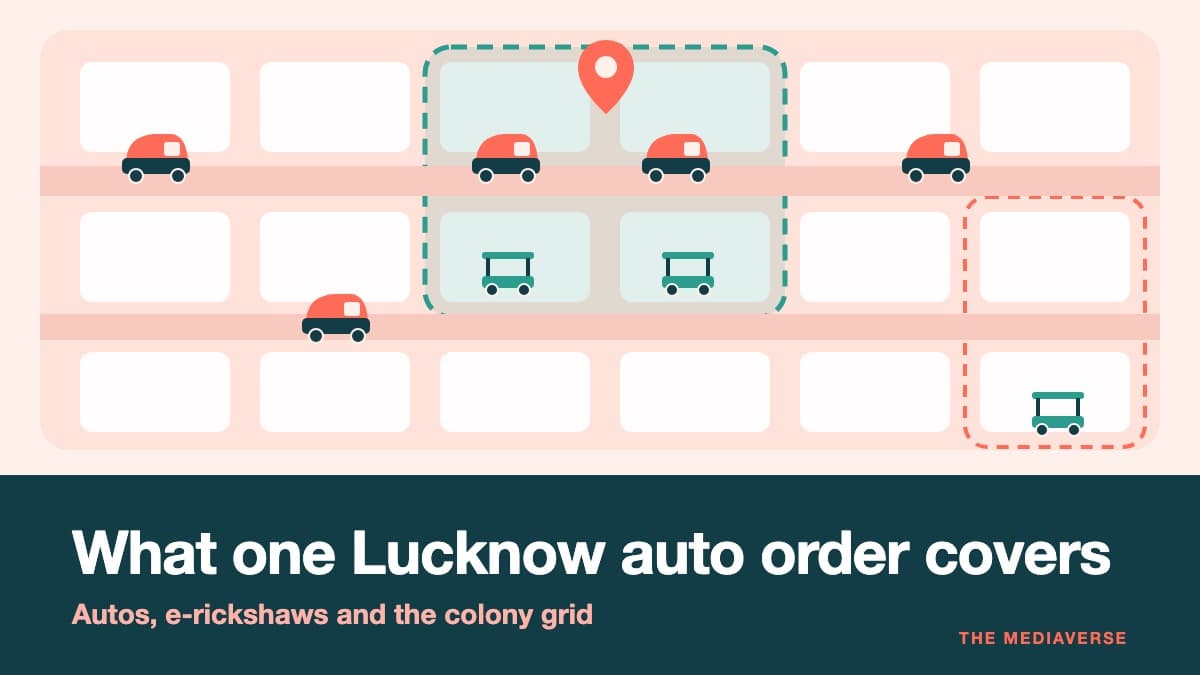
Auto Branding in Lucknow (2026): What the 300-Hood Minimum Covers Across Autos, E-Rickshaws and the Colony Grid
Lucknow prices autos and e-rickshaws on one national card, from Rs.85,000 for 500 panels. What one minimum order means in the page's own colony grids, how much of each zone it takes, and how the fog, monsoon and admission calendar shape the booking.
Auto Branding in Hyderabad (2026): What the 85,000-Auto Fleet and the Gate and Zone Map Actually Support
Four Hyderabad IT gate queues, 650 autos, and minimum orders of 300 hoods or 500 panels. What the published fleet and zone counts can actually carry, where the other 400 panels should run, and why 700 panels cost more than 800.