

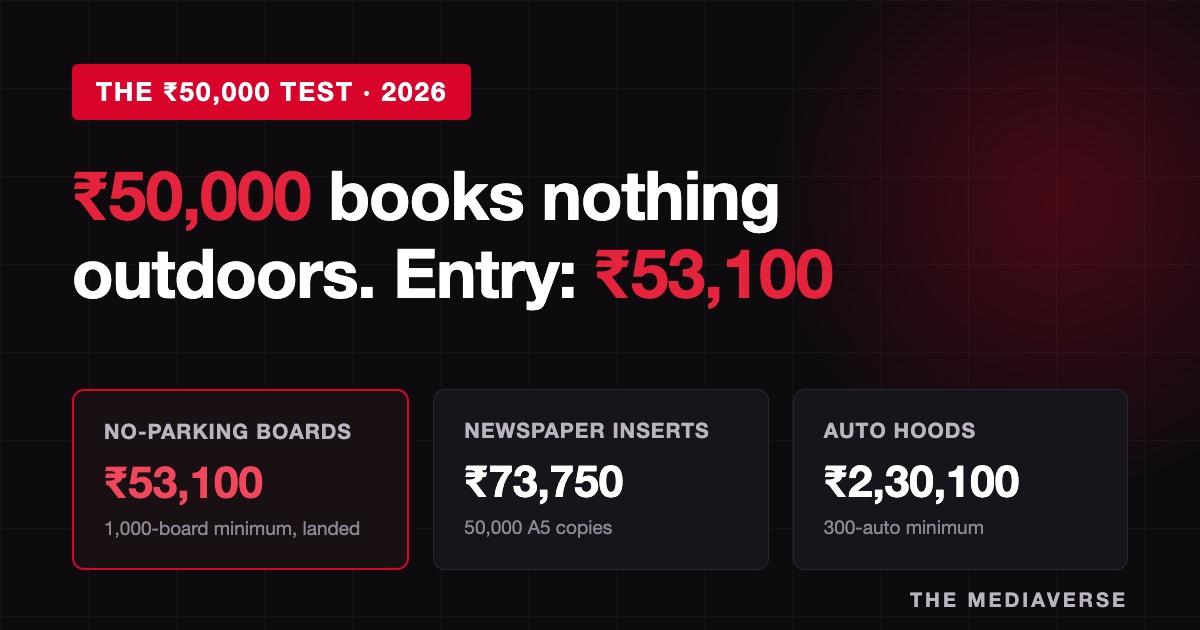
Rs.50,000 is one of the most common first outdoor budgets a local business puts on the table, and at The Mediaverse published rates it books none of the three formats this post compares. The cheapest entry ticket in Indian outdoor is 1,000 no-parking boards, the published minimum order, at Rs.45 per board: Rs.45,000 before tax, Rs.53,100 once 18% GST is added, installed and photo-verified. That is Rs.3,100 above the budget. The same Rs.50,000 is about 68% of the Rs.73,750 entry ticket for newspaper insertion, where the minimum order is 50,000 copies, and about 22% of the Rs.2,30,100 entry ticket for auto hood branding, where the minimum is 300 autos. So this comparison is not really about rates. It is about minimum order quantities, and the worked math below shows exactly where each format starts, what a small stretch unlocks, and when holding the money is the better call.
What does Rs.50,000 actually buy in outdoor advertising?
The three formats compared here are the ones local businesses actually shortlist at this budget: no-parking board advertising on residential gates, newspaper insertion into the morning paper, and auto rickshaw branding. All three publish one-time rates, not monthly rentals, and all three rates are quoted before 18% GST. The table below puts the published entry ticket of each format side by side. Read the minimum order row first, because that is the line that rules every one of the three out at Rs.50,000.
The formats also do different jobs, which matters as much as the arithmetic. A no-parking board is a fixed, 24x7 presence on the gate a resident passes every single day, built for weeks of repeated exposure in a chosen catchment. A newspaper insert is one morning of reach: 50,000 households see your flyer on the same day, then it is over. A branded auto hood is a moving presence across the city for months, seen at signals from three sides. Rs.50,000 does not change what each format is good at; at the published minimums it simply books none of them, and the question becomes which entry ticket is worth stretching or waiting for.
The Rs.50,000 test: entry ticket by format (2026 published rates)
| No-parking boards | Newspaper inserts (A5) | Auto hood branding | |
|---|---|---|---|
| Published rate | Rs.45 per board (Rs.35 at 5,000+) | Rs.1.25 per copy (Rs.1.15 above 50,000) | Rs.650 per auto (Rs.630 at 500+) |
| Minimum order | 1,000 boards | 50,000 copies per format | 300 autos |
| Entry total before GST | Rs.45,000 (1,000 boards) | Rs.62,500 | Rs.1,95,000 |
| Landed total with 18% GST | Rs.53,100 | Rs.73,750 | Rs.2,30,100 |
| Fits Rs.50,000? | No, short by Rs.3,100 | No, short by Rs.23,750 | No, short by Rs.1,80,100 |
| What the rate includes | Board, print, transport, installation, geo-tagged report | Print and insertion; design Rs.2,000 per creative extra | Print and installation; union fee extra in some areas |
Published 2026 rates from The Mediaverse rate cards. All totals are one-time. GST 18% added in the landed row.
Two clarifications before the verdict. The A4 pamphlet, the most detailed insert size, lands at Rs.1,00,300 for its 50,000-copy minimum at Rs.1.70 per copy, even further from Rs.50,000 than the A5. And the cheaper auto format does not close the gap either: the 24x6 inch back panel sticker at Rs.170 per auto carries a 500-auto minimum, which is Rs.85,000 before tax and Rs.1,00,300 landed.
Why are no-parking boards still the closest format to Rs.50,000?
Because rates and minimums point in opposite directions. Per unit, all three formats are cheap: Rs.1.25 for an insert, Rs.45 for a board, Rs.650 for an auto. What decides affordability is the smallest campaign each format lets you book. Newspaper insertion is sold in print runs, and the published floor is 50,000 copies per format, so even the cheapest size starts at Rs.62,500 before GST. Auto branding is sold in fleets, because a campaign spread over a handful of autos disappears in a city of lakhs of vehicles; the published floor is 300 autos for hoods and 500 autos for back panel stickers.
No-parking boards sit closest to the budget because their minimum campaign is the smallest ticket on the rate card. The published floor is 1,000 boards at Rs.45 each for orders under 5,000, which is Rs.45,000 before tax and Rs.53,100 landed, against Rs.73,750 for the cheapest insert run and Rs.2,30,100 for the smallest hood fleet. A 1,000-board campaign is also no compromise: gate-level boards are how residential catchments get saturated at any budget, and 1,000 boards is genuine saturation for two or three localities.
One caution so the math stays honest. The 1,000-board minimum is a hard floor on the published rate card, not a suggestion: there is no published rate for 700 or 900 boards, so never budget around a quantity that cannot be invoiced. Check the whole invoice too: the board rate is one-time and all-inclusive, while auto rates can add an auto-union fee in some areas and inserts add Rs.2,000 per creative if the design is ours.
How far do 1,000 no-parking boards go?
1,000 boards is a serious residential footprint, not a token run. Board campaigns are planned by locality: you pick the societies, streets and pincodes, and boards go up on house gates and compound walls with the owner's or society's permission. Spread across one catchment, 1,000 boards can blanket the approach roads and society gates of the two or three localities your customers actually come from, and every board stays up around the clock with no rental meter running.
The working math: 1,000 boards at Rs.45 each is Rs.45,000, plus Rs.8,100 GST, Rs.53,100 all-in. Scaling up keeps the same arithmetic: 2,000 boards land at Rs.1,06,200, and at 5,000 boards the rate drops to Rs.35 per board, Rs.1,75,000 before tax and Rs.2,06,500 landed. Before printing, put a response hook on the creative: a coupon code, a QR code or a dedicated phone number. The rate includes a geo-tagged photo report of every placement, so coverage is verifiable and response can be matched to locality.
If the 1,000 boards are meant for one colony that an insert run would also cover, our gate board or newspaper insert comparison shows why the board usually costs less per colony home, and where the insert overtakes it.
A worked allocation for a clinic, a coaching centre or a store: split 1,000 boards across three catchment localities as 450 in the primary locality, 330 in the second and 220 in the third, weighted by where enquiries already come from. That is enough density for a resident to pass your brand at their own gate, a neighbour's gate and the society entrance on a single walk out. Where a locality is dominated by large gated societies, concentrate a smaller count on entrance gates and main internal roads instead of scattering boards thinly across every colony.
What can you book if you stretch past Rs.50,000?
If the budget has any give, the next entry tickets sit at clear rungs. Each rung below is the full landed cost of the smallest bookable campaign of that format at the published rates.
Rung 1: 1,000 no-parking boards
Rs.45,000 at Rs.45 per board plus 18% GST, the published 1,000-board minimum order. The cheapest bookable outdoor campaign on the rate card, Rs.3,100 above Rs.50,000, all-inclusive through installation and geo-tagged reporting.
Rung 2: 50,000 A5 newspaper inserts
Rs.62,500 at Rs.1.25 per copy plus GST. One morning drop across chosen circulation zones; add Rs.2,000 per creative if we design it.
Rung 3: 500-auto back panel campaign
Rs.85,000 at Rs.170 per auto for the 24x6 inch sticker plus GST. Same landed total as 50,000 A4 inserts at Rs.1.70 per copy.
Rung 4: 300-auto hood campaign
Rs.1,95,000 at Rs.650 per auto plus GST. The signature moving-media format, seen at signals from three sides.
Landed totals include 18% GST. Auto campaigns can attract an auto-union fee in some areas, billed extra.
Timing matters on the stretch too. Insert campaigns need 5 to 10 working days of lead time, Times of India requires at least 7 days, and festival weeks book out 3 to 4 weeks ahead. Auto hood campaigns take about 3 to 5 days from design approval to installation across the fleet. Boards move in phases as gate permissions are secured, locality by locality, with the geo-tagged report building as boards go live.
The honest reading of the ladder: nothing on it fits inside Rs.50,000. The first rung sits Rs.3,100 above the budget, the jump from boards to inserts is Rs.20,650, and the jump from inserts to a bookable auto fleet is another Rs.1,56,350. If Rs.50,000 is genuinely a hard ceiling this quarter, the ladder says stretch Rs.3,100 to the boards or wait, never a diluted version of a bigger format.
When should you wait instead of spending Rs.50,000?
There are cases where the right call is to hold the money. If Rs.50,000 is a hard ceiling with no give at all, nothing on the published rate card books, and the honest move is to wait a cycle rather than chase a sub-minimum quantity that cannot be invoiced. If your customers come from across the city rather than two or three localities, gate-level boards lose their main advantage, and the formats that match your reach start at Rs.73,750 and climb. And if the campaign is tied to one launch morning, insertion is the right tool and boards are the wrong one, so wait until the budget clears the 50,000-copy minimum rather than buying boards because they sit nearest the number.
Which format wins at Rs.50,000? The verdict and the checklist
Our recommendation is direct: at exactly Rs.50,000, book nothing, and at Rs.53,100, book no-parking boards. The Rs.3,100 stretch to the published 1,000-board minimum is the smallest move that turns this budget into a bookable campaign: the spend is one-time with no rental, and the geo-tagged report means you can audit exactly what you paid for. Treat the other two formats as the upgrade path, not alternatives. Move up the ladder when the budget crosses Rs.73,750 with a launch morning to own, or Rs.2,30,100 with a brand to build city-wide. If your budget already sits near Rs.2,00,000 and you are choosing between formats on performance, start from cost per response instead and work backwards.
The decision checklist before you book:
- Is my customer base concentrated in 2 or 3 localities? If yes, boards fit the job as well as the budget.
- Can I put a coupon code, QR code or dedicated phone number on the creative before printing?
- Can I stretch Rs.3,100 past the ceiling? Rs.50,000 books nothing; the 1,000-board minimum lands at Rs.53,100 with GST.
- Do I need a specific launch date? Boards build steadily; a 50,000-copy insert drop lands in one morning.
- Have I confirmed my localities suit gate boards? Installation is permission-led, gate by gate.
- Am I comparing landed totals? Every published rate here is quoted before 18% GST.
- If waiting one quarter takes me past Rs.73,750, does a bigger format serve the goal better than boards now?
The final sanity check is the one we apply to every outdoor plan: know your campaign total to the rupee before anything prints. Every figure in this post comes from the published rate cards on our service pages, so any quotation you receive should reconcile line by line against the numbers above. If it does not, ask why before you sign, whoever you are buying from.
The same minimum-order discipline is applied to a regulated category in our outdoor playbook for clinics, pharmacies and diagnostic centres, where three plans start from the 1,000-board floor.
Every rupee figure on this page is a rate card figure, quoted before tax. For the landed totals with 18% GST added, and what a tax-inclusive budget of Rs.50,000 or Rs.2,00,000 actually reaches, see what outdoor advertising costs after GST.
One thing this page assumes and should say plainly: these rates are national. Auto branding and no-parking boards cost the same in all ten cities we publish, and only mobile van pricing changes, as set out in our city by city rate card comparison.
Is GST included in the published outdoor advertising rates?
No. Every rate on The Mediaverse rate cards is quoted before GST, and 18% applies on top at billing. That is why this post works in landed totals: Rs.45,000 of boards becomes Rs.53,100, Rs.62,500 of A5 inserts becomes Rs.73,750, and a Rs.1,95,000 hood campaign becomes Rs.2,30,100. Budget on the GST-inclusive figure, since that is the amount that actually leaves your account. Auto campaigns can also attract an auto-union fee in some areas, billed extra.
What do you get for Rs.45 per no-parking board?
Everything from print to proof. The Rs.45 rate applies from the 1,000-board minimum order up to 4,999 boards (Rs.35 from 5,000 boards) and covers the 1ft x 1.5ft sunpack board itself, printing in your chosen method, transport to the target localities, permission from the house owner or society, and installation on the gate or compound wall. Each placement is photographed and geo-tagged, so you receive a verifiable report of where every board went live. Only GST is extra.
How do you measure response from a Rs.50,000 board campaign?
Put a response hook on the creative before printing: a coupon code, a QR code to a landing page, or a dedicated phone number used nowhere else. With the 1,000-board minimum live at Rs.53,100, every 50 tracked enquiries works out to about Rs.1,062 per response, and 200 enquiries to about Rs.266 per response. The geo-tagged placement report tells you which localities the boards are in, so you can match enquiry pincodes against coverage and double down where the response came from.
What budget do you need to run all three formats together?
About Rs.3,56,950 at the published minimums. The entry tickets are Rs.53,100 for 1,000 no-parking boards, Rs.73,750 for 50,000 A5 newspaper inserts, and Rs.2,30,100 for a 300-auto hood campaign, all inclusive of 18% GST. Most local businesses should not start there. Run the board campaign first, read the response data, then add inserts for a launch week or hoods for sustained visibility once the first format has proved the catchment responds.
Are there cheaper rates for bigger orders?
Yes, every format publishes a volume tier. No-parking boards drop from Rs.45 to Rs.35 per board at 5,000 boards, so a 5,000-board campaign is Rs.1,75,000 plus GST, Rs.2,06,500 landed. Auto hoods drop from Rs.650 to Rs.630 per auto at 500 autos. Newspaper inserts drop above 50,000 copies: A5 from Rs.1.25 to Rs.1.15, A4 from Rs.1.70 to Rs.1.50, and A2 from Rs.2.20 to Rs.2.00 per copy. None of the volume tiers is reachable inside Rs.50,000.
Tags
Quick Answers
What is the best outdoor advertising format for a Rs.50,000 budget in India?
None of the three classic formats is bookable at Rs.50,000 on The Mediaverse published minimums. The closest is no-parking board advertising: the minimum order is 1,000 boards at Rs.45 each, Rs.45,000 plus 18% GST, Rs.53,100 landed, so it needs Rs.3,100 more than the budget. Auto hood branding needs Rs.2,30,100 at its 300-auto minimum and newspaper insertion needs Rs.73,750 at its 50,000-copy minimum. Stretch to Rs.53,100, or hold the budget until it clears an entry ticket.
How many no-parking boards does Rs.50,000 buy?
None. The published minimum order is 1,000 boards, and at Rs.45 per board that is Rs.45,000 before tax, Rs.53,100 once 18% GST is added, so Rs.50,000 falls Rs.3,100 short of the smallest bookable campaign. The rate itself is all-inclusive: a 1ft x 1.5ft sunpack board, printing, transport to your target localities and permission-led installation on gates and compound walls, with a geo-tagged photo report of every placement and no monthly rental afterwards.
Can you run auto rickshaw branding with Rs.50,000?
Not at the published minimums. Auto hood branding costs Rs.650 per auto one-time with a 300-auto minimum, so the entry campaign is Rs.1,95,000 plus Rs.35,100 GST, Rs.2,30,100 in total. Rs.50,000 covers about 76 autos, a quarter of the minimum. The cheaper back panel stickers do not rescue the budget either: the 24x6 inch sticker at Rs.170 per auto carries a 500-auto minimum, which is Rs.85,000 plus GST, Rs.1,00,300 landed.
What is the minimum budget for newspaper insertion in India?
Rs.73,750 all-in for the cheapest format. The Mediaverse minimum order is 50,000 copies per format, and A5 leaflets at Rs.1.25 per insert come to Rs.62,500, plus Rs.11,250 GST. A4 pamphlets at Rs.1.70 per copy land at Rs.1,00,300 for the same 50,000 copies, and A2 flyers at Rs.2.20 land at Rs.1,29,800. Add Rs.2,000 per creative if you need the design done. Lead time is 5 to 10 working days.
Looking for professional Transit Advertising services?
The Mediaverse runs end-to-end transit advertising campaigns across India with geo-tagged delivery and transparent, all-inclusive pricing.
Explore our Transit Advertising solutionsSummarize this guide with AI
Open this article in your favourite AI assistant
Related Guides
- no parking board advertising service
- newspaper insertion service
- auto rickshaw branding service
- auto back panel branding rates
- the complete 2026 guide to no-parking board advertising
- how to measure outdoor advertising ROI
- how to set an outdoor advertising budget
- the admission-season playbook for coaching institutes and colleges
Written by

The Mediaverse Team
India's Leading Outdoor Advertising Agency
The Mediaverse is a national-level outdoor advertising and integrated marketing organization that provides complete OOH, ATL, BTL, retail, and transit media solutions across India. With years of experience executing high-performance campaigns for brands in FMCG, Real Estate, E-commerce, EdTech, Automotive, Healthcare, and Retail, The Mediaverse combines creativity, data-driven media planning, and flawless on-ground execution. As a full-stack outdoor advertising provider, The Mediaverse offers Auto Branding, Mobile Van Branding, Newspaper Insertion Advertising, Shop Name Board Branding, In-Store Branding, Hoardings, Transit Media, Kiosks, Mall Media, Activations, and all forms of Below-The-Line marketing. Known for its pan-India network, strategic route planning, premium print quality, and Cheqmate™ GPS-based verification, The Mediaverse ensures 100% transparent and result-oriented campaign delivery. The Mediaverse’s editorial team produces deeply researched, SEO-optimized, and generative-engine-friendly content to help businesses understand the power of outdoor advertising and make informed decisions that maximize brand visibility and ROI across urban, suburban, and rural markets.
Related Articles
The Smallest Order in Every Outdoor Format in Bangalore, Side by Side (2026)
Six outdoor formats, six different floors, one city. Every Bangalore minimum order with GST added, what each one covers against the denominators our own pages publish, and which to buy first.
Which Outdoor Formats Charge a Festival Premium, and Which Hold Flat All Year (2026)
We checked every published rate card for seasonal pricing. There is one surcharge on the whole site, and it is smaller than the rush fee most buyers pay without noticing. What rises, what holds flat, and how to plan an October campaign backwards from the published lead times.
Do Our Outdoor Rates Differ by City? The Auto and Van Cards Side by Side (2026)
We read all ten published city pages side by side. Auto branding is one national price everywhere. Mobile vans and shop name boards are the city-priced formats, the LED rate varies by 36 percent, and the fabrication line moves a short booking more than the day rate does.