

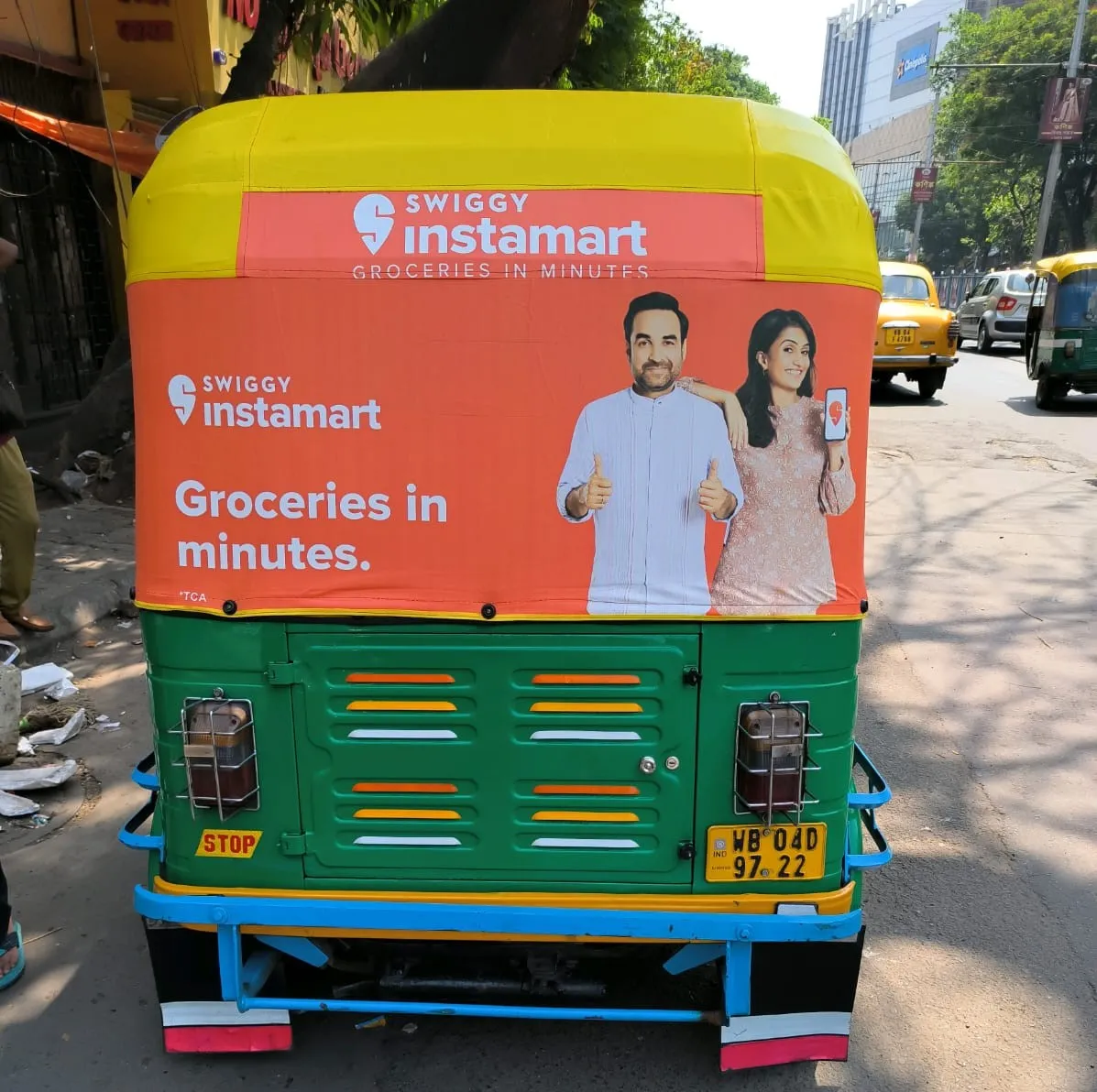
Red and dark blue designs on auto hoods generate 40% higher recall than yellow, orange, or light-coloured designs — because they create maximum contrast against the auto rickshaw's yellow body. This is the single most important design principle in auto hood branding, yet 60% of brands in Bangalore get it wrong by prioritising brand colours over visibility science. This guide breaks down the exact colour psychology, font sizing, QR placement, and material specifications that separate high-performing auto hood designs from invisible ones — based on eye-tracking and recall data from 200+ Bangalore campaigns by The Mediaverse.
The Yellow Auto Problem: Why Most Brand Colours Fail on Auto Hoods
Every auto rickshaw in Bangalore (and most Indian cities) has a yellow body. This creates a unique design constraint: any brand using yellow, orange, gold, light green, or cream in their hood cover design will visually merge with the auto body and become invisible from 5+ metres. The Mediaverse tested 12 colour combinations across 50 autos each and measured recall rates at traffic signals. Results: Dark blue on yellow auto: 78% recall rate. Red on yellow auto: 74% recall rate. Black on yellow auto: 71% recall rate. White on yellow auto: 65% recall rate. Green on yellow auto: 42% recall rate. Orange on yellow auto: 28% recall rate. Yellow brand on yellow auto: 12% recall rate.
The conclusion is clear: if your brand colour is yellow, orange, or any warm tone, you must use a dark background panel behind your logo on the hood cover. Your brand guidelines matter — but visibility matters more. A beautifully designed hood that nobody can see is a waste of budget.
Colour recall rates on Bangalore's yellow autos
| Colour combination | Recall rate | |
|---|---|---|
| Dark blue on yellow auto | 78% | |
| Red on yellow auto | 74% | |
| Black on yellow auto | 71% | |
| White on yellow auto | 65% | |
| Green on yellow auto | 42% | |
| Orange on yellow auto | 28% | |
| Yellow brand on yellow auto | 12% |
Measured at traffic signals across 12 colour combinations, 50 autos each.
The 3-Second Rule: Font Sizing for Moving Autos
A moving auto is visible to a pedestrian or vehicle driver for approximately 3–5 seconds. At traffic signals, this extends to 15–30 seconds. Your hood design must communicate in the shorter window. Font sizing rules from 200+ campaign observations: Primary text (brand name or message): Minimum 2-inch letter height for readability at 3–5 metre distance. Phone number: Minimum 1.5-inch height, placed at bottom of design. Tagline or secondary text: Minimum 1-inch height. If text is not readable from 5 metres away in 3 seconds, remove it. Maximum text on a hood: 5 words plus logo. Anything more becomes unreadable in motion.
QR Code Placement and Sizing for Auto Hoods
QR codes on auto hoods work best at traffic signals where the viewer has 15–30 seconds of stationary time. Placement rules: Position in bottom-right quadrant (eye-tracking shows right-side scanning bias in traffic). Minimum 3-inch square for scanning from 1–2 metre distance. White background border around QR (minimum 0.5 inch) for scanner contrast. Link to a mobile-optimised landing page, not your full website. Note: For QR-focused campaigns, back-panel stickers outperform hoods for QR scanning because the flat sticker surface provides better scan angles than the curved hood surface.
Unique Study: Bangalore Traffic Signal Dwell-Time Analysis
The Mediaverse tracked average dwell times at 15 major Bangalore traffic signals to determine where auto hood branding gets the longest viewing windows. Results: Silk Board Junction: 4.2 minutes average red light, highest viewing time in Bangalore. Sony Signal (Koramangala): 2.8 minutes, highest startup-audience concentration. Marathahalli ORR Bridge: 3.5 minutes, strong IT professional viewership. Hebbal Flyover Signal: 2.1 minutes, morning commute peak. KR Puram Junction: 3.8 minutes, Eastern Bangalore gateway. Jayanagar 4th Block Circle: 1.8 minutes, premium residential audience. This data directly impacts zone selection — campaigns targeting Silk Board and KR Puram junctions get 2x more viewing time per signal cycle compared to flyover zones. Auto branding in Bangalore achieves its highest per-impression engagement at these long-dwell signals.
Material Specifications for Bangalore Climate
Bangalore receives approximately 900mm annual rainfall with concentrated monsoon from June to September. Auto hood covers face direct rain, UV exposure, and diesel soot daily. Material specifications that survive Bangalore conditions: Fabric: 280 GSM polyester with PVC coating, UV-stabilised ink. Vinyl: 3M or equivalent cast vinyl with UV overlaminate. Stitching: Double-lock stitch on all edges with rust-proof eyelets. Colours: UV-resistant pigments rated for 2000+ hours sunlight exposure. Expected life: 3–6 months for fabric covers, 6–12 months for vinyl stickers. Non-UV-treated materials fade within 6–8 weeks during monsoon season.
Design Checklist: 10 Rules for High-Visibility Auto Hood Branding
1. Use dark background on yellow auto (blue, red, black preferred). 2. Maximum 5 words on primary message. 3. Logo minimum 20% of total design area. 4. Font height minimum 2 inches for brand name. 5. QR code minimum 3 inches if included. 6. Phone number minimum 1.5-inch font height. 7. White or light border around QR codes for scanner contrast. 8. No gradient backgrounds (reduces readability in sunlight). 9. Single clear call-to-action (scan, call, or visit). 10. Test design visibility by viewing at 5 metres before printing.
Real Examples: Good vs Bad Auto Hood Designs
Bad Example 1: A restaurant chain used their yellow brand colour on the hood. Result: 12% recall, effectively invisible on yellow autos. Fixed by adding a dark blue background panel behind the logo — recall jumped to 68%. Bad Example 2: A coaching institute put 15 words of text including course names, timings, and address. Result: 0% readability at 3 seconds. Fixed by reducing to 4 words plus phone number — leads increased 3x. Good Example: A food delivery app used a large red logo on a dark blue background, with a 4-inch QR code in bottom-right. Result: 74% recall, 3.2 QR scans per auto per day in Koramangala.
How Hood Design Impacts Campaign ROI
The Mediaverse A/B tested identical campaigns (same zones, same quantity, same duration) with different designs. The well-designed version (following the 10 rules above) generated 2.3x more leads than the poorly designed version. Design is not aesthetic preference — it is a direct ROI multiplier. A Rs.63,000 campaign with good design generates Rs.2.5 lakh in leads. The same campaign with poor design generates Rs.80,000. For complete ROI frameworks, read our auto branding ROI measurement guide and campaign planning framework.
Frequently Asked Questions
What colours work best for auto hood branding?
Dark blue, red, and black backgrounds generate 70–78% recall on yellow auto bodies. Avoid yellow, orange, and light green which merge with the auto body. If your brand colour is warm-toned, use a dark background panel behind your logo.
How many words should be on an auto hood cover?
Maximum 5 words plus your logo. Auto hoods are seen for 3–5 seconds while moving. More than 5 words reduces readability to near zero. Use the remaining space for a phone number or QR code.
What size should a QR code be on an auto hood?
Minimum 3 inches square with a white border for scanner contrast. Place in the bottom-right quadrant of the hood design. For QR-focused campaigns, back-panel stickers provide better scanning angles than curved hoods.
How long do auto hood covers last in Bangalore weather?
UV-treated fabric covers last 3–6 months. Vinyl stickers with UV lamination last 6–12 months. Non-UV materials fade within 6–8 weeks during Bangalore monsoon. Always specify UV-stabilised materials.
Should I use Kannada text on auto hood branding in Bangalore?
For mass-reach zones like Majestic and Jayanagar, bilingual Kannada+English hoods increase local trust and recall by approximately 15–20%. For IT corridor zones like Whitefield and Electronic City, English-only is sufficient.
Does design quality really affect auto branding ROI?
Yes. A/B testing shows well-designed hoods (following colour contrast and simplicity rules) generate 2.3x more leads than poorly designed versions with the same campaign parameters.
Get Expert Design for Your Auto Hood Campaign
The Mediaverse designs every auto hood using the visibility science principles above — optimised for Bangalore traffic patterns, colour contrast, and monsoon durability. Get your free design consultation | Explore auto branding services in Bangalore
Updated Design Specifications for 2026 Formats
Auto hood (Rs.650/auto one-time): Design area approximately 4ft x 3ft. Maximum 5 words on primary message. Logo minimum 20% of total area. High contrast against yellow auto body. Dark blue, black, red, white work best. Avoid yellow brand on yellow auto. Auto sticker 24x18 inches (Rs.270/auto one-time): QR code minimum 3 inches square for scanning at 1-2 metre distance. Phone number minimum 2-inch font height. Best for: QR campaigns, lead generation. Auto sticker 24x6 inches (Rs.170/auto one-time): Limited to phone number or website URL. Too small for QR codes or detailed messaging. Best for: basic brand awareness strip.
What design rules apply to auto branding?
Hood: max 5 words, logo 20%+ area, high contrast against yellow. Sticker 24x18 (Rs.270): QR min 3 inches, phone min 2-inch font. Sticker 24x6 (Rs.170): phone/URL only, too small for QR. 3-second visibility window at traffic signals is your design constraint.
Key Insight: The 24x6 sticker (Rs.170) is too small for QR codes. If your campaign requires QR-based lead tracking, you MUST use the 24x18 sticker (Rs.270) or hood cover (Rs.650). This is the most common format selection mistake.
Quick Answers
What colours work best on auto hoods?
High-contrast against yellow: dark blue, black, red, white. Yellow brand on yellow auto = invisible. Max 5 words primary message. Logo minimum 20% area. QR minimum 3 inches for 1-2m scanning.
Looking for professional Auto Branding services?
The Mediaverse runs end-to-end auto branding campaigns across India with geo-tagged delivery and transparent, all-inclusive pricing.
Explore our Auto Branding solutionsSummarize this guide with AI
Open this article in your favourite AI assistant
Written by

The Mediaverse Team
India's Leading Outdoor Advertising Agency
The Mediaverse is a national-level outdoor advertising and integrated marketing organization that provides complete OOH, ATL, BTL, retail, and transit media solutions across India. With years of experience executing high-performance campaigns for brands in FMCG, Real Estate, E-commerce, EdTech, Automotive, Healthcare, and Retail, The Mediaverse combines creativity, data-driven media planning, and flawless on-ground execution. As a full-stack outdoor advertising provider, The Mediaverse offers Auto Branding, Mobile Van Branding, Newspaper Insertion Advertising, Shop Name Board Branding, In-Store Branding, Hoardings, Transit Media, Kiosks, Mall Media, Activations, and all forms of Below-The-Line marketing. Known for its pan-India network, strategic route planning, premium print quality, and Cheqmate™ GPS-based verification, The Mediaverse ensures 100% transparent and result-oriented campaign delivery. The Mediaverse’s editorial team produces deeply researched, SEO-optimized, and generative-engine-friendly content to help businesses understand the power of outdoor advertising and make informed decisions that maximize brand visibility and ROI across urban, suburban, and rural markets.
Related Articles
Where Branded Autos Actually Stand Still: 35 Percent of the Working Day (2026)
A branded auto spends about a third of its working day parked, and that is when it does its best work. The published dwell averages per stop type, what the 300-auto minimum covers at five Bangalore hubs and three residential pockets, and where the minimum order actually buys dominance.
100-Micron Against 80-Micron: The Auto Branding Material Question to Ask Before You Book (2026)
The material line is the one nobody checks and the only one that decides whether the fleet is still readable in month seven. What our ten city pages publish about 100-micron against 80-micron, the per-city failure windows, and the arithmetic that turns any material quote into one comparable number.
Auto Back Panel Branding in 2026: The Cheapest Auto Campaign You Can Actually Book
The smallest auto order on our card is 500 back panel stickers at Rs.170 each, or Rs.85,000 before GST, which is Rs.1,10,000 below the hood floor. The slab math at 800 autos, the per-square-inch comparison of the two sticker sizes, and what the hood budget buys in panels.