
What is auto branding in Mumbai and why does it work?
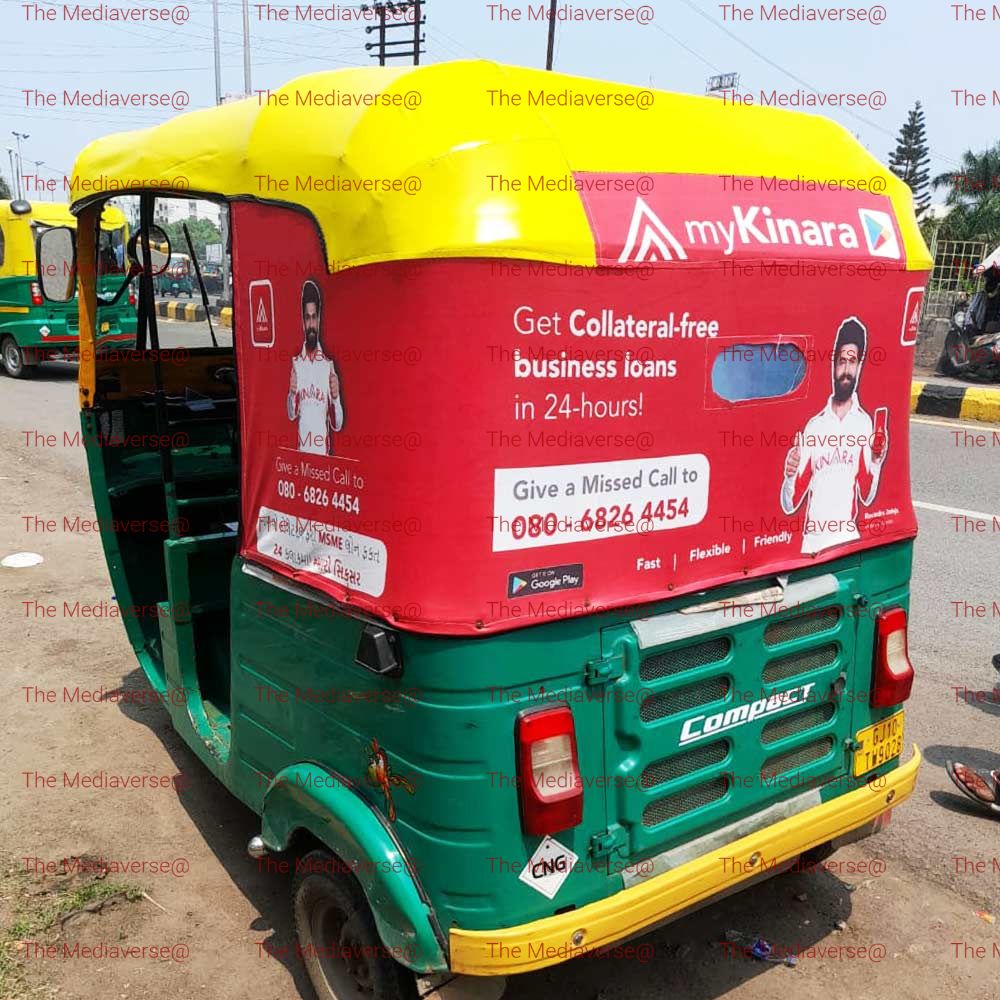
Auto branding in Mumbai puts your brand on auto-rickshaw hoods (rexine wraps from ₹650 per auto, one-time) and rear panels (vinyl stickers from ₹140 per auto, one-time) clustered around suburban railway station exits. The city has 4.5 lakh registered autos, and they carry the last-mile load for roughly 80 lakh daily local train exits, which means a branded auto meets commuters at the precise moment they step off mass transit and look for a ride home. In our campaigns, each branded auto delivers an estimated 20,000–40,000 daily impressions at ₹3–6 CPM.
Auto Branding in Mumbai: Auto Rickshaw Advertising Built Around the Railway-to-Home Last Mile
The Mediaverse converts Mumbai's 4.5 lakh suburban auto fleet into a station-exit advertising grid that reaches 80 lakh daily commuters at their most receptive moment.
Hood ₹650/auto one-time | Back Panel ₹170/auto one-time | MCGM-compliant | Monsoon-rated materials
Auto branding in Mumbai operates on a fundamentally different principle than any other Indian city. Mumbai's 80 lakh daily local train commuters exit at suburban stations. Andheri, Borivali, Thane, Dadar, Ghatkopar. and immediately transition to auto-rickshaws for the last 1–3 km home. This station-exit moment is advertising gold: the commuter has left the underground platform, is back at street level, and is actively scanning for their auto ride. A branded auto at Andheri West station exit is the first visual stimulus that 3 lakh daily commuters encounter when they emerge from the railway system.
The Mediaverse provides auto rickshaw advertising in Mumbai through a station-exit clustering strategy. We deploy branded autos at specific suburban station exits. concentrating 30–80 vehicles per station zone. to create saturated brand presence at the exact point where Mumbai's commuter population transitions from mass transit to personal last-mile transport. This railway-to-home advertising layer is something no hoarding, no Mumbai mobile van branding campaign, and no digital ad can replicate.
How much does auto branding cost in Mumbai?
One-time per auto (print plus install), not monthly. GST 18% extra. Some areas charge an auto-union fee, billed extra.
- • Full Hood Branding (Rexine Wrap): ₹650 per auto (300–499), ₹630 per auto (500+). MOQ 300.
- • Back Panel Sticker 24"x6" (Vinyl): ₹170 per auto (500–799), ₹140 per auto (800+). MOQ 500.
- • Back Panel Sticker 24"x18" (Vinyl): ₹270 per auto (500–799), ₹240 per auto (800+). MOQ 500.
All rates include design, printing, marine-grade installation, and MCGM permits. Pricing per The Mediaverse 2026 national rate card.
Is auto branding worth it in Mumbai?
Yes, and the reason is turnover. A Mumbai auto rarely sits idle: because 80 lakh local train commuters need a ride for the final kilometre or two every day, each auto clocks an estimated 25–35 passenger trips daily, against 15–20 in most other metros. Every one of those trips is a fresh set of eyes on your hood or back panel, at a one-time cost per auto rather than a monthly rental. Few formats in the city put the cost-per-impression maths so firmly in the advertiser's favour.
How many autos should I brand in Mumbai?
For effective station-exit zone coverage, The Mediaverse recommends a minimum of 30 autos per station zone. This creates visible brand presence at the station exit that commuters encounter daily. For multi-station campaigns covering a suburban line (e.g., Andheri to Borivali. 8 stations), 500–800 autos are typical. A practical starting point: 500 back-panel (24"x6") autos across 2 station zones at ₹85,000 (500 × ₹170, one-time). enough to measure commuter response before scaling.
Which Mumbai areas are best for auto branding?
Note: Auto-rickshaws operate only in Mumbai's suburban zones (beyond Bandra/Sion). South Mumbai uses taxis. Station-exit selection depends on target residential catchment.
What results can you expect from auto branding in Mumbai?
Expect frequency, not fireworks. The format earns its keep through daily repetition: the same households in Borivali or Kandivali see your branded autos on the same station-to-home routes week after week. Hospitals near suburban stations use it for walk-in awareness, coaching centres near Andheri and Borivali stations use it for enrolment enquiries, and June–September campaigns get a quiet bonus because monsoon traffic crawls and street-level exposure time stretches. We track response through dedicated phone lines and QR codes rather than promising percentages upfront.
What is Auto Branding in Mumbai?
Auto branding in Mumbai is hyperlocal outdoor advertising on auto-rickshaws. hood wraps (rexine) and back-panel stickers (vinyl). deployed across Mumbai's suburban zones. Mumbai has 4.5 lakh registered auto-rickshaws operating in MCGM zones beyond the Bandra-Sion boundary, serving as the city's primary last-mile transport from suburban railway stations to residential colonies, markets, and offices.
Why Mumbai's railway system makes auto branding uniquely powerful
Mumbai's local train network carries approximately 80 lakh passengers daily across the Western, Central, and Harbour lines. Every one of these commuters exits at a suburban station and transitions to last-mile transport. predominantly auto-rickshaws. This station-exit transition creates the highest-density auto advertising opportunity in India. A branded auto at Andheri West station exit is seen by an estimated 3 lakh daily commuters. Auto rickshaw advertising in Mumbai leverages this railway-exit concentration in a way that no other city's auto network can replicate. For arterial road visibility, businesses can combine this with mobile van branding in Mumbai on WEH and LBS Marg corridors.
Mumbai auto branding formats and reach
Each Mumbai auto generates an estimated 20,000–40,000 daily impressions at ₹3–6 CPM, based on The Mediaverse fleet tracking data. Mumbai's higher auto-passenger turnover (25–35 rides/day) means interior branding delivers noticeably more captive contacts per auto than we see in other metros. For businesses seeking to reach the same households via direct mail, pairing auto branding with newspaper insertion in Mumbai through Times of India and Mumbai Mirror creates a two-layer system: autos at station exits + pamphlets at doorsteps. Physical storefront visibility can be added with shop name boards in Mumbai.
Key facts about Mumbai auto branding at a glance:
- • Fleet size: 4.5 lakh registered autos (suburban zones only)
- • Operating zone: Beyond Bandra/Sion boundary. Western, Central, Harbour line catchments
- • Station-exit opportunity: 80 lakh daily local train commuters transitioning to auto last-mile
- • Daily impressions/auto: 20,000–40,000 (tracked estimate)
- • Passenger turnover: 25–35 rides/day (highest in India)
- • Materials: Marine-grade monsoon-rated vinyl (2,400mm annual rainfall)
Auto Branding in Mumbai. Quick Facts
Why Mumbai's Railway-to-Home Commuter Pattern Creates India's Most Valuable Auto Advertising Grid
No other Indian city funnels its entire commuter population through a single transit system the way Mumbai does. The local train → station exit → auto ride → home sequence creates a predictable, repeatable, high-density advertising touchpoint at every suburban station, and The Mediaverse plans its Mumbai auto deployments specifically around this railway-exit pattern.
Station-Exit Capture
Mumbai's 80 lakh daily local train commuters exit at suburban stations and immediately scan for auto-rickshaws. This is the single highest-attention moment in their commute. they've left the crowded platform, they're at street level, and they're actively looking at vehicles. A branded auto parked at Andheri West exit is the first brand a commuter encounters after 45 minutes underground. In our experience, station-exit auto branding achieves stronger recall compared to random auto placement.
Key stations: Andheri (3L exits/day), Borivali (2.5L), Thane (2L), Ghatkopar (1.8L)
Narrow-Lane Home Delivery
Mumbai's residential geography is built on narrow 10–15 foot lanes in chawl clusters, SRA colonies, and old residential societies. No van, bus, or hoarding reaches inside these lanes. But the auto that carries a commuter from Borivali station to their ground-floor flat in IC Colony travels through these exact lanes. delivering your brand to the most inaccessible residential spaces in India's most valuable advertising market.
Coverage: Borivali IC Colony, Kandivali Samata Nagar, Thane Naupada, Andheri Lokhandwala
Monsoon Captive Window
During Mumbai's June–September monsoon, auto usage surges as commuters avoid walking in heavy rain. Rides climb sharply, and passengers spend longer inside autos due to waterlogged roads. This creates a 4-month captive-audience bonus: more passengers per auto, longer ride times per passenger, and extended stationary periods at stands. Our monsoon-season campaigns consistently show stronger response.
Monsoon advantage: Marine-grade vinyl rated for 2,400mm Mumbai rainfall
5 Railway Station-Exit Zones with Highest Auto Branding Value in Mumbai
Daily exit estimates from Mumbai Suburban Railway (MRVC published data). Auto density from The Mediaverse coordination network.
Andheri Station (W+E)
Mumbai's busiest suburban station. Western and Eastern exits serve Andheri West (Lokhandwala, Versova, 4 Bungalows) and Andheri East (MIDC, Marol, Chakala, Saki Naka). Auto branding at Andheri captures the highest-income suburban commuter segment.
Borivali Station (W)
Terminates the Western line. Serves IC Colony, Borivali National Park area, Kandivali link. Massive residential catchment of family households. strong for healthcare, education, and FMCG auto branding in Mumbai.
Thane Station
Gateway to Thane city and extended MMR. Largest auto fleet of any single Mumbai station. Serves Naupada, Ghodbunder Road feeder, and Thane West residential belt. Real estate auto branding performs exceptionally here.
Ghatkopar Station
Metro-to-railway interchange. Serves Vikhroli, Kanjurmarg, Powai (IIT campus), and LBS Marg commercial belt. Tech-savvy commuter demographic. strong for D2C and fintech auto branding campaigns in Mumbai.
Kandivali Station (W)
Dense residential zone. Samata Nagar, Mahavir Nagar, Thakur Village. Family-dominant demographic. Coaching centres, hospitals, and local retail chains see the highest walk-in conversion from Kandivali station-exit auto campaigns.
3 Residential Zones Where Auto Branding in Mumbai Creates Inescapable Neighbourhood Presence
Borivali West. IC Colony & Surrounds
Approximately 5 lakh residents in narrow colony lanes accessible only by auto. Over 800 autos operate exclusively within this zone, ferrying residents from Borivali station to their homes. A 50-auto branded cluster in IC Colony creates repeated weekly brand encounters per household. Primary audience: Gujarati and Marathi middle-class families. strong for healthcare, education, and retail auto branding.
Andheri West. Lokhandwala to Versova
Approximately 4 lakh residents including Bollywood industry professionals, media workers, and young professionals in PGs. Over 600 autos serve the Lokhandwala-Versova-4 Bungalows triangle. Auto rickshaw advertising in this Mumbai zone reaches the city's highest-spending suburban demographic. effective for premium restaurant launches, fitness brands, and entertainment marketing. Station-exit autos from Andheri West carry this audience directly into the zone.
Thane West. Naupada to Majiwada
Approximately 8 lakh residents in Mumbai's fastest-growing suburban city. Over 1,200 autos serve the Thane station to residential zone last-mile corridor. Auto branding in Thane captures the new-township buyer demographic. families who have recently moved from Mumbai proper to Thane for larger homes. Real estate developers running auto campaigns from Thane station exit observe significantly higher site-visit conversion compared to digital campaigns.
Material Specifications: How Our Auto Branding Survives Mumbai's 2,400mm Monsoon
Mumbai receives approximately 2,400mm annual rainfall. the heaviest of any major Indian metro. Standard auto branding materials fail within 30–45 days during monsoon. The Mediaverse uses upgraded marine-grade specifications:
Hood: Marine-Grade Rexine
120-micron rexine (vs. 80-micron standard) with waterproof adhesive rated for continuous heavy rainfall exposure. Colour-matched to Mumbai's black auto hoods. Hood covers typically run 6 to 12 months through the monsoon season; back panel stickers typically 4 to 6 months.
Back Panel: Marine Vinyl
Waterproof vinyl with sealed-edge lamination preventing water ingress during torrential rain. Anti-fungal coating prevents mould growth common in Mumbai's humidity. UV-resistant inks maintain print clarity through all seasons.
Monsoon Replacement Guarantee
Any monsoon-damaged branding gets free replacement within 48 hours. Monthly field audits increase to bi-weekly during June–September. In our Mumbai campaigns, the large majority of units hold full visibility right through the season, and the rest get swapped under the guarantee.
Mumbai Advertising Market Overview
Mumbai, India's financial capital with a population exceeding 2 crore, presents the highest-density market for mobile van branding in India. The city's unique geography — a narrow peninsula stretching north-south — means that key arterial roads like the Western Express Highway, Eastern Express Highway, and LBS Marg carry enormous daily traffic. Peak advertising seasons include Diwali (October-November), Ganesh Chaturthi (August-September), IPL season, and the Mumbai marathon. Mumbai's commercial hubs in BKC, Lower Parel, and Andheri attract FMCG, fintech, real estate, and entertainment brands. The city's high cost-per-impression ratio in static OOH makes mobile vans a compelling alternative — delivering 3x the reach at 40% lower cost compared to static billboards.
Auto Branding Formats Available in Mumbai
Full Hood Branding (Rexine Wrap)
Complete coverage of the auto-rickshaw's rear hood. 120-micron marine-grade rexine with waterproof adhesive. specifically formulated for Mumbai's 2,400mm monsoon rainfall. Colour-matched to Mumbai's black auto hood standard. Visible from behind, above, and both sides in traffic and at station exits. One-time price (print plus install), MOQ 300, GST 18% extra.
- ✓Marine-grade 120-micron rexine (Mumbai monsoon-rated)
- ✓Visible from 3 angles. rear, top, and sides
- ✓Black auto colour-matched for Mumbai fleet
- ✓Includes design, print, installation, MCGM permits
Back Panel Sticker 24"x6" (Vinyl)
High-visibility marine vinyl sticker on the auto's rear panel in a compact 24"x6" size. Sealed-edge waterproof lamination with anti-fungal coating. built for Mumbai's humidity and rain. The lowest-cost format for mass station-exit zone campaigns. One-time price, MOQ 500, GST 18% extra.
- ✓Marine vinyl with anti-fungal monsoon coating
- ✓Eye-level with trailing traffic and pedestrians
- ✓₹170/auto (500–799), ₹140/auto (800+)
- ✓Lowest-cost format for mass station-exit reach
Back Panel Sticker 24"x18" (Vinyl)
Larger-format marine vinyl sticker on the auto's rear panel in a 24"x18" size that gives creative more room while keeping the low cost-per-impression of vinyl. Sealed-edge waterproof lamination with anti-fungal coating. built for Mumbai's humidity and rain. One-time price, MOQ 500, GST 18% extra.
- ✓Marine vinyl with anti-fungal monsoon coating
- ✓Larger creative area for bolder messaging
- ✓₹270/auto (500–799), ₹240/auto (800+)
- ✓Eye-level with trailing traffic and pedestrians
Auto Branding vs Newspaper Flyers vs Local Billboards in Mumbai
| Parameter | Mumbai Auto Branding | Newspaper Flyers | Local Billboards |
|---|---|---|---|
| CPM | ₹3–6 (lowest) | ₹12–25 | ₹35–70 |
| Station-exit coverage | Yes. autos queue at every exit | No | Rare. limited inventory near stations |
| Narrow-lane reach | Yes. enters chawl/colony lanes | Door delivery (often discarded) | No. main road only |
| Daily impressions/unit | 20,000–40,000 per auto | 1,000–3,000 per batch | 8,000–20,000 per board |
| Monsoon performance | Improves (higher ridership, stronger response) | Degrades (wet paper) | Reduced visibility in rain |
| Captive interior contacts | 25–35 riders/day (Mumbai high turnover) | N/A | N/A |
| Cost efficiency | Highest (lowest CPM) | Moderate | Lowest (highest CPM) |
| Setup speed | 48 hours | 3–5 days | 10–21 days |
Indicative comparison based on typical Mumbai outdoor media rates.
The Mumbai Station-Exit Grid. Our Proprietary Auto Deployment System
Instead of scattering autos randomly, The Mediaverse clusters branded autos at specific railway station exits to capture Mumbai's commuter population at their most attentive transition moment.
Station Selection
Identify target station exits based on your residential catchment (e.g., "Andheri West exit for Lokhandwala-Versova audience"). Map auto stands, exit density, and commuter flow patterns.
Exit-Zone Clustering
Deploy 30–80 branded autos from stands within 500m of the station exit. These autos serve the exact last-mile routes that commuters take from station to home. ensuring brand contact during transit.
Monsoon Optimization
During Jun–Sep, adjust fleet mix: increase interior branding (longer rides) and add replacement capacity for rain-damaged units. Monsoon campaigns run at higher frequency due to increased auto usage.
Performance Tracking
Weekly reports showing station-zone coverage. Monthly field audits (bi-weekly during monsoon). Integration with dedicated phone lines and QR tracking for conversion measurement.
Best Areas for Auto Branding in Mumbai
These are the top-performing localities for mobile van advertising in Mumbai, selected based on footfall density, commercial activity, and campaign ROI data from The Mediaverse.
Dadar
Central Mumbai transit hub with 5 lakh daily footfall from railway station
Andheri
Western suburbs commercial centre with corporate offices and retail
Borivali
High residential density with 3+ lakh daily commuters
Bandra
Affluent demographic, Linking Road shopping district
BKC (Bandra-Kurla Complex)
Premium business district with corporate headquarters
Lower Parel
High-rise offices and entertainment hubs (Phoenix Mills)
Thane
Rapidly growing suburban market with young demographics
Navi Mumbai
IT parks in Airoli, Vashi, and Belapur with tech-savvy audience
Powai
IIT-Bombay area with startup and tech company concentration
Goregaon
Film City proximity — entertainment and media industry
Malad
Mixed commercial-residential with Inorbit Mall traffic
Chembur
Eastern suburb with growing commercial corridors
Colaba
South Mumbai tourist and high-end retail zone
Worli
Sea Link approach road with high-value eyeball traffic
Ghatkopar
Metro hub connecting east-west corridors
Which Businesses Benefit Most from Auto Branding in Mumbai?
Healthcare & Diagnostics
The highest-converting use case for Mumbai auto rickshaw advertising. Hospitals near suburban stations deploy station-exit auto clusters to capture commuters transitioning past the hospital. Walk-in patient acquisition campaigns benefit from the low cost-per-impression efficiency of this format compared to digital search for Mumbai healthcare keywords.
Coaching & Education
Coaching centres near Andheri, Borivali, and Thane stations use station-exit auto branding to reach students and working professionals commuting daily. Enrollment inquiry campaigns make auto branding in Mumbai a cost-effective student acquisition channel for suburban coaching institutes.
Real Estate (Thane & MMR)
Developers use Thane and Kalyan station-exit auto fleets to reach the new-township buyer demographic. families considering moves from central Mumbai to extended MMR. Back-panel autos running the station-to-showroom route create a daily brand touchpoint during the buyer's commute.
D2C Apps & Fintech
Interior seat-back QR codes on Ghatkopar and Andheri fleets target Mumbai's tech-savvy suburban commuter. Mumbai's higher auto-passenger turnover means each QR-equipped auto generates more scans per day than we typically see elsewhere, and monsoon slow-traffic rides extend scan time.
FMCG & Retail
New store openings in Kandivali, Malad, and Goregaon use station-exit auto clusters to build neighbourhood awareness within the store's 2 km catchment. Festival-season campaigns (Diwali, Ganesh Chaturthi) timed with shopping peaks deliver strong seasonal visibility.
Bollywood & Entertainment
Film releases use Andheri West auto fleets (Bollywood industry neighbourhood) and suburban station-exit autos to build mass awareness across Mumbai's cinema-going suburban population. Weekend show timings align with auto usage peaks.
Which Local Train Line Should Your Mumbai Auto Campaign Follow?
Most briefs we receive say "we want autos in Mumbai". The better question is which railway line, because each of the three suburban lines feeds a different kind of household, and the auto stands along them behave differently too.
The Western Line (Bandra to Dahisar) is where retail, coaching, and healthcare budgets usually land. The Andheri to Borivali stretch packs the region's densest mix of salaried families, and stands at Goregaon, Malad, and Kandivali feed compact colony grids where one auto passes the same building gate several times a day. Two operational notes from our campaigns here: stands around Andheri East and the MIDC belt are among the pockets where the auto union charges its own fee (billed extra at actuals, as our rate card notes), and the Metro lines that now parallel SV Road and Link Road have added a second commuter stream at interchange points, so autos positioned near Metro exits at Andheri and Dahisar pick up bonus footfall the railway data alone does not show.
The Central Line (Sion to Kalyan via Thane) is real estate and BFSI territory. Ghatkopar gives you the Metro One interchange crowd heading toward Powai and LBS Marg offices, while Mulund, Dombivli, and Kalyan serve the family belts that developers along Ghodbunder Road want at their site offices. When a Thane-side builder asks us where to start, the honest answer is usually Thane station itself: its auto fleet is the largest at any single station in the region, and the station-to-society routes run straight past most project hoardings, letting the auto act as the moving reminder between them.
The Harbour Line (Vashi to Panvel) is the value pick. Navi Mumbai's planned sectors mean wider roads and quicker auto circulation, and with the new airport ecosystem pulling jobs toward Ulwe and Panvel, brands that book Harbour-line autos now are buying tomorrow's catchment at today's volume rates. FMCG and D2C launches that need broad, budget-efficient coverage tend to do well pairing Vashi and Nerul with one Western-line anchor station.
One rule cuts across all three lines: brief for the monsoon before it arrives. We schedule installations so fresh vinyl cures before the first June downpour, keep replacement stock printed for the season, and advise Marathi-plus-Hindi creative for Central and Harbour catchments, where a bilingual back panel simply reads faster from a wet, crowded footpath.
Mumbai Auto Branding Pricing (2026)
| Format | Lower Tier | Higher Tier | MOQ | Best For |
|---|---|---|---|---|
| Full Hood (Rexine) | ₹650 (300–499) | ₹630 (500+) | 300 | Premium awareness |
| Back Panel 24"x6" (Vinyl) | ₹170 (500–799) | ₹140 (800+) | 500 | Mass station-exit reach |
| Back Panel 24"x18" (Vinyl) | ₹270 (500–799) | ₹240 (800+) | 500 | Larger creative, mass reach |
All prices are one-time per auto (print plus install), not monthly. GST 18% extra. Some areas charge an auto-union fee, billed extra. Rates include design, printing, marine-grade installation, and MCGM permits.
📍 Mumbai Pricing Note: South Mumbai and Bandra routes carry a 10–15% premium due to higher permit costs and traffic density. Suburban routes in Thane and Navi Mumbai are available at standard rates. Monsoon season (June-September) may require weather-resistant LED vans.
Mumbai Auto Branding Campaign Results
Examples of The Mediaverse Mumbai auto branding campaigns across formats and station zones.
Multi-Specialty Hospital. Borivali
300 hood-branded autos clustered at Borivali station exit + IC Colony zone for a health check-up campaign. Autos parked at hospital gate served as stationary reinforcement.
- • Format: Full hood (300 autos × ₹650 = ₹1,95,000, one-time)
- • Zone: Borivali station exit + IC Colony
- • Investment: ₹1,95,000 (plus GST)
- • Goal: Walk-in patient inquiries
CA Coaching Centre. Andheri
500 back-panel autos at Andheri West station exit + Lokhandwala zone targeting working professionals commuting to evening classes.
- • Format: Back panel 24"x6" (500 autos × ₹170 = ₹85,000, one-time)
- • Zone: Andheri W station + Lokhandwala-Versova
- • Investment: ₹85,000 (plus GST)
- • Goal: Coaching enrollment inquiries
Fintech App. Ghatkopar/Thane
800 back-panel branded autos with QR codes across Ghatkopar and Thane station-exit fleets. Monsoon campaign leveraging slow-traffic dwell time for QR scanning.
- • Format: Back panel 24"x6" + QR (800 autos × ₹140 = ₹1,12,000, one-time)
- • Zone: Ghatkopar + Thane station-exit fleets
- • Investment: ₹1,12,000 (plus GST)
- • Goal: App installs via in-auto QR scans
From The Mediaverse Team
Mumbai Auto Branding
“Mumbai auto branding operates on a fundamentally different economics than any other city. The reason: the local train system. No other Indian metro funnels 80 lakh daily commuters through a single transit network that exits directly into an auto-rickshaw ecosystem. This creates what we call the 'railway-to-home last-mile grid'. and it's the most predictable, high-density auto advertising opportunity in India.
In our experience, station-exit clustering outperforms random auto placement on recall. The mechanism is straightforward: a commuter emerging from Andheri station after 45 minutes underground is in a heightened-attention state. scanning for their auto, processing their surroundings, and mentally transitioning from work-mode to home-mode. A branded auto at that exit captures this attention window.
For businesses entering Mumbai auto rickshaw advertising, our recommended starting point is 500 back-panel (24"x6") autos across 2 station zones: approximately ₹85,000 one-time (500 × ₹170). Choose stations based on your residential catchment (e.g., Borivali for West Mumbai families, Ghatkopar for East Mumbai tech workers). This provides enough station-zone data to measure commuter response before scaling to a full suburban-line campaign.”
Why Choose The Mediaverse for Auto Branding in Mumbai
Station-Exit Grid System
Our Mumbai deployments are built around railway station-exit zones, not scattered at random. We cluster 30–80 autos per station to capture commuters at the mass-transit-to-last-mile transition, the highest-attention moment in the Mumbai commuter journey.
Marine-Grade Monsoon Materials
120-micron rexine, anti-fungal vinyl coating, sealed-edge waterproofing. all rated for Mumbai's 2,400mm annual rainfall. Free monsoon replacement guarantee with bi-weekly field audits June–September.
Station-Zone Analytics
Weekly reports showing station-exit coverage, estimated commuter contacts per zone, and conversion tracking via dedicated phone lines and QR scans. The most detailed station-level auto branding analytics available in Mumbai.
Auto Branding in Mumbai: Frequently Asked Questions
Q: How much does auto branding cost in Mumbai?
Think in one-time, per-auto rates rather than monthly rent. The full hood wrap in marine-grade rexine works out to ₹650 per auto when you book 300–499 vehicles and ₹630 from 500 autos onward, with a 300-auto minimum. Vinyl back panels come in two sizes: the 24"x6" panel at ₹170 per auto for 500–799 units (₹140 once you cross 800) and the 24"x18" panel at ₹270 for 500–799 (₹240 at 800 plus), both with a 500-auto minimum. Those figures already cover design, printing, installation, and MCGM permits. Add 18% GST, and budget a small extra at certain Mumbai stands where the auto union levies its own fee, which we bill at actuals.
Q: How many autos are available for branding in Mumbai?
The fleet is enormous but geographically specific. Roughly 4.5 lakh autos are registered in Mumbai, and every one of them plies the suburbs beyond the Bandra-Sion line, feeding the Western, Central, and Harbour railway catchments. Because we work directly with station-exit auto stands rather than through brokers, a first batch of 100-plus branded autos can be on the road within about 48 hours of artwork approval, and a multi-station push of 500 or more autos usually wraps up inside a week.
Q: Which Mumbai station zones are best for auto branding?
Match the station to the audience you want. Andheri, with around 3 lakh daily exits on both flanks, gives you the highest-earning suburban commuters heading into Lokhandwala, Versova, and MIDC. Borivali, at roughly 2.5 lakh exits, is family-household territory and our default recommendation for healthcare and education brands. Thane runs the biggest single-station auto fleet in the region, upwards of 3,000 vehicles, and is where real estate campaigns tend to concentrate. Ghatkopar adds a Metro interchange and a tech-leaning crowd, while Kandivali West serves dense residential pockets like Samata Nagar and Thakur Village. We map your residential catchment first, then pick the exits.
Q: Do auto campaigns work during Mumbai's monsoon?
The rains help rather than hurt. Between June and September, commuters who would normally walk the last kilometre hail an auto instead, so ridership climbs and each ride stretches longer on waterlogged roads, which means extra time in front of your interior QR code. On the materials side we print on marine-grade stock rated for Mumbai's 2,400mm annual rainfall, run field audits every two weeks instead of monthly through the season, and replace any rain-damaged unit free within 48 hours.
Q: What results can I expect from auto branding in Mumbai?
What the format reliably delivers is repetition at a low cost per contact. Your autos work the same station-to-home routes daily, so the same households encounter the brand again and again, and Mumbai's 25–35 passenger trips per auto per day multiply the interior contacts. Hospitals typically run it for walk-in awareness, coaching institutes for admission-season enquiries, and apps for QR-driven installs. We would rather set up dedicated phone numbers and QR tracking and let your own dashboard show the response than quote a made-up percentage.
Q: Why don't autos operate in South Mumbai?
It is a regulatory boundary, not a commercial one. Auto-rickshaws are permitted only beyond the Bandra-Sion line, so Fort, Colaba, Churchgate, and Marine Drive run on kaali-peeli taxis instead. In practice this suits most advertisers: the suburban belt the autos do cover holds the bulk of Mumbai's households and its biggest consumer volume. When a brand needs town-side presence too, we layer in van branding or taxi options alongside the suburban auto grid.
Q: How does Mumbai auto branding compare to mobile van branding?
They solve different halves of the same city. A van is a moving billboard for arterial corridors, WEH and LBS Marg, priced as daily hire of ₹3,000–₹7,500 per van by format plus a one-time fabrication charge of ₹8,000–₹20,000. An auto is a one-time buy (₹140–₹650 per vehicle depending on format and volume) that slips into station-exit queues and 10-foot residential lanes no van can enter. The campaigns that perform best in our experience run both: vans for the highway sightline, autos for last-mile saturation around the stations.
Q: Why choose The Mediaverse for auto branding in Mumbai?
Because we plan the campaign the way Mumbai actually moves. Deployments are built around specific railway station exits with commuter-flow mapping rather than random citywide scatter. Materials are specced for this coastline: 120-micron rexine hoods, anti-fungal vinyl, and a free monsoon replacement guarantee backed by bi-weekly rain-season audits. And reporting goes down to the station zone, with estimated commuter contacts per exit and conversion tracking through dedicated lines and QR codes.
Build a Complete Mumbai Advertising Strategy
Auto branding in Mumbai delivers station-exit and narrow-lane coverage. For arterial highway visibility, pair with van branding. For doorstep reach, add newspaper insertion. For physical storefront presence, install shop boards.
Mobile Van Branding in Mumbai
For high-impact visibility on WEH, LBS Marg, and Eastern Freeway. arterial corridors where auto branding doesn't reach. Vans handle highways, autos handle station exits.
Explore Mumbai Van Branding →Shop Name Boards in Mumbai
Establish your physical storefront presence with ACP and LED signage across Andheri, Borivali, Thane, and all Mumbai suburban commercial zones.
Explore Mumbai Shop Boards →Newspaper Insertion in Mumbai
Reach the same suburban households at the doorstep via pamphlet insertion in Times of India, Mumbai Mirror, and Navbharat Times.
Explore Mumbai Newspaper Ads →Auto Branding in Other Cities
The Mediaverse offers auto branding across India. Explore our services in these cities:
Also Available in Nearby Cities
Start Your Mumbai Auto Branding Campaign. Own Every Station-Exit Zone
Ganesh Chaturthi (Sep) and Diwali (Oct-Nov) are peak demand periods. For 100+ auto station-zone campaigns, booking 7 days in advance is recommended.
Get your free Mumbai auto branding quote or speak with our suburban advertising team.
Explore More Advertising Services
Auto Branding services across India
All Services in MumbaiAuto, van, print and signage advertising in Mumbai
Mobile Van Branding in MumbaiView mobile van branding options in Mumbai
Newspaper Insertion in MumbaiView newspaper insertion options in Mumbai
Shop Name Board in MumbaiView shop name board options in Mumbai
No Parking Board Advertising in MumbaiView no parking board advertising options in Mumbai
Auto Branding in Other Cities
Auto Branding in Other Cities
The Mediaverse offers auto branding across India's top markets.
More Advertising Services in Mumbai
Explore all outdoor advertising options available in Mumbai, Maharashtra.