

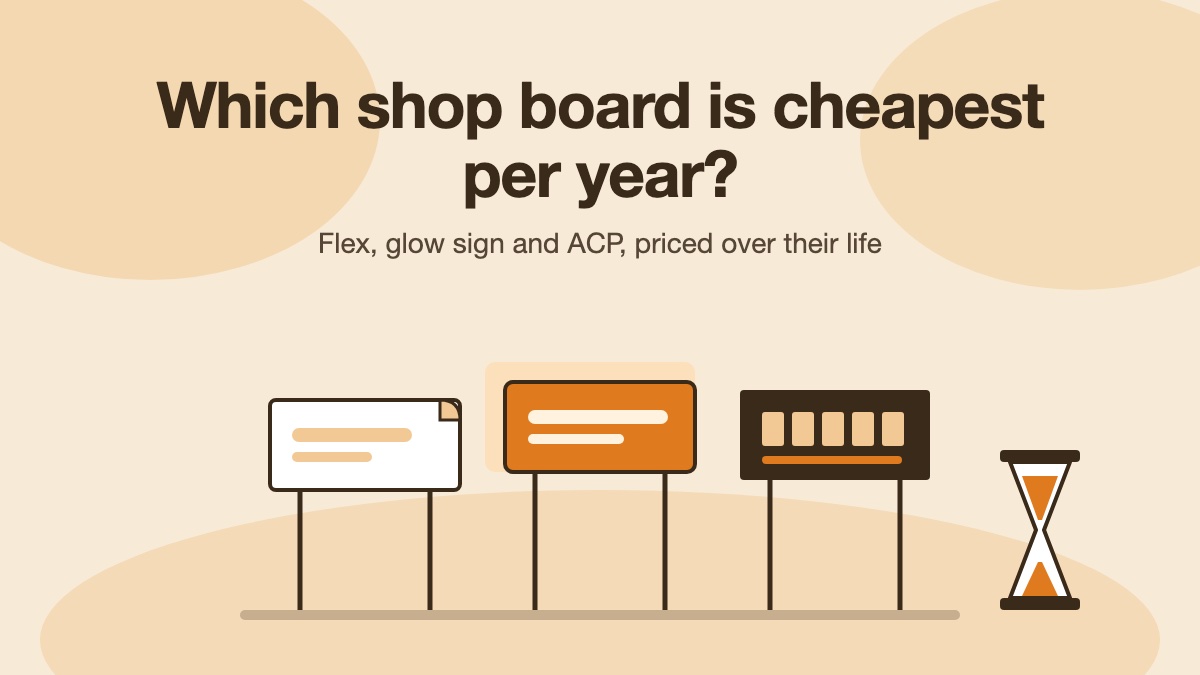
Which shop name board is cheapest once you divide its price by how long it lasts? On the cards and lifespans our ten city shop name board pages publish, the glow sign wins in all ten cities. At the midpoint of each page's own figures a GSB glow sign costs Rs.50 a sq ft per year in Lucknow and Rs.100 in Mumbai, while a flex board costs Rs.69 and Rs.108, because flex is priced at a third of a glow sign but lasts 8 to 18 months against 3 to 5 years. Unlike our insert and auto rates, the board card is not national: ACP runs from Rs.350 a sq ft in Lucknow to Rs.1,050 in Mumbai, so the per-year cost changes city by city. Every per-year figure below is our arithmetic on figures read from the ten live pages on 4 October 2026.
What does each city's shop name board card publish?
Price per sq ft and published life by board type, from each city page (read 4 October 2026)
| City | Flex or non-lit: price, life | GSB glow sign: price, life | ACP panel: price, life | |
|---|---|---|---|---|
| Ahmedabad | Rs.55 to Rs.95, 8 to 12 months | Rs.180 to Rs.320, 3 to 5 years | Rs.450 to Rs.700, 5+ years | |
| Bangalore | Rs.85 to Rs.150, 12 to 18 months | Rs.260 to Rs.450, 3 to 5 years | Rs.690 to Rs.950, 5+ years | |
| Chennai | Rs.70 to Rs.120, 10 to 14 months | Rs.220 to Rs.380, 3 to 5 years | Rs.550 to Rs.800, 5+ years | |
| Delhi | Rs.80 to Rs.140, 12 to 18 months | Rs.250 to Rs.420, 3 to 5 years | Rs.650 to Rs.900, 5+ years | |
| Hyderabad | Rs.75 to Rs.130, 8 to 12 months | Rs.230 to Rs.400, 3 to 5 years | Rs.600 to Rs.850, 5+ years | |
| Jaipur | Rs.50 to Rs.85, 8 to 12 months | Rs.160 to Rs.300, 3 to 5 years | Rs.400 to Rs.650, 5+ years | |
| Kolkata | Rs.60 to Rs.100, 8 to 12 months | Rs.180 to Rs.320, 3 to 5 years | Rs.450 to Rs.700, 5+ years | |
| Lucknow | Rs.40 to Rs.75, 8 to 12 months | Rs.140 to Rs.260, 3 to 5 years | Rs.350 to Rs.550, 5+ years | |
| Mumbai | Rs.100 to Rs.170, 12 to 18 months | Rs.300 to Rs.500, 3 to 5 years | Rs.750 to Rs.1050, 5+ years | |
| Pune | Rs.65 to Rs.110, 10 to 14 months | Rs.200 to Rs.350, 3 to 5 years | Rs.500 to Rs.750, 5+ years |
Per sq ft rates and durability as published in each live city shop name board pricing table on 4 October 2026. Each page states its rates include design, fabrication, transport, installation and the local permit work, with a 2-year warranty on ACP and GSB; GST is not stated in these tables. Jaipur's ACP row is its Pink City ACP line. ACP with 3D letters and other premium rows are left out; some carry 7 plus years.
The method: price divided by life, per sq ft. A flex board in Chennai at Rs.70 to Rs.120 that lasts 10 to 14 months works out to Rs.60 to Rs.144 a sq ft per year depending on which ends you pair; at the midpoints, Rs.95 over 12 months, it is Rs.95. A glow sign at Rs.220 to Rs.380 over 3 to 5 years is Rs.75 at the midpoints, Rs.300 over 4 years. ACP is published as 5 plus years with no upper figure, so we divide by 5, which makes its per-year number a ceiling rather than an estimate.
Which board type is cheapest per year of life in each city?
Our arithmetic: cost per sq ft per year at the midpoint of each page's price and life
| City | Flex per year | GSB per year | ACP per year, at 5 years | GSB cheaper than flex by | |
|---|---|---|---|---|---|
| Hyderabad | Rs.123 | Rs.79 | up to Rs.145 | 36 percent | |
| Kolkata | Rs.96 | Rs.62 | up to Rs.115 | 35 percent | |
| Ahmedabad | Rs.90 | Rs.62 | up to Rs.115 | 31 percent | |
| Jaipur | Rs.81 | Rs.58 | up to Rs.105 | 29 percent | |
| Lucknow | Rs.69 | Rs.50 | up to Rs.90 | 28 percent | |
| Chennai | Rs.95 | Rs.75 | up to Rs.135 | 21 percent | |
| Pune | Rs.88 | Rs.69 | up to Rs.125 | 21 percent | |
| Mumbai | Rs.108 | Rs.100 | up to Rs.180 | 7 percent | |
| Bangalore | Rs.94 | Rs.89 | up to Rs.164 | 6 percent | |
| Delhi | Rs.88 | Rs.84 | up to Rs.155 | 5 percent |
Midpoint price divided by midpoint life: flex over the middle of its published months, GSB over 4 years, ACP over 5 years, which is the published floor, so the ACP column is a ceiling. Sorted by the GSB advantage. Electricity for a lit board, LED replacement and repainting are not on any card and are not included.
Hyderabad tops the gap at 36 percent because its flex is priced in the middle of the ten cards, up to Rs.130 a sq ft, but given the shortest life, 8 to 12 months, the same life as the cheaper Ahmedabad, Jaipur, Kolkata and Lucknow cards. Kolkata, Ahmedabad, Jaipur and Lucknow follow at 28 to 35 percent. Delhi, Bangalore and Mumbai sit at the bottom, 5 to 7 percent, because their pages give flex 12 to 18 months, the longest life on any card. Chennai and Pune, with 10 to 14 months, fall between. Our Chennai street guide found the glow sign cheapest per year on that city's card; the same holds on all ten.
On a typical 4 by 2 ft board, the 8 sq ft size most pages price, the Chennai midpoints come to about Rs.760 a year for flex and Rs.600 for a glow sign, on our arithmetic. The absolute saving is small on a small board and grows with frontage: on Mumbai's typical 3 by 6 ft, 18 sq ft, it is about Rs.1,944 a year for flex against Rs.1,800 for GSB.
Why does a flex board last longer in some cities than others?
The life column is where the cards differ most, and each page explains its own figure. Delhi's page says flex lasts 12 to 18 months only with an anti-dust coating, against roughly 6 months without it; its 12 to 18 month figure is for the coated board. Mumbai's page gives 12 to 18 months for an anti-fungal coated flex, set against 2,400 mm of monsoon rain and coastal humidity, and calls its ACP marine-grade and its glow signs IP67 sealed. Bangalore's page also publishes 12 to 18 months but rates flex only fair in sustained rain and says it needs full replacement every 12 to 18 months.
At the short end, Hyderabad's page rates flex poor in 45 degree heat and says it warps by May, which is why it gives 8 to 12 months. Ahmedabad pairs 8 to 12 months with heat-rated housings and ACP rated for 90 degree surface temperatures, and Jaipur and Lucknow use the same 8 to 12 months with dust-sealed or monsoon-rated glow signs. Kolkata's page builds its whole card around 85 to 95 percent humidity, with anti-fungal coatings on ACP. Chennai and Pune sit in the middle at 10 to 14 months, Chennai citing salt air and UV-resistant inks, Pune the monsoon.
Two practical points follow. First, the published life assumes the coating the page describes, so a cheaper uncoated flex from elsewhere will not last as long and its per-year cost will be higher than our table shows. Second, the cities where flex comes closest to a glow sign per year, Delhi, Bangalore and Mumbai, are exactly the ones where the page's longer flex life depends on that coating. Ask for it by name on the quote.
Does ACP ever beat a glow sign on cost per year?
Not on any published life. Dividing each city's midpoint ACP price by its midpoint GSB cost per year gives the life ACP would need to match it: about 9 years in every one of the ten cities, from 9.0 in Lucknow, Chennai and Mumbai to 9.25 in Delhi. That uniformity is itself a finding, because it means every city card prices ACP at roughly 2.3 times a glow sign. No page publishes an ACP life beyond 5 plus years for the plain panel, or 7 plus for 3D steel or brass letters.
So ACP is not the economy choice and the pages do not claim it is. It is bought for what the per-year sum leaves out: heat, salt air and monsoon ratings the pages describe city by city, heritage compliance in Jaipur's Walled City and Ahmedabad's pol lanes, 3D lettering, and a fascia that does not need replacing on a lease of 5 years or more. If those matter, the per-year premium is the price of them. If they do not, a glow sign is the cheaper permanent board everywhere we publish.
When is a flex board still the right choice?
When the shop will not be there long enough for life to matter. A flex board is replaced, not repaired, so its per-year cost only counts if you need a board for longer than one flex life. Chennai's page notes 8 to 12 month average tenancy for coaching centres in Tambaram, Chrompet and Anna Nagar; for a tenancy that short, the lowest upfront price wins and flex at Rs.70 to Rs.120 a sq ft is the honest answer. The same goes for pop-ups, seasonal stalls and testing a location. Flex is also installed in 3 days against about 5 for a glow sign, which matters for an opening date.
Our arithmetic: when each board type is the cheaper choice
| Expected time at the address | Cheapest choice on the published cards | Why | |
|---|---|---|---|
| Under one flex life (8 to 18 months by city) | Flex or non-lit | Lowest upfront price; it never has to be replaced | |
| About 1.5 to 5 years | GSB glow sign | Lowest cost per year in all ten cities, and lit after dark | |
| 5 years or more, or heritage, coastal or heat-rated frontage | ACP, if its ratings matter to you | Higher per year on published life, bought for durability ratings, compliance and lettering |
Ranges from the ten city pages. Electricity and LED replacement for glow signs are not on the card and narrow the GSB advantage; how much depends on hours lit and local tariffs, which no page publishes.
What the per-year sum leaves out cuts mostly one way. A glow sign draws electricity every evening it is lit, and Bangalore's page lists LED replacement every 3 to 5 years as its maintenance; neither cost is on any card, and both narrow the glow sign's lead. How much depends on the hours you trade after dark and your local tariff, which no page publishes, so we have not guessed it. In the three cities where GSB leads by only 5 to 7 percent, Delhi, Bangalore and Mumbai, a modest power bill could close the gap entirely, and there the honest comparison is closer to a tie. In Hyderabad, Kolkata, Ahmedabad, Jaipur and Lucknow, where the lead is 28 to 36 percent, it is harder to erase. The same pages note that a lit board keeps working after dark and through Delhi's fog season, which an unlit flex does not, and that difference is not in the arithmetic either.
Which city pages publish figures that do not reconcile?
Rs.180 in every title: all ten pages carry Rs.180 a sq ft in their page title. On the cards themselves, Rs.180 appears only in Ahmedabad and Kolkata, as the bottom of the GSB range. In Mumbai the cheapest glow sign is Rs.300 and in Bangalore Rs.260; in Lucknow it is Rs.140. A buyer searching on the title figure should check the city card.
Hyderabad and Bangalore warranties: both pages list a 1-year warranty on non-lit boards. Bangalore gives flex 12 to 18 months, so that holds. Hyderabad gives flex 8 to 12 months, so at the low end the warranty outlasts the board's own published life. Ask which applies before relying on it.
Delhi's two ACP promises: the Delhi page lists a 5 plus year no-fade warranty against its ACP board, while its pricing table and handover step state a 2-year structural warranty on ACP and GSB. They may cover different things, colour and structure, but the page does not say so.
Jaipur's comparison table prices both its Pink City ACP and standard ACP at Rs.400 to Rs.850, while its pricing table splits plain Pink City ACP at Rs.400 to Rs.650 from ACP with 3D letters at Rs.550 to Rs.850. We used the pricing table. Kolkata lists a Puja overlay at Rs.120 to Rs.250 lasting 2 to 3 Puja seasons, which is a seasonal add-on rather than a shop board and is left out of the comparison.
What should you check before ordering a board?
Five questions settle most of this: how long you expect to trade at the address; whether you trade after dark, which decides between GSB and an unlit board; the sq ft of your frontage, priced on your city's card rather than a headline; whether the area carries heritage, coastal or heat conditions that the ACP ratings answer; and what the warranty covers in writing, given the warranty lines above. Then compare quotes per sq ft per year, not per board.
Is a glow sign board cheaper than a flex board in the long run?
On our ten city pages, yes. At the midpoint of each page's price and published life, a GSB glow sign costs less per sq ft per year than a flex board in every city, by 5 percent in Delhi up to 36 percent in Hyderabad, on our arithmetic. Flex costs about a third as much upfront but lasts 8 to 18 months against 3 to 5 years for a glow sign. Electricity is not included.
How long does a flex shop board last compared with ACP and GSB?
Our city pages give flex or non-lit boards 8 to 12 months in Ahmedabad, Hyderabad, Jaipur, Kolkata and Lucknow, 10 to 14 months in Chennai and Pune, and 12 to 18 months in Bangalore, Delhi and Mumbai. GSB glow signs are published at 3 to 5 years and plain ACP at 5 plus years in all ten cities, with 7 plus years for some 3D steel and brass letter boards.
Why is ACP more expensive per year if it lasts longer?
Because the cards price ACP at roughly 2.3 times a glow sign while publishing only 5 plus years of life against 3 to 5. To match a midpoint glow sign per year, ACP would need about 9 years in every city, on our arithmetic, and no page publishes that. ACP is chosen for heat, salt-air and monsoon ratings, heritage compliance and 3D lettering, not for cost per year.
Are shop name board rates the same in every city?
No. Unlike our auto and newspaper insert cards, the board card changes by city. A GSB glow sign is Rs.140 to Rs.260 a sq ft in Lucknow, Rs.230 to Rs.400 in Hyderabad and Rs.300 to Rs.500 in Mumbai; plain ACP runs from Rs.350 in Lucknow to Rs.1,050 in Mumbai. Each page's rates include design, fabrication, transport, installation and local permit work.
When should I choose a flex board for my shop?
When you expect to trade at the address for less than one flex life, 8 to 18 months depending on the city, or need the board up in 3 days. Short tenancies, pop-ups and location tests fit flex. Chennai's page notes 8 to 12 month average tenancy for some coaching centres, where the lowest upfront price is the right call. For anything longer, a glow sign costs less per year.
Tags
Quick Answers
Which shop name board is cheapest per year in Indian cities?
The GSB glow sign, in all ten cities we publish. At the midpoint of each city page's price and life, it costs Rs.50 a sq ft per year in Lucknow up to Rs.100 in Mumbai, against Rs.69 to Rs.123 for flex, on our arithmetic. Flex is cheaper upfront but lasts 8 to 18 months; a glow sign lasts 3 to 5 years. ACP at its 5-year floor costs the most per year.
How much does a shop name board cost per sq ft in 2026?
It depends on the city and the board. On our ten city pages, flex runs from Rs.40 a sq ft in Lucknow to Rs.170 in Mumbai, a GSB glow sign from Rs.140 to Rs.500, and plain ACP from Rs.350 to Rs.1,050. Rates include design, fabrication, transport, installation and local permit work, with a 2-year warranty on ACP and GSB. Mumbai's card is the highest and Lucknow's the lowest.
How long would an ACP board need to last to beat a glow sign on cost?
About 9 years, in every one of the ten cities, on our arithmetic. Each city card prices plain ACP at roughly 2.3 times a glow sign, and a glow sign lasts 3 to 5 years. No city page publishes more than 5 plus years for plain ACP, or 7 plus for 3D steel or brass letters, so on published figures ACP is never the cheaper board per year.
Looking for professional Shop Name Board services?
The Mediaverse runs end-to-end shop name board campaigns across India with geo-tagged delivery and transparent, all-inclusive pricing.
Explore our Shop Name Board solutionsSummarize this guide with AI
Open this article in your favourite AI assistant
Related Guides
Written by

The Mediaverse Team
India's Leading Outdoor Advertising Agency
The Mediaverse is a national-level outdoor advertising and integrated marketing organization that provides complete OOH, ATL, BTL, retail, and transit media solutions across India. With years of experience executing high-performance campaigns for brands in FMCG, Real Estate, E-commerce, EdTech, Automotive, Healthcare, and Retail, The Mediaverse combines creativity, data-driven media planning, and flawless on-ground execution. As a full-stack outdoor advertising provider, The Mediaverse offers Auto Branding, Mobile Van Branding, Newspaper Insertion Advertising, Shop Name Board Branding, In-Store Branding, Hoardings, Transit Media, Kiosks, Mall Media, Activations, and all forms of Below-The-Line marketing. Known for its pan-India network, strategic route planning, premium print quality, and Cheqmate™ GPS-based verification, The Mediaverse ensures 100% transparent and result-oriented campaign delivery. The Mediaverse’s editorial team produces deeply researched, SEO-optimized, and generative-engine-friendly content to help businesses understand the power of outdoor advertising and make informed decisions that maximize brand visibility and ROI across urban, suburban, and rural markets.
Related Articles
Shop Name Boards Street by Street in Lucknow (2026): What Hazratganj, Aminabad and Gomti Nagar Each Need
Five Lucknow corridors, one published card. What Hazratganj, Aminabad and Chowk, Gomti Nagar, Aliganj and the Vidhan Sabha belt each need, why fog favours the glow sign, and why our own jobs came in under the card.
Shop Name Boards Street by Street in Chennai (2026): What T. Nagar, Anna Nagar and the OMR Each Need
Five Chennai belts, about 130 new storefronts a month, one published card. What T. Nagar, Anna Nagar, the OMR, Velachery and Mylapore each need, why a glow sign beats flex per year, and why two of our own jobs came in under the card.
Shop Name Boards Street by Street in Hyderabad (2026): What Ameerpet, Gachibowli and Kukatpally Each Need
Ameerpet and SR Nagar open about 40 new shops a month, Gachibowli and HITEC City about 35. The 2026 Hyderabad board card belt by belt, why two of our own three published jobs price below their own per square foot floor, and what GHMC does and does not publish.