

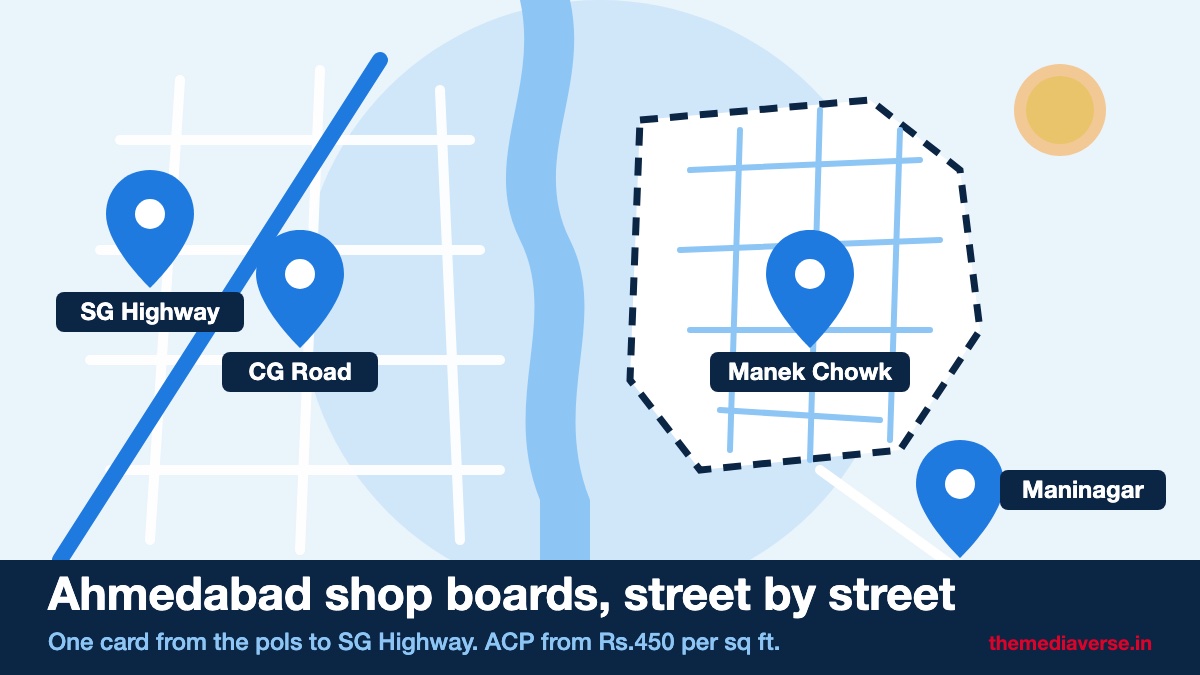
The Manek Chowk job on our Ahmedabad shop name board page is told in two sentences. A pol-lane cloth merchant put up a new fascia, the Ahmedabad Municipal Corporation removed it and issued a Rs.5,000 fine, and the replacement, a 3 by 2 ft heritage-compliant ACP board in ochre and cream, cost Rs.4,200 and went up in 5 days with the AMC audit inside the window. On the page's arithmetic that shopkeeper paid Rs.9,200 for a Rs.4,200 board. The lesson the page draws is the one it is built around: Ahmedabad is two cities for signage, a Walled City where AMC caps size, colour and material lane by lane, and a newer city along CG Road, SG Highway and Satellite where the only rules are Gujarati plus English lettering and a summer the page puts at 48 degrees. What the page does not say, and what this guide works out street by street, is that the card is one card for both cities, ACP from Rs.450 per sq ft and a heritage line from Rs.350, read on 29 October 2026, and that the Walled City's caps cost a shop area rather than rate.
What does the Ahmedabad shop name board card cost per square foot?
Our shop name board page for Ahmedabad prices five lines per square foot and puts a typical board figure beside each, four of them at 4 by 2 ft and the heritage line at the 3 by 2 ft the pols allow, so the first column of arithmetic below is the page's own. Every quote covers Gujarati lettering, heat-rated fabrication, transport, fitting and AMC permits with heritage clearance included, and ACP and GSB carry a 2-year heat-rated warranty that the page says covers heat damage, UV fade, structural integrity and monsoon exposure with repairs attended within 48 hours. Two things are missing. The page does not mention GST on any line, where our auto, van and insertion pages all say it is extra. And the Navratri overlay, which the page returns to in six places, is "priced separately" in the pricing footnote and carries no figure anywhere, so the one seasonal product the page sells hardest is the one it does not price.
Heat-rated ACP, 4 mm aluminium composite, PVDF coating rated to 90 degrees surface temperature, overlay clip points built in
The page's typical 4 by 2 ft board: Rs.3,600 to Rs.5,600. Its workhorse for CG Road and SG Highway frontages and any permanent board outside the Walled City; 200 plus colours on the page's count.
Heritage-compliant pol-lane board, AMC-approved materials, ochre, terracotta, cream and muted gold palette, traditional Gujarati letterforms
The page's typical 3 by 2 ft board: Rs.2,100 to Rs.3,600. The line for Manek Chowk, Dhal ni Pol, Khadia and the other pols; the comparison table rates its heat resistance "good" against "excellent" for plain ACP.
ACP with 3D letters, Gujarati or English, stainless steel or gold finish, LED backlight available
4 by 2 ft: Rs.4,800 to Rs.7,200. The showroom line for CG Road, SG Highway restaurant chains and Satellite boutiques, and the jeweller line on Relief Road and in the Manek Chowk gold bazaar. The LED backlight is not priced.
GSB glow sign, IP65 housing, LED drivers rated to 50 degrees ambient, heat-tolerant acrylic
4 by 2 ft: Rs.1,440 to Rs.2,560. Pharmacies, after-hours clinics and the CG Road, Law Garden and SG Highway eateries the page says trade after 8 PM. It is the Rs.180 in the page's title.
Non-lit flex or vinyl, UV-resistant inks
4 by 2 ft: Rs.440 to Rs.760. The page's line for short leases, seasonal stalls and shops testing a location, and the quick temporary boards it mentions for Law Garden Navratri stalls.
The Ahmedabad shop name board card as published on the live city page, read on 29 October 2026, per square foot, with the page's own typical board figure beside each line. Inclusions as stated: Gujarati lettering, heat-rated fabrication, transport, fitting, AMC permits and heritage clearance; 2-year heat-rated warranty on ACP and GSB. GST is not mentioned on the page. The Navratri overlay is listed as priced separately with no figure. Life figures are the page's.
Two figures need a second reading. The page's title promises a board from Rs.180 per sq ft, and that is the glow sign floor, not a fascia: the cheapest permanent fascia on the card is the heritage board at Rs.350 and the cheapest ACP is Rs.450, which is what the hero chip actually says. And the FAQ states that the heat-rated build costs 15 percent more and lasts 5 plus years, without saying more than what. Read against the ACP line, a standard build would be Rs.391 to Rs.609 per sq ft, our arithmetic, but the page sells no such line, so the 15 percent is an argument for the card, not a discount off it.
Why does the Walled City cost a shop area rather than rate?
The two Ahmedabads on the page differ by Rs.100 per sq ft in the shop's favour and by half the board against it. The heritage line is cheaper than plain ACP at both ends of its band, Rs.350 against Rs.450 and Rs.600 against Rs.700. What AMC caps, on the page's description, is the board: typically 3 by 2 ft where the lane narrows, with the buying tip adding that one lane permits 4 by 2 ft and the next caps at 3 by 2, and that the colour and material lists shift with the zoning. So the largest board the card prices for a narrow pol is 6 sq ft at Rs.2,100 to Rs.3,600, while the 4 by 2 ft ACP board the page uses as its example everywhere else is 8 sq ft at Rs.3,600 to Rs.5,600, and a CG Road showroom can go to 6 by 3 or 8 by 4 ft at the same rate. Where a lane does permit 4 by 2 ft, the heritage board is Rs.2,800 to Rs.4,800, Rs.800 less than plain ACP at the same size. The fine is the other half of the arithmetic. At Rs.2,000 to Rs.10,000 with removal, the top of the page's fine band is 2.8 to 4.8 times the price of the largest compliant board, and the page's own Manek Chowk job, a Rs.5,000 fine followed by a Rs.4,200 board, cost the merchant 2.2 times what a compliant board would have on day one.
Which board does each Ahmedabad zone group need, and what does it cost at the card?
The page sorts Ahmedabad into six zone groups, then describes five corridors and three industries in enough detail to say which line each street buys and in which script. The card does not move between them, apart from the heritage line, which only the pols can use. What moves is the script hierarchy, the finish, whether the board has to work after dark and, inside the wall, the size. The table pairs each group with the board the page recommends for it, an example size we chose, and the price at the published band. Where the page publishes an installed job in the same group, its figure sits beside ours.
Our pairing of the Ahmedabad page's six zone groups with its card: script note, the board the page recommends, an example size and its price
| Zone group and localities on the page | Script note on the page | Board the page pairs with it | Example board, our choice | At the card, our arithmetic | |
|---|---|---|---|---|---|
| Heritage and pol lanes: Manek Chowk, Fernandez Bridge pols, Dhal ni Pol, Khadia | Gujarati-first, restrained traditional calligraphy; AMC caps typically 3 by 2 ft, earth tones, approved materials | Heritage-compliant ACP, Rs.350 to Rs.600 | 3 by 2 ft, 6 sq ft, the cap | Rs.2,100 to Rs.3,600; the page's Manek Chowk textile shop at this size was Rs.4,200 | |
| Premium commercial: CG Road, Satellite, SG Highway, Prahlad Nagar | Balanced bilingual or English-led with Gujarati support; no heritage caps | ACP with 3D letters and LED backlight, Rs.600 to Rs.900; GSB for the after-dark crowd | 6 by 3 ft ACP with 3D letters, 18 sq ft | Rs.10,800 to Rs.16,200; the page's CG Road restaurant at this size, with LED and an overlay, was Rs.16,800 | |
| Retail powerhouse: Law Garden, Maninagar, Navrangpura, Ellisbridge, Paldi | Gujarati-first on the Maninagar market stretch; the hierarchy reversed on Law Garden so the visiting buyer's language leads | Heat-rated ACP with Gujarati calligraphy, Rs.450 to Rs.700; quick temporary boards for Navratri stalls | 8 by 3 ft ACP, 24 sq ft | Rs.10,800 to Rs.16,800 | |
| New commercial: Vastrapur, Bodakdev, Thaltej, South Bopal, Gota | The page states no script rule for this group; Vastrapur falls in its Satellite corridor, where fascias compete on finish | ACP with stainless steel 3D letters, Rs.600 to Rs.900, the page's default for Satellite and Vastrapur boutiques, salons and premium F&B | 10 by 3 ft ACP with 3D letters, 30 sq ft | Rs.18,000 to Rs.27,000 | |
| Market and wholesale: Rani No Hajiro, Sindhi Market, Relief Road, Kalupur | Gujarati-first on Relief Road; ornate gold-finish scripts for jewellers | ACP with gold-finish stainless steel 3D letters, Rs.600 to Rs.900 | 8 by 4 ft, 32 sq ft | Rs.19,200 to Rs.28,800; the page's Relief Road jeweller at this size was Rs.19,500 | |
| Textile hub: Ashram Road, Ring Road textile markets, Naroda GIDC | No script rule stated; the page says a west-facing board on Ashram Road cooks all afternoon | Heat-rated ACP, Rs.450 to Rs.700 | 10 by 4 ft ACP, 40 sq ft | Rs.18,000 to Rs.28,000 |
Zone groups, localities, script notes and board pairings as published on the live Ahmedabad page, read on 29 October 2026. Example sizes are ours and prices multiply the area by the low and high end of the published band. GST is not mentioned on the page. Outside the pols the page names no frontage widths and no maximum board size.
Two things stand out in the pairing. First, four of the six groups buy the same two lines, ACP or ACP with 3D letters, at the same rate, so from Satellite to Naroda GIDC the price of a board is its area times a band that does not know the address. Second, the heritage group is the only one where the page prices a board smaller than its 4 by 2 ft example, and the only one where it describes a removal. The groups the page is quietest about, new commercial and the textile hub, are also the ones with no script note, which the language section further down the page fills in only for the older streets.
Should a CG Road or SG Highway board lead with Gujarati or English?
The page's language section is the most careful of its kind on any of our city pages, and it is advice rather than a cited rule. It gives three answers by street. On the Maninagar market stretch, in the old-city bazaars around Manek Chowk and along Relief Road, trade still runs in Gujarati, so the Gujarati name goes large across the top with the English rendering in a smaller line beneath for newer customers and delivery riders. On CG Road, SG Highway, Satellite and Prahlad Nagar, where the crowd is corporate staff, students, NRI families and franchise customers who know a brand by its English mark, boards run balanced bilingual or English-led with Gujarati support, and the page warns both ways: a purely Gujarati fascia loses the passer-by who does not read the script, and dropping Gujarati altogether reads as tone-deaf. Law Garden gets the third answer: its handicraft and chaniya choli sellers trade with visitors from across India, especially through Navratri, so the page often reverses the hierarchy and lets the visiting buyer's language lead with Gujarati beneath.
None of this changes the price, and the page cites no Gujarat or AMC language rule for any of it; its hero line that the fascia "still has to carry Gujarati plus English lettering" is its own practice, and Gujarati typography by in-house typographers working from 12 plus typefaces, the page's count, is inside every line of the card. The two craft points it adds do touch the specification. Gujarati letterforms carry loops and curves that thin strokes ruin at distance, so the page cuts Gujarati lettering slightly heavier than the equivalent English, especially on backlit GSB faces where the glow eats fine lines, and on 3D lettering conjunct characters need deeper relief to stay readable in flat afternoon light. On the card that is the Rs.600 to Rs.900 line for a 3D board and the Rs.180 to Rs.320 line for a glow sign; the page prices no premium for heavier Gujarati cuts.
What do Maninagar, Law Garden and Relief Road boards do differently?
Maninagar is the page's clearest Gujarati-first street and its clearest clinic street. Its market stretch takes the Gujarati-large, English-small hierarchy, and its clinics, along with Navrangpura, Satellite and Paldi, need legible Gujarati and English boards carrying what the page calls the required medical disclosures, plus GSB units in heat-resistant housings for after-hours visibility; the page says AMC prescribes specific healthcare signage formats and that it prepares them with every clinic job, without saying what they are. A 6 by 3 ft glow sign for a Maninagar clinic is Rs.3,240 to Rs.5,760 at the card, and the same frontage in heat-rated ACP with the disclosures is Rs.8,100 to Rs.12,600. Maninagar is also one of the page's five Navratri zones with Law Garden, CG Road, Satellite and Naranpura, where it says shops without festive dressing hand seasonal trade to neighbours who have it.
Law Garden and Ellisbridge is where the page says design has to match the exact address: textile and handicraft sellers want Gujarati calligraphy, incoming cafes want modern bilingual fascias, and Navratri stall operators want quick temporary boards, which on the card is the non-lit line at Rs.55 to Rs.95 per sq ft, Rs.440 to Rs.760 for a 4 by 2 ft stall board, up in 3 days and rated 8 to 12 months. Relief Road sits in the market and wholesale group with Kalupur, Sindhi Market and Rani No Hajiro, and the page names it twice: once as a Gujarati-first trading street and once as the jewellery corridor where orders peak ahead of the November to February wedding season and again before Dhanteras. Its Relief Road job, an 8 by 4 ft ACP board with ornate gold-finish stainless steel 3D Gujarati lettering at Rs.19,500 in 7 days, is the one installed job on the page that lands inside its own card, and we reconcile it below. The page does not say whether Relief Road falls under the Walled City caps; its heritage zone list names Manek Chowk, Dhal ni Pol, Khadia, Teen Darwaza and Astodia, and its permit FAQ says it handles whichever AMC zone a shop falls in "from Kalupur to SG Highway", so a Relief Road or Kalupur shop should ask which zone it is in before choosing a size.
Which Ahmedabad board costs least per year in 48 degree heat?
The page's heat material is its second argument after heritage: May and June regularly push past 48 degrees, a west-facing board on Ashram Road or SG Highway cooks all afternoon, ordinary flex warps, budget inks bleach and adhesives let go, and its buying tip says a south-facing board in June reaches 75 to 80 degrees, which is why the PVDF coating is rated to 90. All of those are the page's own figures with no weather station or test named, and the 48 degree line sits beside a climate chip of 12 degrees in winter and 800 mm of monsoon. What the page does publish for every line is a life figure, and dividing the card by it is the method from our cost per year of life in ten cities guide.
The Ahmedabad card divided by the page's own life figures: cost per sq ft per year and per year for the page's typical board
| Line | Rate per sq ft | Life on the page | Per sq ft per year, our arithmetic | Typical board per year, our arithmetic | |
|---|---|---|---|---|---|
| Heat-rated ACP | Rs.450 to Rs.700 | 5 plus years | Rs.90 to Rs.140 | Rs.720 to Rs.1,120 for 4 by 2 ft | |
| Heritage-compliant pol-lane board | Rs.350 to Rs.600 | 5 plus years | Rs.70 to Rs.120 | Rs.420 to Rs.720 for 3 by 2 ft | |
| ACP with 3D letters | Rs.600 to Rs.900 | 5 plus years | Rs.120 to Rs.180 | Rs.960 to Rs.1,440 for 4 by 2 ft | |
| GSB glow sign | Rs.180 to Rs.320 | 3 to 5 years | Rs.36 to Rs.107 | Rs.288 to Rs.853 for 4 by 2 ft | |
| Non-lit flex or vinyl | Rs.55 to Rs.95 | 8 to 12 months | Rs.55 to Rs.143 | Rs.440 to Rs.1,140 for 4 by 2 ft |
Rates and life figures as published on the live Ahmedabad page, read on 29 October 2026. Per-year figures divide the rate by the life; where the page says 5 plus years the 5-year floor is used, and the non-lit line is worked at both ends of its 8 to 12 month range. Typical board is 4 by 2 ft on every line except heritage, which uses the page's 3 by 2 ft. GST is not mentioned on the page.
The reading is the same as in Kolkata, with a wider gap. A non-lit board at the top of its band replaced every eight months, which is the page's own life figure for this climate, costs Rs.143 per sq ft a year, more than heat-rated ACP at Rs.140 at the very top of its band and well above its Rs.90 floor, so the page's budget line only saves money on a stall, a short lease or a shop testing a location, the three uses the page itself gives it. The glow sign is the cheapest permanent line per year at Rs.36 to Rs.107 and the cheapest upfront, which is why the page pushes it at every after-dark trade from CG Road eateries to Maninagar clinics. The heritage board, the one line a shopkeeper cannot choose, is also the second cheapest per year.
What does the Navratri overlay add, and why is it the one thing the page does not price?
The overlay is the product the page builds its seasonal pitch around and the only one on it without a figure. Its description: a light festive panel carrying Garba and Dandiya artwork in reds, yellows and greens, clipped over the permanent board on concealed mounts that every permanent board the page makes already carries, nothing glued or drilled, 2 days to fit, down after the season, reusable for 2 to 3 seasons, booked in July and August so it is up before the first Garba night in September. Three of the page's six corridor and industry notes mention it, its CG Road job included one, and its FAQ says overlays are popular from Law Garden to Maninagar. Its pricing footnote then says "Navratri overlays are priced separately" and no price follows, where our Kolkata page prices its Durga Puja overlay at Rs.120 to Rs.250 per sq ft with a 10 percent discount for ordering it with the board. For a buyer reading on 29 October 2026 the practical line is that Navratri 2026 has passed, the order window closed in August, and the next overlay is for September 2027, booked in July or August next year, at a price to be asked for on the call. The one overlay figure the page does give is the one inside its CG Road job, and the job does not separate it.
How many boards does the page say each corridor orders?
Like our Jaipur and Kolkata pages, the Ahmedabad page publishes a demand count per corridor, each marked approximate with a tilde and no source or date. Taken at face value they say which queue a new order joins and, in this city, how much of the page's business the heritage caps actually touch.
The Ahmedabad page's five corridor demand counts, with the board and script note it attaches to each and our annual arithmetic
| Corridor on the page | Boards a month on the page | Board and script note on the page | A year, our arithmetic | Share of the page total | |
|---|---|---|---|---|---|
| SG Highway and Prahlad Nagar | About 30 new stores | Franchises, F&B and retail feeding the IT belt; English leads, Gujarati supports; premium ACP with 3D for restaurant chains, GSB after dark | About 360 | 30 percent | |
| CG Road and Navrangpura | About 25 new stores | The flagship strip; ACP with 3D letters and LED backlight in Gujarati and English; overlay bookings spike from September; no heritage caps | About 300 | 25 percent | |
| Satellite and Vastrapur | About 20 new stores | Upmarket neighbourhood retail competing on finish; ACP with stainless steel 3D letters the default; no heritage restrictions | About 240 | 20 percent | |
| Law Garden and Ellisbridge | About 15 new or renovated | Gujarati calligraphy for textile and handicraft sellers, bilingual fascias for cafes, quick temporary boards for Navratri stalls | About 180 | 15 percent | |
| Manek Chowk pols | About 10 renovated | AMC caps at 3 by 2 ft, earth tones, approved materials; compliant ACP with restrained Gujarati calligraphy | About 120 | 10 percent |
Monthly counts, board and script notes as published on the live Ahmedabad page, read on 29 October 2026, each count marked approximate by the page. Annual figures multiply by 12; shares divide by the 100-a-month total. The page gives no source and no date for the counts.
Two readings follow. The page's counts put 90 percent of its boards outside the Walled City caps and only 10 percent, about 120 a year, under them, so the heritage rules that take up the most words on the page govern the fewest orders; the heat specification, which applies to all 100 a month, is the rule that touches every job. And 1,200 boards a year is a larger figure than the 1,140 the Kolkata page counts or the 720 on the Jaipur page, but it is the page's estimate of its own order flow across five corridors, not a count of Ahmedabad shopfronts, and the sixth zone group, the textile hub along Ashram Road and Naroda GIDC, has no count at all.
Which AMC rules does the Ahmedabad page actually publish?
More than our other city pages, and still not a document. The page says the Walled City earned UNESCO World Heritage status in 2017 and that AMC polices signage inside it: pol-lane boards must stay within size caps, typically 3 by 2 ft where the lane narrows, stick to earth-tone palettes with no neon or fluorescent colour, and use approved materials only, with corrugated metal and plastic sheeting ruled out. Break the rules and AMC can order the board down and levy fines of Rs.2,000 to Rs.10,000. The buying tip adds that the caps genuinely vary, one lane at 4 by 2 ft and the next at 3 by 2, with the colour and material lists shifting with the zoning, which is why the page surveys the lane and pulls its AMC classification on day 1 before any design. Outside the wall the page says there are no heritage caps on CG Road, SG Highway and Satellite, and its permit FAQ says it handles the standard AMC signage permit on every job and the heritage documentation, size approvals, colour clearances and material compliance, for whichever zone a shop falls in. That is the whole of it. The page publishes no permit fee, no bylaw or notification number, no height rule, no maximum size outside the pols and no list of which lanes carry which cap, so the clearance it includes in the price is a service you cannot price or check from the page. Our earlier Ahmedabad cost guide from July described AMC as levying advertisement fees to be budgeted beside fabrication; the live page quotes no such fee and folds permits into the rate, and its ACP floor of Rs.450 sits well above the Rs.180 that guide quoted for ACP, so read that guide for the regulatory framing and this card for the price. Three questions for the call follow: whether any AMC charge is passed through, which cap applies to your lane, and what the healthcare signage format the page mentions for clinics actually requires.
Do the page's three installed jobs reconcile with its card?
The Ahmedabad page's three installed jobs against its own card
| Job on the page | Size and lines on the page | Price on the page | Card band for the same specification, our arithmetic | Per sq ft and verdict | |
|---|---|---|---|---|---|
| Textile shop, Manek Chowk pol lane | Heritage-compliant ACP, 3 by 2 ft, ochre and cream; 5 days including the AMC audit; replaced a board AMC removed with a Rs.5,000 fine | Rs.4,200 | Rs.2,100 to Rs.3,600 | Rs.700 per sq ft; Rs.100 above the Rs.600 top of the heritage band, Rs.600 above a top-of-band quote | |
| Restaurant, CG Road main strip | ACP with stainless steel 3D letters and LED, 6 by 3 ft, plus a Navratri overlay; 5 days plus 2 | Rs.16,800 total | Board Rs.10,800 to Rs.16,200; LED and overlay unpriced | Rs.933 per sq ft for everything; Rs.600 above the top of the 3D band, which the unpriced LED and overlay may or may not explain | |
| Jeweller, Relief Road | ACP with gold-finish stainless steel 3D Gujarati letters, 8 by 4 ft; 7 days for the metalwork; a Dhanteras overlay mentioned in the text, not in the cost line | Rs.19,500 | Rs.19,200 to Rs.28,800 | Rs.609 per sq ft; inside the band, Rs.300 above its floor |
Jobs, sizes, lines and prices as published on the live Ahmedabad page, read on 29 October 2026. Card bands multiply the area by the published per sq ft band for the stated line. Per sq ft figures divide the job price by the board area. The LED backlight and the Navratri overlay have no published price, so the CG Road job cannot be fully reconciled.
One of three reconciles cleanly, which sits between the Jaipur page's two of three and the Kolkata page's none, and closer to the Delhi page, where both jobs ran over. The Manek Chowk job is the useful one for a pol-lane buyer: a heritage board quoted at Rs.700 per sq ft is above the page's own band, and the page does not say whether the Rs.4,200 includes work the card does not price. The CG Road job is a different problem. The card prices neither the LED backlight it lists as available on the 3D line nor the overlay it sells on every page, so Rs.16,800 for an 18 sq ft board with both is unverifiable rather than wrong. For a buyer the use is practical: quote against the card, ask what a 3D quote above Rs.900 per sq ft contains, and ask for the overlay and the backlight as separate lines, because the page does not give them.
Which Ahmedabad dates can a brief placed on 29 October 2026 still make?
The page gives timelines from design approval: 5 working days for ACP and GSB boards, with the AMC heritage check completed inside the same 5-day window for Walled City addresses rather than added on top, 5 to 7 days for 3D letters, 3 days for non-lit flex and 2 days for a Navratri overlay, with a 48-hour emergency service at a 20 percent premium if the shutter opens sooner. Its process page spells the 5 days out as survey and heritage audit on day 1, 2 to 3 mockups on days 1 to 2, fabrication on days 2 to 4 and transport, install and handover on day 5. Taking a survey on Thursday 29 October and a design approved on Friday 30 October, and counting every timeline in working days, the table says what each line can make.
Install dates from a Friday 30 October 2026 design approval, by board line, against the dates on the Ahmedabad calendar
| Board line | Timeline on the page | Install date, our arithmetic | What it is in time for | |
|---|---|---|---|---|
| Non-lit flex | 3 days | Wednesday 4 November | Dhanteras and Diwali on 8 November; a stall or temporary shopfront for the Diwali shopping week | |
| Heat-rated ACP, GSB or heritage board | 5 working days, AMC check inside the window | Friday 6 November | Diwali on Sunday 8 November, two days clear; the whole November to February wedding season | |
| ACP with 3D letters | 5 to 7 days | Friday 6 to Tuesday 10 November | Diwali only at the fast end; otherwise the wedding season and Uttarayan on 14 January | |
| Any board, emergency | 48 hours at a 20 percent premium | Monday 2 November at the latest | A shop opening this week; adds Rs.1,620 to Rs.2,520 to a 6 by 3 ft ACP board and Rs.420 to Rs.720 to a 3 by 2 ft heritage board at the card | |
| Navratri overlay | 2 days to fit; booked July to August for September | Not in 2026 | Navratri 2027, booked in July or August 2027, at a price the page does not publish |
Timelines as published on the live Ahmedabad page, read on 29 October 2026. Install dates are our arithmetic in working days from a Friday 30 October approval. Diwali falls on Sunday 8 November 2026 with Dhanteras in the days before it; Uttarayan falls on 14 January 2027; the page puts the wedding season at November to February. Navratri 2026 has passed and the page's overlay order window closed in August.
Where do the Ahmedabad page's numbers stop?
Reading the page as a buyer would, the first gap is tax: no line mentions GST. The second is the overlay, sold in six places and priced in none. The third is the backlight, listed as available on the 3D line with no figure, which is what makes the CG Road job impossible to check. The fourth is the regulator: the page gives caps, colours, materials and a fine band, more than any other city page, but no fee, no bylaw and no lane list, so the clearance it includes cannot be priced from the page. The fifth is size outside the wall: the 4 by 2 ft example beside each line is the only commercial-zone dimension the page offers, and its two commercial jobs are 6 by 3 and 8 by 4 ft, so a 20 ft frontage on SG Highway is pricing its own board.
Several lines are the page's own assertions or leftovers rather than facts to plan on. The 48 degree summers, the 75 to 80 degree board surface, the 90 degree PVDF rating, the 800 mm monsoon, the 12 plus typefaces, the 200 plus colours and the 15 percent heat-rated premium carry no source. The corridor counts are estimates the page marks as such. The pricing note under the price table talks about vans near garba venues and premium routes, the market overview calls Ahmedabad a market for mobile van advertising, and the best-areas list of 15 localities, Gandhinagar and Motera included, is introduced as mobile van localities; all three are van-page text rendered on a shop board page and say nothing about boards. The page's title line of Rs.180 per sq ft is the glow sign floor. And "stronger foot traffic after install", the page's walk-in impact line, has no number behind it. None of this changes what the card charges; it fixes what to ask before signing.
What would three bookable Ahmedabad boards look like?
Take a saree house in a Manek Chowk pol refitting before the wedding season. The page's brief is a heritage-compliant board inside the lane's cap, earth tones, traditional Gujarati calligraphy with the English line small beneath, so a 3 by 2 ft board at Rs.2,100 to Rs.3,600, surveyed and classified on day 1 and up by Friday 6 November on the standard 5 days, with the AMC papers handed over at install. Against it sit the page's own job on the same lane at Rs.4,200, and the Rs.2,000 to Rs.10,000 fine the compliant board is there to avoid. If the lane turns out to permit 4 by 2 ft, the same board is Rs.2,800 to Rs.4,800.
Or take a franchise restaurant opening in Prahlad Nagar off SG Highway in the second week of November. The page's brief is English-led with Gujarati support, a glow sign for the after-8 PM crowd and premium 3D for the fascia if the chain's spec demands it. A 10 by 3 ft GSB is Rs.5,400 to Rs.9,600 at the card and lasts 3 to 5 years on the page, Rs.1,080 to Rs.3,200 a year; the same 30 sq ft as ACP with stainless steel 3D letters is Rs.18,000 to Rs.27,000 at 5 plus years, Rs.3,600 to Rs.5,400 a year, with the LED backlight unpriced on top. A design approved on Friday 30 October has the glow sign up by Friday 6 November and the 3D board between 6 and 10 November; for the Diwali weekend the glow sign is the only one of the two the card can promise.
Or take a jeweller on Relief Road upgrading for the November to February wedding season the page describes, with Dhanteras already too close for 7-day metalwork. An 8 by 4 ft ACP board with gold-finish stainless steel 3D Gujarati letters is Rs.19,200 to Rs.28,800 at the card, the page's own Relief Road job at the same specification was Rs.19,500, and a Friday 30 October approval lands it between 6 and 10 November, inside the season even if it misses Diwali. The overlay the page's jeweller added for Dhanteras is a line to ask for, since the card does not give it. For the society lanes in Paldi and Maninagar the storefront never sees, the page itself points to auto branding in Ahmedabad, and for the Gujarati breakfast table to the dailies covered in our Ahmedabad newspaper insertion guide.
Is Gujarati compulsory on an Ahmedabad shop name board?
On the page it is practice, not a cited rule. The page says the fascia has to carry Gujarati plus English lettering outside the wall, sets Gujarati large on the Maninagar market stretch, around Manek Chowk and along Relief Road, runs balanced bilingual or English-led boards on CG Road, SG Highway, Satellite and Prahlad Nagar, and often reverses the hierarchy on Law Garden for visiting buyers. Gujarati typography from 12 plus typefaces is inside every price. The page cites no Gujarat or AMC language rule, so a shop planning an English-only board should ask that question on the call.
What does a typical 4 by 2 ft shop board cost in Ahmedabad?
The page prices its own typical board on every line, read 29 October 2026: Rs.3,600 to Rs.5,600 in heat-rated ACP, Rs.4,800 to Rs.7,200 with 3D letters, Rs.1,440 to Rs.2,560 as a GSB glow sign and Rs.440 to Rs.760 as non-lit flex, with the heritage line priced at the 3 by 2 ft the pols allow, Rs.2,100 to Rs.3,600. Each figure includes Gujarati lettering, heat-rated fabrication, transport, fitting and AMC permits with heritage clearance, and ACP and GSB carry a 2-year heat-rated warranty. GST is not mentioned on the page.
Does the Ahmedabad shop board card change between CG Road and Manek Chowk?
The rate does not and the size does. ACP is Rs.450 to Rs.700 per sq ft on CG Road, SG Highway, Satellite and everywhere else outside the wall, with 3D letters at Rs.600 to Rs.900 and glow signs at Rs.180 to Rs.320. Inside the pols the page prices a separate heritage-compliant line at Rs.350 to Rs.600, Rs.100 cheaper per sq ft, but AMC typically caps the board at 3 by 2 ft, so the largest heritage board is Rs.2,100 to Rs.3,600 against Rs.3,600 to Rs.5,600 for a 4 by 2 ft ACP board on CG Road. The Walled City costs area, not rate.
What does a Navratri overlay board cost in Ahmedabad and when do you order it?
The page does not publish a price. Its pricing footnote says Navratri overlays are priced separately and no figure follows, although the overlay appears in six places on the page and inside its Rs.16,800 CG Road job. What it does publish: a clip-on panel with Garba and Dandiya artwork mounted on concealed points every permanent board already carries, nothing glued or drilled, 2 days to fit, reusable for 2 to 3 seasons, booked in July and August to be up before the first Garba night in September. Navratri 2026 has passed, so the next overlay is for September 2027, booked next July or August.
Which Ahmedabad shop board lasts longest in the heat?
On the page's own life figures, heat-rated ACP, the heritage board and ACP with 3D letters are all rated 5 plus years, GSB glow signs 3 to 5 years and non-lit flex 8 to 12 months. The specification behind the 5 years is 4 mm ACP with a PVDF coating the page rates to 90 degrees surface temperature, heat-tolerant acrylic on GSB faces, LED drivers rated to 50 degrees ambient and UV-stabilised inks, covered by a 2-year warranty on heat damage, UV fade, structure and monsoon exposure. Divided by life, ACP is Rs.90 to Rs.140 per sq ft a year and non-lit flex up to Rs.143.
Do the page's three installed Ahmedabad jobs match its rate card?
One does. The Relief Road jeweller's 8 by 4 ft gold-finish 3D board at Rs.19,500 is Rs.609 per sq ft, inside the Rs.600 to Rs.900 band. The Manek Chowk textile shop's 3 by 2 ft heritage board at Rs.4,200 is Rs.700 per sq ft, Rs.100 above the top of the Rs.350 to Rs.600 heritage band. The CG Road restaurant's 6 by 3 ft 3D board with LED and a Navratri overlay at Rs.16,800 is Rs.933 per sq ft all in, Rs.600 above the 3D band, and cannot be checked because the page prices neither the backlight nor the overlay. Quote against the card, not the jobs.
Tags
Quick Answers
How much does a shop name board cost in Ahmedabad per square foot?
Rs.450 to Rs.700 per sq ft for heat-rated ACP, Rs.600 to Rs.900 with 3D letters, Rs.180 to Rs.320 for a GSB glow sign, Rs.55 to Rs.95 non-lit and Rs.350 to Rs.600 for a heritage-compliant pol-lane board, one card from Manek Chowk to SG Highway on our Ahmedabad page as read on 29 October 2026. Every price includes Gujarati lettering, heat-rated fabrication, transport, fitting and AMC permits with heritage clearance, and ACP and GSB carry a 2-year heat-rated warranty. The page does not mention GST. A 6 by 3 ft ACP fascia is Rs.8,100 to Rs.12,600; the Navratri overlay has no published price.
What are the AMC heritage rules for a shop board in the Ahmedabad pols, as the page publishes them?
Inside the UNESCO-listed Walled City the page says AMC caps board size, typically 3 by 2 ft where a lane narrows and 4 by 2 ft in the next lane over, limits palettes to earth tones such as ochre, terracotta, cream and muted gold with no neon or fluorescent colour, and restricts materials to an approved list that rules out corrugated metal and plastic sheeting. A board that breaks the rules can be ordered down with a fine of Rs.2,000 to Rs.10,000. The heritage check happens on day 1 inside the 5-day window. The page publishes no permit fee, no bylaw number and no lane-by-lane list.
How fast can an Ahmedabad shop board go up before Diwali 2026?
Five working days from design approval for ACP, GSB and heritage boards, with the AMC check inside the window, 5 to 7 days for 3D letters, 3 for non-lit flex and a 48-hour emergency at a 20 percent premium, all on the page. A survey on Thursday 29 October 2026 with the design approved on Friday 30 October puts a 5-day board up by Friday 6 November, two days before Diwali on Sunday 8 November; a 3D board lands between 6 and 10 November, so only the fast end makes Diwali; non-lit flex is up by Wednesday 4 November. The Navratri overlay cannot be ordered until July 2027.
Looking for professional Shop Name Board services?
The Mediaverse runs end-to-end shop name board campaigns across India with geo-tagged delivery and transparent, all-inclusive pricing.
Explore our Shop Name Board solutionsSummarize this guide with AI
Open this article in your favourite AI assistant
Related Guides
Written by

The Mediaverse Team
India's Leading Outdoor Advertising Agency
The Mediaverse is a national-level outdoor advertising and integrated marketing organization that provides complete OOH, ATL, BTL, retail, and transit media solutions across India. With years of experience executing high-performance campaigns for brands in FMCG, Real Estate, E-commerce, EdTech, Automotive, Healthcare, and Retail, The Mediaverse combines creativity, data-driven media planning, and flawless on-ground execution. As a full-stack outdoor advertising provider, The Mediaverse offers Auto Branding, Mobile Van Branding, Newspaper Insertion Advertising, Shop Name Board Branding, In-Store Branding, Hoardings, Transit Media, Kiosks, Mall Media, Activations, and all forms of Below-The-Line marketing. Known for its pan-India network, strategic route planning, premium print quality, and Cheqmate™ GPS-based verification, The Mediaverse ensures 100% transparent and result-oriented campaign delivery. The Mediaverse’s editorial team produces deeply researched, SEO-optimized, and generative-engine-friendly content to help businesses understand the power of outdoor advertising and make informed decisions that maximize brand visibility and ROI across urban, suburban, and rural markets.
Related Articles

Shop Name Boards Street by Street in Kolkata: Gariahat, Park Street, Salt Lake and the KMC Rules the Page Publishes (2026)
One card, six zone groups: what a shop board costs on Gariahat, Burrabazar, College Street, Park Street, Salt Lake Sector V and in the south at our Kolkata page's per sq ft rates, what the Puja overlay and the three KMC rules the page publishes add, why none of its three installed jobs matches its card, and which November dates a late-October brief can still make.
Shop Name Boards Street by Street in Jaipur: Johari Bazaar, MI Road and the Walled City Colour Rule (2026)
One card, six zone groups: what a shop board costs on Johari Bazaar, Bapu Bazaar, MI Road, C-Scheme, Raja Park and the Sitapura wedding belt at our Jaipur page's per sq ft rates, how the Walled City colour rule and the JMC fine band change the arithmetic, and which dates a late-October brief can still make.
Shop Name Boards in Delhi Street by Street: Chandni Chowk, Karol Bagh and Lajpat Nagar at Rs.80 to Rs.1,150 per sq ft, Five Authorities (2026)
Chandni Chowk, Karol Bagh and Lajpat Nagar worked against the Delhi shop board card: one set of rates, three frontages, two authorities with different size caps and annual fees, the page's own installed jobs reconciled, and the calendar windows it publishes.