

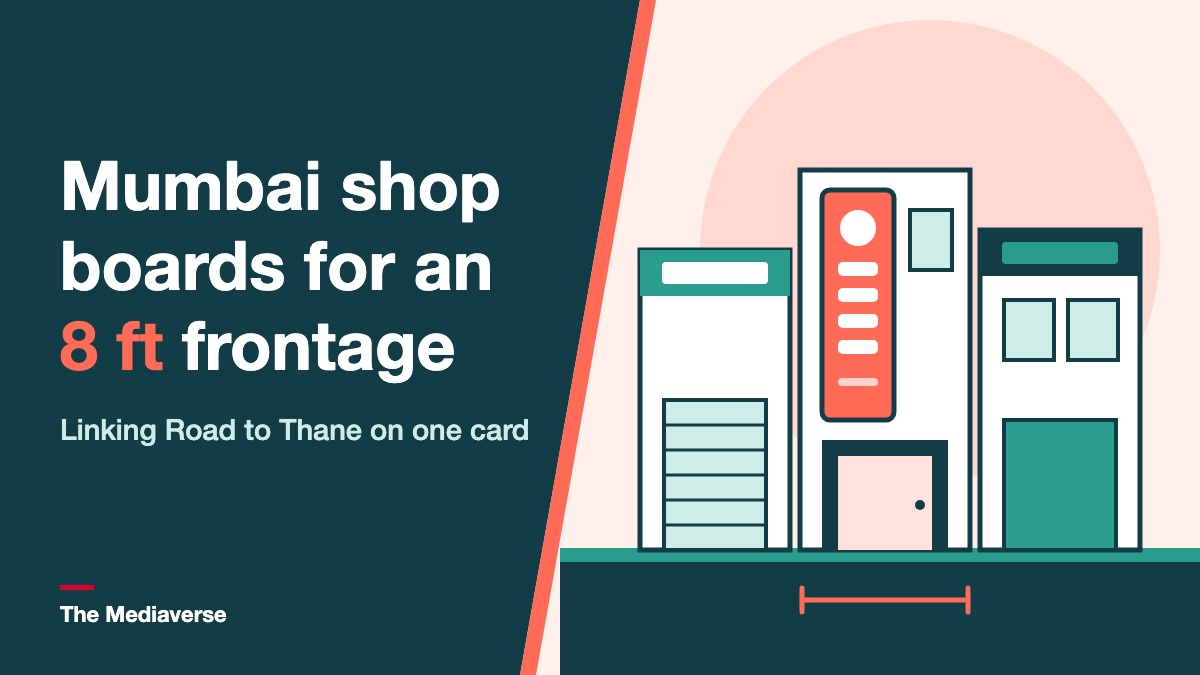
Eight to twelve feet. That is the average suburban shop frontage our Mumbai shop name board page works from, against the 15 to 20 ft it gives for Bangalore and 20 to 30 ft for Delhi, and it is the figure the rest of the page hangs on. The card itself does not change by street: monsoon-grade ACP is Rs.750 to Rs.1,050 per sq ft, ACP with stainless steel 3D letters Rs.950 to Rs.1,300, an IP67 glow sign Rs.300 to Rs.500 and a non-lit flex board Rs.100 to Rs.170, read on 13 November 2026. The page's typical board is 3 by 6 ft, 18 sq ft, which makes it Rs.13,500 to Rs.18,900 in ACP, Rs.17,100 to Rs.23,400 with 3D letters, Rs.5,400 to Rs.9,000 as a glow sign and Rs.1,800 to Rs.3,060 non-lit. This guide pairs that card with the five corridors the page describes, from an 8 ft Linking Road shopfront to a 15 ft one on Ghodbunder Road, and checks the page's three installed jobs against its own rates.
What does the Mumbai shop name board card cost per square foot?
Our shop name board page for Mumbai prices four lines per square foot and puts a typical 3 by 6 ft figure beside each, so the first column of arithmetic below is the page's own. Every price includes narrow-frontage design, fabrication, transport, installation, MCGM permits and marine-grade materials, with a 2-year structural warranty on ACP and GSB. The page also mentions multi-outlet discounts for 3 or more franchise locations, without a figure.
Monsoon-grade ACP, 4 mm PVDF-coated aluminium composite, marine-grade waterproof adhesive
The page's typical 3 by 6 ft board: Rs.13,500 to Rs.18,900. Its standard for permanent restaurant, retail and clinic signage, available in vertical narrow-frontage layouts.
ACP with stainless steel 3D letters, LED backlight halo sealed to IP67
3 by 6 ft: Rs.17,100 to Rs.23,400. The premium food, franchise and high street line; the page recommends stainless steel over acrylic letters for salt air.
GSB glow sign, IP67 enclosure, anti-fungal acrylic face, auto-dusk sensor
3 by 6 ft: Rs.5,400 to Rs.9,000. The line the page calls essential for evening-active food, pharmacy, salon and clinic shopfronts.
Non-lit flex or vinyl, anti-fungal coated
3 by 6 ft: Rs.1,800 to Rs.3,060. The page's line for temporary installations, pop-ups and cost-sensitive shops.
The Mumbai shop name board card as published on the live city page, read on 13 November 2026, per square foot, with the page's own typical 3 by 6 ft board figure beside each line. Inclusions as stated: narrow-frontage design, fabrication, transport, installation, MCGM permits, marine-grade materials; 2-year structural warranty on ACP and GSB. GST is not mentioned on the page. Expedite pricing and the multi-outlet discount are mentioned and not priced.
One figure needs a second reading. The page's title promises a board from Rs.180 per sq ft, and no line on the card starts there: the non-lit floor is Rs.100, the glow sign floor Rs.300 and the cheapest ACP Rs.750, which is what the hero strip actually says. Our July cost guide for Mumbai quoted Rs.180 to Rs.400 plus per sq ft before this card was published, and the title looks like a leftover from that range. Plan from the card, not the title.
Why does an 8 ft frontage change the shape of the board and not its price?
The page's argument is geometric. A 6 by 3 ft horizontal board designed for a wider city becomes a 4 by 3 ft board on a Mumbai shopfront, it says, too small for a name, a logo and a tagline to read from 15 metres down a crowded footpath. Its answer is to turn the board: vertical 3 by 6 and 3 by 8 ft formats that use height, with stacked 3D lettering it says reads from 30 plus metres. On a per sq ft card that turn is free. A 3 by 6 ft vertical board and a 6 by 3 ft horizontal board are both 18 sq ft. What the shrunken 4 by 3 ft board loses is a third of the area, and what the 3 by 8 ft board adds is a third more.
The Mumbai page's four board formats priced at its card, our arithmetic
| Format on the page | Area | ACP at Rs.750 to Rs.1,050 | ACP with 3D letters at Rs.950 to Rs.1,300 | GSB at Rs.300 to Rs.500 | |
|---|---|---|---|---|---|
| 4 by 3 ft, what a 6 by 3 ft design shrinks to on a narrow shopfront | 12 sq ft | Rs.9,000 to Rs.12,600 | Rs.11,400 to Rs.15,600 | Rs.3,600 to Rs.6,000 | |
| 3 by 6 ft vertical, the page's typical board | 18 sq ft | Rs.13,500 to Rs.18,900 | Rs.17,100 to Rs.23,400 | Rs.5,400 to Rs.9,000 | |
| 3 by 7 ft vertical, the size of the page's Lokhandwala job | 21 sq ft | Rs.15,750 to Rs.22,050 | Rs.19,950 to Rs.27,300 | Rs.6,300 to Rs.10,500 | |
| 3 by 8 ft vertical, the tallest format the page names | 24 sq ft | Rs.18,000 to Rs.25,200 | Rs.22,800 to Rs.31,200 | Rs.7,200 to Rs.12,000 |
Formats and rates as published on the live Mumbai page, read on 13 November 2026. Prices multiply the area by the low and high end of each published band. The first three price columns of the 3 by 6 ft row are the page's own figures. GST is not mentioned on the page.
So the narrow-frontage premium is not on the rate card at all. A shop that moves from the shrunken 4 by 3 ft board to the page's 3 by 6 ft vertical pays Rs.4,500 to Rs.6,300 more in ACP for half as much board again, and the step from 3 by 6 to 3 by 8 ft costs the same Rs.4,500 to Rs.6,300. The page states no maximum height or projection for any ward, so whether a 3 by 8 ft board is allowed above a given shutter is a question for the survey on day 1, not something the page answers.
Which board does each Mumbai corridor need, and what does it cost at the card?
The page names six zone groups and then describes five corridors in enough detail to pair each with a board. The card does not move between them. What moves is the frontage width the page gives, whether the board has to work after dark, and the script. Unlike our Jaipur, Kolkata and Ahmedabad pages, the Mumbai page publishes no monthly demand count for any corridor, so there is no queue arithmetic to do here.
Our pairing of the Mumbai page's five corridors with its card: frontage, the board the page recommends, an example size and its price
| Corridor on the page | Frontage and note on the page | Board the page pairs with it | Example board, our choice | At the card, our arithmetic | |
|---|---|---|---|---|---|
| Linking Road and Hill Road, Bandra | 8 to 10 ft shopfronts packed side by side; evening illumination critical | ACP with 3D letters and backlight, which it calls the standard there | 3 by 6 ft vertical ACP with 3D letters, 18 sq ft | Rs.17,100 to Rs.23,400 | |
| Lokhandwala and Versova | Narrow frontages needing vertical format; 200 plus restaurants and salons, fast tenant turnover | GSB glow sign for evening dining visibility | 3 by 6 ft vertical GSB, 18 sq ft | Rs.5,400 to Rs.9,000; the page's Lokhandwala cafe took a 3 by 7 ft 3D board at Rs.18,500 | |
| Andheri West and SV Road | 8 to 12 ft; clinics, coaching centres and retail; MCGM compliance particularly enforced | ACP with clear typography | 3 by 6 ft ACP, 18 sq ft | Rs.13,500 to Rs.18,900; the page's Andheri West pharmacy took a 4 by 3 ft GSB at Rs.9,800 | |
| Dadar TT and Hindu Colony | Mixed 6 to 15 ft; heritage shops and new food entries; Marathi and English boards common | No single line named; every inch of board space matters | 4 by 3 ft bilingual ACP on a 6 ft shopfront, 12 sq ft | Rs.9,000 to Rs.12,600 | |
| Thane West and Ghodbunder | 12 to 15 ft, slightly wider; price-sensitive market | Horizontal ACP; GSB and non-lit for tighter budgets | 8 by 3 ft horizontal ACP, 24 sq ft, or the same size as GSB | Rs.18,000 to Rs.25,200 in ACP; Rs.7,200 to Rs.12,000 as GSB |
Corridors, frontage widths and board pairings as published on the live Mumbai page, read on 13 November 2026. Example sizes are ours and prices multiply the area by the low and high end of the published band. The page gives no frontage figure in feet for Lokhandwala beyond its 9 ft cafe job. GST is not mentioned on the page.
Two things stand out. Three of the five corridors buy on light before material: Bandra, Lokhandwala and the Andheri station approaches are where the page says shopping happens after dark, and its GSB line at Rs.300 to Rs.500 is less than half the ACP rate. And Thane is the only corridor where the page says width is available, so it is the only one where a horizontal board is its recommendation rather than a mistake.
What do Linking Road, Lokhandwala and Dadar do differently?
Linking Road and Hill Road are the page's premium case. Shopfronts of 8 to 10 ft sit side by side, it says some fashion frontages on Linking Road, Colaba Causeway and Fashion Street are as small as 6 ft, and shops compete on signage quality for an affluent and tourist audience. The line it names is 3D lettering on ACP with a backlight, Rs.17,100 to Rs.23,400 for the typical 3 by 6 ft board. Lokhandwala and Versova are its turnover case: 200 plus restaurants and salons on the page's count, tenants changing often, and glow signs dominating because dining there is an evening trade. A 3 by 6 ft GSB is Rs.5,400 to Rs.9,000, about a third of the 3D board, and the page rates it for 3 to 5 years, which suits a tenancy that may not last longer.
Dadar TT is the one corridor the page describes by script. Frontages run from 6 to 15 ft, heritage shops sit beside new food entries, and Marathi and English boards are common. The page's language section adds that in Dadar, Girgaon, Lalbaug and the Thane market lanes the Marathi line is the one many customers read first, and that Devanagari runs wider than Latin script for the same name, so on a narrow frontage the two languages stack vertically. None of that changes the rate: the page says bilingual layout is part of the design stage and not a surcharge. For reach beyond the shutter the page itself points a shopfront to auto branding in Mumbai for station exits, and our Mumbai newspaper insertion and no-parking board guides cover the household and society-gate routes.
Which Mumbai board costs least per year through the monsoon?
The page's second argument after frontage is weather. It puts Mumbai's rainfall at about 2,400 mm a year with 90 percent plus humidity in a 4-month monsoon, and says standard ACP adhesives fail within one season and flex delaminates in weeks. Those are the page's own figures, with no source given. What can be checked is its arithmetic: each line carries a life figure, so the card divides into a cost per year.
The Mumbai card divided by the page's own life figures: cost per sq ft per year and per year for the typical 3 by 6 ft board
| Line | Rate per sq ft | Life on the page | Per sq ft per year, our arithmetic | 3 by 6 ft board per year, our arithmetic | |
|---|---|---|---|---|---|
| Monsoon-grade ACP | Rs.750 to Rs.1,050 | 5 plus years | Rs.150 to Rs.210 | Rs.2,700 to Rs.3,780 | |
| ACP with stainless steel 3D letters | Rs.950 to Rs.1,300 | 7 plus years | Rs.136 to Rs.186 | Rs.2,443 to Rs.3,343 | |
| GSB glow sign, IP67 | Rs.300 to Rs.500 | 3 to 5 years | Rs.60 to Rs.167 | Rs.1,080 to Rs.3,000 | |
| Non-lit flex, anti-fungal coated | Rs.100 to Rs.170 | 12 to 18 months | Rs.67 to Rs.170 | Rs.1,200 to Rs.3,060 |
Rates and life figures as published on the live Mumbai page, read on 13 November 2026. Per-year figures divide the rate by the life; where the page says 5 plus or 7 plus years the floor is used, the GSB line is worked from its floor over 5 years to its top over 3, and the non-lit line from its floor over 18 months to its top over 12. GST is not mentioned on the page.
The reading is unusual among our city cards. On the page's own figures the dearest line upfront is cheaper per year than plain ACP at both ends, Rs.136 against Rs.150 and Rs.186 against Rs.210, because stainless steel letters are rated 7 plus years where the ACP panel is rated 5 plus. The gap rests entirely on that 7-year figure, which the page asserts and does not source. The non-lit board is the weak buy: at the top of its band, replaced every 12 months, it costs Rs.170 per sq ft a year, more than a glow sign at any point and within Rs.16 of the top of the 3D band, and the page itself says it is invisible after dark. Our ten-city guide on cost per year of life applies the same method to every card.
Does a Mumbai shop board have to carry Marathi?
On the page, yes. It says that under Maharashtra's shops and establishments rules a shop's name must appear in Marathi in the Devanagari script, with the Marathi lettering no smaller and no less prominent than any other language, and that the BMC runs periodic enforcement drives, naming Andheri and Dadar as wards where inspections are not theoretical. It cites no section number, no fine amount and no date for any drive, so treat it as the page's summary of the rule and confirm the current requirement with the ward office. What the page does commit to is practical: bilingual layout sits inside the design stage at no extra charge, the permit file matches the board that goes up, franchise logos stay as they are with a Marathi name line added, and an older board can be retrofitted with a matched Marathi fascia panel or letter line. The retrofit has no published price. The page also says it handles the MCGM signage permit, the electrical permit where a glow sign needs one, and access with the housing society when a shop sits under a residential building; it publishes no permit fee for any of them.
Do the page's three installed jobs reconcile with its card?
The Mumbai page's three installed jobs against its own card
| Job on the page | Size and lines on the page | Price on the page | Card band for the same specification, our arithmetic | Per sq ft and verdict | |
|---|---|---|---|---|---|
| Cafe, Lokhandwala, 9 ft frontage | Vertical ACP with stacked 3D acrylic letters and LED backlight halo, 3 by 7 ft; 6 days | Rs.18,500 | Rs.19,950 to Rs.27,300 on the 3D line; Rs.15,750 to Rs.22,050 as plain ACP | Rs.881 per sq ft; Rs.1,450 below the floor of the 3D band, inside the plain ACP band | |
| Pharmacy, Andheri West, 10 ft frontage | IP67 GSB with auto-dusk sensor, 4 by 3 ft, plus a medical compliance text panel; 7 days including the electrical permit | Rs.9,800 | Rs.3,600 to Rs.6,000 for the GSB; the panel is unpriced | Rs.817 per sq ft for everything; Rs.3,800 above the top of the GSB band | |
| Cafe franchise, 4 outlets: Bandra, Andheri, Thane, Vashi | ACP with stainless steel 3D letters in four sizes for 8, 10, 12 and 14 ft frontages; all four in 10 days | Rs.72,000 total | Sizes not published; four typical 3 by 6 ft boards would be Rs.68,400 to Rs.93,600 | Rs.18,000 an outlet on average; cannot be checked without the sizes or the multi-outlet discount |
Jobs, sizes, lines and prices as published on the live Mumbai page, read on 13 November 2026. Card bands multiply the area by the published per sq ft band for the stated line. Per sq ft figures divide the job price by the board area. The page prices neither the medical compliance panel nor the multi-outlet discount, and gives no sizes for the franchise boards.
None of the three reconciles cleanly, the same record as our Kolkata page. The Lokhandwala job is the instructive one: the page recommends stainless steel letters for salt air and prices its 3D line on that specification, then shows a job with acrylic letters at Rs.881 per sq ft, under its own 3D floor of Rs.950. The page does not say acrylic is cheaper, but a buyer quoted the 3D band should ask which letter material the quote assumes. The pharmacy runs the other way, Rs.3,800 over the glow sign band, with a compliance panel the card does not list. And Rs.72,000 for four outlets is believable against four typical boards, yet proves nothing without the sizes. The page's result lines for these jobs, such as stronger footpath discovery, carry no numbers and are not repeated here as evidence.
Which dates can a design approved on Monday 16 November 2026 make?
The page gives 5 to 7 working days from design approval for ACP and GSB boards and 3 to 4 for non-lit, and says the Mumbai timeline runs longer than other cities because MCGM permit processing and housing society coordination sit inside it. Its process runs survey on day 1, design on days 1 to 2, fabrication on days 2 to 5 and installation on days 5 to 7. Diwali 2026 fell on 8 November, so the next fixed dates on a Mumbai shop calendar are Christmas and the New Year, and after them the monsoon the page builds its specification around.
Install dates from a Monday 16 November 2026 design approval, by board line
| Board line | Timeline on the page | Install date, our arithmetic | What it is in time for | |
|---|---|---|---|---|
| Non-lit flex | 3 to 4 working days | Thursday 19 to Friday 20 November | A pop-up or stall for the December season | |
| Monsoon-grade ACP or GSB glow sign | 5 to 7 working days, permits inside the window | Monday 23 to Wednesday 25 November | Christmas on 25 December with a month clear; the June 2027 monsoon with six months clear | |
| ACP with stainless steel 3D letters | 5 to 7 working days | Monday 23 to Wednesday 25 November | The same dates as plain ACP; the page gives the metalwork no extra days | |
| Any board, expedited | Available at a premium the page does not price | Not stated | A fixed launch date; get the premium in writing before approving the design |
Timelines as published on the live Mumbai page, read on 13 November 2026. Install dates are our arithmetic in working days, Monday to Friday, counted from the day after a Monday 16 November approval. The page states no number of days and no price for its expedite service.
Where do the Mumbai page's numbers stop?
Reading the page as a buyer would, the first gap is tax: no line mentions GST. The second is everything sold without a figure: the expedite premium, the multi-outlet discount for 3 or more outlets, the Marathi retrofit panel, the medical compliance panel and any MCGM or electrical permit fee. The third is the regulator: the page names MCGM and the Marathi requirement and gives no size cap, no fee schedule, no section number and no fine amount, where our Ahmedabad page publishes caps and a fine band. The fourth is demand: there are no corridor counts. Several lines are the page's assertions and not facts to plan on: the 2,400 mm rainfall, the 90 percent humidity, the suburban rents of Rs.200 to Rs.500 per sq ft a month, the 30 plus metre reading distance, the 50,000-hour LED and the claim that Mumbai runs 10 to 15 percent above Bangalore. And three blocks are mobile van text rendered on a shop board page: the pricing note about a South Mumbai and Bandra route premium and LED vans, the market overview, and the 15-locality best-areas list. They are not part of the card and nothing in this guide uses them.
What does a typical 3 by 6 ft shop board cost in Mumbai?
The page prices its own typical 3 by 6 ft board on every line, read 13 November 2026: Rs.13,500 to Rs.18,900 in monsoon-grade ACP, Rs.17,100 to Rs.23,400 with stainless steel 3D letters, Rs.5,400 to Rs.9,000 as an IP67 glow sign and Rs.1,800 to Rs.3,060 as non-lit flex. Each figure includes narrow-frontage design, fabrication, transport, installation and MCGM permits, with a 2-year structural warranty on ACP and GSB. GST is not mentioned on the page.
Does a vertical shop board cost more than a horizontal one in Mumbai?
Not at the same area. The card is per square foot, so a vertical 3 by 6 ft board and a horizontal 6 by 3 ft board are both 18 sq ft and cost the same, Rs.13,500 to Rs.18,900 in ACP. Height is what adds cost: the page's 3 by 8 ft vertical format is 24 sq ft, Rs.18,000 to Rs.25,200 in ACP, which is Rs.4,500 to Rs.6,300 more than 3 by 6 ft. The page states no height limit for any ward.
Does the Mumbai shop board rate change between Bandra and Thane?
The card does not. ACP is Rs.750 to Rs.1,050 per sq ft and a glow sign Rs.300 to Rs.500 in every corridor the page describes. What changes is the frontage: 8 to 10 ft on Linking Road and Hill Road, 8 to 12 ft in Andheri West and 12 to 15 ft in Thane West, the one corridor where the page says a horizontal board fits. A note about a South Mumbai and Bandra premium sits under the price table, but it refers to van routes and is leftover text from another service.
Is a glow sign cheaper than ACP for a Mumbai shop that trades in the evening?
Upfront, yes, by more than half. A 3 by 6 ft IP67 glow sign is Rs.5,400 to Rs.9,000 against Rs.13,500 to Rs.18,900 for ACP. Per year on the page's own life figures it is Rs.1,080 to Rs.3,000 against Rs.2,700 to Rs.3,780, so its range sits lower, although a top-of-band glow sign replaced after 3 years, Rs.3,000 a year, costs more than an ACP board at its floor. The page calls it essential for evening-active food, pharmacy, salon and clinic shopfronts in Bandra, Lokhandwala and Andheri.
How fast can a shop name board go up in Mumbai?
The page gives 5 to 7 working days from design approval for ACP and glow sign boards and 3 to 4 working days for non-lit flex, with MCGM permit processing and housing society coordination inside the window. A design approved on Monday 16 November 2026 puts an ACP or GSB board up between Monday 23 and Wednesday 25 November, and a non-lit board on Thursday 19 or Friday 20 November. Expedited installation is offered at a premium the page does not price.
Tags
Quick Answers
How much does a shop name board cost in Mumbai per square foot?
Rs.750 to Rs.1,050 per sq ft for monsoon-grade ACP, Rs.950 to Rs.1,300 with stainless steel 3D letters, Rs.300 to Rs.500 for an IP67 glow sign and Rs.100 to Rs.170 for non-lit flex, one card for every corridor on our Mumbai page as read on 13 November 2026. The typical 3 by 6 ft board is Rs.13,500 to Rs.18,900 in ACP. Prices include narrow-frontage design, fabrication, installation and MCGM permits; GST is not mentioned.
What size shop board fits an 8 ft Mumbai frontage?
The page recommends turning the board vertical: 3 by 6 ft or 3 by 8 ft, using height in place of width, with stacked 3D lettering it says reads from 30 plus metres. At the card a 3 by 6 ft board is Rs.13,500 to Rs.18,900 in ACP and a 3 by 8 ft board Rs.18,000 to Rs.25,200. A horizontal 6 by 3 ft design shrinks to about 4 by 3 ft on such a shopfront, Rs.9,000 to Rs.12,600, which the page says is too small to read from 15 metres.
Do the installed jobs on the Mumbai page match its rate card?
None of the three does cleanly. The Lokhandwala cafe's 3 by 7 ft board with 3D acrylic letters at Rs.18,500 is Rs.881 per sq ft, Rs.1,450 below the Rs.19,950 floor of the 3D band. The Andheri West pharmacy's 4 by 3 ft glow sign with a medical panel at Rs.9,800 is Rs.3,800 above the Rs.6,000 top of the glow sign band. The four-outlet franchise at Rs.72,000 publishes no board sizes, so it cannot be checked.
Looking for professional Shop Name Board services?
The Mediaverse runs end-to-end shop name board campaigns across India with geo-tagged delivery and transparent, all-inclusive pricing.
Explore our Shop Name Board solutionsSummarize this guide with AI
Open this article in your favourite AI assistant
Related Guides
Written by

The Mediaverse Team
India's Leading Outdoor Advertising Agency
The Mediaverse is a national-level outdoor advertising and integrated marketing organization that provides complete OOH, ATL, BTL, retail, and transit media solutions across India. With years of experience executing high-performance campaigns for brands in FMCG, Real Estate, E-commerce, EdTech, Automotive, Healthcare, and Retail, The Mediaverse combines creativity, data-driven media planning, and flawless on-ground execution. As a full-stack outdoor advertising provider, The Mediaverse offers Auto Branding, Mobile Van Branding, Newspaper Insertion Advertising, Shop Name Board Branding, In-Store Branding, Hoardings, Transit Media, Kiosks, Mall Media, Activations, and all forms of Below-The-Line marketing. Known for its pan-India network, strategic route planning, premium print quality, and Cheqmate™ GPS-based verification, The Mediaverse ensures 100% transparent and result-oriented campaign delivery. The Mediaverse’s editorial team produces deeply researched, SEO-optimized, and generative-engine-friendly content to help businesses understand the power of outdoor advertising and make informed decisions that maximize brand visibility and ROI across urban, suburban, and rural markets.
Related Articles
Shop Name Boards Street by Street in Ahmedabad: CG Road, Manek Chowk, SG Highway and Maninagar on One Card (2026)
One card, six zone groups and two rulebooks: what a shop board costs on CG Road, SG Highway, Satellite, Law Garden, Maninagar, Relief Road and inside the Manek Chowk pols at our Ahmedabad page's per sq ft rates, why the AMC caps cost area rather than rate, what the page publishes about fines and permits, why its Navratri overlay has no price, which of its three installed jobs matches its card, and which November dates a late-October brief can still make.

Shop Name Boards Street by Street in Kolkata: Gariahat, Park Street, Salt Lake and the KMC Rules the Page Publishes (2026)
One card, six zone groups: what a shop board costs on Gariahat, Burrabazar, College Street, Park Street, Salt Lake Sector V and in the south at our Kolkata page's per sq ft rates, what the Puja overlay and the three KMC rules the page publishes add, why none of its three installed jobs matches its card, and which November dates a late-October brief can still make.
Shop Name Boards Street by Street in Jaipur: Johari Bazaar, MI Road and the Walled City Colour Rule (2026)
One card, six zone groups: what a shop board costs on Johari Bazaar, Bapu Bazaar, MI Road, C-Scheme, Raja Park and the Sitapura wedding belt at our Jaipur page's per sq ft rates, how the Walled City colour rule and the JMC fine band change the arithmetic, and which dates a late-October brief can still make.