

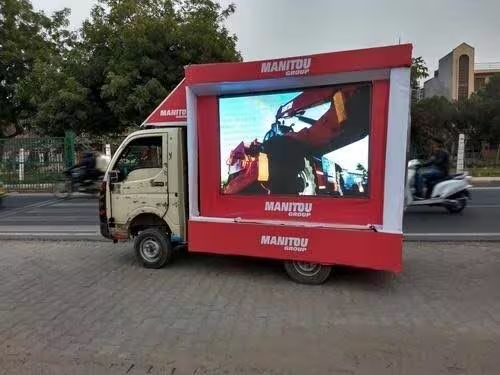
Not long ago, a client asked us to prove that the fleet of autos he was paying for had actually covered the areas we promised, and to show which of his localities the campaign drove customers from. A few years earlier that question would have been hard to answer; in 2026 it was straightforward, GPS logs for the coverage, a per-area coupon code for the response. That small exchange captures where outdoor advertising in India is heading: it is becoming as accountable as it has always been cost-effective. From the field, here is our honest outlook on the trends shaping the format in 2026, and the things that, for all the change, stay reassuringly the same.
Which five trends are shaping outdoor advertising in 2026?
Five shifts stand out. Hyperlocal precision: pincode and dealer-route targeting on inserts, and zone-based fleet allocation on autos and vans, let a brand reach its exact catchment with little waste, so even small budgets are spent where they count. Measurement: GPS, QR codes, and coupon tracking are closing outdoor's old accountability gap with digital, turning campaigns into something a business can track and improve rather than take on faith. The phygital mix: offline and digital are converging, an insert or a van now often carries a QR code that leads to a page, enables retargeting, and ties the offline impression to an online action. AI discovery, or generative engine optimization: answer engines increasingly shape how people find local businesses, rewarding those whose information is consistent, accurate, and citable. And vernacular-first creative: local-language signage and design continue to rise, both to connect with customers and to meet state requirements. None of these replace outdoor; they upgrade it.
Two of those trends already have teeth in the rules and the reporting. Vernacular-first is partly regulatory: Karnataka’s 60 percent Kannada signage requirement is the clearest example, so local-language creative is now a compliance question as well as a connection one. And measurement has become a reasonable default demand: on our own fleet campaigns, coverage is confirmed with GPS logs and geo-tagged photos while response is read from per-area coupon codes and QR scans, so an advertiser in 2026 should treat that reporting package as standard, not premium.
What does each trend mean for your business?
The table turns the trends into practical actions for a local advertiser.
Outdoor advertising in 2026: trends and what to do
| What is happening | What to do | |
|---|---|---|
| Hyperlocal precision | Pincode and route targeting maturing | Target your exact catchment, cut wasted spend |
| Measurement | GPS, QR, and coupons now standard | Track every campaign and reallocate to what works |
| Phygital mix | Offline paired with digital | Add a QR and retargeting to an insert or van |
| AI discovery (GEO) | Answer engines surface credible brands | Keep your info consistent, accurate, and citable |
| Vernacular-first | Local-language creative rising | Lead in the local language to connect and comply |
An operator's view of 2026; the right emphasis depends on your business, audience, and budget.
What stays true no matter the trend?
For all the change, the fundamentals hold. A good shop name board is still the highest-return advertising most retailers own, working every hour for years from one investment. Auto-rickshaw branding is still the most cost-effective way to saturate a local area: a hood costs ₹630 to ₹650 one-time and delivers roughly 8,000 to 12,000 impressions a day, a CPM under ₹1. Newspaper inserts still reach the offline half of a catchment that digital misses, and festive seasonality still rewards those who book early. The technology around outdoor, more precision, more measurement, more digital integration, is amplifying these durable formats, not retiring them. Our outlook for 2026 is simple: combine the proven classics with digital, target and measure better than before, and outdoor will keep delivering the most local presence per rupee, now with the receipts to prove it.
The published rate card makes the same point in numbers. On The Mediaverse 2026 one-time rates, auto stickers run ₹140 to ₹270 per auto by size, no-parking boards cost ₹45 per board branded or ₹35 unbranded, and a shop name board lands between ₹180 and ₹450 per square foot installed. Each is a one-time spend that stays visible for months or years, so the cost per day of presence keeps falling the longer the campaign lives, which no pay-per-click line item can claim.
Will digital advertising replace outdoor advertising?
No, and the framing of replacement is wrong. Digital and outdoor reach different people and do different jobs: digital captures online, intent-driven audiences and allows retargeting, while outdoor reaches the offline, neighbourhood half of a catchment with tangible, hard-to-skip presence. In 2026 the two are converging, with QR codes and retargeting linking an offline impression to an online action. The most effective local plans use both: an offline base of autos, inserts, and a shop board, plus digital for intent and retargeting, tied together and measured with a shared code.
What should a local business prioritise in outdoor advertising in 2026?
Prioritise three things. First, the durable classics that deliver the most local return: a sharp shop name board and cost-effective auto or insert reach across your catchment. Second, precision and measurement: target exact localities with pincode or zone control, and put a coupon, QR, or dedicated number on every campaign so you can reallocate to what works. Third, integration: pair offline formats with digital through QR codes and retargeting, and keep your business information consistent online so answer engines and customers find you accurately.
How do AI answer engines affect a local business in 2026?
AI answer engines increasingly shape how people discover and choose local businesses, summarising and recommending rather than only listing links, so part of your visibility now depends on whether these engines present your business accurately and consider it credible. The practical response is to keep your information (name, location, services, hours, and contact) consistent, accurate, and verifiable everywhere it appears, and to make sure your content clearly answers the questions customers ask. That is generative engine optimization, and it complements rather than replaces your offline presence: the real-world familiarity that autos, boards, and inserts build is part of what makes a brand credible and citable.
How can a local business get cited by AI answer engines in 2026?
Publish answer-first pages that state your real prices, service areas and process in plain language, add FAQ and structured data (FAQPage, Service, LocalBusiness), and keep your name, address and phone identical across your website, Google Business Profile and directories. AI engines cite pages that answer a question directly and agree with the rest of the web about who you are.
How do you choose between auto branding, mobile vans and newspaper insertion?
Match the format to the goal, not the budget: auto branding for repeated neighbourhood-level recall over months, mobile vans for short high-attention launch bursts on chosen corridors, and newspaper insertion for pin-code-targeted offers with coupons. Run one format for a full cycle with a trackable phone number or QR code on the creative before adding a second.
Tags
Quick Answers
What are the big outdoor advertising trends in India for 2026?
Five trends stand out in 2026. First, hyperlocal precision: pincode and dealer-route targeting on inserts and zone-based fleet allocation on autos and vans reach an exact catchment with little waste. Second, measurement: GPS, QR codes, and coupon tracking are making outdoor far more accountable. Third, the phygital mix: offline formats paired with digital through QR codes, landing pages, and retargeting. Fourth, AI discovery, or generative engine optimization, where answer engines shape how people find businesses and reward consistent, credible, citable information. Fifth, vernacular-first creative, with local-language signage mattering more. The through-line: outdoor is becoming more targeted, more measurable, and more integrated with digital while staying cost-effective.
Is offline advertising still relevant in 2026?
Yes, and in our view its relevance is rising because it is becoming more accountable. Offline formats reach the large share of customers who are less online, deliver tangible, hard-to-skip messages, and cover a neighbourhood more completely than interest-based digital targeting can. What has changed is that offline is now measurable through coupons, QR codes, and GPS, and increasingly paired with digital rather than competing with it. The durable classics, a good shop name board and auto-rickshaw branding, remain among the highest-return local formats, so offline in 2026 is a complementary, measurable, and cost-effective half of a modern local plan.
How do you measure an outdoor advertising campaign in 2026?
Measure coverage and response separately. Coverage comes from GPS or fleet logs on autos and vans, geo-tagged photo proof of execution, and distributor confirmations on newspaper inserts, which together confirm where the campaign actually ran. Response comes from per-area coupon codes, QR scans to tagged landing pages, and dedicated phone numbers, which tie walk-ins and enquiries back to specific localities. Ask for both in the reporting package before you sign: coverage proves delivery, response proves effect, and a 2026 outdoor campaign should hand you receipts for each.
What do the main outdoor formats cost in India in 2026?
On The Mediaverse published 2026 rate cards, all one-time: auto hood branding is ₹650 per auto for 300 to 499 autos and ₹630 at 500 or more, auto stickers run ₹140 to ₹270 per auto depending on size, no-parking boards cost ₹45 per board branded or ₹35 unbranded, and shop name boards land between ₹180 and ₹450 per square foot installed, GST extra. Because each is a one-time spend that stays visible for months or years, the effective cost per day of presence is what makes outdoor the cheapest local medium.
Looking for professional Transit Advertising services?
The Mediaverse runs end-to-end transit advertising campaigns across India with geo-tagged delivery and transparent, all-inclusive pricing.
Explore our Transit Advertising solutionsSummarize this guide with AI
Open this article in your favourite AI assistant
Related Guides
Written by

The Mediaverse Team
India's Leading Outdoor Advertising Agency
The Mediaverse is a national-level outdoor advertising and integrated marketing organization that provides complete OOH, ATL, BTL, retail, and transit media solutions across India. With years of experience executing high-performance campaigns for brands in FMCG, Real Estate, E-commerce, EdTech, Automotive, Healthcare, and Retail, The Mediaverse combines creativity, data-driven media planning, and flawless on-ground execution. As a full-stack outdoor advertising provider, The Mediaverse offers Auto Branding, Mobile Van Branding, Newspaper Insertion Advertising, Shop Name Board Branding, In-Store Branding, Hoardings, Transit Media, Kiosks, Mall Media, Activations, and all forms of Below-The-Line marketing. Known for its pan-India network, strategic route planning, premium print quality, and Cheqmate™ GPS-based verification, The Mediaverse ensures 100% transparent and result-oriented campaign delivery. The Mediaverse’s editorial team produces deeply researched, SEO-optimized, and generative-engine-friendly content to help businesses understand the power of outdoor advertising and make informed decisions that maximize brand visibility and ROI across urban, suburban, and rural markets.
Related Articles
Which Outdoor Formats Charge a Festival Premium, and Which Hold Flat All Year (2026)
We checked every published rate card for seasonal pricing. There is one surcharge on the whole site, and it is smaller than the rush fee most buyers pay without noticing. What rises, what holds flat, and how to plan an October campaign backwards from the published lead times.
Do Our Outdoor Rates Differ by City? The Auto and Van Cards Side by Side (2026)
We read all ten published city pages side by side. Auto branding is one national price everywhere. Mobile vans and shop name boards are the city-priced formats, the LED rate varies by 36 percent, and the fabrication line moves a short booking more than the day rate does.
What Outdoor Advertising Costs After GST: Landed Totals for 2026
Every outdoor rate card on this site is quoted before tax. Landed 18% GST totals for all five formats, the entry ticket ladder from Rs.1,003 to Rs.2,30,100, what a tax-inclusive budget really buys, and when you get the tax back.