

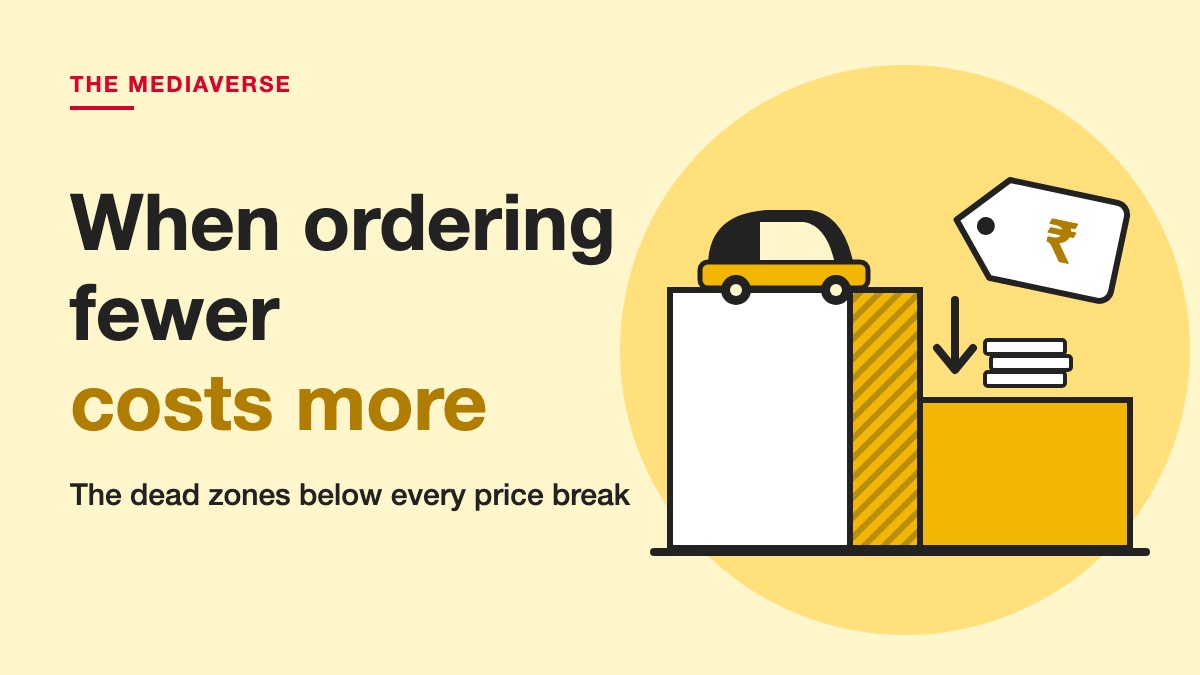
The usual advice is to start small and scale. On four lines of our 2026 rate cards, starting slightly smaller costs more. 499 auto hoods at Rs.650 come to Rs.3,24,350. 500 hoods at Rs.630 come to Rs.3,15,000. One more auto, Rs.9,350 less. The same thing happens on both back panel sizes and on no-parking boards, because each card drops to a lower per-unit rate at a fixed quantity and the rate is set by the quantity band of the whole order. Just below each break sits a band of quantities that cost more than the break itself. We call that band the dead zone. This post maps all four from the live pages as read on 16 November 2026, with every total shown as our own arithmetic before 18 percent GST.
Which order sizes cost more than the next price slab?
The four dead zones on our 2026 outdoor rate cards, before GST
| Format | Lower slab | Upper slab | Total at the break | Quantities that cost more | Overpay at the worst point | |
|---|---|---|---|---|---|---|
| Auto hood | Rs.650 per auto, 300 to 499 autos | Rs.630 per auto from 500 | 500 autos: Rs.3,15,000 | 485 to 499 autos | Rs.9,350 at 499 autos | |
| Back panel, 24 by 6 inch | Rs.170 per auto, 500 to 799 autos | Rs.140 per auto from 800 | 800 autos: Rs.1,12,000 | 659 to 799 autos | Rs.23,830 at 799 autos | |
| Back panel, 24 by 18 inch | Rs.270 per auto, 500 to 799 autos | Rs.240 per auto from 800 | 800 autos: Rs.1,92,000 | 712 to 799 autos | Rs.23,730 at 799 autos | |
| No-parking board | Rs.45 per board below 5,000 boards | Rs.35 per board from 5,000 | 5,000 boards: Rs.1,75,000 | 3,889 to 4,999 boards | Rs.49,955 at 4,999 boards |
Rates and slabs from the live Bangalore auto branding page and the national no-parking board page, read on 16 November 2026. All prices are one-time. Break totals, dead zones and overpays are our arithmetic, before 18 percent GST and before any auto-union fee. Minimum orders are 300 autos for hoods, 500 autos for back panels and 1,000 boards.
The crossover is one division. Take the total at the break, divide it by the lower-slab rate and round up. Rs.3,15,000 divided by Rs.650 is 484.6, so 484 hoods (Rs.3,14,600) still cost Rs.400 less than 500 hoods, and 485 hoods (Rs.3,15,250) cost Rs.250 more. For the small back panel, Rs.1,12,000 divided by Rs.170 is 658.8: 658 panels cost Rs.1,11,860 and 659 cost Rs.1,12,030. For the large panel, Rs.1,92,000 divided by Rs.270 is 711.1: 711 panels cost Rs.1,91,970 and 712 cost Rs.1,92,240. For boards, Rs.1,75,000 divided by Rs.45 is 3,888.9: 3,888 boards cost Rs.1,74,960 and 3,889 cost Rs.1,75,005.
The slabs themselves sit on the auto branding rate card and the no-parking board advertising page. Two earlier posts cover single formats in more depth: the back panel campaign guide and the Rs.45 against Rs.35 break-even for boards. This one puts every break on one page so a planner can check a quantity in ten seconds.
Why is the dead zone 15 autos wide on hoods and 1,111 boards wide on no-parking boards?
Because the width follows the discount. Rs.630 is 3.1 percent below Rs.650, so the dead zone covers the last 3 percent of quantities below 500 autos: 15 of them. Rs.35 is 22.2 percent below Rs.45, so the zone covers the last 22.2 percent below 5,000 boards: 1,111 quantities. The deeper the cut at the break, the earlier a planner should stop thinking in lower-slab rates.
How wide each dead zone is, and why
| Format | Rate cut at the break | Quantities in the dead zone | Zone as a share of the break quantity | |
|---|---|---|---|---|
| Auto hood | Rs.20 per auto, 3.1 percent | 15 | 3.0 percent of 500 | |
| Back panel, 24 by 6 inch | Rs.30 per auto, 17.6 percent | 141 | 17.6 percent of 800 | |
| Back panel, 24 by 18 inch | Rs.30 per auto, 11.1 percent | 88 | 11.0 percent of 800 | |
| No-parking board | Rs.10 per board, 22.2 percent | 1,111 | 22.2 percent of 5,000 |
Our arithmetic on the published slabs. The zone counts every whole quantity from the crossover to one unit below the break.
Two readings matter. First, the same Rs.30 cut produces two different zones on the two back panels, because Rs.30 is a bigger share of Rs.170 than of Rs.270. Second, the hood break is shallow enough to ignore unless the plan already sits within 15 autos of 500, while the board break reshapes any plan above roughly 3,900 gates.
What does the same money buy on the upper slab?
Turn the overpay around. The money that pays for the largest lower-slab order buys more units at the upper rate, and leaves change.
The largest lower-slab order against the same budget at the upper rate
| Budget | At the lower rate | At the upper rate | Extra units | |
|---|---|---|---|---|
| Rs.3,24,350 | 499 hoods at Rs.650 | 514 hoods at Rs.630 (Rs.3,23,820) | 15 autos | |
| Rs.1,35,830 | 799 panels of 24 by 6 inch at Rs.170 | 970 panels at Rs.140 (Rs.1,35,800) | 171 autos | |
| Rs.2,15,730 | 799 panels of 24 by 18 inch at Rs.270 | 898 panels at Rs.240 (Rs.2,15,520) | 99 autos | |
| Rs.2,24,955 | 4,999 boards at Rs.45 | 6,427 boards at Rs.35 (Rs.2,24,945) | 1,428 boards |
Our arithmetic before GST. Upper-rate quantities are rounded down to the last whole unit the budget covers.
On boards that is 1,428 more gates for Rs.10 less. On the small back panel it is 171 more autos for Rs.30 less. Extra units only count if they can be placed: more autos need more routes inside the catchment, and more boards need more gates where the owner agrees. If the area cannot absorb them, the next section applies.
What does rounding up save on a typical plan?
The worst case is the last unit before the break, and few plans land exactly there. Mid-zone plans are more common, so here are four illustrative quantities, one per format, each sitting inside its dead zone. These are worked sums on the card, not client campaigns.
Four mid-zone plans, as planned and rounded up to the break
| Plan | As planned | Rounded up to the break | Saved | Extra units | |
|---|---|---|---|---|---|
| 490 auto hoods | 490 at Rs.650: Rs.3,18,500 | 500 at Rs.630: Rs.3,15,000 | Rs.3,500 | 10 autos | |
| 760 back panels, 24 by 6 inch | 760 at Rs.170: Rs.1,29,200 | 800 at Rs.140: Rs.1,12,000 | Rs.17,200 | 40 autos | |
| 760 back panels, 24 by 18 inch | 760 at Rs.270: Rs.2,05,200 | 800 at Rs.240: Rs.1,92,000 | Rs.13,200 | 40 autos | |
| 4,200 no-parking boards | 4,200 at Rs.45: Rs.1,89,000 | 5,000 at Rs.35: Rs.1,75,000 | Rs.14,000 | 800 boards |
Illustrative quantities chosen by us to sit inside each dead zone. Totals are our arithmetic on the published slabs, before GST.
The 4,200-board plan is the one to remember. A planner who counted 4,200 gates and ordered exactly that many would pay Rs.14,000 more than a planner who ordered 5,000 and kept 800 boards for a second locality or for replacements. On the small back panel, 760 autos cost Rs.17,200 more than 800. On hoods the saving is small, Rs.3,500, but it still comes with 10 more autos on the road.
When is staying below the break the right order?
Whenever the plan sits below the crossover instead of inside the zone. 300 hoods cost Rs.1,95,000, which is Rs.1,20,000 less than the 500-auto total of Rs.3,15,000. 500 small back panels cost Rs.85,000 against Rs.1,12,000 for 800. 1,000 boards cost Rs.45,000 against Rs.1,75,000 for 5,000. Nobody should buy 5,000 boards to save Rs.10 a board when the locality has 1,200 gates. The break is a reason to round up only from inside the dead zone, where the larger order is cheaper in absolute rupees.
Hold the number or round up: the rule for each format
| Format | Hold your quantity if the plan needs | Round up to the break if the plan needs | |
|---|---|---|---|
| Auto hood | 300 to 484 autos | 485 to 499 autos: order 500 | |
| Back panel, 24 by 6 inch | 500 to 658 autos | 659 to 799 autos: order 800 | |
| Back panel, 24 by 18 inch | 500 to 711 autos | 712 to 799 autos: order 800 | |
| No-parking board | 1,000 to 3,888 boards | 3,889 to 4,999 boards: order 5,000 |
Our arithmetic on the published slabs and minimums, before GST. Quantities below each minimum are not bookable.
The auto cards carry one line the crossover ignores: some areas charge an auto-union fee, billed extra. The page publishes neither its amount nor whether it is charged per auto, so in a fee area confirm it before rounding up, because a per-auto fee would be paid on every added auto. The cheapest way into each format is a separate question, covered in the smallest order in every format in Bangalore.
Does the newspaper insertion card have a dead zone?
It may, and the page does not settle it. The newspaper insertion card sets a 50,000-copy minimum at Rs.1.25 for A5, Rs.1.70 for A4 and Rs.2.20 for A2, with bulk rates above 50,000 copies of Rs.1.15, Rs.1.50 and Rs.2.00. It does not say whether the bulk rate reprices the whole order or only the copies above 50,000. The two readings differ by real money.
A 60,000-copy insertion order under the two readings of the bulk rate
| Size | 50,000 copies, the minimum | 60,000 copies, bulk rate on the whole order | 60,000 copies, bulk rate on the extra 10,000 only | Gap | |
|---|---|---|---|---|---|
| A5 | Rs.62,500 | Rs.69,000 | Rs.74,000 | Rs.5,000 | |
| A4 | Rs.85,000 | Rs.90,000 | Rs.1,00,000 | Rs.10,000 | |
| A2 | Rs.1,10,000 | Rs.1,20,000 | Rs.1,30,000 | Rs.10,000 |
Rates from the live newspaper insertion page, read on 16 November 2026. Both 60,000-copy totals are our arithmetic before GST. The page does not state which basis applies.
The gap is the first 50,000 copies multiplied by the rate difference, so it stays fixed however large the run gets: Rs.5,000 on A5 and Rs.10,000 on A4 and A2. We are not going to guess which reading applies to a given paper and run. Ask for the slab basis on the written quote before approving any insertion above 50,000 copies.
What do the four breaks look like with 18 percent GST?
GST is charged on the order total, so it never moves a crossover: the cheaper order before tax is the cheaper order after it. It does widen the rupee gap. With GST the break totals land at Rs.3,71,700 for 500 hoods, Rs.1,32,160 for 800 small panels, Rs.2,26,560 for 800 large panels and Rs.2,06,500 for 5,000 boards. The worst-case overpays grow to about Rs.11,033 on hoods, Rs.28,119 and Rs.28,001 on the two panels and Rs.58,947 on boards. Landed totals for whole campaigns are worked through in the cost after GST guide.
Our recommendation: size from the catchment, then check the table
Fix the quantity from the ground first: how many autos the routes can carry, how many gates the colonies have. Then check that number against the table. If it lands inside a dead zone, order the break quantity, take the extra units and pay less. If it lands below the crossover, keep it, and do not let a lower per-unit rate talk you into units you cannot place. When you request a quote for auto branding in Bangalore or any other city on the national card, give the catchment and the quantity you have in mind and ask for the totals on both sides of the break.
What should you check before fixing the quantity?
- Which slab does the quantity fall in, and how many units is it from the next break?
- Is it inside 485 to 499 hoods, 659 to 799 small panels, 712 to 799 large panels or 3,889 to 4,999 boards?
- Can the catchment place the extra units: routes for autos, agreeing gates for boards?
- Is an auto-union fee charged in the area, and on what basis?
- For inserts above 50,000 copies, does the quote state whether the bulk rate covers the whole run?
- Are the two options being compared as totals with GST, not as per-unit rates?
Is it cheaper to order 500 auto hoods than 499?
Yes. On our 2026 card 499 hoods are billed at Rs.650 each, which is Rs.3,24,350, while 500 hoods are billed at Rs.630 each, which is Rs.3,15,000. The larger order costs Rs.9,350 less before GST and adds one auto. The same holds from 485 autos upward, because 485 hoods at Rs.650 already come to Rs.3,15,250.
At what quantity do no-parking boards become cheaper at the Rs.35 rate?
From 3,889 boards. Our page prices orders under 5,000 boards at Rs.45 a board and orders of 5,000 or more at Rs.35, all-inclusive. 5,000 boards cost Rs.1,75,000, and 3,889 boards at Rs.45 cost Rs.1,75,005. Any plan between 3,889 and 4,999 boards costs more than 5,000 boards, by up to Rs.49,955 at 4,999, before GST.
Do the price breaks apply to the whole order or only to the extra units?
On the auto and no-parking cards the rate is set by the quantity band of the order, so the lower rate applies to every unit: Rs.630 per auto for 500 or more hoods, Rs.35 per board for 5,000 or more boards. That is what creates the dead zones. The newspaper insertion page lists bulk rates above 50,000 copies without stating the basis, so confirm it on the written quote.
Should I increase my order just to reach a lower rate?
Only from inside a dead zone, where the bigger order is cheaper in total rupees. Below the crossover the bigger order costs more money even though each unit is cheaper: 300 hoods cost Rs.1,95,000 against Rs.3,15,000 for 500. Size the order from the routes and gates the catchment has, then check whether it falls in 485 to 499 hoods, 659 to 799 or 712 to 799 back panels, or 3,889 to 4,999 boards.
Does GST change where the price break crossover falls?
No. GST at 18 percent is charged on the order total, so the cheaper order before tax is also the cheaper order after it. The crossovers stay at 485 hoods, 659 and 712 back panels and 3,889 boards. Only the rupee gap grows: the Rs.49,955 worst-case overpay on boards becomes about Rs.58,947 with GST, and the Rs.9,350 on hoods becomes about Rs.11,033.
Tags
Quick Answers
Which outdoor advertising order sizes cost more than a larger order?
Four bands on our 2026 rate cards, before GST: 485 to 499 auto hoods (500 cost Rs.3,15,000), 659 to 799 back panels of 24 by 6 inch (800 cost Rs.1,12,000), 712 to 799 back panels of 24 by 18 inch (800 cost Rs.1,92,000) and 3,889 to 4,999 no-parking boards (5,000 cost Rs.1,75,000). In each band the order is billed at the higher slab rate and totals more than the break quantity at the lower rate.
How do I calculate the crossover quantity for a volume price break?
Multiply the break quantity by the lower rate to get the break total, divide that by the higher rate and round up. For hoods, 500 times Rs.630 is Rs.3,15,000, and Rs.3,15,000 divided by Rs.650 is 484.6, so 485 autos is the first quantity that costs more than 500. The same sum gives 659 and 712 for the two back panel sizes and 3,889 for no-parking boards.
How much can ordering just below a price break overpay?
At the last quantity before each break, before GST: Rs.9,350 on 499 auto hoods, Rs.23,830 on 799 small back panels, Rs.23,730 on 799 large back panels and Rs.49,955 on 4,999 no-parking boards. The same money at the break rate buys 514 hoods, 970 small panels, 898 large panels or 6,427 boards, which is 15, 171, 99 and 1,428 extra units.
Looking for professional Transit Advertising services?
The Mediaverse runs end-to-end transit advertising campaigns across India with geo-tagged delivery and transparent, all-inclusive pricing.
Explore our Transit Advertising solutionsSummarize this guide with AI
Open this article in your favourite AI assistant
Related Guides
Written by

The Mediaverse Team
India's Leading Outdoor Advertising Agency
The Mediaverse is a national-level outdoor advertising and integrated marketing organization that provides complete OOH, ATL, BTL, retail, and transit media solutions across India. With years of experience executing high-performance campaigns for brands in FMCG, Real Estate, E-commerce, EdTech, Automotive, Healthcare, and Retail, The Mediaverse combines creativity, data-driven media planning, and flawless on-ground execution. As a full-stack outdoor advertising provider, The Mediaverse offers Auto Branding, Mobile Van Branding, Newspaper Insertion Advertising, Shop Name Board Branding, In-Store Branding, Hoardings, Transit Media, Kiosks, Mall Media, Activations, and all forms of Below-The-Line marketing. Known for its pan-India network, strategic route planning, premium print quality, and Cheqmate™ GPS-based verification, The Mediaverse ensures 100% transparent and result-oriented campaign delivery. The Mediaverse’s editorial team produces deeply researched, SEO-optimized, and generative-engine-friendly content to help businesses understand the power of outdoor advertising and make informed decisions that maximize brand visibility and ROI across urban, suburban, and rural markets.
Related Articles
The Smallest Order in Every Outdoor Format in Bangalore, Side by Side (2026)
Six outdoor formats, six different floors, one city. Every Bangalore minimum order with GST added, what each one covers against the denominators our own pages publish, and which to buy first.
Which Outdoor Formats Charge a Festival Premium, and Which Hold Flat All Year (2026)
We checked every published rate card for seasonal pricing. There is one surcharge on the whole site, and it is smaller than the rush fee most buyers pay without noticing. What rises, what holds flat, and how to plan an October campaign backwards from the published lead times.
Do Our Outdoor Rates Differ by City? The Auto and Van Cards Side by Side (2026)
We read all ten published city pages side by side. Auto branding is one national price everywhere. Mobile vans and shop name boards are the city-priced formats, the LED rate varies by 36 percent, and the fabrication line moves a short booking more than the day rate does.