

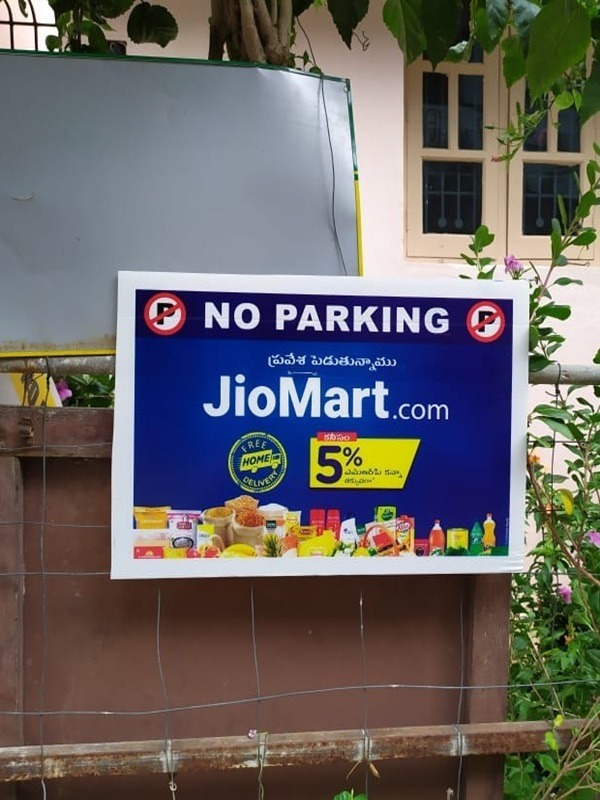
Walk up to almost any independent house or society gate in India and you will find a small board with two words: No Parking. It is functional, ignored, and — for an advertiser — the most under-used piece of media real estate in the country. Every one of those gates sits on a route that residents, domestic staff, delivery riders and visitors use several times a day, at eye level, in the exact neighbourhood a local business wants to reach. No parking board advertising takes that mandatory sign and turns it into a branded, always-on advertisement without removing the parking message that makes residents happy to keep it.
This guide is the definitive 2026 reference for the format in India: what it is, what it costs, the materials and printing behind it, how to plan coverage across a locality, and exactly when it beats — and when it loses to — a hoarding, an auto, a van or a newspaper insert. Every number here is a real, first-party figure, not an industry estimate.
What is no parking board advertising, exactly?
No parking board advertising is a hyperlocal out-of-home format in which a branded no-parking board is installed on the gate or compound wall of a residence or housing society. The board carries an advertisement in its main visual area, while a clear 'No Parking' message remains visible so it still serves its civic purpose. Because it is fixed and permission-based, it behaves like a tiny, permanent billboard at the entrance of a home — one of thousands you can place across a chosen area.
The format sits between two worlds. It has the permanence and physical credibility of signage, and the granular, household-level targeting of direct mail — without the recurring rental of a hoarding or the per-piece waste of a leaflet drop. That combination is why local-first categories like real estate, healthcare, coaching and retail keep returning to it.
How is it different from a hoarding or a poster?
A hoarding is a single large site that you rent monthly to reach passing traffic. A pole poster or wall poster is usually unpermitted, short-lived and quickly torn down. A no-parking board is different on both counts: it is placed with explicit permission on private property, and it is bought once rather than rented. Residents keep it because it genuinely marks their gate as a no-parking zone, so your brand stays put long after a poster would have disappeared.
The board: size, material and the dual-purpose layout
The standard board is 1ft × 1.5ft and made from Sunpack (sunboard) sheet — a rigid, lightweight, weather-resistant plastic substrate that holds print well and survives sun, rain and dust through a typical campaign. Its size is deliberate: large enough to read clearly from across a gate, small enough to mount neatly on a grille, pillar or compound wall without dominating the entrance or inviting objection.
Layout is what makes the format work. The 'No Parking' message stays in a clear, legible band so the board does its civic job, while the main visual area carries your logo, offer and contact details. Good design here follows a simple three-second rule: a brand mark, one line of value, and a phone or QR — nothing that competes with the parking notice for attention.
Which printing technology is used for outdoor gate boards?
Boards can be printed using four methods, chosen by budget, volume and how harsh the local weather is. UV printing cures ink instantly under ultraviolet light for the most scratch- and fade-resistant finish — worth the premium for long campaigns or high-sun belts. Solvent and eco-solvent printing give durable, weatherproof output at a lower cost, with eco-solvent adding lower odour and a more environmentally friendly ink. Digital printing is the most economical for large volumes where the campaign window is shorter.
For most residential campaigns, eco-solvent on Sunpack is the practical sweet spot: weatherproof enough for months outdoors, affordable at scale, and clean to produce. We match the method to the brief rather than defaulting to one.
How much does no parking board advertising cost in 2026?
Pricing is all-inclusive and volume-based. Under 5,000 boards, the rate is ₹45 per board. At 5,000 boards and above, it drops to ₹35 per board. Crucially, both rates already include the board, the printing, transportation to site, and installation on the gate — there is no separate production charge, no logistics line, and no monthly rental. You pay once, and the board works around the clock for the campaign period.
No parking board advertising rate card (2026, all-inclusive)
Standard
All-inclusive: board, printing, transportation and installation. Ideal for single-locality and pilot campaigns.
- 1ft×1.5ft Sunpack board
- Print, transport & install included
- No monthly rental
- Permission-based gate installation
- Geo-tagged proof of placement
Bulk
The same all-inclusive package at the bulk rate — the format's best value for city-wide or multi-locality saturation.
- 1ft×1.5ft Sunpack board
- Print, transport & install included
- No monthly rental
- Multi-locality coverage planning
- Geo-tagged proof-of-delivery report
In practice that means a 1,000-board pilot in one part of a city is roughly ₹45,000, a 5,000-board push is about ₹1,75,000 at the bulk rate, and a 10,000-board city-wide saturation is around ₹3,50,000 — all before any special customisation. The 5,000-board mark is the break-even worth planning around: crossing it cuts the per-board price by more than a fifth. For a full budget-fit comparison against newspaper inserts and auto hoods, see what a Rs.50,000 budget actually books outdoors.
How many boards does a locality actually need?
Coverage, not raw count, is what makes a hyperlocal campaign feel everywhere. The goal is enough density that a resident sees your brand on multiple gates on their normal route — at their own gate, their neighbour's, the society entrance, and the lane they walk to the market. As a planning rule of thumb, saturating a single residential pocket of a few thousand households takes a few hundred to a couple of thousand boards depending on housing type: independent-house belts need more boards per family, while a dense cluster of societies covers more residents per gate.
This is also where the price tiers interact with strategy. If your target is two or three adjacent localities, you are often already near the 5,000-board threshold — so widening coverage slightly can lower your per-board cost while increasing reach. We plan the locality map first, then size the order to land on the right side of the break-even.
When should you choose no parking boards — and when not?
Choose no parking boards when your customer is defined by where they live, when you need 24x7 repeat exposure rather than a single passing glance, and when you want to own a neighbourhood for a fraction of a hoarding's cost. They are ideal for a new clinic, a school's admission season, a builder's project catchment, a bank branch, a restaurant's delivery radius, or a candidate's ward.
They are the wrong tool when you need mass, city-agnostic reach on highways and arterial roads — that is a hoarding's or a moving format's job — or when your audience is best reached in transit rather than at home. The honest answer is that no parking boards are a precision instrument for residential reach, not a substitute for every other format. Most strong campaigns pair them with a moving format for breadth.
Which industries get the most from gate advertising?
Any business whose customers are chosen at the neighbourhood level benefits. Real estate and builders saturate the catchment around a new project or sales office. Hospitals, clinics and diagnostic labs own the residential pockets around their facility. Coaching institutes and schools reach parents during admission season. Banks, NBFCs and loan agents build branch-level recall. Jewellery, apparel and home-improvement brands dominate a locality before festive and wedding seasons. Restaurants and cloud kitchens claim their delivery radius. Home-service brands — plumbing, pest control, solar, water purifiers — convert proximity directly into calls.
How a campaign runs: permission, install and proof
A campaign moves through five stages. First we map the target localities with you and size the order against the price tiers. Second we design the dual-purpose board so the parking notice and your brand both read cleanly. Third we print on Sunpack using the method matched to your weather and window. Fourth our field team secures permission from each homeowner or the society's Resident Welfare Association and installs the board on the gate or compound wall. Fifth we hand over a geo-tagged report documenting where every board went up.
The permission step is the quiet reason the format lasts. Because consent is taken upfront and the board is genuinely useful to the resident, boards are kept rather than removed — so your brand earns weeks or months of exposure from a one-time cost. The geo-tagged report is what turns that into accountable media: you can see, gate by gate, exactly what you paid for.
Map the target localities
Pick the neighbourhoods where your customers live and size the order against the ₹45/₹35 price tiers, planning density so residents see your brand on multiple gates along their route.
Design the dual-purpose board
Lay out the board so the 'No Parking' message stays legible while your logo, offer and contact occupy the main visual area, following the three-second readability rule.
Print on Sunpack sheet
Print the 1ft×1.5ft Sunpack boards using UV, solvent, eco-solvent or digital printing, matched to the campaign's weather exposure and duration.
Secure permission and install
Our field team obtains consent from each homeowner or the society RWA, then fixes the board to the gate or compound wall at clear eye level.
Receive geo-tagged proof
After installation we share a geo-tagged proof-of-delivery report listing every board's location across the booked localities, so the spend is fully accountable.
No parking boards vs other formats: an honest comparison
No format is universally best. The table below compares no parking boards with the formats advertisers most often weigh against them, on the dimensions that actually decide a media plan — cost model, reach type, exposure pattern and the kind of goal each one serves.
No parking boards vs hoarding vs auto vs van vs newspaper
| Format | Cost model | Reach type | Exposure | Best for | |
|---|---|---|---|---|---|
| No parking boards | ₹35–₹45/board, one-time, all-inclusive | Hyperlocal, household-level | 24x7, fixed, repeat | Owning a chosen neighbourhood | |
| Hoarding | High monthly rental per site | Mass, traffic-based | Continuous but single site | Highway & arterial mass reach | |
| Auto branding | Per-auto, monthly | Mobile, city-wide | Moving, daytime | Broad city visibility on the move | |
| Mobile van branding | Per-van, per-day/route | Mobile, route-based | Moving, campaign-burst | Launch theatre & event routes | |
| Newspaper insertion | Per-thousand inserts | Household, by edition/zone | One-day, in-hand | A dated offer delivered home |
Gate boards win on cost-per-day and household-level precision; moving and mass formats win on breadth. Strong plans often pair a gate-board base with one broad-reach format.
Read across the table and the logic is clear. If your success depends on being unmistakably present in specific residential pockets, a one-time ₹35–₹45 board that works 24x7 is hard to beat on efficiency. If you need to blanket a whole city's roads regardless of where people live, a moving or mass format earns its keep. The two are complements more often than rivals.
Frequently asked questions
What size is a standard no parking advertising board?
The standard board is 1ft × 1.5ft, printed on Sunpack (sunboard) sheet. The size reads clearly from across a gate while staying compact enough to mount neatly on a grille, pillar or compound wall without dominating the entrance.
Do you need permission to install a no parking board?
Yes. Because boards are fixed to private gates and compound walls, our field team takes consent from each homeowner or the housing society's Resident Welfare Association before installing. Since the board doubles as a genuine no-parking notice, residents generally welcome it, which keeps the campaign stable.
How long does a no parking board last outdoors?
Printed on Sunpack and finished with a weatherproof method such as UV or eco-solvent, a board comfortably survives sun, rain and dust through a typical multi-month campaign. UV printing offers the most fade- and scratch-resistant finish for longer or high-sun deployments.
Is no parking board advertising legal in India?
Installed with the property owner's or society's permission on private property, gate boards are a permission-based private-property format, distinct from unpermitted pole posters or regulated public hoardings. For political or election use, follow the relevant Election Commission and local guidelines on placement and disclosures.
Which cities do you cover for no parking board advertising?
We plan and install across India's major metros, including Delhi, Mumbai, Bangalore, Hyderabad, Chennai, Kolkata, Pune, Ahmedabad, Jaipur and Lucknow, with locality-level coverage maps for each. Tell us your target areas and volume for an exact, all-inclusive quote.
Can I run a campaign in just one neighbourhood?
Absolutely — that is the format's core strength. You choose the localities and the boards appear only there. A single-pocket pilot typically runs a few hundred to a couple of thousand boards at the ₹45 rate; widening to adjacent localities can push you to the ₹35 bulk rate while increasing reach.
No parking board advertising is, at its simplest, the cheapest credible way to make a brand feel present in the neighbourhoods that matter to it. Decide the localities, size the order around the 5,000-board break-even, and a one-time ₹35–₹45 per board buys a 24x7 presence on the gates your customers pass every day. Tell us your target areas and volume and we will return an exact, all-inclusive plan with geo-tagged proof of every board.
Tags
Quick Answers
What is no parking board advertising?
No parking board advertising turns the mandatory no-parking sign outside a house or housing society into a branded, 24x7 hyperlocal advertisement. A 1ft×1.5ft Sunpack board carries your brand in the main visual area while the 'No Parking' message stays clearly visible. It is fixed to gates and compound walls with the owner's or society's permission, giving an always-on presence in the exact localities you choose.
How much does no parking board advertising cost in India?
It costs ₹45 per board for orders under 5,000 boards and ₹35 per board at 5,000 boards and above. Both rates are all-inclusive — they cover the board, printing, transportation and installation, with no monthly rental. So a 1,000-board campaign is about ₹45,000 and a 10,000-board campaign is about ₹3,50,000, before any customisation. The final figure depends on quantity, localities, printing method and permissions.
Is no parking board advertising better than a hoarding?
For hyperlocal goals, usually yes. A single hoarding is one expensive, regulated site reaching passing traffic. The same budget spent on no-parking boards puts your brand on hundreds or thousands of residential gates across the localities you pick, with 24x7 repeat exposure and no monthly rental. A hoarding still wins for mass highway reach; gate boards win for owning a neighbourhood.
Where are no parking boards installed?
They are installed on the gates and compound walls of independent houses and at the entry gates of housing societies, always with the owner's or the Resident Welfare Association's permission. Because the board doubles as a genuine no-parking notice, residents value it and keep it up, which gives your campaign a long, stable residency at eye level on the route everyone uses.
Looking for professional No Parking Board Advertising services?
The Mediaverse runs end-to-end no parking board advertising campaigns across India with geo-tagged delivery and transparent, all-inclusive pricing.
Explore our No Parking Board Advertising solutionsSummarize this guide with AI
Open this article in your favourite AI assistant
Related Guides
Written by

The Mediaverse Team
India's Leading Outdoor Advertising Agency
The Mediaverse is a national-level outdoor advertising and integrated marketing organization that provides complete OOH, ATL, BTL, retail, and transit media solutions across India. With years of experience executing high-performance campaigns for brands in FMCG, Real Estate, E-commerce, EdTech, Automotive, Healthcare, and Retail, The Mediaverse combines creativity, data-driven media planning, and flawless on-ground execution. As a full-stack outdoor advertising provider, The Mediaverse offers Auto Branding, Mobile Van Branding, Newspaper Insertion Advertising, Shop Name Board Branding, In-Store Branding, Hoardings, Transit Media, Kiosks, Mall Media, Activations, and all forms of Below-The-Line marketing. Known for its pan-India network, strategic route planning, premium print quality, and Cheqmate™ GPS-based verification, The Mediaverse ensures 100% transparent and result-oriented campaign delivery. The Mediaverse’s editorial team produces deeply researched, SEO-optimized, and generative-engine-friendly content to help businesses understand the power of outdoor advertising and make informed decisions that maximize brand visibility and ROI across urban, suburban, and rural markets.
Related Articles
Gate-to-street saturation: no-parking boards plus auto hoods in one catchment, the worked plan (2026)
The entry ticket for one catchment covered from gate to street is ₹2,83,200 landed: 1,000 gate boards plus 300 auto hoods. Seven steps, the timings for both formats, three priced plans and the honest list of what the rate card leaves out.
Outdoor advertising for clinics, pharmacies and diagnostic centres: formats, compliance and catchment (2026)
A pharmacy plan of 1,000 gate boards plus a glow sign board is ₹56,168 landed; a clinic plan of 2,000 boards plus 50,000 A5 inserts is ₹1,79,950; a diagnostic centre plan with 300 auto hoods is ₹5,36,900. Plus the rules on what a medical board may say and how far each facility's catchment reaches.
No Parking Board Advertising vs Hoardings: Which Wins for One Locality in 2026?
A hoarding looks like the premium buy — but for dominating ONE locality, it usually loses to no parking gate boards. Here is the honest, side-by-side comparison on cost model, reach, exposure and targeting, plus a clear verdict and decision checklist.