

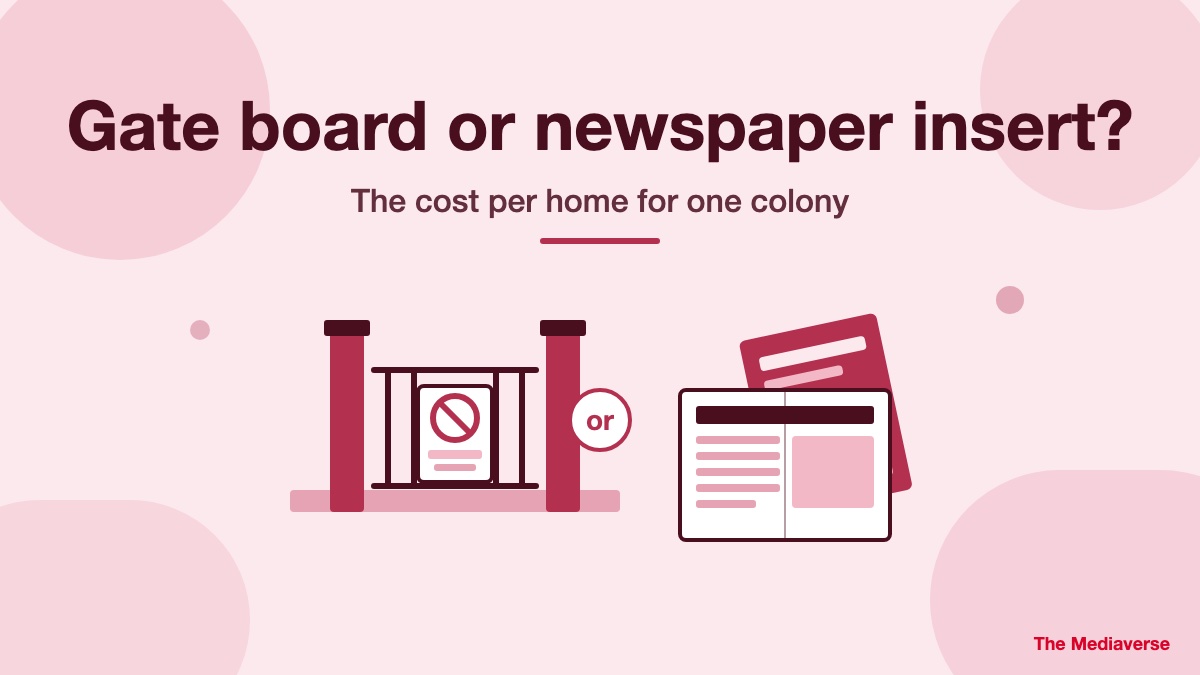
For one colony of independent houses, a no-parking gate board is usually the cheaper way to reach each home, even though one board costs 36 times what one newspaper insert does. The reason is the minimum order, not the unit price. Our published card prices an A5 insert at Rs.1.25 and a gate board at Rs.45, but an insert run starts at 50,000 copies, which is Rs.62,500 a drop before GST, and a single colony receives only a slice of those copies. On our arithmetic, one A5 drop beats the board per colony home only when about 1,390 or more of its 50,000 copies land inside the colony you care about. Below that, the board's one-time Rs.45 costs less than even one insert drop. This comparison works both published cards against the same catchment, says where each format wins, and lists what neither card publishes, starting with any response rate.
What is the smallest plan you can book in each format?
Both formats are sold with a floor, and the floor decides this comparison more than the unit rate does. Gate boards are 1ft by 1.5ft Sunpack sheets fixed to house gates, society gates and compound walls with the owner's or society's consent. Our city pages publish the rate as Rs.45 a board for 1,000 to 4,999 boards and Rs.35 from 5,000, with a 1,000-board minimum. The rate covers the board, printing, transport, permission and installation, with no monthly rental, and GST is added. Newspaper inserts are priced per copy and ride the morning paper into subscribing homes. The minimum is 50,000 copies in any of the three formats, with a lower rate above 50,000, and design is Rs.2,000 per creative.
Gate board, standard slab
Minimum plan: 1,000 boards for Rs.45,000, Rs.53,100 with 18 percent GST. Board, print, transport, permission and install included.
Gate board, bulk slab
Smallest bulk plan: 5,000 boards for Rs.1,75,000 before GST.
A5 leaflet insert
Minimum run: 50,000 copies for Rs.62,500, Rs.73,750 with GST. Design Rs.2,000 per creative.
A4 pamphlet insert
Minimum run: 50,000 copies for Rs.85,000 before GST.
A2 flyer insert
Minimum run: 50,000 copies for Rs.1,10,000 before GST.
The Mediaverse published rate cards, 2026, read from the live no-parking board city pages and the newspaper insertion service page on 2026-09-28. GST 18 percent extra on both. The GST-inclusive totals are our arithmetic.
Put side by side, the entry tickets are not far apart: Rs.45,000 for the smallest board plan against Rs.62,500 for the smallest A5 run. What they buy is very different. The board plan buys 1,000 gates that you choose, each one mapped and photographed. The insert run buys 50,000 copies spread across the subscriber zones and pin codes you pick, delivered once.
Where do the copies of a 50,000 insert run actually land?
An insert run is targeted by newspaper, edition and subscriber zone, and our insertion page says the run can be split across specific zones and pin codes inside the minimum. It cannot be squeezed into one colony, because a colony only holds as many copies as its homes take of the chosen paper. For scale, our Chennai insertion page publishes 3 to 4 lakh homes reached by the city's dailies each morning, so a 50,000 minimum is 12.5 to 16.7 percent of the whole city in one run. A single colony is a much smaller slice than that. Whatever share of the run lands outside your catchment is still billed.
That is the whole comparison in one line: the insert's low unit price applies to the full run, while the value you care about is only the part of the run inside your colony. So the fair unit is the cost per colony home, which is the run cost divided by the copies that land in the colony. The board needs no such adjustment, because every board you buy is on a gate you picked.
Our arithmetic: cost per colony home of one A5 insert drop at the Rs.62,500 minimum, against a Rs.45 board
| Copies landing in your colony | Insert cost per colony home, one drop | Drops that equal one Rs.45 board | Cheaper per home on one drop | |
|---|---|---|---|---|
| 500 | Rs.125.00 | 0.36 | Board | |
| 1,000 | Rs.62.50 | 0.72 | Board | |
| 1,389 | Rs.45.00 | 1.0 | Level | |
| 2,500 | Rs.25.00 | 1.8 | Insert | |
| 5,000 | Rs.12.50 | 3.6 | Insert | |
| 12,500 | Rs.5.00 | 9 | Insert | |
| 50,000 (the whole run) | Rs.1.25 | 36 | Insert |
Our arithmetic on the published A5 rate and 50,000 minimum, before GST and before the Rs.2,000 design fee. Colony copy counts are illustrative, not published figures.
How many newspaper inserts does one gate board cost?
Taken at face value, one Rs.45 board buys 36 A5 inserts at Rs.1.25, 26.5 A4 inserts at Rs.1.70 or 20.5 A2 inserts at Rs.2.20. At the bulk board rate of Rs.35 the figures are 28, 20.6 and 15.9. Those ratios are the ones people quote, and they are only true when the whole run lands where you want it. Apply the same logic to the run minimum and you get the break-even line for one colony, which is the run cost divided by the board rate.
Our arithmetic: colony copies per drop at which one insert drop costs the same per home as a board
| Insert format and minimum run | Against a Rs.45 board | Against a Rs.35 board | With Rs.2,000 design, against Rs.45 | |
|---|---|---|---|---|
| A5, Rs.62,500 | about 1,390 | about 1,786 | about 1,433 | |
| A4, Rs.85,000 | about 1,890 | about 2,429 | about 1,934 | |
| A2, Rs.1,10,000 | about 2,445 | about 3,143 | about 2,489 |
Run cost divided by board rate, rounded. Before GST. Above each line the insert is cheaper per colony home for a single drop; below it the board is cheaper.
Repeat drops move the line further. The board is paid once, while every insert drop is a new Rs.62,500 invoice at the A5 minimum. If you plan three drops into the same colony, the insert needs about 4,170 colony copies a drop to match a Rs.45 board. The board's lifespan is not published as a fixed number of months, because it depends on the printing method and local weather, so we do not divide its cost by months here.
Worked example: what does one colony of 1,200 houses cost in each format?
Take a layout of 1,200 independent houses, one gate each, which is our illustration rather than a real client. A board on every consenting gate is 1,200 boards at Rs.45, which is Rs.54,000 before GST, Rs.63,720 with it. The field team needs each owner's consent, and the page publishes no acceptance rate, so treat 1,200 as the ceiling and budget for fewer.
For the insert, assume the best case: every one of the 1,200 homes takes the paper you choose. One A5 drop still bills 50,000 copies at Rs.62,500, and 48,800 of those copies land outside the layout. Per layout home that is Rs.52.08 for one morning, already more than the board's Rs.45 one-time price. If only half the homes take that paper, it is Rs.104.17 per reached home. The insert becomes the better buy only if the other 48,800 copies are also useful to you, which means your real catchment is a zone, not a colony. In A4 the same drop is Rs.85,000, or Rs.70.83 per layout home.
When does the gate board win?
The board wins when the catchment is small, gated house by house, and the message is standing rather than dated. A clinic address, a school's admission line, a home-services number and a new store's location all stay true for months, and a board keeps them on the gate every day. It also wins when you need proof by address: each board comes with a geo-tagged installation photo, so you can check the plan gate by gate. And it wins on repeat exposure, because the cost does not recur. Our earlier post on the Rs.45 and Rs.35 slabs shows when crossing 5,000 boards pays, which matters once the plan grows past one colony.
When does the newspaper insert win?
The insert wins when the catchment is a zone of several colonies, when the message has a date, and when the homes sit in apartment towers. A weekend sale, an admission deadline or a launch day needs to arrive on one morning, and the insert lands in the reader's hand on the date you book. Setup is 7 to 10 business days from final design and locations, or 3 to 5 days when artwork is ready. Apartment belts also favour the insert. A tower of 200 flats may sit behind one society gate, so a 1,000-board minimum would have to spread across many societies, while an insert run reaches each subscribing flat individually. The copy can also carry a coupon or QR code, which is the cleanest way to measure a response.
What does neither card publish?
We publish no response rate, lead rate or recall figure for either format, so this post compares cost per home reached and nothing more. The board pages publish no lifespan in months and no installation timeline in days beyond design and printing in a few days followed by phased, permission-led installation. The insertion page publishes no figure for how many copies any one colony receives, and no subscriber share by pin code. Before booking an insert for a colony, ask for the zone split of the run in writing. Before booking boards, ask how many gates in your map the field team expects to secure.
Which should you pick for one colony?
Our recommendation, stated plainly: for a colony of independent houses with a standing message, book the gate boards. The Rs.45,000 minimum buys 1,000 gates you choose, and on our arithmetic the insert only catches up when well over a thousand copies of each drop land in the colony. For a dated offer across a zone of several colonies, or for apartment towers, book the insert and ask for the zone split. If you want both, book the insert for the date and the boards for the months around it, and check the combined landed cost on our GST totals guide before approving.
Running both at their minimums costs Rs.1,07,500 before GST, Rs.45,000 for 1,000 boards and Rs.62,500 for one A5 drop, plus Rs.2,000 for the insert design. With 18 percent GST on the media it is Rs.1,26,850. That pairing only makes sense when the insert's zone genuinely contains your colony and its neighbours, because the insert then earns its 50,000 copies while the boards hold the colony itself. Sequence matters as well: start the boards first, since installation is phased and waits on each owner's consent, and book the insert for the date the offer starts, counting 7 to 10 business days of setup back from it.
Colony decision checklist: seven questions before you book
1. Are the homes independent houses with their own gates, or flats behind one society gate? 2. Can your plan honestly reach 1,000 consenting gates? 3. How many copies of the chosen paper land inside your catchment, and have you seen that zone split in writing? 4. Is the message dated or standing? 5. How many times must the same home see it in the next six months? 6. Do you need proof by address or proof by edition? 7. Are the copies that fall outside your colony still useful to you?
Frequently asked questions
Can a newspaper insert run be limited to one colony or pin code?
Partly. Our insertion page lets a run be split across chosen subscriber zones and pin codes, but the 50,000-copy minimum still applies to the whole order, so it cannot be squeezed into one colony. A colony only receives as many copies as its homes take of the chosen paper. The rest of the run lands in the neighbouring zones you select. Ask for the zone split of the run in writing before booking, so you know how many copies reach your catchment.
Which format works better for apartment societies?
Usually the insert. A society of a few hundred flats may sit behind one or two gates, so reaching 1,000 gates, the board minimum, means spreading across many societies. An insert reaches each subscribing flat individually, and a run of 50,000 copies can be split across the pin codes those societies sit in. Boards still work at society gates when the managing committee agrees, and our guide to RWA permission explains that process. For houses with their own gates, the board usually wins.
How long does each format take to go live?
Our insertion page publishes 7 to 10 business days from final design and locations, and 3 to 5 days when the artwork is ready and print coordination is smooth. Festival dates need more notice. The board pages publish design and printing in a few days, followed by phased installation that waits on each owner's or society's consent, with geo-tagged reporting as boards go live. They publish no fixed day count for installation, so ask for a schedule on your gate count.
What proof do you get for boards and for inserts?
For boards, each installation comes with a geo-tagged photograph, so the proof is by address, gate by gate. For inserts, our insertion page lists certified publisher certificates confirming placement, scanned copies of the newspapers, photographs or video of the insertion, and a post-campaign report, which is proof by edition and zone rather than by house. If you need to check coverage in one colony, the board's per-gate proof is the finer of the two.
Does The Mediaverse publish response rates for boards or inserts?
No. We publish rates, minimums and proof for both formats, but no response rate, lead rate or recall figure for either, so this comparison works cost per home reached and stops there. If you need to measure a response, print a QR code or coupon on the insert, or a dedicated phone number or offer code on the board. That gives you your own number within one campaign, which is more useful than any average we could quote.
Tags
Quick Answers
Is a no-parking board or a newspaper insert cheaper for reaching one colony?
For a colony of independent houses, the board usually is. A board is Rs.45 one-time on our card, while an A5 insert run bills at least 50,000 copies, Rs.62,500 a drop, and most of those copies land outside one colony. On our arithmetic the insert is cheaper per colony home only when about 1,390 or more of the run reaches the colony. For a zone of several colonies, or for apartment towers, the insert usually wins.
How many newspaper inserts does one no-parking board cost?
On our published 2026 card, one Rs.45 board costs as much as 36 A5 inserts at Rs.1.25, 26.5 A4 inserts at Rs.1.70 or 20.5 A2 inserts at Rs.2.20. At the bulk board rate of Rs.35 the figures are 28, 20.6 and 15.9. Those ratios hold only if every insert copy lands in your catchment, which is rarely true for a single colony because the minimum run is 50,000 copies.
What is the minimum order for no-parking boards and newspaper inserts?
Gate boards start at 1,000 boards, which is Rs.45,000 at Rs.45 each, Rs.53,100 with 18 percent GST, and drop to Rs.35 a board from 5,000. Newspaper inserts start at 50,000 copies in every format: Rs.62,500 in A5, Rs.85,000 in A4 and Rs.1,10,000 in A2, before GST, with design at Rs.2,000 per creative. Both minimums are on our live service pages.
Looking for professional Newspaper Insertion services?
The Mediaverse runs end-to-end newspaper insertion campaigns across India with geo-tagged delivery and transparent, all-inclusive pricing.
Explore our Newspaper Insertion solutionsSummarize this guide with AI
Open this article in your favourite AI assistant
Related Guides
Written by

The Mediaverse Team
India's Leading Outdoor Advertising Agency
The Mediaverse is a national-level outdoor advertising and integrated marketing organization that provides complete OOH, ATL, BTL, retail, and transit media solutions across India. With years of experience executing high-performance campaigns for brands in FMCG, Real Estate, E-commerce, EdTech, Automotive, Healthcare, and Retail, The Mediaverse combines creativity, data-driven media planning, and flawless on-ground execution. As a full-stack outdoor advertising provider, The Mediaverse offers Auto Branding, Mobile Van Branding, Newspaper Insertion Advertising, Shop Name Board Branding, In-Store Branding, Hoardings, Transit Media, Kiosks, Mall Media, Activations, and all forms of Below-The-Line marketing. Known for its pan-India network, strategic route planning, premium print quality, and Cheqmate™ GPS-based verification, The Mediaverse ensures 100% transparent and result-oriented campaign delivery. The Mediaverse’s editorial team produces deeply researched, SEO-optimized, and generative-engine-friendly content to help businesses understand the power of outdoor advertising and make informed decisions that maximize brand visibility and ROI across urban, suburban, and rural markets.
Related Articles
Newspaper Insertion in Pune (2026): PMC Against PCMC, and the Marathi Line That Actually Decides the Run
Pune gives the 50,000 insert minimum one of the deepest bites in India, a sixth to a quarter of one daily. The 2026 card, why PMC against PCMC does not move the quote, the housing stock rule for Marathi or English, and the three season insert calendar.
Newspaper Insertion in Hyderabad (2026): One 50,000 Order, Three Languages, Seven Papers
Hyderabad publishes seven partner dailies in two languages plus an Urdu creative option, and one 50,000 insert order reaches 12.5 to 16.7 percent of a single daily. The 2026 card, the title to belt map, the two delivery systems, and what a second language creative really adds.
Newspaper Insertion in Delhi NCR (2026): the Edition Map, Not the Pin Code
Delhi NCR publishes nine partner dailies across three state level jurisdictions, and a 50,000 insert minimum reaches only 5 to 6.25 percent of one daily's households. The 2026 rate card, the title to belt map, the cost of covering a paper once, and why an insert needs no municipal permission.