

The cheapest auto branding campaign you can actually book in 2026 is not a hood campaign. It is 500 autos carrying the 24 inch by 6 inch back panel sticker at Rs.170 per auto, which is Rs.85,000 before GST. The hood campaign most briefs ask for starts at 300 autos at Rs.650 each, or Rs.1,95,000. Same fleet, same ten cities, same one-time billing, and a gap of Rs.1,10,000 at the floor.
This is a booking guide rather than a format argument. Which canvas suits which message is already covered in our hood against back panel comparison. What follows is only the money: what the floor costs at both sticker sizes, where the volume slabs sit and how much an order placed one auto short gives away, which sticker size is the cheaper canvas by area, and what happens if you spend the hood budget on panels instead.
Who this is for: a single-city advertiser with between Rs.85,000 and Rs.2,00,000 to spend, who wants the name moving on vehicles rather than standing on one gate, and who can approve artwork inside a week. Before you start you need three things: a locality list for the city you are buying, artwork that survives a four-to-one strip, and a decision on whether the ad has to generate a response or only be remembered. Those three choices set the quantity, the sticker size and the slab, in that order, and everything below is the arithmetic that follows from them.
What does the cheapest bookable auto campaign cost in 2026?
Our back panel page publishes four rates and one minimum. The 24 inch by 6 inch sticker is Rs.170 per auto for orders of 500 to 799 autos and Rs.140 per auto from 800 autos up. The larger 24 inch by 18 inch sticker is Rs.270 and Rs.240 across the same two slabs. The minimum order is 500 autos. Every rate is one-time and covers design, printing and installation, so there is no monthly rental to renew and nothing to pay again if the sticker outlives the campaign. GST at 18 percent is extra, and the auto branding hub adds that some areas charge an auto-union fee, billed at actuals.
Five hundred autos is the unit of purchase rather than an estimate of availability. Our auto branding hub states that fleets of hundreds to thousands of autos are available in major cities, so the minimum is a commercial floor and not a supply limit, and it applies city by city. What the floor buys is 500 vehicles working their own routes through the localities you pick, for roughly four to six months, with print and fitting paid for once. There is no renewal date anywhere in the model, which is why the monthly framing every other medium uses does not transfer to it.
Entry ticket for every auto format at its published minimum, 2026
Back panel sticker, 24x6 inch
The smallest auto order on the card. Rs.1,00,300 landed with 18 percent GST.
- Minimum order 500 autos
- Rs.170 per auto for 500 to 799
- Rs.140 per auto from 800 up
- Published life 4 to 6 months
Back panel sticker, 24x18 inch
Three times the print area of the 24x6 strip. Rs.1,59,300 landed with GST.
- Minimum order 500 autos
- Rs.270 per auto for 500 to 799
- Rs.240 per auto from 800 up
- Room for an offer and a QR code
Auto hood cover
The awareness format, and the highest floor of the three. Rs.2,30,100 landed with GST.
- Minimum order 300 autos
- Rs.650 per auto for 300 to 499
- Rs.630 per auto from 500 up
- Published life 6 to 12 months
Published 2026 pan-India auto rate card. All rates are one-time print plus installation, not monthly rent. GST 18 percent extra, and an auto-union fee applies at actuals in some areas.
By our arithmetic the sticker floor is 44 percent of the hood floor, and the Rs.1,10,000 between them before tax is the reason this format sits on the card at all. A business that cannot sign Rs.1,95,000 can still put a campaign on 500 autos in one city this month. Landed totals for every format at its own minimum, with the tax line worked out, are in our post on what outdoor advertising costs after GST.
One honest qualification on the word cheapest. This is the cheapest auto campaign on our card, not the cheapest outdoor campaign we sell. A thousand no-parking boards at Rs.45 each is Rs.45,000, and 50,000 A5 newspaper inserts at Rs.1.25 a copy is Rs.62,500, both below the Rs.85,000 auto floor. What the auto floor buys that neither of those does is a moving surface: a board stays on one gate and an insert is read once on one morning, while a branded auto carries the same message through several localities every day for months. Whether that is worth the extra Rs.22,500 to Rs.40,000 is a question about the brief, not about the rate card.
Why does ordering 800 back panels cost less than ordering 799?
Because both sticker sizes change slab at exactly 800 autos, and the drop is steep enough to swallow the extra unit whole. At 799 panels you pay Rs.170 each, which is Rs.1,35,830. At 800 panels you pay Rs.140 each, which is Rs.1,12,000. The 800th auto does not cost Rs.140. It saves Rs.23,830.
Where each auto format changes slab, and what the unit that crosses it is worth
| Published slab break | Order one unit below the break | Order at the break | What crossing the break saves | |
|---|---|---|---|---|
| Back panel sticker, 24x6 | 800 autos, Rs.170 down to Rs.140 | 799 autos, Rs.1,35,830 | 800 autos, Rs.1,12,000 | Rs.23,830 and one more auto |
| Back panel sticker, 24x18 | 800 autos, Rs.270 down to Rs.240 | 799 autos, Rs.2,15,730 | 800 autos, Rs.1,92,000 | Rs.23,730 and one more auto |
| Auto hood cover | 500 autos, Rs.650 down to Rs.630 | 499 autos, Rs.3,24,350 | 500 autos, Rs.3,15,000 | Rs.9,350 and one more auto |
The more useful number is where the crossover actually begins, and that one is ours rather than the card’s. Eight hundred panels at Rs.140 cost Rs.1,12,000, and Rs.1,12,000 divided by Rs.170 is 658.8 autos. So from 659 panels upwards, an exact order at the higher rate costs more than simply taking 800 at the lower one. On the 24x18 sticker the same division puts the crossover at 712 panels, and on hoods, where 500 autos at Rs.630 is Rs.3,15,000, it sits at 485 autos.
That gives three dead bands on our own rate card: 659 to 799 autos on the 24x6 sticker, 712 to 799 on the 24x18, and 485 to 499 on hoods. Any quantity inside one of them is more expensive than the next slab up, and the extra autos are free rather than merely cheap. If your zone plan lands in a dead band, order up to the break and put the spare units in the next locality.
This works against our own invoice, which is why it belongs in public. A rate card is a card. It does not warn you that 799 is the single worst quantity printed on it.
Which back panel sticker size is cheaper per square inch?
The 24x6 sticker is 144 square inches of print. The 24x18 is 432 square inches, three times the area, and it costs 59 percent more at Rs.270 against Rs.170. Rate divided by area is the only honest way to compare the two canvases, and it reverses the intuition that the small one is the cheap one.
Cost per square inch of print at each published slab
| Print area | Rate at 500 to 799 autos | Cost per square inch | Rate at 800 autos and above | Cost per square inch at 800 plus | |
|---|---|---|---|---|---|
| Back panel sticker, 24x6 | 144 square inches | Rs.170 per auto | Rs.1.18 | Rs.140 per auto | Rs.0.97 |
| Back panel sticker, 24x18 | 432 square inches | Rs.270 per auto | Rs.0.63 | Rs.240 per auto | Rs.0.56 |
So the cheap-looking sticker is the expensive one by area, at close to twice the cost per square inch at both slabs. What the Rs.170 strip actually buys is a letterbox four times wider than it is tall, which holds a name, a category and a phone number and nothing else. The Rs.270 sticker holds a name, an offer and a QR code at a size a person in the next vehicle can actually scan. If the campaign has to carry a response mechanism, the larger sticker is both the better canvas and the cheaper one by area.
One figure is missing from that table on purpose. We do not publish the print area of a hood cover anywhere on the site, so there is no honest like-for-like cost per square inch for the hood, and estimating one would be inventing a number. The hood is plainly the bigger canvas, seen from behind and from above by anyone walking past a queue of autos, and that is as far as the published data lets anyone go.
What does a panel cost per auto per month, and what does the hood budget buy in panels?
Both formats are billed once, so cost per auto per month is arithmetic against the published material life rather than a price on any card. Our pages publish 4 to 6 months for a back panel sticker and 6 to 12 months for a hood cover, both as typical ranges from our own campaigns rather than a warranty. At the 500-auto entry rate of Rs.170, a panel is Rs.28 to Rs.43 per auto per month. A hood at Rs.650 is Rs.54 to Rs.108. The table below uses the 800-plus rates instead, because that is what the same money actually buys.
Rs.1,95,000, the hood floor, spent three ways
| Units at that spend | Rate used | Published life | Cost per auto per month | Auto-months on the road | |
|---|---|---|---|---|---|
| Back panel sticker, 24x6 | 1,392 autos | Rs.140 per auto | 4 to 6 months | Rs.23 to Rs.35 | 5,568 to 8,352 |
| Back panel sticker, 24x18 | 812 autos | Rs.240 per auto | 4 to 6 months | Rs.40 to Rs.60 | 3,248 to 4,872 |
| Auto hood cover | 300 autos | Rs.650 per auto | 6 to 12 months | Rs.54 to Rs.108 | 1,800 to 3,600 |
At the pessimistic end of each published life, 1,392 panels give 5,568 auto-months against 1,800 for 300 hoods, roughly three times as much presence for the same Rs.1,95,000. Read that for what it is: a count of vehicles multiplied by months. It says nothing about recall, enquiries or sales, and we publish no response benchmark that would let anyone convert it into one. A hood is a far larger surface on a vehicle a pedestrian sees from behind and above, and the reason this comparison stops at presence is that presence is the only part of it our data actually supports.
One question the card does not answer is what happens at month five. Because billing is one-time, a refresh is a new order rather than a renewal, and none of our pages state whether re-printing on autos already carrying your sticker is priced any differently from a fresh 500. If the campaign is meant to run a full year, ask for that in writing before the first order, because at the published rates a second round at the minimum is another Rs.85,000 and a second 800-panel round another Rs.1,12,000.
How do you book 500 back panels without giving money away?
Set the quantity from the slab, not from the budget
Before anything else, check your number against the three dead bands. On the 24x6 sticker, anything from 659 to 799 autos should become 800. On the 24x18, anything from 712 to 799 should become 800. On hoods, 485 to 499 should become 500. This single check is worth up to Rs.23,830 on a back panel order and Rs.9,350 on a hood order, and it is the cheapest decision in the whole process because it costs nothing but arithmetic.
Choose the size by print area and by message, not by headline price
The 24x6 strip at Rs.170 is Rs.1.18 per square inch; the 24x18 at Rs.270 is Rs.0.63. If the ad only has to say who you are and where you are, the strip is enough. The moment it has to carry an offer, a discount code or a QR code that works at two metres in traffic, buy the 432 square inch canvas. Ordering the strip and then cramming an offer into it is the most common way this format is wasted.
Fix the city and the zone split before the artwork
The 500 auto minimum is published per city, not per campaign, so 250 autos in Bangalore and 250 in Pune does not clear it in either place. Inside one city, decide the split across localities before design, because a strip sticker read at a signal in a market lane and one read on a ring road are not the same brief. Our multi-city post sets out how the per-city minimums stack up on a national plan.
Get GST and the union fee into the quote in writing
Every rate on our cards is pre-tax. On a 500-panel order at Rs.170, the 18 percent GST is Rs.15,300, which takes Rs.85,000 to Rs.1,00,300. The auto branding hub also states that some areas charge an auto-union fee, billed at actuals, and that is the one line on a back panel quote that is not fixed in advance. Ask which stands or localities in your plan carry it and what the fee was the last time it was paid there.
Design for a four-to-one letterbox
A 24 by 6 inch sticker is a 4:1 strip. Logos stacked over a tagline over a number will not survive it. One line of type at the largest size the strip allows, one number, and nothing that depends on being read for more than two seconds. The 24x18 is a 4:3 panel and behaves like a small poster. Our post on what actually reads from 20 feet at a signal covers the type sizes and contrast that hold up on a moving auto.
Book the install window, and ask exactly what express means
Plan on 2 to 5 working days from artwork approval for a 500-panel install and get the date in writing. Our own pages publish this more than once and not identically: 2 to 3 working days with 24 hour express on the service page, a 48 hour setup on the city pages, and 48 hours to 5 days in the FAQ data on the national page. Stickers do fit faster than hood wraps, which are published at 3 to 5 working days.
Agree the proof and the replacement clock before a sticker goes on
The back panel page publishes photo-verified proof of installation and route reporting for every campaign, and our city pages publish free replacement of a damaged or early-faded unit within 48 hours. Ask for the install photos as a dated set covering all 500 autos rather than a sample, because 500 units is the scale at which sampling starts to hide gaps, and ask who calls in a peeled sticker: the driver, the field auditor or you.
Is the back panel rate the same in every city?
Yes, on every page we publish. All ten city auto pages, Bangalore, Mumbai, Delhi, Hyderabad, Chennai, Pune, Kolkata, Ahmedabad, Jaipur and Lucknow, carry the same Rs.170 and Rs.140 for the 24x6 sticker, the same Rs.270 and Rs.240 for the 24x18, and the same 500 auto minimum. We checked all ten for this post rather than assuming it, because it is not true of everything we sell: our mobile van day rates differ city by city, which we wrote about separately. For back panels the only published variables are the 18 percent GST and the auto-union fee that some areas charge at actuals.
The material specification is published too, and it is worth asking a cheaper vendor about by name. Hood covers are 100-micron rexine with UV-stabilised lamination. Back panels are sealed-edge vinyl with rain-proof lamination, described as anti-fungal on the Chennai page for coastal humidity. Our Bangalore page calls 80 micron the industry standard that typically shows fading and peeling within 60 days, and that is the number to hold a quote of Rs.90 or Rs.100 a panel against. A sticker that fails inside two months is not a cheaper campaign, it is a shorter one.
What we do not publish, and how that should change your plan
Three gaps, named plainly. There is no print area for a hood cover anywhere on the site, so a cost per square inch across the two formats cannot be calculated and is not attempted here. The impression figures on our own pages do not agree with each other: the auto branding hub describes 30,000 to 50,000 daily impressions for a branded auto while the back panel page describes 30,000 plus monthly impressions, and neither is a third-party audited measurement, which is why no cost per impression appears anywhere in this post. And the lead time is written in at least three different ways across our pages, so 2 to 5 working days is the honest planning range.
What that leaves you is a format whose price, minimum, inclusions, slab breaks and expected life are all published and checkable, and whose performance is not. Buy it for what the card actually promises, which is 500 or more vehicles carrying your name through chosen localities for roughly four to six months at a one-time cost, and measure the response yourself with a distinct number or a QR code that lands on a page you control.
Measurement is the part you own. Put a phone number on the sticker that rings nowhere else, or a QR code that lands on a page with its own tracking, and a presence buy becomes countable at no extra cost. Without one of the two, honest reporting on 500 panels stops at installation photos, routes and the published material life, which is exactly what our own pages promise and no more than that.
What should you confirm before signing a 500-panel order?
Five lines to get in writing on a back panel quote
| Why it matters at 500 panels | What our pages already publish | |
|---|---|---|
| The quantity and the slab it sits in | A quantity inside a dead band costs more than the next slab up, by up to Rs.23,830 | Rs.170 for 500 to 799 autos, Rs.140 from 800 up, on the 24x6 sticker |
| Sticker size and print area | The two sizes differ by 288 square inches and Rs.100 per auto, and only one of them holds a QR code | 24x6 inch at Rs.170, 24x18 inch at Rs.270, both one-time |
| Tax and any union fee | GST turns Rs.85,000 into Rs.1,00,300, and the union fee is the only unfixed line on the quote | GST 18 percent extra; some areas charge an auto-union fee at actuals |
| Install date and proof | A 500-auto fit is a scheduling job, and photo proof is how you know it happened | Published lead times of 24 hours to 5 days, photo-verified proof of installation |
| Material and replacement | A sticker that peels in 60 days makes the cheapest campaign the most expensive one | Sealed-edge vinyl with rain-proof lamination, free replacement within 48 hours |
If you want it quoted, ask for three numbers on the same sheet: 500 panels, 800 panels and your own planned quantity. The slab will show up in the totals, and you will be able to see for yourself which of the three is the one to sign. The back panel page carries the current card, and the contact form on it reaches the team that fits these campaigns.
Frequently asked questions
How long does a back panel sticker last on the road?
Our pages publish 4 to 6 months for a back panel sticker and 6 to 12 months for a hood cover. Both are typical ranges from our own campaigns rather than a guaranteed service life, because a rear panel takes more knocks, washing and direct handling than a hood does. The rate is one-time either way, so a sticker that survives longer keeps working at no extra charge, and a unit that tears or fades early is replaced free within 48 hours.
Does the back panel rate change from city to city?
No. All ten city pages we publish, from Bangalore and Mumbai to Jaipur and Lucknow, carry the same Rs.170 and Rs.140 for the 24x6 sticker, the same Rs.270 and Rs.240 for the 24x18, and the same 500 auto minimum. Our mobile van day rates do differ by city, so the flat auto card is a feature of the format rather than a general policy. GST and a local auto-union fee in some areas are the published extras.
How quickly can 500 back panels go live?
Plan on 2 to 5 working days from artwork approval and get the date in writing. Our pages publish this figure more than once and not identically: the service page says 2 to 3 working days with express at 24 hours, the city pages advertise a 48 hour setup, and the FAQ data on the national page says 48 hours to 5 days. Stickers do fit faster than full hood wraps, which are published at 3 to 5 working days.
What is the landed cost of 500 back panels with GST?
Rs.1,00,300 for the 24x6 sticker and Rs.1,59,300 for the 24x18, taking the published Rs.170 and Rs.270 rates at the 500 auto minimum and adding 18 percent. Every rate card on our site quotes pre-tax, so the tax line is yours to budget for. If your business claims input tax credit that GST is recoverable, which changes the real cost of the campaign, and it is worth confirming with your accountant before you compare formats.
What proof do you get that 500 stickers were actually installed?
Photo-verified proof of installation for every auto and route reporting are what the back panel page publishes, alongside free replacement of damaged units within 48 hours and field audits after the fit. Ask for the install photos as a dated set covering the full order rather than a sample, because 500 units is the scale at which sampling starts hiding gaps. The impression estimates on the page are our own and are not third-party audited.
Tags
Quick Answers
What is the cheapest auto branding campaign you can book in India?
Five hundred autos carrying the 24 inch by 6 inch back panel sticker at Rs.170 per auto, which is Rs.85,000 before GST and Rs.1,00,300 with it. That is the smallest auto order our published card accepts. Hood branding starts at 300 autos at Rs.650 each, or Rs.1,95,000, so the back panel floor sits Rs.1,10,000 below it. Both rates are one-time per auto and include design, printing and installation.
How much does auto back panel branding cost per auto in 2026?
The 24 inch by 6 inch sticker is Rs.170 per auto for 500 to 799 autos and Rs.140 from 800 autos up. The 24 inch by 18 inch sticker is Rs.270 and Rs.240 across the same slabs. The minimum order is 500 autos, the charge is one-time rather than monthly, and GST at 18 percent is extra. Some areas also charge an auto-union fee, billed at actuals.
Is it cheaper to order 800 back panel stickers than 799?
Yes, by Rs.23,830 on the 24x6 sticker. At 799 panels the rate is Rs.170, so the order is Rs.1,35,830. At 800 panels the rate drops to Rs.140 and the order is Rs.1,12,000, for one more auto. By our own arithmetic the crossover starts at 659 panels, so any quantity from 659 to 799 costs less if you order 800 instead. On the 24x18 sticker the crossover starts at 712.
Which back panel sticker size is better value?
The 24 inch by 18 inch, measured by print area. It is 432 square inches against 144 for the 24x6, three times the canvas for 59 percent more money, which is Rs.0.63 per square inch against Rs.1.18 at the 500 to 799 slab. The smaller strip is four times wider than it is tall and holds a name and a number. The larger one holds an offer and a readable QR code.
Looking for professional Auto Branding services?
The Mediaverse runs end-to-end auto branding campaigns across India with geo-tagged delivery and transparent, all-inclusive pricing.
Explore our Auto Branding solutionsSummarize this guide with AI
Open this article in your favourite AI assistant
Related Guides
Written by

The Mediaverse Team
India's Leading Outdoor Advertising Agency
The Mediaverse is a national-level outdoor advertising and integrated marketing organization that provides complete OOH, ATL, BTL, retail, and transit media solutions across India. With years of experience executing high-performance campaigns for brands in FMCG, Real Estate, E-commerce, EdTech, Automotive, Healthcare, and Retail, The Mediaverse combines creativity, data-driven media planning, and flawless on-ground execution. As a full-stack outdoor advertising provider, The Mediaverse offers Auto Branding, Mobile Van Branding, Newspaper Insertion Advertising, Shop Name Board Branding, In-Store Branding, Hoardings, Transit Media, Kiosks, Mall Media, Activations, and all forms of Below-The-Line marketing. Known for its pan-India network, strategic route planning, premium print quality, and Cheqmate™ GPS-based verification, The Mediaverse ensures 100% transparent and result-oriented campaign delivery. The Mediaverse’s editorial team produces deeply researched, SEO-optimized, and generative-engine-friendly content to help businesses understand the power of outdoor advertising and make informed decisions that maximize brand visibility and ROI across urban, suburban, and rural markets.
Related Articles
Minimum Orders Are Per City, Not Per Campaign: What a 10-City Outdoor Rollout Really Floors At (2026)
Every city page publishes its own minimum: 300 autos for hood branding, 500 for back panel stickers, 1,000 no-parking boards, 50,000 insert copies. Multiply by ten cities and a national campaign floors between Rs.4,50,000 and Rs.19,50,000, which decides the shape of the plan before creative does.
Auto Branding for Restaurant and Cloud Kitchen Launches: The Delivery-Radius Zone Playbook (2026)
Auto branding is priced and deployed by zone, which makes it the outdoor format that can be pointed at a restaurant or cloud kitchen's own delivery radius. Published rates, worked launch-campaign totals, and a five-step zone mapping process.
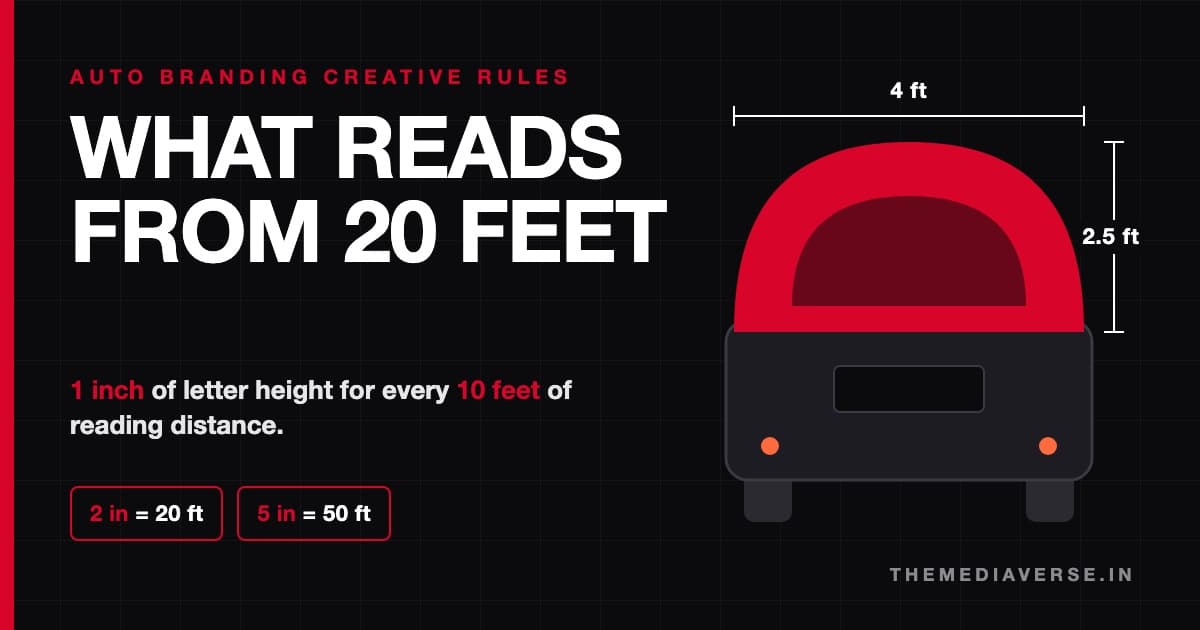
Auto branding creative rules: what actually reads from 20 feet at a signal (2026 playbook)
An auto hood is 4 ft by 2.5 ft and reads at roughly 1 inch of letter height per 10 feet. Eight creative rules ranked by what a reprint on 300 autos costs, plus the paper test to run before the print run.