

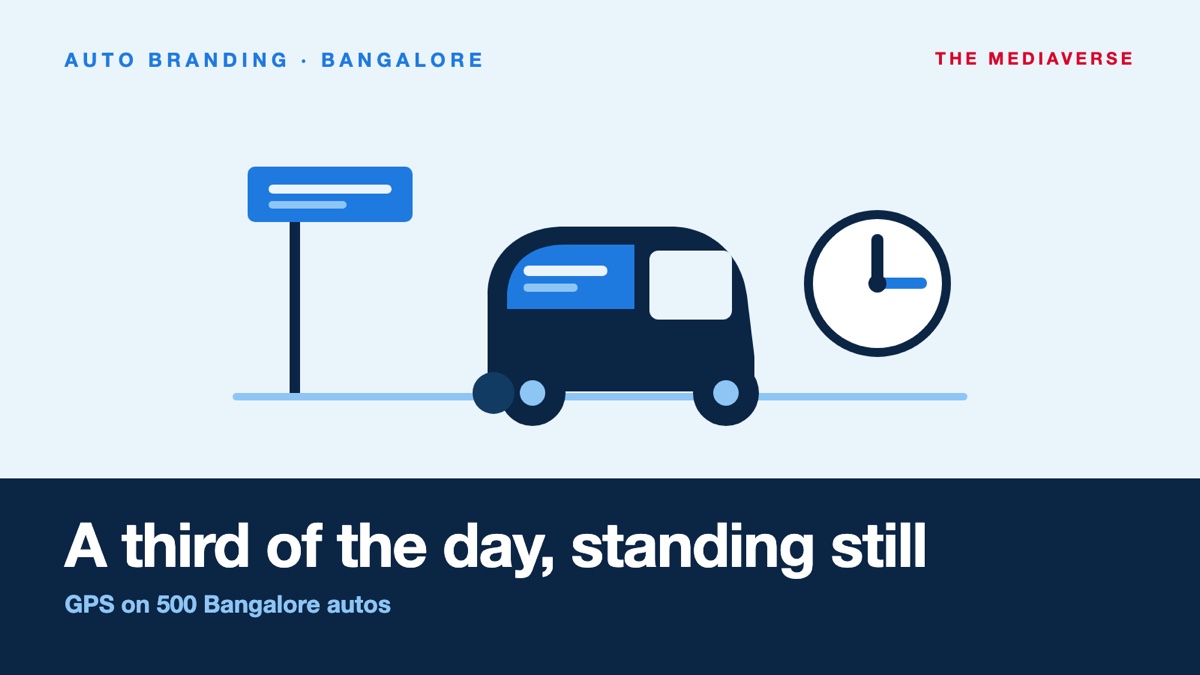
Our GPS tracking of 500 Bangalore autos shows the average auto spends approximately 35 percent of its operating hours standing still. Not driving, not carrying a passenger: parked at a stand, idling at a chai stall, waiting at a hospital gate. That is the single most useful number we publish about auto branding, and until now no post on this blog had used it.
It matters because of what a branded auto is during those hours. Moving, it is a passing impression at traffic speed. Stopped, it is a small hoarding standing two feet from a queue of people with nothing to look at. The rate does not change between the two states: a hood is Rs.650 per auto one-time for 300 to 499 autos and Rs.630 from 500 up, whether the auto spends its day in third gear or at a stand.
So the planning question is not how many autos to book. It is where the fleet you book is going to stand still, and for how long. This post compares the four stop types we have dwell data for, then compares the five Bangalore hubs and three residential pockets whose fleet sizes we publish, and ends with a verdict on where a 300-auto minimum order actually buys dominance instead of decoration.
How long does a branded auto actually stand still?
These are the dwell averages published on our Bangalore auto branding page, from the same GPS study of 500 autos. Read them as averages per stop, not as daily totals, because that distinction is where most planning goes wrong.
Published average dwell per stop type, Bangalore GPS study of 500 autos
| Stop type | Published average dwell | Against the shortest stop | Who is standing next to the auto | |
|---|---|---|---|---|
| Auto stand | 45 minutes | 3.0 times a tech park gate stop | Waiting riders, shopkeepers, the queue behind | |
| Hospital entrance | 25 minutes | 1.7 times | Attendants and families with long idle waits | |
| Chai stall | 20 minutes | 1.3 times | Drivers, office staff on a break, local foot traffic | |
| Tech park gate | 15 minutes | The shortest of the four | Employees filing past on entry and exit |
The named hotspots behind those averages are on the same page: the Koramangala 5th Block stand, the ITPL gate, Majestic bus station and JP Nagar market. If your creative is a phone number or a QR code rather than a logo, those four locations are where it has a chance of being read rather than glimpsed, because a 45-minute stop is the only part of the day when a stranger has time to take a photograph of your auto.
Now the honest limit of the table. We publish the average length of a stop and we do not publish how often an auto makes each kind of stop. Without that second number, nobody can multiply their way to total stationary minutes per location type, including us. The 35 percent figure is a whole-day total across all stops, not a sum you can rebuild from the four rows above, and any vendor who hands you a neat minutes-per-day-per-location table has built it out of assumptions rather than data.
One more limit worth stating plainly: this dataset is Bangalore only. No other city page on our site publishes a dwell study, so a Kolkata or Jaipur plan that quotes 35 percent is quoting a Bangalore number in a city with different stand density, traffic and working hours. We are not going to extend it for you, and you should be sceptical of anyone who does.
Which Bangalore hub does a 300-auto order actually cover?
The minimum hood order is 300 autos. Our Bangalore page publishes the fleet size at each of five high-density hubs, from the auto coordination network for 2024 to 2026, which makes the next calculation possible. Every share below is a ceiling, because each published fleet figure carries a plus sign and the real fleet is at least that large.
What the minimum and the 500-auto slab can cover at each published hub
| Hub | Published fleet size | Share at the 300-auto minimum | Share at 500 autos | |
|---|---|---|---|---|
| Majestic metro and bus hub | 3,000 or more autos | No more than 10 percent | No more than 16.7 percent | |
| Electronic City toll | 1,500 or more autos | No more than 20 percent | No more than 33.3 percent | |
| Whitefield ITPL gate | 1,200 or more autos | No more than 25 percent | No more than 41.7 percent | |
| Koramangala 5th Block | 800 or more autos | No more than 37.5 percent | No more than 62.5 percent | |
| MG Road metro exit | 600 or more autos | No more than 50 percent | No more than 83.3 percent |
Read the third column across, because it is the whole argument. The same purchase order, the same Rs.1,95,000 at the 300-auto minimum, is a tenth of the fleet at Majestic and half the fleet at the MG Road metro exit. At Majestic a rider watching the auto queue sees nine unbranded autos for every one of yours. At MG Road they see one for one. Nothing about the rate card tells you that, and it is the difference between a campaign people notice and a campaign that exists only in the report.
The counter-argument for Majestic is volume, and our page publishes the basis for it: approximately 2 lakh daily commuters transition from metro or bus to auto at that hub, against a Bangalore Metro system carrying roughly 6 lakh daily riders in total, per the BMRCL figure cited on our page. Majestic is where the people are. It is also where your 300 autos are hardest to see. Both things are true, and a plan that does not name the trade-off is hiding it.
What does the same order do inside a residential pocket?
The three residential zones we publish are a different shape of the same problem. Fleet numbers are smaller, resident numbers are large, and the lanes are places vans and buses physically cannot go, with autos navigating them 40 to 60 times a day according to the same page.
The three published residential pockets against a 300-auto order
| Zone | Published residents | Published autos operating inside | Share at 300 autos | Residents per branded auto at 300 | |
|---|---|---|---|---|---|
| BTM Layout 1st and 2nd Stage | About 4 lakh | About 400 circulating daily | About 75 percent | 1,333 | |
| Marathahalli, Bellandur and Sarjapur pocket | About 6 lakh | 1,000 or more in a 5 km pocket | No more than 30 percent | 2,000 | |
| JP Nagar, Banashankari and Jayanagar triangle | About 8 lakh | 1,500 or more | No more than 20 percent | 2,667 |
BTM is the outlier and the lesson. Three hundred autos inside a fleet of about 400 is roughly three in four autos in the neighbourhood carrying one brand, which is the closest thing to saturation that Rs.1,95,000 can buy anywhere in this city. Our own page uses a far more conservative example, a 50-auto cluster, which is about 12.5 percent of that fleet and is the sensible starting size. The point of the table is the ceiling, not the recommendation.
Notice also that autos per lakh residents is not constant: about 100 in BTM against roughly 167 in the Marathahalli pocket and about 188 in the JP Nagar triangle, by our own division of the published figures. Fleet density and population density do not move together, so a fixed 300-auto order lands as a different level of saturation in each of the three zones, and the zone with the most residents is the one where your order disappears fastest.
What does an hour of standing still actually cost?
Because the rate is one-time, the stationary hours are free after the first payment, which makes cost per stationary hour a fair way to read the 35 percent figure. One warning before the table: we publish no figure for daily operating hours per auto, so the hours column below is an assumption you supply, and the campaign length comes from our published material life of 6 to 12 months for a hood.
Cost per stationary hour on a Rs.650 hood, our arithmetic on the published 35 percent
| Assumed operating day | Stationary hours per day at 35 percent | Cost per stationary hour over 6 months | Cost per stationary hour over 12 months | |
|---|---|---|---|---|
| 8 hours | 2.8 hours | Rs.1.29 | Rs.0.64 | |
| 10 hours | 3.5 hours | Rs.1.03 | Rs.0.51 | |
| 12 hours | 4.2 hours | Rs.0.86 | Rs.0.42 |
Even at the least generous row, an auto standing still costs about a rupee and a quarter an hour for six months, and the figure halves if the material survives the full published year. That is the real argument for the format, and it is an arithmetic argument rather than a claim about recall or response, neither of which we publish a benchmark for. What the money buys is presence-hours. What those hours are worth to your business depends on the offer on the panel.
When does the transit hub win, and when does the residential pocket?
Take the hub when the campaign is about volume of first impressions and you can afford to be one voice among many: a launch with a citywide message, a category nobody has to be taught, or a budget that clears 500 autos so the fleet share stops being a rounding error. The MG Road metro exit is the exception that works at the minimum, because 600 or more autos is small enough for 300 to register.
Take the residential pocket when frequency against the same faces matters more than raw reach: a coaching centre, a clinic, a food delivery brand, a PG-targeted service, anything where the buyer needs to see you four or five times before acting. A pocket also survives a smaller budget with its dignity intact, because share of fleet is what people actually perceive, and 50 autos inside BTM reads as more present than 300 scattered across Majestic.
Neither fits when your catchment is a single building or a single street, which is smaller than an auto route, or when the message needs more than a glance and there is no stand in the catchment to give it one. In those cases the honest answer is a different format, and our no-parking board and hood saturation playbook covers the arithmetic for the gate-level version of this problem.
Our verdict
At the 300-auto minimum, take the residential pocket. The published numbers only support hub dominance at MG Road, and everywhere else the minimum order buys between a tenth and a quarter of a hub fleet, which is the level at which a campaign is visible in a report and invisible on the road. Above 500 autos the calculation changes and the hubs become reasonable, because 500 is more than 40 percent of the ITPL gate fleet and more than 60 percent of Koramangala 5th Block.
If you want this run on your own catchment, the practical way to brief it is to name the zone rather than the quantity, let the fleet size in that zone set the order, and ask for the stand list your autos will actually idle at. Our Bangalore page carries the fleet figures for all five hubs and all three residential pockets, and the rate card is the same Rs.650 and Rs.630 wherever you point it.
Placement checklist before you sign
- Which zone is the order for, and what is the published or quoted fleet size in that zone?
- What share of that fleet does my quantity represent, and would a passer-by notice that share?
- Which named stands will these autos idle at, and are they inside my catchment or just near it?
- Does my creative work at a 15-minute glance, or does it need a 45-minute stop to be read?
- Am I buying reach at a hub or frequency in a pocket, and does my product need to be explained?
- If the answer is a hub, does the budget clear 500 autos, and if not, which smaller hub fits the quantity?
How much of the day does a branded auto spend parked?
Approximately 35 percent of operating hours, according to the GPS tracking of 500 Bangalore autos published on our Bangalore auto branding page. The study breaks that time across auto stands at an average of 45 minutes per stop, hospital entrances at 25, chai stalls at 20 and tech park gates at 15. It does not publish how many stops of each type an auto makes in a day, so the stop averages cannot be rebuilt into a daily total.
Is 300 autos enough to dominate a Bangalore auto stand or hub?
It depends entirely on the hub, and the gap is large. Against the fleet sizes we publish, 300 autos is no more than 10 percent of the Majestic fleet of 3,000 or more, and no more than 50 percent of the MG Road metro exit fleet of 600 or more. Our own recommendation at the minimum order is a residential pocket instead, where 300 autos can reach about 75 percent of the roughly 400 autos circulating inside BTM Layout.
Does an auto branding rate change if the auto stands still more often?
No. The published hood rate is Rs.650 per auto one-time for 300 to 499 autos and Rs.630 from 500 up, everywhere in Bangalore and in the other nine cities we publish cards for, and a back panel sticker is Rs.170. Nothing in the pricing is tied to distance covered, hours worked or time spent stationary, which is why stationary time is effectively free presence once the one-time charge is paid.
Can I use the 35 percent stationary figure for a campaign in another city?
We would not. The study covers 500 autos in Bangalore and no other city page on our site publishes a dwell dataset, so applying it to Kolkata, Jaipur or Delhi means assuming identical stand density, traffic patterns and working hours across very different cities. Use it as a Bangalore planning figure and treat any vendor quoting it nationally as someone borrowing a number rather than measuring one.
What does a branded auto cost per hour of standing still?
Between Rs.1.29 and Rs.0.42 an hour on a Rs.650 hood, by our own arithmetic on the published 35 percent. The spread comes from two assumptions: the operating day, where an 8-hour day gives 2.8 stationary hours and a 12-hour day gives 4.2, and the campaign life, where our pages publish 6 to 12 months for a hood. We publish no operating-hours figure, so the day length is yours to supply.
Tags
Quick Answers
What percentage of the day does a branded auto spend stationary?
Approximately 35 percent of operating hours, from the GPS tracking of 500 Bangalore autos published on our Bangalore auto branding page. The same study puts the average stop at 45 minutes at an auto stand, 25 minutes at a hospital entrance, 20 at a chai stall and 15 at a tech park gate. During those hours a branded auto works as a small stationary hoarding at no extra charge, because the rate is one-time.
Where should a 300-auto Bangalore campaign actually be placed?
In a residential pocket rather than a transit hub, on the numbers we publish. Three hundred autos is about 75 percent of the roughly 400 that circulate inside BTM Layout, but no more than 10 percent of the Majestic hub fleet of 3,000 or more. The exception is the MG Road metro exit, where a fleet of 600 or more means the minimum order can reach no more than half and still register.
How much does stationary auto advertising cost per hour?
Between Rs.1.29 and Rs.0.42 per stationary hour on a Rs.650 hood, by our own arithmetic. A 10-hour operating day gives 3.5 stationary hours at the published 35 percent, which is Rs.1.03 an hour across a 6-month campaign and Rs.0.51 across 12 months. We publish no operating-hours figure, so the day length is an assumption the buyer supplies rather than a number we measured.
Which auto stop type gives a brand the most exposure time?
The auto stand, by a wide margin. Our published dwell averages put a stand stop at 45 minutes against 25 at a hospital entrance, 20 at a chai stall and 15 at a tech park gate, so one stand stop is three times a gate stop. Named stationary hotspots on our Bangalore page are the Koramangala 5th Block stand, the ITPL gate, Majestic bus station and JP Nagar market.
Looking for professional Auto Branding services?
The Mediaverse runs end-to-end auto branding campaigns across India with geo-tagged delivery and transparent, all-inclusive pricing.
Explore our Auto Branding solutionsSummarize this guide with AI
Open this article in your favourite AI assistant
Related Guides
Written by

The Mediaverse Team
India's Leading Outdoor Advertising Agency
The Mediaverse is a national-level outdoor advertising and integrated marketing organization that provides complete OOH, ATL, BTL, retail, and transit media solutions across India. With years of experience executing high-performance campaigns for brands in FMCG, Real Estate, E-commerce, EdTech, Automotive, Healthcare, and Retail, The Mediaverse combines creativity, data-driven media planning, and flawless on-ground execution. As a full-stack outdoor advertising provider, The Mediaverse offers Auto Branding, Mobile Van Branding, Newspaper Insertion Advertising, Shop Name Board Branding, In-Store Branding, Hoardings, Transit Media, Kiosks, Mall Media, Activations, and all forms of Below-The-Line marketing. Known for its pan-India network, strategic route planning, premium print quality, and Cheqmate™ GPS-based verification, The Mediaverse ensures 100% transparent and result-oriented campaign delivery. The Mediaverse’s editorial team produces deeply researched, SEO-optimized, and generative-engine-friendly content to help businesses understand the power of outdoor advertising and make informed decisions that maximize brand visibility and ROI across urban, suburban, and rural markets.
Related Articles
100-Micron Against 80-Micron: The Auto Branding Material Question to Ask Before You Book (2026)
The material line is the one nobody checks and the only one that decides whether the fleet is still readable in month seven. What our ten city pages publish about 100-micron against 80-micron, the per-city failure windows, and the arithmetic that turns any material quote into one comparable number.

Auto Back Panel Branding in 2026: The Cheapest Auto Campaign You Can Actually Book
The smallest auto order on our card is 500 back panel stickers at Rs.170 each, or Rs.85,000 before GST, which is Rs.1,10,000 below the hood floor. The slab math at 800 autos, the per-square-inch comparison of the two sticker sizes, and what the hood budget buys in panels.
Minimum Orders Are Per City, Not Per Campaign: What a 10-City Outdoor Rollout Really Floors At (2026)
Every city page publishes its own minimum: 300 autos for hood branding, 500 for back panel stickers, 1,000 no-parking boards, 50,000 insert copies. Multiply by ten cities and a national campaign floors between Rs.4,50,000 and Rs.19,50,000, which decides the shape of the plan before creative does.