

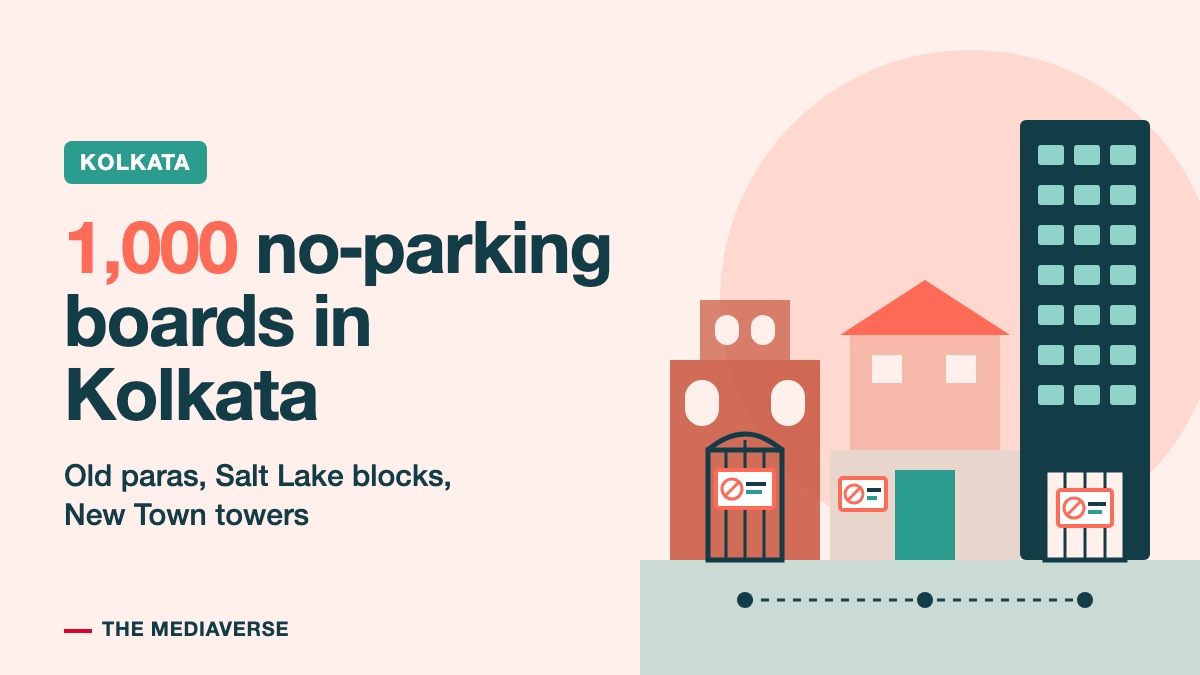
"Kolkata does not think in pin codes. It thinks in paras." That line opens our Kolkata no parking board page, and it is the right place to start pricing the smallest campaign the city will take. The minimum is 1,000 boards at Rs.45 each, so Rs.45,000, or Rs.53,100 with 18 percent GST, with the board, printing, transport and installation included and no monthly rental afterwards. The Rs.35 rate in the page headline applies only from 5,000 boards, which cost Rs.1,75,000, or Rs.2,06,500 with GST. What the page adds beyond the card is that Kolkata has three different kinds of gate, the old-city para, the planned Salt Lake block and the New Town tower, and 1,000 boards stretch a very different distance on each.
What do 1,000 no-parking boards cost in Kolkata?
The card has two slabs and one minimum. From 1,000 to 4,999 boards the rate is Rs.45 a board; from 5,000 it is Rs.35. GST at 18 percent is added on top. The page states that the figure covers the board itself, printing, transport and installation, and the national no parking board advertising page specifies the board as a 1 ft by 1.5 ft Sunpack sheet, installed only after permission from the house owner or residents' society, and geo-tagged and photographed once it is up.
Minimum order
Rs.45,000 before GST, Rs.53,100 with GST. About a third to a half of the page's own Behala and Thakurpukur example.
One southern belt
Rs.90,000 to Rs.1,35,000 before GST, Rs.1,06,200 to Rs.1,59,300 with GST. The page sizes a focused Behala and Thakurpukur push here.
Multi-area blanket
Rs.1,75,000 before GST, Rs.2,06,500 with GST at exactly 5,000. The page says South Kolkata plus Salt Lake and New Town goes past this slab.
The Kolkata no parking board card as published on the live city page on 21 October 2026: Rs.45 per board for orders under 5,000 boards, Rs.35 from 5,000, minimum 1,000, all-inclusive, no monthly rental, GST extra. The Behala and Thakurpukur range and the South Kolkata, Salt Lake and New Town example are the page's own; with-GST totals are our arithmetic at 18 percent.
Two lines on the card deserve a second read. The headline says boards start from Rs.35, but every order below 5,000 boards, the minimum included, is billed at Rs.45. And the slabs cross before 5,000: 3,889 boards at Rs.45 cost Rs.1,75,005, five rupees more than 5,000 boards at Rs.35. Anything between 3,889 and 4,999 boards should be rounded up to 5,000, which buys up to 1,111 more boards for the same money or less. Our 45 versus 35 break-even post works the same crossover on the national card.
The page also lists what moves a final quotation: quantity, the specific paras chosen, the printing method, permissions and any customisation. It publishes no surcharge for any of them, so the Rs.45 and Rs.35 figures are the card, and anything above them should arrive as a written line in the quote.
Why does the same 1,000 boards cover so much more in New Town than in Shyambazar?
Because a board is fixed per gate, and Kolkata's gates hold very different numbers of households. The page describes three gate types and plans each differently. The first is the old-city para of North Kolkata and much of Bhowanipore and Kalighat, narrow galis where individual house gates sit a few feet apart and boards are read by pedestrians at arm's length. The second is the planned grid of Salt Lake's sectors and blocks, with consistent boundary walls and gate positions, which lets boards be spaced evenly so one campaign covers an entire block without doubling up. The third is the vertical city of New Town and the EM Bypass towers, where hundreds of families sit behind a single society gate.
For the towers the page is specific: one well-placed board at the entrance and one at the visitor parking line, which it says does the work of a dozen boards in a low-rise para. Two boards a society means 1,000 boards could reach up to about 500 society entrances, by our arithmetic. The page publishes no count of societies in New Town or of houses per para, so treat that as a ceiling on the arithmetic, not a forecast of reach, and ask for the mapped gate list with the quote.
How 1,000 boards behave on Kolkata's three gate types (from our Kolkata page, read 21 October 2026)
| Gate type | Where the page places it | How boards go up | What 1,000 boards means | Creative the page advises | |
|---|---|---|---|---|---|
| Old-city para | North Kolkata, Bhowanipore, Kalighat; Shyambazar and Hatibagan | One board per house gate, gates a few feet apart, read at arm's length | Up to 1,000 individual house gates, the fewest households per board | Large Bengali lettering, short message | |
| Planned grid | Salt Lake (Bidhannagar) sectors and blocks | Evenly spaced on consistent boundary walls | Whole blocks covered without doubling up | English-first with a Bengali line near Sector V | |
| Vertical city | New Town, Rajarhat, EM Bypass towers | One at the society entrance, one at the visitor parking line | Up to about 500 society entrances at two boards each | English-first with a Bengali line |
Gate types, placement advice and language guidance as published on the live Kolkata no parking board page on 21 October 2026. The 500-society figure is our arithmetic on the page's two-boards-a-society advice. The page publishes no gate, house or society count for any area.
The practical consequence for a 1,000-board order is a choice between depth and breadth. In a para, the boards stay near the business: a Behala clinic can put its name on the gates of its own catchment, read every day at walking pace. In New Town, the same order spreads across far more households but fewer separate gates per neighbourhood. Neither is better on the card, because both cost Rs.45,000; the right one depends on whether your customers live within walking distance or arrive by car.
Which Kolkata areas does a 1,000-board order fit?
The page lists six placement areas. Spread evenly, 1,000 boards would be about 167 an area, which is thin for any one of them, so a minimum order usually works best kept inside one or two areas that match the customer.
The six placement areas on our Kolkata no parking page (read 21 October 2026)
| Area | Localities the page names | What the page says | Who the page pairs with it | |
|---|---|---|---|---|
| South Kolkata | Ballygunge, Gariahat, Alipore, Tollygunge | House gates and older apartment blocks | Premium brands | |
| Salt Lake and New Town | Bidhannagar sectors, Rajarhat high-rise belt | Uniform block layouts make full residential saturation straightforward | Even residential saturation; real estate and townships | |
| North and Central Kolkata | Shyambazar, Hatibagan, lanes off College Street, Sealdah, Esplanade | Old paras with strong associations and constant foot traffic | Bengali-first family reach | |
| Howrah | Shibpur, Salkia | Dense housing, value-conscious buyers, heavy daily movement | Mass-reach campaigns | |
| Greater suburbs | Dum Dum, Lake Town, Barasat, Jadavpur, Behala | Fast-filling middle-class housing where new clinics, schools and stores compete | Coaching, schools, clinics, new retail | |
| Commercial pockets | Park Street, Esplanade, Gariahat market stretches | Shop shutters and office gates in the busiest trading lanes | Brands selling to traders and shoppers |
Areas, localities and what the page says about each, as published on the live Kolkata no parking board page on 21 October 2026, from its placement list and its FAQ on the best areas. Category pairings are the page's own. The 167-a-area figure is our arithmetic.
Two pairings on the page translate directly into a 1,000-board brief. A hospital or clinic takes every residential gate within its catchment, so a single locality such as Behala is the natural unit. Coaching centres and schools target parents across Jadavpur, Salt Lake and Dum Dum in the April to July admission window, which is three areas, so 1,000 boards there means about 333 each before any weighting. The page's sizing example is the honest benchmark: 2,000 to 3,000 boards for a focused Behala and Thakurpukur push. A minimum order is a partial version of that, not a city campaign.
Should Kolkata boards be in Bengali or English?
The page answers by area. In Gariahat, Behala, Shyambazar and Howrah it recommends Bengali-first copy with the brand name in English, because the board is read by grandparents and domestic help as much as by working professionals. In the blocks around Salt Lake Sector V and in New Town it recommends English-first with a Bengali line, for a mixed audience of migrant and Bengali IT households. On every board, the no-parking instruction itself stays bilingual, which the page gives as the reason associations like keeping the boards up.
A 1 ft by 1.5 ft board does not hold much. In the old paras, where the page says boards are read at arm's length, it advises large lettering and a short message. In practice that means the bilingual no-parking line, the brand, one benefit and a phone number, with nothing else competing for the space. A mixed order across, say, Behala and New Town therefore needs two artworks, one Bengali-first and one English-first; the page lists customisation among the quote factors without pricing it, so confirm in writing whether a second artwork changes the Rs.45 rate.
Who gives consent for a board on a Kolkata gate?
Every board sits on a private gate or compound wall, so the page says the field team speaks to the homeowner, the flat-owners' association or the para club before a board goes up. It calls this step the campaign itself in Kolkata, and argues it is why boards last: a gate-keeper who agreed to the board protects it. The page adds that Kolkata paras run on local clubs and residents' associations that look after their gates, and that a clean, legible parking notice is useful to them.
That consent model also explains why boards rather than hoardings carry this budget. The page contrasts the two directly: Kolkata Municipal Corporation (KMC) regulates hoarding sites on arteries such as the EM Bypass and AJC Bose Road tightly, while a gate board is a privately agreed notice at a residence. It does not cite a KMC rule for gate boards, and neither do we. What the page does say is that consent takes time: collection and printing for a few thousand boards takes weeks, not days.
When should a Kolkata no-parking campaign be booked?
The page names two windows. For Durga Puja, it says orders should be locked by late July or August so boards are on gates before Mahalaya; boards installed by mid-September then ride Puja, Lakshmi Puja, Kali Puja and Bhai Phonta into the winter wedding season, at the same one-time rate. For admission season it plans installs in April and May around Jadavpur, Salt Lake and Dum Dum, when parents compare coaching centres and schools.
This post is published on 21 October 2026, so the Puja window has passed for this year. Kali Puja falls on Diwali night, 8 November, and with consent and printing taking weeks on the page's own description, a 1,000-board order placed now should not be planned around it. The windows that remain open are the winter wedding season the page mentions, the April and May admission installs, and next year's Puja, for which the page's own timing means locking the order by August 2027. Our Durga Puja 2026 playbook covers the festival across every format.
The Kolkata calendar for a gate-board order (timings from our Kolkata page, read 21 October 2026)
| Window | When boards should be up | Areas the page names | Order by | |
|---|---|---|---|---|
| Admission season | April and May installs | Jadavpur, Salt Lake, Dum Dum | Weeks before April | |
| Durga Puja run | Before Mahalaya, installed by mid-September | Every para | Late July or August | |
| Lakshmi Puja, Kali Puja, Bhai Phonta | Carried by Puja-season boards | Every para | Same order as Puja | |
| Winter wedding season | Carried by Puja-season boards | Jewellery, saree and retail catchments | Same order as Puja, or a separate order |
Windows, areas and lead-time guidance as published on the live Kolkata no parking board page on 21 October 2026. The Kali Puja date is the 2026 Diwali date. The page publishes no exact installation lead time beyond weeks for a few thousand boards.
How does the Rs.45,000 minimum compare with other Kolkata formats?
Among the per-unit formats on our Kolkata pages, the board minimum is the cheapest entry. The newspaper insertion in Kolkata floor is 50,000 A5 inserts at Rs.1.25, so Rs.62,500. The auto branding in Kolkata page prices a 24 x 6 inch back panel at Rs.170 an auto for 500 to 799 autos, so Rs.85,000 at the 500-auto minimum, and a full hood at Rs.650 an auto with a 300-auto minimum, so Rs.1,95,000.
Entry orders on our Kolkata pages, before and with GST (read 21 October 2026)
| Format | Rate | Minimum | Entry cost before GST | With GST | |
|---|---|---|---|---|---|
| No-parking boards | Rs.45 a board | 1,000 boards | Rs.45,000 | Rs.53,100 | |
| Newspaper insertion, A5 | Rs.1.25 an insert | 50,000 inserts | Rs.62,500 | Rs.73,750 | |
| Auto back panel, 24 x 6 inch | Rs.170 an auto | 500 autos | Rs.85,000 | Rs.1,00,300 | |
| Auto full hood | Rs.650 an auto | 300 autos | Rs.1,95,000 | Rs.2,30,100 |
Rates and minimums as published on the live Kolkata no parking board, newspaper insertion and auto branding pages on 21 October 2026. With-GST figures are our arithmetic at 18 percent. These are different formats with different durations and audiences, compared on entry cost only.
The comparison is about entry cost, not value, because the formats do different jobs. An insert lands once, on a single morning, across 50,000 copies of the dailies the page names. A board stays on one gate for the campaign period at eye level. Our Kolkata newspaper insertion guide works out what 50,000 copies cover, and the outdoor advertising in Kolkata hub lists every format in the city.
What does our Kolkata page not publish?
Four gaps matter for planning a 1,000-board order. First, gate counts: no number of houses, gates or societies per area, which is why the 500-society and 167-an-area figures above are arithmetic, not survey data. Second, an installation lead time: only that a few thousand boards take weeks. Third, a campaign duration: the page speaks of months of visibility and the campaign period, but states no fixed term, so ask for it in writing. Fourth, a reprint or replacement rate: none is published, so a damaged or changed board should be quoted before the order, not assumed.
The page also mentions nothing about any KMC permission for gate boards and gives no recall or response figure, and this post adds none. If a vendor quotes you a Kolkata response rate for gate boards, ask what it was measured on. Our older Kolkata no parking board guide gives the wider city picture, and the Lucknow 1,000-board guide applies the same minimum to a city of colony grids and old-city lanes.
Which 1,000-board plan should you book in Kolkata?
Three plans fit the minimum without stretching it. A neighbourhood business, such as a clinic, diagnostic centre or bank branch, puts all 1,000 boards into the paras of its own catchment, Bengali-first, for Rs.53,100 with GST. A New Town or Rajarhat real-estate project uses the tower pattern, two boards a society, across the high-rise belt in English-first artwork. An admission campaign splits the order between Jadavpur, Salt Lake and Dum Dum and books installs for April and May. Anything wider, two or more areas at real density, is the page's own 2,000 to 3,000 or 5,000-plus territory, and from 3,889 boards the 5,000-board order is the cheaper buy.
What is the minimum order for no parking boards in Kolkata?
1,000 boards. Our Kolkata page prices them at Rs.45 each for any order under 5,000, so the minimum costs Rs.45,000 before GST and Rs.53,100 with 18 percent GST. The rate covers the board, printing, transport and installation, with no monthly rental. The Rs.35 rate in the page headline starts only at 5,000 boards, which cost Rs.1,75,000, or Rs.2,06,500 with GST.
How many New Town societies can 1,000 boards cover?
Up to about 500, by our arithmetic. Our Kolkata page advises one board at the society entrance and one at the visitor parking line for the New Town and EM Bypass towers, which is two boards a society. The page publishes no count of societies in New Town, so treat 500 as a ceiling and ask for the mapped list of gates with the quote.
Do Kolkata no parking boards need KMC permission?
Our Kolkata page does not cite a KMC permission for gate boards. It says KMC regulates hoarding sites tightly, while gate boards go on private gates and compound walls with consent from the homeowner, the flat-owners' association or the para club before installation. The national page adds that boards are installed only after permission and are geo-tagged and photographed. Ask for the consent record with the installation report.
Can a 1,000-board order mix Bengali and English boards?
The page recommends exactly that split by area: Bengali-first copy with the brand name in English in Gariahat, Behala, Shyambazar and Howrah, and English-first with a Bengali line in Salt Lake and New Town, with the no-parking instruction bilingual on every board. A mixed order needs two artworks. The page lists customisation as a quote factor without pricing it, so confirm whether it changes the Rs.45 rate.
Is it too late to book Kolkata boards for this festive season?
For Durga Puja 2026, yes. Our page says Puja orders should be locked by late July or August so boards are up before Mahalaya, and that consent and printing for a few thousand boards take weeks. Kali Puja falls on 8 November this year, too close to plan around. The open windows are the winter wedding season, April and May admission installs, and next year's Puja, ordered by August 2027.
Tags
Quick Answers
How much do 1,000 no parking boards cost in Kolkata?
Rs.45,000 before GST and Rs.53,100 with 18 percent GST. Our Kolkata page prices boards at Rs.45 each for orders under 5,000 and Rs.35 from 5,000, minimum 1,000, with the board, printing, transport and installation included and no monthly rental. The page sizes a focused Behala and Thakurpukur push at 2,000 to 3,000 boards, so 1,000 is a partial belt.
Where do no parking boards go in Kolkata?
On three kinds of gate, by our Kolkata page: individual house gates a few feet apart in old paras such as Shyambazar and Kalighat, evenly spaced boundary-wall gates on Salt Lake's planned blocks, and New Town and EM Bypass tower societies, where it advises one board at the entrance and one at the visitor parking line. It names six placement areas, from South Kolkata to Howrah.
When should a Kolkata no parking board campaign be booked?
Our Kolkata page names two windows. For Durga Puja it says to lock orders by late July or August so boards are up before Mahalaya, carrying the brand through Kali Puja into the wedding season. For admissions it plans April and May installs around Jadavpur, Salt Lake and Dum Dum. Consent and printing for a few thousand boards take weeks, not days.
Looking for professional No Parking Board Advertising services?
The Mediaverse runs end-to-end no parking board advertising campaigns across India with geo-tagged delivery and transparent, all-inclusive pricing.
Explore our No Parking Board Advertising solutionsSummarize this guide with AI
Open this article in your favourite AI assistant
Related Guides
Written by

The Mediaverse Team
India's Leading Outdoor Advertising Agency
The Mediaverse is a national-level outdoor advertising and integrated marketing organization that provides complete OOH, ATL, BTL, retail, and transit media solutions across India. With years of experience executing high-performance campaigns for brands in FMCG, Real Estate, E-commerce, EdTech, Automotive, Healthcare, and Retail, The Mediaverse combines creativity, data-driven media planning, and flawless on-ground execution. As a full-stack outdoor advertising provider, The Mediaverse offers Auto Branding, Mobile Van Branding, Newspaper Insertion Advertising, Shop Name Board Branding, In-Store Branding, Hoardings, Transit Media, Kiosks, Mall Media, Activations, and all forms of Below-The-Line marketing. Known for its pan-India network, strategic route planning, premium print quality, and Cheqmate™ GPS-based verification, The Mediaverse ensures 100% transparent and result-oriented campaign delivery. The Mediaverse’s editorial team produces deeply researched, SEO-optimized, and generative-engine-friendly content to help businesses understand the power of outdoor advertising and make informed decisions that maximize brand visibility and ROI across urban, suburban, and rural markets.
Related Articles
1,000 No-Parking Boards in Lucknow: The Rs.45,000 Minimum Across LDA Sectors and Old-City Lanes (2026)
The smallest Lucknow no-parking order is 1,000 boards at Rs.45. How the page plans them on the LDA grid and in the old city, which of six groups to pick, who consents, Hindi-first artwork and the gaps.
1,000 No-Parking Boards in Jaipur: The Rs.45,000 Minimum, Scheme by Scheme, and the Wedding Install Date (2026)
The smallest Jaipur no-parking order is 1,000 boards at Rs.45. How the page plans them scheme by scheme, which of six belts to pick, who consents, Hindi-first artwork and the wedding install date.
1,000 No-Parking Boards in Chennai: The Rs.45,000 Minimum, Tamil-First Gates and the Monsoon Calendar (2026)
The smallest Chennai no-parking order is 1,000 boards at Rs.45. Where the page's six areas put them, who gives consent, which gates need coastal fixings, and when they can go up before Aadi, Pongal and admissions.