
What is auto branding in Kolkata and why is it effective?
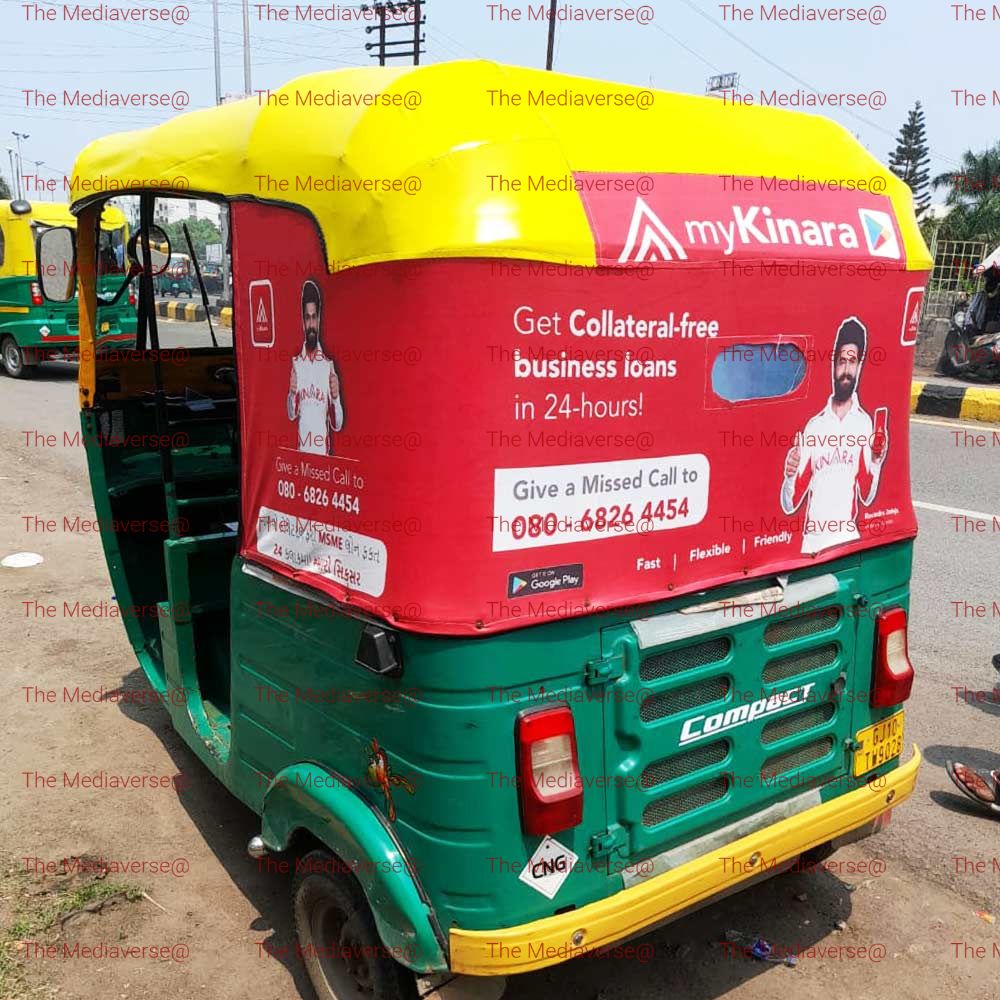
Auto branding in Kolkata means printing your brand on the city's auto-rickshaws, hood wraps from ₹650 per auto and back-panel stickers from ₹170 per auto, both one-time rates covering print and installation (GST 18% extra). It works here because autos are the only motor vehicles that enter the 6-foot galis of North Kolkata, Howrah, and Bhowanipore, delivering an estimated 12,000-25,000 daily impressions per auto at ₹2-5 CPM from a 40,000-plus registered fleet. During Durga Puja the same autos carry an estimated 4 crore pandal-hoppers, so festival-season surge impressions come built into the standard rate.
Kolkata Auto Branding: The Last-500m Gali Penetrator for North Kolkata, Howrah & Puja-Circuit Advertising
The Mediaverse turns Kolkata's 40,000+ yellow autos into the only advertising surface that enters 6-foot-wide galis in North Kolkata, Howrah, and Bhowanipore where even cycle-rickshaws struggle to fit.
Hood ₹650/auto one-time | Back Panel ₹170/auto one-time | 48-hour setup
Auto branding in Kolkata solves an advertising access problem that exists nowhere else in India at this scale: North Kolkata's residential paras and Howrah's lane networks are built on 6-foot-wide galis. lanes so narrow that even cycle-rickshaws struggle to navigate them during peak hours. Mobile vans cannot enter. Buses do not exist here. Hoardings have no mounting surface. The only motor vehicle that physically fits inside these galis is the auto-rickshaw. This makes Kolkata auto rickshaw advertising the sole outdoor advertising surface inside the densest residential zones of eastern India's largest city.
The Mediaverse provides auto rickshaw advertising in Kolkata through a proprietary Last-500m Gali Penetrator approach. We cluster 20-50 branded vehicles within specific gali networks. Bagbazar's para lanes, Howrah Shibpur's interior roads, Bhowanipore's residential cross-galis. to create an estimated 10-14 repeat brand encounters per resident per week. During Durga Puja, these same autos become pandal-hopping transport for 4 crore visitors, delivering surge impressions at zero additional cost.
How much does auto branding cost in Kolkata?
- • Full Hood Branding (Rexine Wrap): ₹650 per auto for 300-499 autos, ₹630 per auto for 500+ (one-time, print + install). MOQ 300.
- • Back Panel Sticker 24"x6" (Vinyl): ₹170 per auto for 500-799, ₹140 per auto for 800+. MOQ 500.
- • Back Panel Sticker 24"x18" (Vinyl): ₹270 per auto for 500-799, ₹240 per auto for 800+. MOQ 500.
All auto branding prices are one-time per auto (print + install), not monthly. GST 18% extra. Some areas charge an auto-union fee, billed extra. Rates include design, printing, installation, and KMC permits. Pricing based on The Mediaverse 2026 national rate card. Kolkata offers the lowest metro auto branding rates in India. approximately 30-40% cheaper than Bangalore or Mumbai.
Why is auto branding in Kolkata different from other cities?
Kolkata's North Kolkata and Howrah residential zones are built on 6-foot-wide galis. lanes so narrow that even cycle-rickshaws struggle during peak hours. No mobile van, bus, or car-based advertising can physically enter these lanes. The auto-rickshaw is the only motor vehicle that fits. This creates a monopoly advertising surface: inside the densest residential pockets of Kolkata, auto branding is not one of many outdoor options. it is the only one. Additionally, during Durga Puja (Sep-Oct), an estimated 4 crore visitors use autos as their primary pandal-hopping transport, generating a seasonal surge of 3-5x normal impressions at the standard one-time rate.
How many autos should I brand in Kolkata?
For effective gali-level saturation, The Mediaverse recommends a minimum of 20 autos per target para (2 km radius). In Kolkata's narrow-gali zones. Bagbazar, Howrah Shibpur, Bhowanipore. this creates an estimated 10-14 weekly brand encounters per resident. For citywide campaigns, 800+ autos across 4-5 zones are typical. A practical starting point: 500 back-panel (24"x6") autos in one para zone at ₹170/auto = ₹85,000 one-time. enough to test zone response before scaling. For Puja-circuit campaigns, 100+ autos across 3 pandal routes is recommended.
Which Kolkata areas are best for auto branding?
Zone selection depends on business type and target audience. The Mediaverse provides zone-specific recommendations based on auto fleet density data across KMC and Howrah Municipal zones.
What results does auto branding deliver in Kolkata?
Auto branding in Kolkata delivers strong cost-per-impression efficiency as a high-frequency, low-cost format. Typical use cases include coaching-centre back-panel campaigns (a low-cost alternative to Google Ads for similar keywords in Kolkata), jewellery showroom hood-branding during the festive season, and D2C interior-branding app campaigns. Kolkata's lower media costs mean the cost per rupee invested is among the most efficient in any Indian metro.
What is Auto Branding in Kolkata?
Auto branding in Kolkata is a form of hyperlocal outdoor advertising where brand messages are printed on auto-rickshaw surfaces. primarily the hood (rexine top cover) and back panel (rear vinyl sticker). Kolkata has 40,000+ KMC-registered auto-rickshaws operating across North Kolkata, South Kolkata, Howrah, Salt Lake, and the EM Bypass corridor, forming a distributed advertising network that accesses 6-foot-wide residential galis, bazaar lanes, and pandal routes where hoardings, mobile vans, and even cycle-rickshaws cannot physically operate.
Why Kolkata auto rickshaw advertising is the only medium inside North Kolkata's galis
Unlike mobile van branding in Kolkata (which operates on arterial roads like EM Bypass and AJC Bose Road), auto branding penetrates the last 500 metres of the consumer journey. North Kolkata's Bagbazar, Kumartuli, and Shyambazar paras are built on a pre-colonial lane grid where galis measure 6-8 feet wide. Cars cannot enter. Even hand-pulled rickshaws are being phased out. The auto-rickshaw is the only motorized transport that navigates these lanes. dropping riders at doorsteps, para club entrances, and neighbourhood sweet shops. A branded auto inside a Bagbazar gali is the sole outdoor advertising surface a resident sees between their front door and the main road.
How auto branding differs from other Kolkata outdoor advertising
Each Kolkata auto generates an estimated 12,000-25,000 daily impressions at ₹2-5 CPM, based on The Mediaverse fleet tracking data. This makes Kolkata auto rickshaw advertising the cheapest per-impression outdoor format in any Indian metro city. For businesses that also need arterial road visibility, combining auto branding with Kolkata mobile van branding creates a two-layer system: vans handle EM Bypass and Park Street awareness while autos handle gali-level saturation inside residential paras. Businesses requiring physical storefront signage can complement both with shop name boards in Kolkata.
Key facts about Kolkata auto branding at a glance:
- • Fleet size: 40,000+ KMC-registered autos across North/South Kolkata, Howrah, Salt Lake, EM Bypass
- • Formats: Hood wrap (rexine), back panel sticker (vinyl), interior seat-back
- • Impressions: 12,000-25,000 per auto per day (based on campaign tracking)
- • CPM: ₹2-₹5. lowest metro OOH format in India
- • Gali access: Only motor vehicle entering 6-ft-wide North Kolkata and Howrah galis
- • Deployment: 48 hours for first batch, 5-7 days for 100+ autos
- • Puja Bonus: 4 Cr+ pandal-hopping visitors during Sep-Oct at the standard one-time rate
Auto Branding in Kolkata. Quick Facts
Why Auto Rickshaw Advertising in Kolkata Outperforms Every Other Hyperlocal Format
Kolkata's pre-colonial gali grid creates a physical advertising monopoly: inside the densest residential zones, the auto-rickshaw is the only motor vehicle. and therefore the only mobile advertising surface. Layer on the Durga Puja pandal-circuit surge, and Kolkata auto branding delivers a dual-advantage no other Indian metro replicates.
6-Foot Gali Monopoly
North Kolkata's Bagbazar, Kumartuli, and Shyambazar paras are built on 6-8 foot galis. Howrah's Shibpur and Belur interior lanes are similarly narrow. Cars cannot enter. Mobile vans are physically impossible. Even cycle-rickshaws jam during peak hours. The auto-rickshaw is the only motor vehicle that fits. making branded autos the sole outdoor advertising surface inside these zones. A branded auto navigating a Bagbazar gali is not competing with other OOH media. It is the only OOH media that exists there.
Monopoly zones: Bagbazar, Kumartuli, Shyambazar, Howrah Shibpur, Belur, Maniktala, Jorasanko
Durga Puja Pandal-Circuit Surge
During the 10-day Durga Puja festival (Sep-Oct), an estimated 4 crore visitors flood Kolkata for pandal-hopping. Autos become the primary pandal-to-pandal transport. carrying visitors between Bagbazar, College Street, Deshapriya Park, and Sreebhumi pandals. A 500-auto branded fleet deployed on 3 pandal circuits generates an estimated 3-5x normal monthly impressions at the standard one-time rate. Brands booking auto campaigns receive this Puja surge as a built-in bonus.
Key pandal circuits: Bagbazar-College Street, Deshapriya Park-Ekdalia, Sreebhumi-Salt Lake, Santosh Mitra Square-Lebutala
Stationary Gali-Stand Visibility
Our GPS tracking of 400 Kolkata autos shows the average auto spends approximately 40% of operating hours stationary. at gali-mouth stands (50 min avg), bazaar gates like Gariahat and New Market (30 min), station exits (20 min), and hospital entrances (25 min). Inside a 6-foot gali, a stationary branded auto fills the entire visual field of every pedestrian passing by. This creates a mini-hoarding effect at zero additional cost. and in galis, there is no alternative advertising surface to compete for attention.
Stationary hotspots: Bagbazar gali stands, Gariahat crossing, Sealdah exit, Howrah approach, Lake Town market
5 High-Density Auto Hubs Where Kolkata Auto Branding Generates Peak Visibility
Fleet density data from The Mediaverse auto coordination network, 2024-2026.
Sealdah Station Exit
Kolkata's busiest railway terminal. Approximately 10 lakh daily commuters transition from train to auto at this hub. Branded autos queuing at the station exit capture the highest-volume commuter traffic in eastern India. feeding directly into North Kolkata's narrow gali network.
Howrah Station Approach
Western gateway to Kolkata. Approximately 7 lakh daily passengers use Howrah station. Branded autos on the approach road and Howrah bridge exit lanes serve as the first Kolkata brand encounter for intercity traders and travellers arriving from across eastern India.
Gariahat Crossing
South Kolkata's busiest commercial hub. Approximately 3 lakh daily footfall at the Gariahat-Rashbehari intersection. Auto fleet feeds into Bhowanipore, Ballygunge, and Triangular Park gali networks. the densest South Kolkata residential zones.
Salt Lake Sector V
Kolkata's IT corridor. Auto fleet shuttles tech workers between Sector V offices and residential areas in Lake Town, Dum Dum, and New Town. IT-worker demographic with disposable income for D2C, food delivery, and edtech brands.
Bagbazar-Kumartuli Hub
North Kolkata's narrowest-gali zone. Auto fleet navigates galis that measure 6-8 feet wide. serving 4+ lakh residents in Kolkata's oldest residential area. During Puja, this becomes the highest-traffic pandal circuit in the city.
3 Residential Zones Where Auto Branding in Kolkata Creates Gali-Level Saturation
Bagbazar-Kumartuli-Shyambazar Triangle
Approximately 4 lakh residents in North Kolkata's narrowest gali network. Average lane width: 6-8 feet. About 600 autos navigate these galis daily. the only motor vehicles that can. A 30-auto branded cluster operating within this triangle generates an estimated 12+ weekly encounters per resident. During Puja, this zone hosts Bagbazar and Kumartuli pandals. two of the city's top five visited pandals. Strong for jewellery, gold loans, and FMCG brands.
Howrah Shibpur-Belur-Liluah Belt
Approximately 6 lakh residents across the Howrah river's western bank. Interior lanes in Shibpur and Belur measure 6-10 feet. narrower than many South Kolkata roads. Over 800 autos serve this zone, feeding commuters to Howrah station and the industrial pockets along GT Road. Auto branding in Howrah's galis reaches a working-class family demographic at ₹170/auto one-time. the lowest cost hyperlocal advertising available in any Indian metro for this audience segment.
Behala-Thakurpukur-Joka Corridor
Approximately 8 lakh residents in Kolkata's southwestern residential sprawl. This zone has limited metro and bus connectivity, making autos the primary local transport. Over 1,000 autos serve the Behala Chowrasta to Joka corridor. Back-panel ads on the Behala auto fleet offer strong frequency-per-rupee value. driven by the captive transport dependency in this underserved-transit zone.
The Last-500m Gali Penetrator Strategy: How Kolkata Auto Branding Reaches Residents No Other Medium Can
Kolkata's residential structure creates an advertising dead zone in the last 500 metres between the main road and the resident's doorstep. In North Kolkata, South Kolkata paras, and Howrah lanes, this last-500m zone is a network of 6-10 foot galis lined with 3-4 storey buildings. Hoardings cannot be mounted on these narrow facades. Mobile vans cannot enter lanes narrower than 12 feet. Digital screens do not exist in galis. But every day, 40,000+ autos navigate these galis 40-60 times each. dropping residents at doorsteps, para club entrances, neighbourhood bazaars, and street-corner chai stalls.
Estimated impact: A resident in a Bagbazar gali encounters branded autos at (1) their gali-mouth auto stand, (2) the neighbourhood bazaar, (3) the para club entrance, and (4) the Sealdah station exit during their evening commute. an estimated 4 brand encounters per day x 22 working days = 88 monthly exposures from a back-panel auto at ₹170/auto one-time. For arterial-road visibility to complement this gali strategy, businesses can layer in mobile van branding in Kolkata on EM Bypass, Park Street, and AJC Bose Road.
For businesses that also want to reach these same residents via direct mail, newspaper insertion in Kolkata through Anandabazar Patrika and The Telegraph delivers pamphlets to the same households. creating a three-layer advertising system: vans on highways, autos in galis, pamphlets at doorsteps.
Material Specifications: How Our Auto Branding Survives Kolkata's Monsoon and Humidity
Kolkata experiences approximately 1,600mm annual rainfall. heavier than most Indian metros. plus extreme humidity during monsoon months (June-September) that regularly exceeds 90% RH. Standard 80-micron materials used by many vendors typically show adhesive failure and peeling within 45 days in Kolkata's humidity. The Mediaverse uses upgraded specifications:
Hood: 100-Micron Rexine
Thicker than the 80-micron industry standard. UV-stabilized lamination to prevent colour fade. Anti-peel adhesive engineered for Kolkata's 90%+ monsoon humidity. the most demanding adhesion environment in our national portfolio. Hood covers typically run 6 to 12 months in Kolkata conditions; back panel stickers typically 4 to 6 months.
Back Panel: Humidity-Proof Vinyl
High-tack pressure-sensitive vinyl with UV-resistant inks. Humidity-proof lamination prevents water ingress and adhesive failure during Kolkata's June-September monsoon. Gali-operating autos face additional moisture from standing water in narrow lanes. our vinyl is specified to maintain bond through these conditions.
Free Replacement Guarantee
Any auto with damaged branding gets replaced within 48 hours at no additional cost. Monthly field audits across the entire branded fleet plus a dedicated post-monsoon inspection in October ensure campaign quality is maintained throughout the campaign period. including autos operating in waterlogged gali zones.
Kolkata Advertising Market Overview
Kolkata, the cultural capital of India with a metro population exceeding 1.5 crore, presents a value-driven market for mobile van advertising. The city's distinct geography — divided by the Hooghly River with Howrah on the west bank — creates concentrated traffic on key bridges and corridors. Park Street, Esplanade, and Salt Lake are the primary commercial zones. Kolkata's advertising peaks during Durga Puja (October), Diwali, and the Kolkata Book Fair. The city's strong FMCG market, education sector, and growing IT industry in Salt Lake and New Town drive advertising demand. Kolkata offers the lowest mobile van advertising rates among metro cities, making it ideal for brands seeking volume-based reach. The city's tram and bus routes create predictable traffic patterns that enhance van campaign planning.
Auto Branding Formats Available in Kolkata
Full Hood Branding (Rexine Wrap)
Complete coverage of the auto-rickshaw's rear hood area. 100-micron rexine material with full-colour printing. Visible from behind, above, and both sides when the auto is in motion or stationary inside narrow galis. The premium format for maximum brand impact on Kolkata auto rickshaw advertising campaigns. particularly effective inside 6-foot galis where the branded hood fills the pedestrian's entire visual field.
- ✓Full rear-hood coverage. visible from 3 angles
- ✓100-micron non-peel rexine with humidity-proof lamination
- ✓Colour-matched to Kolkata yellow auto standard
- ✓Includes design, print, installation, and audit
Back Panel Sticker 24"x6" (Vinyl)
High-visibility vinyl sticker on the auto's rear panel. directly in the sightline of every pedestrian walking behind the auto in a narrow gali. The highest-reach, lowest-cost format for Kolkata auto branding campaigns requiring large fleet deployment. Priced at ₹170/auto for 500-799 autos and ₹140/auto for 800+ autos.
- ✓Rear panel. eye-level in narrow gali sightlines
- ✓Humidity-resistant vinyl with monsoon-proof lamination
- ✓Compact 24"x6" strip format
- ✓Volume pricing kicks in at 800+ autos
Back Panel Sticker 24"x18" (Vinyl)
Larger vinyl sticker on the auto's rear panel for more creative space and stronger visibility from following traffic in a narrow gali. The bigger back-panel size gives brands more room for logos, offers, and QR codes. Priced at ₹270/auto for 500-799 autos and ₹240/auto for 800+ autos.
- ✓Rear panel. larger 24"x18" creative area
- ✓Humidity-resistant vinyl with monsoon-proof lamination
- ✓More space for logos, offers, and QR codes
- ✓Volume pricing kicks in at 800+ autos
Auto Branding vs Newspaper Flyers vs Local Billboards in Kolkata
| Parameter | Auto Branding | Newspaper Flyers | Local Billboards |
|---|---|---|---|
| CPM (Cost per 1000 impressions) | ₹2-5 | ₹12-25 | ₹30-60 |
| Reaches inside 6-ft residential galis | Yes. only motor vehicle that fits | Delivered to door (often discarded) | No. main road only |
| Daily impressions per unit | 12,000-25,000 per auto | 1,000-2,500 per batch | 4,000-12,000 per board |
| Weekly frequency per resident | 10-14x (gali-clustered zone) | 1x per insertion day | 2-3x (if on commute route) |
| Visibility duration | 30 days continuous | ~30 seconds before disposal | 30 days (fixed location) |
| Puja pandal-circuit reach | Yes. 4 Cr visitors surge | No | Limited. fixed location |
| Cost efficiency | Highest (lowest CPM) | Moderate | Lowest (highest CPM) |
| Setup speed | 48 hours | 3-5 days printing | 10-21 days |
| Targeting precision | 2 km gali-zone clustering | Pin code level | Fixed location only |
Indicative comparison based on typical Kolkata outdoor media rates.
The Last-500m Gali Penetrator. Our Kolkata Auto Clustering Methodology
Instead of scattering autos randomly across Kolkata, The Mediaverse deploys a gali-network clustering strategy that concentrates branded autos inside specific para zones. combined with a Puja-circuit surge grid during Sep-Oct.
Gali-Zone Mapping
Identify target gali network (e.g., "Bagbazar paras, 2 km radius"). Map gali widths, auto stands, para clubs, bazaar entrances, and residential density. Classify zones by gali-width to confirm auto-only accessibility.
Fleet Clustering
Deploy 20-50 branded autos from stands within the target gali zone. Autos naturally circulate inside the narrow-lane network 40-60 times daily. For Puja season, additional autos are deployed at pandal entry points for surge coverage.
Route Optimization
Track GPS data for 7 days to identify which galis and stands see the highest auto traffic. Redistribute fleet to maximize coverage of under-served galis. Pre-Puja: map pandal circuits and inter-pandal auto feeder routes 30 days ahead.
Performance Tracking
Weekly reports showing estimated gali-level encounters per resident. Monthly field audits ensure branding integrity in humidity-exposed gali environments. Puja-season surge reports. Damaged units replaced within 48 hours.
Why Kolkata's Fixed-Route Auto System Makes Branding More Predictable Than in Any Other Metro
Here is something most national advertisers miss about this city: Kolkata autos do not roam. Unlike Delhi or Bangalore, where a metered auto might start the day in one corner of the city and finish in another, the Kolkata auto is shared transport running a fixed route between two fixed points, at a fixed fare, all day, every day. Gariahat to Golpark. Rashbehari to Behala Chowrasta. Ultadanga to Karunamoyee. Shyambazar to Bagbazar ghat. The driver joins the queue at one stand, fills four seats, runs the route, joins the queue at the other end, and repeats this 40 to 60 times a day.
For an advertiser this changes everything. When you brand an auto in Mumbai, you are buying a vehicle whose daily path you can only estimate. When you brand an auto on the Rashbehari-Behala route, you know precisely which crossings, bazaars, school gates, and para entrances your ad will pass, and roughly how many times per day, before you spend a rupee. Branding a route is closer to buying a chain of moving hoardings down one corridor than to scattering vehicles across a city. It also means the same commuters see the same auto repeatedly: a Behala office-goer who takes the route auto every morning meets your back panel ten times a week without you paying for a single extra impression.
The stands themselves are organised under route unions, which is why our rate card notes an auto-union fee in some areas. That fee is not a nuisance; it is the system working. Union consent is what keeps a branded fleet stable on its route for the full campaign instead of dissolving across the city, and our field team negotiates it stand by stand, from the Sector V queues where IT workers board for Karunamoyee to the gali-mouth stands of Kumartuli. When we quote a campaign, we quote it route by route: which corridor, how many autos in that route's pool, and what share of the route your brand will own.
Practical takeaway: pick routes, not zones. A jeweller near Triangular Park does better owning 60% of the Rashbehari-Gariahat route pool than spreading the same autos thinly across South Kolkata. A coaching centre in Salt Lake wins the Ultadanga-Karunamoyee corridor first, then expands. Route-level thinking is how Kolkata operators plan this format, and it is how we plan it with you.
Best Areas for Auto Branding in Kolkata
These are the top-performing localities for mobile van advertising in Kolkata, selected based on footfall density, commercial activity, and campaign ROI data from The Mediaverse.
Park Street
Kolkata's iconic commercial and entertainment strip
Salt Lake (Sector V)
IT hub with TCS, Cognizant, and tech company offices
New Town (Rajarhat)
Rapidly growing township with IT and residential development
Howrah
Howrah Station area — one of India's busiest railway junctions
Esplanade
Central commercial hub with metro connectivity
Gariahat
South Kolkata shopping and residential zone
Ballygunge
Affluent residential area with high-value consumer base
Dum Dum
North Kolkata near airport with residential density
Behala
South-west Kolkata growing residential corridor
Lake Town
North Kolkata residential hub with local retail market
EM Bypass
Eastern bypass road with South City Mall and Acropolis Mall
Jadavpur
University area with student and academic population
Barasat
North 24 Parganas gateway with suburban commercial activity
Tollygunge
Film industry hub with entertainment and cultural activity
Shyambazar
North Kolkata commercial centre with wholesale markets
Which Businesses Benefit Most from Auto Branding in Kolkata?
Jewellery Showrooms & Gold Brands
The highest-impact use case for Kolkata auto rickshaw advertising during festive season. Kolkata's Puja and wedding season (Sep-Feb) drives approximately 60% of annual jewellery sales. Hood-branded autos navigating Bagbazar and Bhowanipore galis. where car-driving shoppers cannot physically see hoardings. place jewellery brands in front of the exact gold-buying families making festive purchase decisions. Hood-branded autos help drive stronger footfall during branded Puja-season campaigns.
Coaching Centres & Tuition Classes
A coaching centre in Jadavpur deploying 30 branded autos within the narrow Jadavpur-Dhakuria-Golpark gali zone can expect every student and parent in the area to encounter the brand multiple times weekly. In Kolkata's dense para system, students walking to classes through galis encounter branded autos at every turn. Back-panel campaigns are a low-cost way to generate enrollment inquiries. typically well below Google Ads costs for coaching keywords in Kolkata.
Hospitals & Diagnostic Centres
Auto branding on the EM Bypass and Gariahat fleet can support stronger walk-in awareness compared to digital search advertising for local healthcare keywords. Inside North Kolkata galis, autos parked at neighbourhood dispensaries and para club entrances create a stationary visibility layer. particularly valuable for diagnostic centres offering home-collection services to the elderly population in these dense residential zones.
Real Estate (New Town & EM Bypass)
Developers deploy 100-auto fleets in specific corridors. for example, Rajarhat-New Town autos for township launches. to drive site visit traffic from the residential cluster where prospective buyers live. In South Kolkata's Behala and Tollygunge galis, auto branding reaches homebuyers who commute from congested old-city paras to new-construction zones. exactly the buyer demographic moving from rented gali homes to purchased flats.
FMCG & Retail Chains
New store openings in Kolkata use gali-zone auto clustering to build hyperlocal awareness within the 2 km catchment area. A supermarket branding 40 autos operating from the local gali-mouth stand in Behala or Lake Town creates daily visibility for residents who will see the store name at their para entrance, the neighbourhood bazaar, and at the gali stand outside their building. touchpoints that exist only inside the gali network.
Restaurants & Sweet Shops
Kolkata's famous mishti (sweet) shops and restaurant chains use Gariahat/Park Street auto fleets to build neighbourhood recognition. Inside North Kolkata galis, a new sweet shop branding 20 autos from the local para stand creates the kind of hyperlocal buzz that would take months of social media to achieve. because in galis, there are no competing advertising surfaces. The branded auto IS the advertisement. Particularly effective during Puja when food traffic peaks across the city.
Kolkata Auto Branding Pricing (2026)
| Format | Lower Tier | Higher Tier | MOQ | Best For |
|---|---|---|---|---|
| Full Hood (Rexine) | ₹650 (300-499) | ₹630 (500+) | 300 autos | Premium gali-level awareness |
| Back Panel 24"x6" (Vinyl) | ₹170 (500-799) | ₹140 (800+) | 500 autos | Mass hyperlocal reach |
| Back Panel 24"x18" (Vinyl) | ₹270 (500-799) | ₹240 (800+) | 500 autos | Larger creative, more impact |
All prices are one-time per auto (print + install), GST 18% extra, and include design, printing, installation, and KMC permits. Some areas charge an auto-union fee, billed extra. Kolkata offers the lowest metro auto branding rates in India. approximately 30-40% cheaper than Bangalore or Mumbai.
📍 Kolkata Pricing Note: Kolkata offers the most competitive mobile van advertising rates among Indian metros. Park Street and Salt Lake routes are at standard rates. During Durga Puja (October), route adjustments are required for pandal areas but impressions increase 3-4x citywide.
Kolkata Auto Branding Campaign Results
Campaign examples from The Mediaverse Kolkata auto branding work.
Jewellery Showroom. Bagbazar Puja-Circuit Campaign
300 hood-branded autos deployed on the Bagbazar-Kumartuli-College Street pandal circuit plus North Kolkata gali networks for a 45-day Puja-season campaign. Autos navigated 6-foot galis where no competing media exists.
- • Format: Full hood branding (₹650/auto, 300-499 tier)
- • Zone: Bagbazar galis + Kumartuli + College Street pandal circuit
- • Duration: 45 days | Investment: ₹1,95,000 one-time
- • Goal: Drive festive-season showroom footfall during Puja
Coaching Centre. Jadavpur Gali-Zone Campaign
500 back-panel branded autos clustered in Jadavpur-Dhakuria-Golpark narrow-lane residential zone for a 60-day pre-admission campaign. Autos penetrated galis where student PGs and hostels are concentrated.
- • Format: Back panel stickers 24"x6" (₹170/auto, 500-799 tier)
- • Zone: Jadavpur + Dhakuria + Golpark gali zone (2 km radius)
- • Duration: 60 days | Investment: ₹85,000 one-time
- • Goal: Generate walk-in admission inquiries from student-PG galis
Food Delivery App. Salt Lake IT Corridor
800 hood-branded autos with QR codes across Salt Lake Sector V, New Town, and Lake Town. Slow gali speeds in Lake Town extended exposure, increasing QR scan rates.
- • Format: Full hood branding + QR code (₹630/auto, 500+ tier)
- • Zone: Salt Lake Sector V + New Town + Lake Town gali zone
- • Duration: 45 days | Investment: ₹5,04,000 one-time
- • Goal: Drive app downloads via in-ride QR scans
From The Mediaverse Team
Kolkata Auto Branding
“Auto branding in Kolkata operates on a physical monopoly dynamic that does not exist in any other Indian metro at this scale. North Kolkata's Bagbazar, Kumartuli, and Shyambazar paras. home to approximately 15 lakh residents. are built on galis measuring 6-8 feet wide. Howrah's Shibpur and Belur lanes are similarly narrow. In these zones, the auto-rickshaw is not just the cheapest advertising medium. It is the only advertising medium. No hoarding can be mounted on 3-storey gali facades. No mobile van can enter a 6-foot lane. No digital screen exists inside a para. When The Mediaverse brands 30 autos operating from a Bagbazar gali-mouth stand, every resident of that para encounters the brand multiple times daily. because there is physically nowhere else for their eyes to go.
The Durga Puja dimension amplifies this further. For 10 days in Sep-Oct, the same gali-network autos transform into pandal-hopping transport for an estimated 4 crore visitors. A brand paying ₹170/auto one-time for gali penetration receives this Puja surge as an embedded bonus. no additional cost, no separate booking. In our experience, brands maintaining year-round gali-zone auto clusters tend to see stronger Puja-season conversion than brands that only activate during the festival period. The year-round gali presence builds the familiarity that Puja-season urgency converts. Combined with mobile van branding in Kolkata on EM Bypass and Park Street, this creates a complete outdoor advertising system covering both arterial roads and the last 500 metres of the consumer journey.
For brands entering Kolkata auto rickshaw advertising, our recommended starting point is 500 back-panel (24"x6") autos in one gali zone at ₹170/auto: ₹85,000 one-time total investment. This provides enough data to measure gali-level response before scaling. If the initial zone demonstrates positive conversion metrics, we expand to adjacent para zones using the same clustering methodology. For Puja-season campaigns, we recommend booking 45-60 days in advance as auto fleet availability tightens significantly during the festival period.”
Why Choose The Mediaverse for Auto Branding in Kolkata
Last-500m Gali Penetrator Methodology
The Mediaverse maps gali-width networks and clusters autos inside 6-foot lanes for monopoly-level visibility. not random city-wide scatter. GPS-tracked fleet coordination ensures concentrated coverage in para zones where no competing OOH media exists, with gali-level frequency estimates reported for every campaign.
Monsoon-Proof Materials
100-micron rexine (vs. industry standard 80-micron), humidity-proof vinyl engineered for Kolkata's 90%+ RH monsoon conditions, and a free replacement guarantee for damaged units. Monthly field audits plus post-monsoon gali-zone inspection ensure material integrity year-round.
Conversion-Tracked Campaigns
Weekly reports showing gali-zone estimated frequency. Puja-season pandal-circuit surge reports. Integration with dedicated phone numbers and QR scan tracking for conversion measurement, so response can be attributed down to the para level across gali and arterial zones.
Auto Branding in Kolkata: Frequently Asked Questions
Q: How much does auto branding cost in Kolkata?
Budget for a single one-time payment per auto covering print and installation; there is no monthly rental in this format. The hood (rexine wrap) runs ₹650 per auto between 300 and 499 vehicles, dropping to ₹630 once you cross 500, with 300 autos as the minimum order. Vinyl back panels come in two sizes: the 24"x6" strip at ₹170 per auto (500-799) or ₹140 (800+), and the larger 24"x18" at ₹270 (500-799) or ₹240 (800+), both with a 500-auto minimum. Add 18% GST, and note that stands in certain paras levy an auto-union fee which we bill separately. Design, printing, fitting, and KMC paperwork are all inside the rate. Rupee for rupee, a Kolkata fleet costs roughly 30-40% less than the same campaign in Bangalore or Mumbai, the cheapest metro auto rates in the country.
Q: Why are autos the only advertising surface inside North Kolkata galis?
Walk from Shyambazar crossing into the interior of Bagbazar, Kumartuli, or Jorasanko and the lanes shrink to 6-8 feet, the width of two people with umbrellas. A car does not fit. A mobile van needs at least 12 feet of clear lane, so it never gets past the gali mouth. The 3-storey house fronts leave no wall for a hoarding, and even a cycle-rickshaw jams here at peak hour. The one motor vehicle that threads these lanes every day, dozens of times, is the auto-rickshaw. So inside these paras your branded auto is not competing with other outdoor media; there simply is no other outdoor media. Howrah Shibpur, Belur, and the older pockets of Bhowanipore have the same lane widths and the same effect.
Q: How does Durga Puja affect auto branding results in Kolkata?
For ten days in September-October the city empties onto the streets: an estimated 4 crore people move pandal to pandal, and the vehicle carrying most of them between Bagbazar, College Street, Deshapriya Park, and Sreebhumi is the auto. A branded fleet on those circuits picks up an estimated 3-5x its normal monthly impressions during the festival, and because the format is priced one-time per auto, that surge costs nothing extra. One pattern we see repeatedly: brands that keep gali-zone clusters running through the year convert better during Puja than brands that appear only in October, because the festival urgency lands on a name the para already knows. Fleet availability tightens sharply before the festival, so lock your autos 45-60 days ahead.
Q: How many autos are available for branding in Kolkata?
The working pool is over 40,000 KMC-registered autos spread across North and South Kolkata, Howrah, Salt Lake, and the EM Bypass belt. Our coordination runs through the stands themselves, from the big Gariahat and Sealdah queues down to the narrow-gali stands of Bagbazar, Kumartuli, and Howrah Shibpur, which is what lets us put 100+ branded autos on the road inside 48 hours for whichever zone you name. Bigger rollouts of 500 autos and up usually wrap installation within 5-7 days.
Q: What results can I expect from auto branding in Kolkata?
Think of it as buying frequency cheaply rather than reach expensively. The campaigns that come back for renewal in Kolkata follow a few patterns: coaching centres running back-panel fleets around Jadavpur and Salt Lake because the cost per enquiry undercuts Google Ads for the same keywords, jewellers running hoods through Gariahat and Bagbazar in the run-up to Puja and the wedding months, and D2C apps using interior panels for QR scans during rides. Inside the narrow-gali paras the numbers tend to look best of all, for a blunt reason: your auto is the only advertisement a resident sees between their door and the main road, so nothing dilutes the impression.
Q: How does auto branding compare to mobile van branding in Kolkata?
Different roads, different job. A branded van lives on the wide arteries: EM Bypass, Park Street, AJC Bose Road, where it builds citywide awareness among fast-moving traffic. An auto lives where the van physically cannot go: the 6-foot galis of Bagbazar and Shibpur, the market lanes off Gariahat and Hatibagan, and the pandal circuits in October. Neither replaces the other. Brands that run both get a two-layer system, van for the arterial impression and auto for the para-level repetition, and the combination is at its strongest during Durga Puja when both arteries and galis are at peak footfall.
Q: Are materials weatherproof for Kolkata conditions?
They have to be, because Kolkata punishes cheap material like no other city we operate in: roughly 1,600mm of rain a year and humidity above 90% from June through September, plus waterlogged galis where autos sit in standing water after a heavy shower. Hoods are done in 100-micron rexine with humidity-resistant adhesive, and back panels in humidity-proof vinyl with monsoon-rated lamination, with hoods typically running 6 to 12 months and back panel stickers 4 to 6 months. If a unit does get damaged, we replace it free within 48 hours. Every fleet gets a monthly audit, and after the monsoon we run a dedicated inspection round through the gali zones where water damage shows up first.
Q: Why choose The Mediaverse for auto branding in Kolkata?
Because we treat Kolkata as a city of paras, not a single market. First, campaigns are planned on the Last-500m Gali Penetrator method: we map which lanes are auto-only, then cluster your fleet inside those specific gali networks instead of scattering autos randomly across the city. Second, the materials are built for this climate, 100-micron rexine and humidity-proof vinyl specified for 90%+ monsoon humidity, backed by a free 48-hour replacement guarantee. Third, the reporting follows Kolkata's two seasons: gali-zone frequency estimates through the year and pandal-circuit surge reports during Puja, with QR and dedicated-number tracking so you can attribute response down to the para level.
Build a Complete Kolkata Advertising Strategy
Auto branding in Kolkata works best as part of a layered outdoor advertising system. Combine gali-level auto monopoly with arterial-road van impact and doorstep newspaper reach for maximum coverage across every consumer touchpoint. from the 6-foot gali to the EM Bypass highway.
Mobile Van Branding in Kolkata
For high-impact arterial road visibility, pair gali-level auto branding with branded canter vans at EM Bypass, Park Street, and AJC Bose Road. Vans handle highways. autos handle the last 500 metres.
Explore Kolkata Van Branding →Shop Name Boards in Kolkata
Establish your physical storefront presence with ACP, GSB, and LED signage across Gariahat, New Market, and Kolkata retail zones. complementing your gali-level auto visibility.
Explore Kolkata Shop Boards →Newspaper Insertion in Kolkata
Reach the same gali-zone households at the doorstep via pamphlet insertion in Anandabazar Patrika, The Telegraph, and Ei Samay.
Explore Kolkata Newspaper Ads →Auto Branding in Other Cities
The Mediaverse offers auto branding across India. Explore our services in these cities:
Also Available in Nearby Cities
Start Your Kolkata Auto Branding Campaign
Puja season (Sep-Oct) and admission season (Jun-Aug) are peak demand periods. For Puja-circuit campaigns, booking 45-60 days in advance is recommended. Gali-zone campaigns can start within 48 hours.
Get your free Kolkata auto branding quote. including gali-zone mapping for your target area.
Explore More Advertising Services
Auto Branding services across India
All Services in KolkataAuto, van, print and signage advertising in Kolkata
Mobile Van Branding in KolkataView mobile van branding options in Kolkata
Newspaper Insertion in KolkataView newspaper insertion options in Kolkata
Shop Name Board in KolkataView shop name board options in Kolkata
No Parking Board Advertising in KolkataView no parking board advertising options in Kolkata
Auto Branding in Other Cities
Auto Branding in Other Cities
The Mediaverse offers auto branding across India's top markets.
More Advertising Services in Kolkata
Explore all outdoor advertising options available in Kolkata, West Bengal.