

I spent a morning walking from a quiet lane behind Gariahat into a Salt Lake block, and the difference told me everything about advertising in Kolkata. In the old para, every gate had its own personality and the local club had a noticeboard the whole lane actually read. In Salt Lake, the gates were newer and the blocks ran on tidy sector logic. Same city, two completely different ways to reach people standing at a front gate — and both, it turns out, are tailor-made for a branded No Parking board.
This is a first-person, on-the-ground guide to no parking board advertising in Kolkata: what the board is, how the city's distinctive para culture makes permission easier, where it lands in the townships of Salt Lake and New Town versus the older fabric of North and Central Kolkata, how Durga Puja shapes timing, and exactly what it costs in 2026. No invented numbers — just the real rate card and honest reasoning for a famously value-conscious market.
What exactly is a no parking board advertisement in Kolkata?
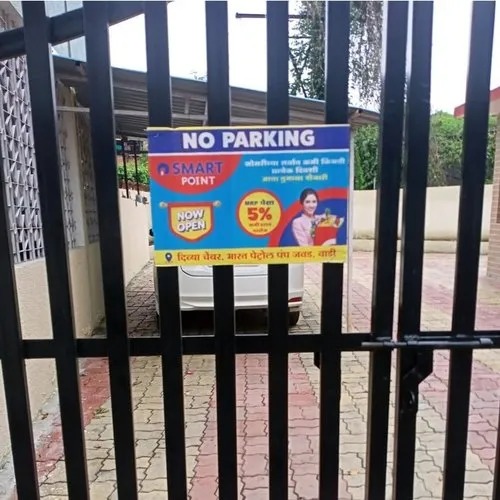
A no parking board is a small, dual-purpose sign installed on the gate or compound wall of an independent house, or at the entry gate of a housing society. It does two jobs at once. It is a genuine No Parking notice — the kind residents actually want, so nobody blocks the gate — and the main visual area is your advertisement. So the board earns its place at the gate on usefulness, and your brand rides along on that usefulness every single day.
The spec is deliberately simple: 1ft × 1.5ft, printed on Sunpack (sunboard) sheet — rigid, lightweight and weatherproof, which matters through a humid Kolkata monsoon. You can print it four ways: UV (most fade and scratch resistant, the premium choice), Solvent, Eco-Solvent (a clean, weatherproof sweet spot) and Digital (cheapest for high volume or a short campaign window). The audience standing at that gate is exactly the everyday flow you want — homeowners and families, domestic staff, delivery riders, visitors and the association office-bearers who run the para.
How does Kolkata's para culture make permission easier?
Kolkata is organised into paras — tight, named neighbourhoods that carry a real sense of shared territory. Most paras have a local club, and many lanes have a residents' association that genuinely speaks for the block. For a gate-board campaign, that is gold. In a city without this layer you knock on doors one by one. In Kolkata you can sit with the para club or association and, in a single conversation, get the go-ahead to place boards across a whole cluster of gates.
Because the No Parking message is a small civic benefit, the club usually treats the board as helpful rather than intrusive. It keeps the lane tidy and stops people parking across someone's gate — a problem every para knows. That goodwill is the quiet advantage Kolkata gives you over metros where every placement is a fresh negotiation. Respect the club's word, keep the design clean, and the permission tends to hold across the whole lane.
Want this planned para by para? Start with our no parking board advertising in Kolkata service page.
Old Kolkata or the new townships — where should you place boards?
Kolkata splits neatly into two placement worlds. The older North and Central Kolkata fabric — around Sealdah, Dum Dum, Behala and the lanes off Gariahat — is dense gated housing with strong para clubs. Here you win on lane-level depth: boards on close-packed gates, all approved through one active club, give you saturation inside a named neighbourhood. The planned townships of Salt Lake and New Town (Rajarhat) work differently. Their block-and-sector addressing makes it simple to cover defined residential pockets and to audit exactly where each board went.
Then there are the affluent pockets — Alipore, Ballygunge and parts of Gariahat — where premium UV-printed boards suit jewellery, real estate and diagnostics brands chasing higher-value households. Tollygunge, Lake Town and Jadavpur give you solid mid-market residential reach, while Barasat and the outer belt extend a campaign into the growing suburbs. The comparison table below maps a few Kolkata housing types to the kind of reach you should expect.
Kolkata area and housing type vs. gate-board reach
| Kolkata area / housing type | Typical gate density | Permission route | Best-fit brands | |
|---|---|---|---|---|
| Salt Lake / New Town blocks | Planned, block-and-sector | Block committee / association | Real estate, banks, diagnostics | |
| Old North/Central paras (Sealdah, Dum Dum) | Dense, lane-packed gates | Para club | Coaching, home services, retail | |
| Affluent pockets (Alipore, Ballygunge) | Lower density, large plots | Homeowner / association | Jewellery, premium real estate | |
| Mid-market (Tollygunge, Lake Town, Jadavpur) | Mixed gated housing | Association / homeowner | Restaurants, clinics, schools | |
| Outer belt (Barasat, Behala fringes) | Spread, growing suburbs | Para club / homeowner | NBFCs, home services, builders |
Reach and density are directional guides for planning, not guarantees. Final placement depends on para-club and homeowner consent on each lane.
How much does no parking board advertising cost in Kolkata in 2026?
The pricing is flat and honest, which suits a market that asks the rate first. It is ₹45 per board for any order under 5,000 boards, and ₹35 per board once you order 5,000 or more. Both rates are all-inclusive: the Sunpack board, the printing, transport across Kolkata and installation on the gate — and there is no monthly rental, ever. You pay once and the board keeps working at the gate.
The maths is easy to sanity-check. A focused 1,000-board run across, say, Ballygunge and Gariahat is about ₹45,000. Step up to a 5,000-board city-wide push and the bulk rate makes it roughly ₹1,75,000 — and 5,000 is the break-even where ₹35 kicks in. A full 10,000-board campaign spanning Salt Lake, New Town, Behala and the suburbs is about ₹3,50,000. No hidden site rent, no renewal invoice next month.
Kolkata no parking board rates (2026, all-inclusive)
Standard
Best for a focused para or a few Kolkata localities like Ballygunge, Gariahat or a Salt Lake cluster.
- 1ft × 1.5ft Sunpack board
- Printing included (UV / Solvent / Eco-Solvent / Digital)
- Transport across Kolkata
- Gate installation included
- No monthly rental
Bulk
Break-even bulk rate for city-wide reach across Salt Lake, New Town, Behala, Dum Dum and the suburbs.
- Everything in Standard
- ₹35/board from 5,000 boards
- 5,000 ≈ ₹1,75,000
- 10,000 ≈ ₹3,50,000
- Geo-tagged proof-of-delivery report
Gate boards vs. a Kolkata hoarding — which is the better spend?
A hoarding near Esplanade or Park Street is one big message at one fixed spot, billed every month. A gate-board run is a one-time cost that spreads your brand across hundreds of house gates inside the exact paras you choose. For a Kolkata advertiser who wants depth inside chosen localities rather than a single landmark site, the gate run usually wins on cost-per-locality — and you never owe rent again.
Gate boards vs. a single Kolkata hoarding
| Factor | No parking gate boards | Single Esplanade/Park Street hoarding | |
|---|---|---|---|
| Cost model | One-time ₹45 / ₹35 per board, install included | Recurring monthly rental | |
| Coverage | Hundreds of gates across chosen paras | One fixed location | |
| Targeting | Lane-level, locality by locality | Whoever passes the site | |
| Audience at point of view | Residents at their own gate | Passing traffic | |
| Proof of delivery | Geo-tagged per-board report | Site photo only |
Both formats have a place; gate boards are built for neighbourhood depth, hoardings for one high-traffic landmark spot.
When should you run a campaign around Durga Puja?
Durga Puja is the year's biggest moment in Kolkata, and the weeks of build-up turn every para into a hive of activity. The smart play is to get gate boards up well before the pandal-hopping crowds arrive, so your brand is already living inside the para when footfall and spending peak. You reach residents at their own gates during the run-up — without paying the premium that pandal sponsorship commands. Plan the install ahead of the season so boards are weathered-in and clean by the time the city is out on the streets.
Because the board is a one-time spend with no rental, it keeps working long after the festival ends — a Puja-timed campaign quietly carries your brand through the rest of the year. For seasonal categories like jewellery, retail and restaurants, that pre-Puja window is the single best time to lock in a Kolkata gate-board run.
How do you approach a para, association or homeowner in Kolkata?
Map the para and find the club or association
Pick your target neighbourhoods — a Salt Lake block, a Gariahat lane, a Behala pocket — and identify the local para club or residents' association that speaks for those gates. In townships, that is usually the block committee; in older paras, the club noticeboard tells you who to ask.
Lead with the No Parking benefit
Open the conversation on usefulness, not advertising: a clean board that keeps gates clear of parked vehicles. Frame it as a small civic help for the lane. In Kolkata's community-minded paras, that framing is what opens the door.
Confirm design, language and placement
Agree the board design and the Bengali-Hindi-English copy mix so it reads cleanly at the gate, then confirm exactly which gates get a board. Get the club's or homeowner's nod before any install — consent first, always.
Install and hand over geo-tagged proof
Our team installs each board on the gate or society entrance and records a geo-tagged photo. You receive a proof-of-delivery report listing every board's block, sector or lane location so you can audit coverage against the plan.
Which Kolkata industries get the most from gate boards?
The format fits any brand that sells to households inside a defined area. Real estate and builders use it to push new projects in Rajarhat and New Town. Hospitals, clinics and diagnostics centres reach families in their catchment. Coaching institutes and schools target parents para by para. Banks and NBFCs, jewellery and retail, restaurants and cloud kitchens, and home services — plumbing, pest control, solar, water purifiers — all put a clear local message right at the gate. Ward-level political and election work fits the same model. Match the print method to the brand: UV for premium jewellery and real estate in Alipore and Ballygunge, eco-solvent for the clean weatherproof middle, digital when you need big volume on a short window.
Ready to plan a Kolkata run? Get a free quote at themediaverse.in/contact or message us on WhatsApp at wa.me/9580088540 — tell us your target paras and we will map the coverage.
Kolkata no parking board advertising — FAQs
What is the minimum order for a gate-board campaign in Kolkata?
There is no large minimum to begin — you can start with a focused run in a single para or a couple of localities like Ballygunge and Gariahat at ₹45 per board. The ₹35 bulk rate begins once your order reaches 5,000 boards, which is the level for a city-wide Kolkata campaign across Salt Lake, New Town, Behala and the suburbs.
Do the boards survive the Kolkata monsoon?
Yes. The boards are printed on Sunpack (sunboard) sheet, which is rigid, lightweight and weatherproof, so they hold up through humid, rainy Kolkata months. For the longest life and the best fade and scratch resistance, choose UV printing — it is the premium option and a good fit for affluent pockets like Alipore and Ballygunge.
Which language should the board copy use in Kolkata?
Kolkata reads comfortably in Bengali, Hindi and English, so most boards use a clean mix. Keep lines short and the script legible at gate distance — the No Parking message and your brand should both register in a glance. We agree the exact language mix with you during design so it suits the para and the audience you are targeting.
Can you cover both Salt Lake townships and older paras in one campaign?
Yes, and many Kolkata campaigns do exactly that. Salt Lake and New Town blocks give clean, auditable coverage by block and sector, while older paras around Sealdah, Dum Dum and Behala add dense lane-level reach through their clubs. We plan both into one coverage map and hand over a single geo-tagged proof-of-delivery report spanning the whole run.
Is there any monthly rental or renewal cost?
No. Unlike a hoarding, a gate-board run is a one-time cost — ₹45 or ₹35 per board with board, printing, transport and installation all included. There is no monthly rental and no renewal invoice. The board keeps working at the gate for as long as it stays up, which is why it usually beats a single Kolkata hoarding on cost-per-locality.
How do I prove the boards were actually installed across Kolkata?
Every install is recorded with a geo-tagged photo, and you receive a proof-of-delivery report listing each board's block, sector or lane location. You can match that report against the agreed coverage map to confirm every para and pocket you paid for was covered — useful for marketing teams and agencies reporting back to clients.
Tags
Quick Answers
How much does no parking board advertising cost in Kolkata?
In Kolkata the rate is ₹45 per board for orders under 5,000 boards and ₹35 per board once you reach 5,000 boards or more. That price is all-inclusive — the 1ft × 1.5ft Sunpack board, printing, transport across the city and installation on the gate — with no monthly rental. A 1,000-board run across a cluster like Ballygunge and Gariahat works out to about ₹45,000, while a 5,000-board city-wide push at the bulk rate is roughly ₹1,75,000. The 5,000 mark is the break-even where bulk pricing begins.
Why does para culture make Kolkata good for gate-board advertising?
Kolkata neighbourhoods are organised into paras, each with its own local club and a strong sense of shared territory. That structure gives you a clear, single point of contact: instead of chasing individual homeowners one by one, you can approach the para club or residents' association and place boards across a whole cluster of gates in one conversation. Because the No Parking message is genuinely useful to residents, the club usually sees the board as a small civic benefit rather than an intrusion, which makes consent easier than in cities without that community layer.
Where in Kolkata do gate boards work best?
They work across the whole city, but in different ways. In planned townships like Salt Lake and New Town (Rajarhat), clean block-and-sector addressing makes it easy to cover defined residential pockets and audit each install. In older North and Central Kolkata neighbourhoods around Sealdah, Dum Dum and Behala, dense gated housing and active para clubs give you reach at the lane level. Affluent pockets such as Alipore, Ballygunge and Gariahat suit premium UV-printed boards for jewellery, real estate and diagnostics brands targeting higher-value households.
Is a gate board cheaper than a hoarding in Kolkata?
For neighbourhood reach, yes. A single hoarding near Esplanade or Park Street carries a recurring monthly rental and shows one message at one spot. A gate-board run is a one-time cost — ₹45 or ₹35 per board, installation included — and spreads your brand across hundreds of house gates inside the exact paras you want. You own no ongoing rent, and the board keeps working at the gate for as long as it stays up. For a value-conscious Kolkata advertiser wanting depth inside chosen localities, gate boards usually beat a single hoarding on cost-per-locality.
Looking for professional No Parking Board Advertising services?
The Mediaverse runs end-to-end no parking board advertising campaigns across India with geo-tagged delivery and transparent, all-inclusive pricing.
Explore our No Parking Board Advertising solutionsSummarize this guide with AI
Open this article in your favourite AI assistant
Related Guides
Written by

The Mediaverse Team
India's Leading Outdoor Advertising Agency
The Mediaverse is a national-level outdoor advertising and integrated marketing organization that provides complete OOH, ATL, BTL, retail, and transit media solutions across India. With years of experience executing high-performance campaigns for brands in FMCG, Real Estate, E-commerce, EdTech, Automotive, Healthcare, and Retail, The Mediaverse combines creativity, data-driven media planning, and flawless on-ground execution. As a full-stack outdoor advertising provider, The Mediaverse offers Auto Branding, Mobile Van Branding, Newspaper Insertion Advertising, Shop Name Board Branding, In-Store Branding, Hoardings, Transit Media, Kiosks, Mall Media, Activations, and all forms of Below-The-Line marketing. Known for its pan-India network, strategic route planning, premium print quality, and Cheqmate™ GPS-based verification, The Mediaverse ensures 100% transparent and result-oriented campaign delivery. The Mediaverse’s editorial team produces deeply researched, SEO-optimized, and generative-engine-friendly content to help businesses understand the power of outdoor advertising and make informed decisions that maximize brand visibility and ROI across urban, suburban, and rural markets.
Related Articles
Gate-to-street saturation: no-parking boards plus auto hoods in one catchment, the worked plan (2026)
The entry ticket for one catchment covered from gate to street is ₹2,83,200 landed: 1,000 gate boards plus 300 auto hoods. Seven steps, the timings for both formats, three priced plans and the honest list of what the rate card leaves out.
Outdoor advertising for clinics, pharmacies and diagnostic centres: formats, compliance and catchment (2026)
A pharmacy plan of 1,000 gate boards plus a glow sign board is ₹56,168 landed; a clinic plan of 2,000 boards plus 50,000 A5 inserts is ₹1,79,950; a diagnostic centre plan with 300 auto hoods is ₹5,36,900. Plus the rules on what a medical board may say and how far each facility's catchment reaches.
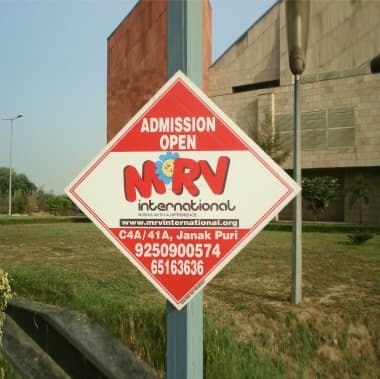
No Parking Board Advertising vs Hoardings: Which Wins for One Locality in 2026?
A hoarding looks like the premium buy — but for dominating ONE locality, it usually loses to no parking gate boards. Here is the honest, side-by-side comparison on cost model, reach, exposure and targeting, plus a clear verdict and decision checklist.