

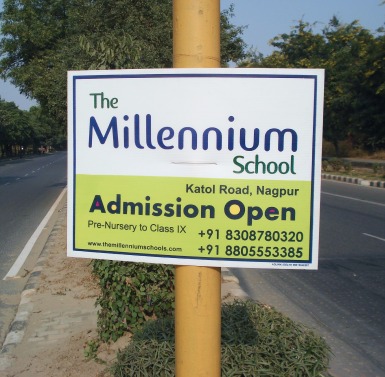
₹10 a board. That is the entire gap between the standard and bulk rates for no parking board advertising — ₹45 per board under 5,000 boards, ₹35 per board at 5,000 boards and above. It sounds tiny until you multiply it. At exactly 5,000 boards, that ₹10 becomes a ₹50,000 saving: ₹1,75,000 at the bulk rate instead of ₹2,25,000 at standard. The number that decides whether you pocket that ₹50,000 is not the rate — it is whether you can genuinely place 5,000 boards. This guide walks the break-even maths honestly, so you scale up only when it actually pays.
What exactly are the ₹45 and ₹35 no parking board rates?
There are only two tiers, and both are all-inclusive. The price covers the 1ft × 1.5ft Sunpack board, the printing, transport to the localities, and installation on the gate. There is no monthly rental — you pay once per board and the board stays up doing its dual job: a real "No Parking" notice and your advertisement. The ₹45 rate applies to any order under 5,000 boards. The moment your order reaches 5,000 boards, the whole order drops to ₹35 per board. That single threshold is the only volume break — there is no separate discount at 2,000 or 8,000.
No parking board advertising price (all-inclusive, no rental)
Standard
For campaigns below the 5,000-board threshold. Same all-inclusive coverage, just the standard per-board rate.
- Order size: 1 to 4,999 boards
- 1ft × 1.5ft Sunpack board
- Board + printing + transport + install
- No monthly rental
- Example: 1,000 boards ≈ ₹45,000
Bulk
Unlocks at 5,000 boards and applies to the whole order. Saves ₹10 on every board versus standard.
- Order size: 5,000 boards and above
- Same Sunpack board + all-inclusive coverage
- ₹10/board cheaper than standard
- Example: 5,000 boards = ₹1,75,000
- Example: 10,000 boards = ₹3,50,000
What does the 5,000-board break-even actually look like in rupees?
The break-even is the point where the bulk rate switches on — 5,000 boards — and the easiest way to see it is to price the same 5,000 boards both ways. At the standard ₹45 rate, 5,000 boards would cost ₹45 × 5,000 = ₹2,25,000. At the bulk ₹35 rate, the same 5,000 boards cost ₹35 × 5,000 = ₹1,75,000. The difference is exactly ₹50,000, which is simply the ₹10 per-board gap multiplied across 5,000 boards. Nothing else changes — same board, same install, same coverage.
The saving keeps scaling above the threshold. At 10,000 boards the bulk rate gives a total of ₹3,50,000; the same boards at ₹45 would have been ₹4,50,000, so the ₹10 gap is now worth ₹1,00,000. The rule is simple: your bulk saving equals ₹10 multiplied by however many boards you order at or above 5,000. There is no extra step-down — ₹35 is the floor.
Standard ₹45 (under 5,000) vs Bulk ₹35 (5,000+)
| Factor | Standard — ₹45/board | Bulk — ₹35/board | |
|---|---|---|---|
| Per-board rate | ₹45 all-inclusive | ₹35 all-inclusive (₹10 cheaper) | |
| Minimum order logic | Any order under 5,000 boards | Triggers only at 5,000 boards and above | |
| Total at 1,000 boards | ≈ ₹45,000 | Not available (below threshold) | |
| Total at 5,000 boards | ₹2,25,000 | ₹1,75,000 (saves ₹50,000) | |
| Total at 10,000 boards | ₹4,50,000 | ₹3,50,000 (saves ₹1,00,000) | |
| Best for | Single-locality or pilot campaigns that cannot fill 5,000 relevant gates | Multi-locality or city-wide campaigns that can genuinely place 5,000+ boards |
All figures use only the published ₹45/₹35 rates; totals are simple rate × quantity. The bulk saving is ₹10 × order quantity and is only realised if every ordered board is actually installed.
Why does the cheaper rate sometimes mean a bigger bill?
This is where advertisers trip up. "₹35 is cheaper than ₹45" is true per board, but the bulk tier only exists at 5,000+ boards — so the cheaper rate always comes attached to a larger order and a larger total cheque. A 1,000-board campaign at ₹45 costs ₹45,000. Jumping to the ₹35 rate means committing to at least 5,000 boards, which is ₹1,75,000. You did not "save" by switching rates; you spent ₹1,30,000 more to buy five times the boards at a better unit price.
So judge the decision on two separate questions. First: can your budget carry the bulk total (₹1,75,000 at 5,000 boards), not just the better per-board rate? Second: do you actually need 5,000 boards' worth of reach? If the honest answer to either is no, the ₹45 tier on a smaller order is the cheaper outcome for you — even though its per-board rate is higher.
How does widening to adjacent localities cross 5,000 without wasting boards?
The classic stuck point: your core locality genuinely supports, say, 3,500 useful gates — independent-house gates and society entry points where your audience actually lives. That is 1,500 short of the bulk threshold. Padding those 1,500 boards onto irrelevant walls just to hit 5,000 is the worst move; you pay ₹35 each for boards that reach nobody, and the "saving" is fiction.
The honest way to cross the line is to widen the footprint into adjacent localities where the same audience lives. Now the extra 1,500 boards do two jobs at once: they unlock the ₹35 rate across the whole 5,000-board order (the ₹50,000 saving becomes real), and they add genuine new reach in neighbourhoods you were not covering. You build the locality list with a coverage map first — counting usable gates per area — so the order size is driven by real demand, not by chasing a discount. If even a widened footprint cannot honestly reach 5,000 relevant gates, that is your signal to stay on the ₹45 tier.
Should you scale to 5,000 boards? A decision checklist
Run through these before committing to the bulk tier. If you can tick the first three honestly, scaling to 5,000 pays. If you cannot, stay on ₹45.
Coverage: Can your target plus adjacent localities supply 5,000 relevant gates where your audience lives — confirmed against a coverage map, not a guess?
Budget: Can you fund the bulk total — ₹1,75,000 at 5,000 boards — and not just admire the ₹35 unit rate?
Installation certainty: Will every ordered board actually go up? The geo-tagged proof-of-delivery report should account for all 5,000, or the ₹50,000 saving is partly spent on idle stock.
If you ticked all three: scale up. The ₹35 rate turns into a clean ₹50,000+ saving with real added reach. If you missed any one, run the campaign at ₹45 on the order size you can genuinely fill, and revisit the bulk tier next cycle. Either way, you can get a free quote for both order sizes and compare the totals before deciding.
The verdict: when does bulk no parking board advertising pay off?
Bulk pays off when your reach need and your budget both already point past 5,000 relevant gates — then the ₹35 rate is a straight ₹50,000-and-rising bonus on spend you were going to make anyway. Bulk does not pay off when you stretch a small campaign to 5,000 just to chase the unit price; you spend ₹1,30,000 more than a ₹45,000 pilot to buy boards you may not place. The rate is the same for everyone. What separates a smart bulk order from a wasteful one is whether the 5,000 boards reach the right gates. Decide on reach first; let the ₹10 saving follow.
Frequently asked questions
Is the ₹35 rate available for orders just below 5,000, like 4,800 boards?
No. The ₹35 bulk rate triggers only at 5,000 boards and above. An order of 4,800 boards is priced at the standard ₹45 per board (≈ ₹2,16,000). If you are close to the threshold, it is usually worth widening to adjacent localities to reach a genuine 5,000 boards, because that unlocks ₹35 on the whole order and adds real reach rather than leaving you just short.
Does the ₹45 or ₹35 price include installation, or is that extra?
Both rates are fully all-inclusive. The per-board price covers the 1ft × 1.5ft Sunpack board, the printing, transport to the localities, and installation on the gate. There is no monthly rental and no separate install fee. You pay once per board and the board stays up serving as both a real No Parking notice and your advertisement.
Is there an even cheaper rate above 10,000 boards?
No. There are only two tiers: ₹45 per board under 5,000, and ₹35 per board at 5,000 and above. ₹35 is the floor and applies equally to 5,000, 10,000 or larger orders. So at 10,000 boards the total is simply ₹35 × 10,000 = ₹3,50,000. Any quote claiming a third, lower tier is not part of this rate card.
What happens to my bulk saving if some boards never get installed?
The ₹50,000 saving at 5,000 boards assumes all 5,000 are actually placed. If, say, 500 boards never go up, you have paid ₹35 each for stock that reaches no one — quietly eroding the discount. This is why the geo-tagged proof-of-delivery report matters: it lists every installed board's location, so you can confirm the full order went up before counting the saving as real.
I only need 1,000 boards in one locality — am I overpaying at ₹45?
No. For a focused 1,000-board campaign in a single locality, ₹45 per board (≈ ₹45,000) is the correct, cheapest outcome for you. The ₹35 rate only exists at 5,000+ boards, so chasing it would mean spending ₹1,75,000 on five times the boards you need. Stay on the ₹45 tier unless your genuine reach requirement grows past 5,000 relevant gates.
Tags
Quick Answers
What is the price of no parking board advertising in India?
No parking board advertising is priced per board, all-inclusive of the board, printing, transport and installation, with no monthly rental. The rate is ₹45 per board for orders under 5,000 boards, and ₹35 per board once you order 5,000 boards or more. So 1,000 boards costs about ₹45,000, 5,000 boards costs ₹1,75,000 at the bulk rate, and 10,000 boards costs ₹3,50,000. The 5,000-board mark is the break-even where the cheaper bulk tier switches on.
How much does the bulk ₹35 tier actually save you?
The bulk tier saves ₹10 on every board versus the ₹45 standard rate. At exactly 5,000 boards that is ₹10 × 5,000 = ₹50,000 saved — you pay ₹1,75,000 instead of the ₹2,25,000 the same 5,000 boards would cost at ₹45. The saving scales with volume: at 10,000 boards the ₹10 gap is worth ₹1,00,000. But the saving is only real if you genuinely install all the boards you order — unplaced stock you have paid for erases the discount.
When does it make sense to scale up to 5,000 boards?
Scaling to 5,000 boards makes sense when you can realistically place all of them on relevant gates without padding the campaign. If your core locality only supports, say, 3,500 useful gates, you have two honest choices: stay on the ₹45 tier for 3,500 boards, or widen to adjacent localities so the extra 1,500 boards add genuine new reach while also unlocking the ₹35 rate on the whole order. Crossing 5,000 only pays when the extra boards reach the right audience, not blank walls.
Looking for professional No Parking Board Advertising services?
The Mediaverse runs end-to-end no parking board advertising campaigns across India with geo-tagged delivery and transparent, all-inclusive pricing.
Explore our No Parking Board Advertising solutionsSummarize this guide with AI
Open this article in your favourite AI assistant
Related Guides
- no parking board advertising service
- complete no parking board advertising guide
- full no parking board advertising cost breakdown
- no parking board advertising in Delhi
- no parking board advertising in Bangalore
- shop name board branding
- auto rickshaw advertising
- gate boards plus auto hoods, priced as one plan
Written by

The Mediaverse Team
India's Leading Outdoor Advertising Agency
The Mediaverse is a national-level outdoor advertising and integrated marketing organization that provides complete OOH, ATL, BTL, retail, and transit media solutions across India. With years of experience executing high-performance campaigns for brands in FMCG, Real Estate, E-commerce, EdTech, Automotive, Healthcare, and Retail, The Mediaverse combines creativity, data-driven media planning, and flawless on-ground execution. As a full-stack outdoor advertising provider, The Mediaverse offers Auto Branding, Mobile Van Branding, Newspaper Insertion Advertising, Shop Name Board Branding, In-Store Branding, Hoardings, Transit Media, Kiosks, Mall Media, Activations, and all forms of Below-The-Line marketing. Known for its pan-India network, strategic route planning, premium print quality, and Cheqmate™ GPS-based verification, The Mediaverse ensures 100% transparent and result-oriented campaign delivery. The Mediaverse’s editorial team produces deeply researched, SEO-optimized, and generative-engine-friendly content to help businesses understand the power of outdoor advertising and make informed decisions that maximize brand visibility and ROI across urban, suburban, and rural markets.
Related Articles
Gate-to-street saturation: no-parking boards plus auto hoods in one catchment, the worked plan (2026)
The entry ticket for one catchment covered from gate to street is ₹2,83,200 landed: 1,000 gate boards plus 300 auto hoods. Seven steps, the timings for both formats, three priced plans and the honest list of what the rate card leaves out.
Outdoor advertising for clinics, pharmacies and diagnostic centres: formats, compliance and catchment (2026)
A pharmacy plan of 1,000 gate boards plus a glow sign board is ₹56,168 landed; a clinic plan of 2,000 boards plus 50,000 A5 inserts is ₹1,79,950; a diagnostic centre plan with 300 auto hoods is ₹5,36,900. Plus the rules on what a medical board may say and how far each facility's catchment reaches.
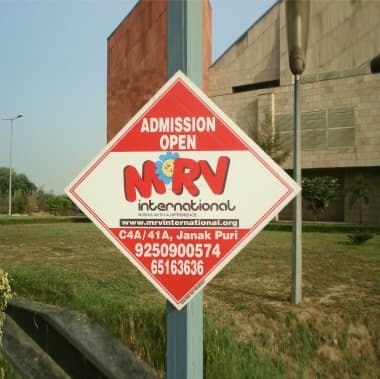
No Parking Board Advertising vs Hoardings: Which Wins for One Locality in 2026?
A hoarding looks like the premium buy — but for dominating ONE locality, it usually loses to no parking gate boards. Here is the honest, side-by-side comparison on cost model, reach, exposure and targeting, plus a clear verdict and decision checklist.