

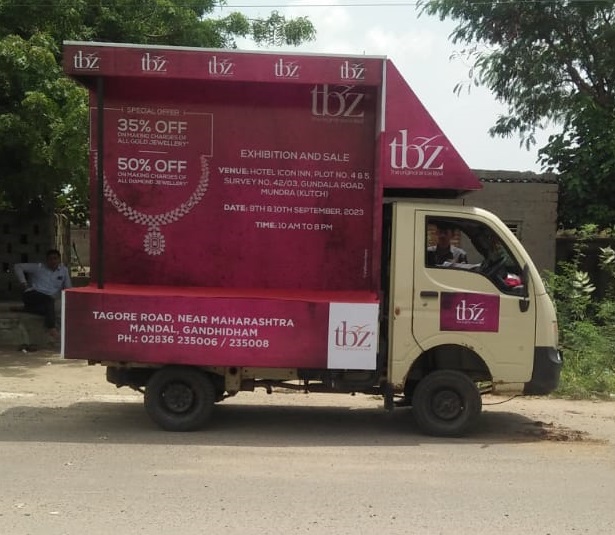
Picture a launch outside a new store, or the entrance to a Navratri ground at dusk: a large, brightly designed van pulls up, its whole body carrying the brand's colours, imagery, and message, sometimes lit or three-dimensional, and every person walking past turns to look. That is the appeal of mobile van branding, a format that does not wait for the audience to pass a fixed point but takes the brand directly to where the audience already is, in a form too big and too striking to ignore. For image-led businesses, schools at admission time, fashion and furniture brands selling on look, it is often the format that fits best. This guide covers what mobile van branding is and why it works, its formats and cost, the van types, when to use it over other formats, how to plan routes, a step-by-step campaign process, design, and measurement, so you can run a van campaign that lands.
What is mobile van branding, and why does it work?
Mobile van branding applies a brand's full design across a vehicle, often with three-dimensional or backlit elements, turning it into a moving, customisable billboard. Its power comes from two things a fixed format cannot offer together: a large, eye-catching canvas, and complete control over where and when it appears. The van can be routed through the neighbourhoods that matter, parked at events, festival grounds, and markets, and timed to peak footfall, so the message goes to the audience rather than waiting for it. This makes it ideal for image-led categories that are sold on look and feel, the vehicle carries a full visual story, and for reaching specific zones, events, or housing catchments precisely. It is the format that combines impact and targeting in motion, which is why brands reach for it when they want to make a strong, controllable impression in a chosen place.
Mobile van branding formats and cost
Van branding is mid-priced among outdoor formats and quoted per campaign rather than as a flat rate, because the cost depends on several variables. The table sets out what drives the cost and where the format sits relative to others.
Mobile van branding cost factors (2026)
| What it depends on | Why it matters | |
|---|---|---|
| Van type and size | Smaller van to large van or truck | Bigger canvas and elaborate displays cost more |
| Level of customisation | Flat wrap vs 3D, lit, or built-out | More elaborate builds cost more |
| Duration | Per van per day or per campaign | Longer campaigns scale the cost |
| Number of vans | One to a small fleet | More vans widen reach and cost |
| Routes and events | City routes, events, festival grounds | Premium events and peak timings cost more |
2026 framing; van branding is mid-priced, between low-cost auto branding and a high-rental hoarding, and quoted per campaign. Request a tailored quote.
Types of vans and what they suit
The right vehicle depends on the goal. Smaller customised vans are nimble, good for threading through city streets, colonies, and tighter market areas, and for covering many neighbourhoods affordably. Larger vans and trucks offer a much bigger canvas and can carry more elaborate, three-dimensional, or backlit displays, which makes them suited to launches, events, and high-footfall locations where a standout, hard-to-miss presence matters. Some campaigns go further, fitting vans with audio, lighting, or display screens, or building them out as roadshow or demonstration vehicles where customers can step in and interact, which suits product launches and experiential campaigns. The decision is whether you need agile, wide coverage or a large, immersive statement at chosen spots; the van type follows from that, and it is the first thing to settle when planning a campaign because it shapes both the impact and the cost.
When to use mobile van branding over other formats
Van branding occupies a clear niche: targeted, high-impact, and mobile. Choose it over auto-rickshaw branding when impact and a larger canvas matter more than the absolute lowest cost per contact, for example when the brand is visual and needs to be shown, not just seen. Choose it over a hoarding when the message needs to travel to several places, neighbourhoods, events, a launch route, rather than wait at a single fixed location. It is not the most efficient format for pure broad saturation, autos usually win there, nor for owning one landmark, where a hoarding fits, but for taking a strong, controllable visual presence to specific audiences and occasions, nothing else does the job as well. In a layered plan, the van is the targeted impact element that complements a broad auto-and-insert reach base, brought in where a particular place or event justifies its mid-tier cost.
Best uses: launches, events, seasons, and catchments
Some uses suit van branding particularly well. Launches: a van can anchor a store or product launch with a bold, mobile presence and even drive a route that points people to the opening. Events and festival grounds: parked at a Navratri ground, a mela, a sports event, or a market on a peak day, a van reaches a large, gathered, receptive audience. Admission and sale seasons: schools and coaching centres use vans to reach parents across residential areas at admission time, and retailers use them to push a sale through their catchment. Specific catchments: a van can be routed through chosen housing colonies or zones to reach a defined audience that a fixed format cannot target. Across all of these, the common thread is a need to take a strong visual message to a particular place, audience, or moment, which is exactly what the format is built for.
Route and timing planning
Most of a van campaign's value is won in the route and timing plan, because a van that drives at random wastes its impact, while one routed to the audience concentrates it. Plan the route around where your customers are: the neighbourhoods they live in, the markets and high streets they visit, the events they attend, and the times those places are busy. For an admission campaign, that means residential colonies in the morning and evening; for a festive push, the grounds and markets at peak hours; for a launch, the area around the store and the routes leading to it. Where useful, park the van at high-footfall spots for dwell time rather than only driving. Coordinate timing with your other formats so the van reinforces an offer that an insert or autos are also carrying. A deliberate route and timing plan is the difference between a van that is seen by the right people at the right moment and one that is merely on the road.
How to run a mobile van campaign: step by step
The process below takes a van campaign from goal to measured result. Work through it in order.
Define the goal, audience, and area
Decide what the campaign should achieve, a launch, event presence, admission reach, or a sale push, and who and where the audience is. The goal and the geography determine the van type, the routes, and the timing, so settle them first. A clear goal also gives you something to measure the campaign against.
Choose the van type for the goal
Match the vehicle to the goal: a smaller customised van for nimble, wide neighbourhood coverage, or a larger van or truck for a big canvas and elaborate displays at events and launches, with audio, lighting, screens, or a roadshow build if the campaign is experiential. The van type shapes both the impact and the cost, so choose it deliberately.
Plan routes and timings around the audience
Map the routes and the times that put the van where your customers are: residential colonies, markets, high streets, and events at their peak hours. Decide where the van drives and where it parks for dwell time. A route built around the audience, not convenience, is what concentrates the van's impact and is central to the campaign's value.
Design for a moving vehicle
Design the wrap for a vehicle in motion and at a distance: a bold, clear message and brand, strong contrast, and a single strong idea rather than a cluttered layout, using the large canvas and any three-dimensional or lit elements to stand out. Make sure the core message reads in the few seconds a passer-by has, and include a clear call to action or contact.
Coordinate with your other formats
Tie the van to the rest of the plan so it reinforces a single message: the same offer on a newspaper insert, the same creative on autos, the same theme as a shop board or launch. A van that carries the same offer customers are seeing elsewhere compounds the effect, rather than acting as an isolated spectacle.
Run, track, and measure
Run the campaign to the plan, track coverage with GPS or route logs to confirm where the van went, and measure response with a coupon code, QR, dedicated number, or on-site activation. Tying the van to a measurable offer turns a visible awareness format into one you can judge, and tells you what to repeat or change next time.
Designing for a van: making the canvas work
A van gives you a large canvas, but it is a moving one, seen briefly and often at a distance, so the design rules are strict. Lead with one strong idea, the brand and a single clear message, rather than crowding the surface with detail that cannot be read in passing. Use bold colour and high contrast so the van reads from across a road, size the key elements for distance, and exploit the format's advantages, the three-dimensional shapes, lit panels, or screens that a flat format cannot offer, to draw the eye. Keep the call to action and contact simple and prominent. For image-led brands, let the visual do the work: a furniture brand can show the product, a fashion brand its look, a school its character. The goal is that someone who sees the van for a few seconds comes away with the brand and the one thing you wanted them to remember, which is what a well-designed moving canvas achieves and a cluttered one does not.
Measuring a van campaign
Van branding is an awareness and impact format, but it is far from unmeasurable. Coverage can be tracked through GPS or route logs that confirm where and when the van operated, so you know the plan was delivered. Response can be measured by attaching a trackable element, a coupon code, QR, dedicated number, or an on-site activation where the van stops, and counting what it generates. For event and launch campaigns, footfall and enquiries during and after the van's presence are useful signals. Tying the van to a measurable offer turns a spectacle into something with a result you can judge and improve. As with all outdoor, some of the value is in awareness and familiarity that direct response does not fully capture, so read the coupon data alongside footfall and enquiry trends, but the format rewards measurement just as much as any other, and the brands that track it get more from each campaign.
Is mobile van branding worth the cost compared with auto branding?
It depends on the goal. Van branding costs more than auto-rickshaw branding because it offers a much larger, customisable canvas and precise control over routes, events, and timing, so it is worth it when impact and targeting matter more than the lowest cost per contact, for a launch, an event, or an image-led brand that needs to be shown. Auto branding is more efficient for broad, low-cost saturation across a city. Many strong plans use both: autos for wide, affordable reach and a van for targeted, high-impact presence at key places and moments. So the van is worth its cost when you need a striking, controllable presence somewhere specific, not as a replacement for the reach autos provide.
What kinds of businesses benefit most from mobile van branding?
Image-led businesses benefit most, because the van carries a full visual story. Schools and coaching centres use vans to reach parents across residential areas at admission time; fashion and apparel brands get a moving, eye-catching showcase; furniture and interiors brands can display their product and reach home-owning catchments. Event-driven and launch campaigns of all kinds also benefit, since a van can anchor an opening or a festival presence. More broadly, any business that needs to take a strong visual message to a specific place, audience, or occasion, rather than wait for people to pass a fixed point, is a good fit. Businesses whose main need is the cheapest possible broad reach may get more from auto branding or inserts.
How long should a mobile van campaign run?
It depends on the goal. For a launch or a single event, a van might run for a day or a few days, concentrated on the occasion and its build-up. For a season, such as an admission period or a sale, a campaign of a few weeks routed through the catchment maintains presence while the opportunity lasts. For ongoing brand-building, longer or recurring runs keep the brand visible, though many brands use the van in focused bursts around key moments rather than continuously, because the format earns most when aimed at a specific time and place. Decide the duration from when your audience is most reachable and most receptive, and concentrate the van there rather than spreading it thinly over a long, undifferentiated period.
Can a mobile van be used at events and festival grounds?
Yes, and it is one of the format's strongest uses. Parked at or routed around a festival ground, a mela, a sports event, a market on a peak day, or a launch, a van reaches a large, gathered, and often receptive audience in one place, and its size and customisation make it a focal point. For experiential campaigns, vans built out with screens, audio, lighting, or as demonstration vehicles let customers interact on site. The keys are to secure the right location and timing for the event, design the van to draw and hold attention, and, where possible, add an on-site activation or offer so the presence converts into response. Event and festival use plays directly to the van's strengths of impact and targeted presence.
Tags
Quick Answers
What is mobile van branding and how does it work?
Mobile van branding turns a vehicle into a moving advertisement, with the brand's design applied across the van's body, and often three-dimensional or backlit elements, so it acts as a customisable billboard that travels. Unlike a fixed hoarding, the van goes to the audience: it can be routed through chosen neighbourhoods, parked at events, festival grounds, and markets, and timed to when and where the target customers are. That combination of a large, eye-catching canvas and precise control over location and timing is what makes van branding distinctive. It works especially well for image-led brands, because the vehicle carries a full visual story, and for reaching specific zones, events, or catchments that a static format cannot target as directly.
How much does mobile van branding cost in India?
Mobile van branding is mid-priced among outdoor formats, typically charged per van per day or per campaign, which places it between low-cost auto-rickshaw branding and a high-rental hoarding. The cost depends on the van type and size, the level of customisation, the campaign duration, the number of vans, and the routes or events covered, so it is quoted per campaign rather than as a flat rate. You are paying for both targeting and impact: the ability to choose exactly where and when the van operates, and a large, striking canvas. For a brand that needs to reach specific areas or events with a strong visual presence, van branding delivers value that a cheaper but untargeted format or a fixed, costly hoarding cannot, which is why it is quoted to the campaign.
When should you use mobile van branding instead of other formats?
Use mobile van branding when you need a strong visual presence taken to a specific place or audience: a launch, a festival ground or event, an admission or sale season, or a set of neighbourhoods or housing catchments. It suits image-led categories, schools, fashion, furniture and interiors, that are sold on look and benefit from a moving, customisable showcase. Choose it over auto branding when impact and a larger canvas matter more than the lowest cost per contact, and over a hoarding when you need to take the message to several places rather than wait at one. For broad, low-cost saturation, autos may be more efficient; for a targeted, high-impact, mobile presence, the van is the right tool.
What types of vans are used for mobile van branding?
Mobile van branding uses a range of vehicle types depending on the goal and budget, from smaller customised vans for nimble city routes and neighbourhood reach, to larger vans and trucks that offer a bigger canvas and can carry more elaborate, three-dimensional, or backlit displays for events and launches. Some campaigns use vans fitted with extra features such as audio, lighting, or display screens, or built out as roadshow or demonstration vehicles where customers can interact. The right type depends on whether you need agile coverage of city streets and colonies or a large, standout presence at events and high-footfall locations. Matching the van type to the goal is the first decision in planning a campaign.
Looking for professional Mobile Van Branding services?
The Mediaverse runs end-to-end mobile van branding campaigns across India with geo-tagged delivery and transparent, all-inclusive pricing.
Explore our Mobile Van Branding solutionsSummarize this guide with AI
Open this article in your favourite AI assistant
Related Guides
- mobile van branding services
- the complete guide to outdoor advertising in India
- auto branding vs mobile van branding
- the festive season booking calendar
- the operator's take on which format fits your business
- how to plan your outdoor advertising budget
- mobile van branding in Mumbai
- auto rickshaw branding services
Written by

The Mediaverse Team
India's Leading Outdoor Advertising Agency
The Mediaverse is a national-level outdoor advertising and integrated marketing organization that provides complete OOH, ATL, BTL, retail, and transit media solutions across India. With years of experience executing high-performance campaigns for brands in FMCG, Real Estate, E-commerce, EdTech, Automotive, Healthcare, and Retail, The Mediaverse combines creativity, data-driven media planning, and flawless on-ground execution. As a full-stack outdoor advertising provider, The Mediaverse offers Auto Branding, Mobile Van Branding, Newspaper Insertion Advertising, Shop Name Board Branding, In-Store Branding, Hoardings, Transit Media, Kiosks, Mall Media, Activations, and all forms of Below-The-Line marketing. Known for its pan-India network, strategic route planning, premium print quality, and Cheqmate™ GPS-based verification, The Mediaverse ensures 100% transparent and result-oriented campaign delivery. The Mediaverse’s editorial team produces deeply researched, SEO-optimized, and generative-engine-friendly content to help businesses understand the power of outdoor advertising and make informed decisions that maximize brand visibility and ROI across urban, suburban, and rural markets.
Related Articles
Mobile Van Branding in Lucknow (2026): Rates, Routes and the E-Rickshaw Question
Lucknow van branding is fabrication plus a day rate: Rs.11,000 buys a single T-Shape day. The full 2026 card, why the LED truck is the cheap option for a one-day booking, what the published three-van and four-van budgets land at after GST, and how the format compares with a Lucknow auto on cost per view.
LED Truck at Rs.8,000 a Day vs T-Shape Van at Rs.2,500: When the 3.2x Premium Pays (Chennai, 2026)
Chennai prices a T-Shape van at Rs.2,500 a day and an LED display truck at Rs.8,000, both with the same published 40 km route and 6 hour window. Here is what the extra Rs.5,500 a day buys, the three cases where it pays, and the arithmetic that shows when it does not.
The One-Day Campaign: Mobile Van Is the Only Outdoor Format You Can Book for a Single Day (2026)
Auto hoods start at 300 autos, no-parking boards at 1,000 and newspaper inserts at 50,000 copies. The mobile van is the only outdoor format The Mediaverse publishes with a minimum measured in days rather than units, and one day starts at Rs.2,200.