

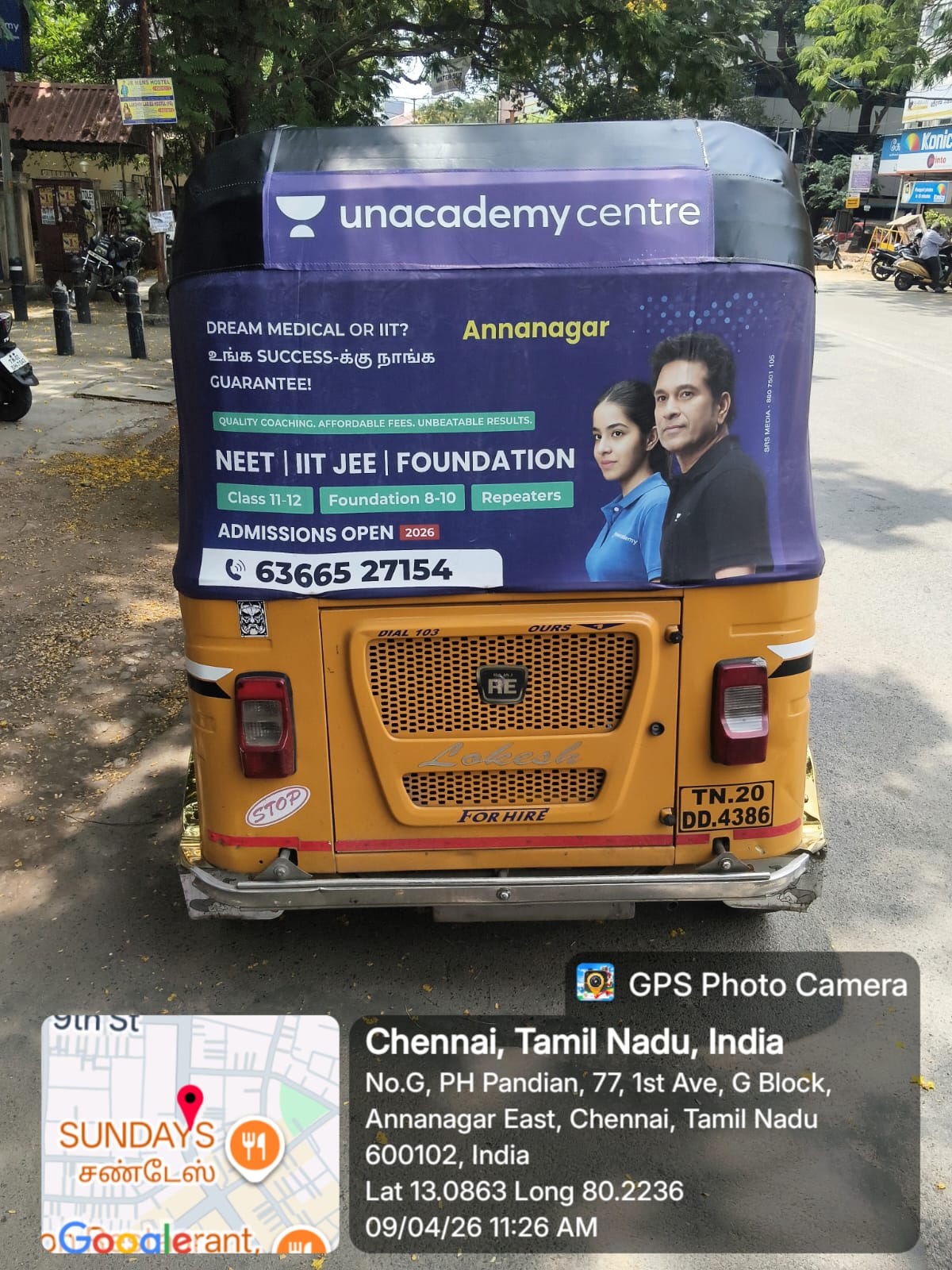
Here is the short version, because you are deciding: auto branding and mobile van branding are not really competitors, they are tools for two different jobs. Auto branding wins when you want sustained, low-cost awareness and frequency across an area over weeks. Mobile van branding wins when you want concentrated, high-impact presence at a specific place and time, a launch, a mall, a market weekend, a night event. If you only remember one line, let it be this: frequency means autos, impact means a van. The rest of this guide gives you the spec table, the exact conditions where each wins, and a checklist to make the call for your campaign.
Auto branding vs mobile van branding: the spec table
The clearest way to decide is to compare the two formats on the metrics that actually drive the choice: cost, efficiency, control, and the kind of campaign each suits.
Auto branding vs mobile van branding (2026)
| Auto branding | Mobile van branding | |
|---|---|---|
| Starting cost | Rs.650 per auto one-time (hood); MOQ 300 = Rs.1,95,000 | Rs.3,000 to Rs.9,000 per van/day |
| Cost per 1,000 impressions | About Rs.2 to Rs.8 (lowest of any format) | Higher per impression; concentrated value |
| Best campaign type | Always-on awareness and frequency | Launches, bursts, events, experiential |
| Location control | Lower; autos run their own routes | High; you choose the exact route and parking |
| Coverage | Citywide, deep into lanes and markets | Specific corridors and hero spots you pick |
| Customisation & night | Hood, or back-panel sticker (24x6 inch Rs.170, 24x18 inch Rs.270) | Fully customisable; LED option for night |
| Typical commitment | One-time hood; minimum 300 autos, runs for weeks | Per day; one or two vans |
| Deployment speed | Fastest; the most prompt format | Fast, but needs route planning |
2026 starting points; actuals vary by city, volume and customisation. Auto branding wins on cost and reach; mobile vans win on control and impact.
When does auto branding win?
Auto branding wins whenever the goal is sustained presence over weeks. If you are a local retailer, clinic, school, real-estate project, or FMCG brand that needs your catchment to see you again and again, autos deliver that repetition at the lowest cost per impression of any outdoor format, roughly Rs.2 to Rs.8 per thousand. A hood is a one-time Rs.650 per auto, not a monthly rent, and the minimum fleet is 300 autos, so the entry ticket is Rs.1,95,000 before GST; that fleet puts your brand deep into residential lanes, markets, and college zones that a van passes through only briefly. Autos are also the most prompt format to deploy. In short: choose autos for everyday awareness, frequency, and value, once your budget clears the 300-auto minimum.
When does a mobile van win?
A mobile van wins when location control and impact matter more than cost per impression. For a product or store launch, an activation outside a mall or a major market on a peak weekend, a night event where an LED van is unmissable, or an experiential campaign for a design-led category, fashion, schools, furniture, interiors, the van puts a fully customised, eye-catching presence exactly where and when your audience gathers. You decide the route and the parking spot; the van is not at the mercy of a driver's own circuit. That control, plus the customisation and the night-time LED option, is what justifies the higher day rate. Choose a van for a concentrated, high-impact moment.
Edge cases: when to use both, or neither
Most real campaigns are not either-or. The strongest structure is both: an auto base running all month for frequency, with one or two vans deployed for the launch week or the peak festive or sale weekend. The autos keep you present; the van creates the spike. Use both when your budget clears roughly Rs.2.5 lakh, the 300-auto base at Rs.1,95,000 plus a few van days, and your campaign has both an always-on goal and a moment to amplify. And neither may be the answer in two cases: if you only need to reach one fixed location, a shop name board or local print may serve better than mobile media, and in Mumbai's island city, where autos do not operate, a van or taxi branding is the transit option. Match the tool to the job, not the other way round.
Our recommendation
If you are building a campaign from scratch and can only start with one format, start with auto branding. It is the cheapest, most flexible, and most prompt way to establish presence, and it is the base that everything else amplifies. Add a mobile van the moment you have a specific high-impact occasion to spend against, a launch, an event, a peak weekend, or an experiential idea that needs a customised, controllable canvas. For design-led categories that live on visual impact, weight the plan more toward vans; for value retail and services that live on repetition, weight it toward autos. We run this exact structure for most clients: autos for the always-on layer, a van for the moment, or let us build the right split for your goal and budget.
Decision checklist: which should you pick?
Answer these six questions and the choice resolves itself. (1) Do you need sustained presence over weeks, or a short high-impact burst? Weeks means autos; a burst means a van. (2) Is your budget recurring/monthly or a one-off event spend? Monthly favours autos; event spend favours a van. (3) Do you need to control exactly where the brand appears? If yes, a van; if not, autos. (4) Is your category experiential or design-led (fashion, schools, furniture, interiors)? If yes, lean van. (5) Are you targeting daytime market frequency or a night event? Night events favour an LED van. (6) Do you need citywide reach or a single hero location? Citywide favours autos; a hero spot favours a van. If your answers split, you want both, with the weighting following the majority.
Is auto branding or mobile van branding better for a product launch?
For the launch moment itself, a mobile van is usually better, because you can put a fully customised, high-impact presence exactly where your launch audience gathers, a mall, a market, or an event, on the days that matter, with an LED option for night visibility. But a launch is stronger when the van burst sits on top of an auto base that builds awareness in the catchment in the weeks before and after, so the spike has context. If you can only afford one for a launch, choose the van for the peak days; if you can afford both, run autos around the van.
Can a small business afford mobile van branding?
Yes, and below the auto minimum it is often the only option. A mobile van at Rs.3,000 to Rs.9,000 per day can be booked for a single day, while autos need the 300-hood minimum of Rs.1,95,000 one-time. So on a small budget, put one or two van days on your opening or biggest sale weekend rather than a sustained run, which gets costly. Once the budget clears the auto minimum, a concentrated auto fleet in your catchment delivers far more exposure per rupee, with a van day layered on top for the peak.
Which format gives more impressions for the money?
Auto branding, by a wide margin, on a cost-per-impression basis. A single branded auto generates an estimated 10,000 to 40,000 daily impressions for a one-time Rs.650 hood, which works out to roughly Rs.2 to Rs.8 per thousand impressions, the lowest of any outdoor format, and keeps falling the longer the hood stays on. A mobile van delivers fewer total impressions per rupee because you pay a premium day rate for control and impact at a chosen spot. So if raw efficiency and reach are your priority, autos win; if concentrated impact at a specific place and time matters most, the van is the trade.
Do mobile vans work better at night than autos?
Yes, especially LED vans. A mobile van, and particularly a self-illuminated LED van, is bright and eye-catching after dark, which makes it the stronger format for night events, festival nights such as Navratri garba grounds, and evening market activations. Autos are primarily a daytime frequency format and are far less visible at night. So for any campaign whose key moments happen in the evening or at night, a van, ideally LED, is the better transit choice, while autos remain the more efficient option for daytime, all-day exposure across a catchment.
Tags
Quick Answers
Should I choose auto branding or mobile van branding?
Choose auto branding for sustained, low-cost frequency across a catchment over weeks; choose a mobile van for concentrated impact at a specific place and time. Auto branding is Rs.650 per auto one-time (Rs.630 from 500, minimum 300 autos) and is cheapest per impression once running. Vans are Rs.3,000 to Rs.9,000 per van per day, dearer per impression but you control exactly where the brand appears, with full customisation and an LED night option. The budgets differ in shape: autos need one Rs.1,95,000 commitment, a van books by the day. Frequency means autos; impact means a van.
Which is cheaper, auto branding or mobile van branding?
Auto branding is far cheaper per impression, though not per order. A hood is Rs.650 per auto one-time, so the smallest bookable fleet of 300 autos is Rs.1,95,000 before GST, which works out at roughly Rs.2 to Rs.8 per thousand impressions, the lowest of any outdoor format. A mobile van is Rs.3,000 to Rs.9,000 per day, so one day starts in the low thousands and buys concentrated impact at a higher cost per impression. For recurring presence autos win; for a short burst, or any budget below the auto minimum, a van is what can actually be booked.
When is a mobile van worth the higher cost over autos?
A mobile van is worth it when location control and impact matter more than cost per impression: a product or store launch, an activation outside a mall or market on a peak weekend, a night event where an LED van stands out, or an experiential campaign for a design-led category such as fashion, schools, furniture, or interiors. The van lets you put a fully customised, eye-catching brand presence exactly where your audience gathers, at the moment they gather. For sustained day-to-day awareness, though, an auto base delivers far more exposure per rupee.
Looking for professional Transit Advertising services?
The Mediaverse runs end-to-end transit advertising campaigns across India with geo-tagged delivery and transparent, all-inclusive pricing.
Explore our Transit Advertising solutionsSummarize this guide with AI
Open this article in your favourite AI assistant
Related Guides
Written by

The Mediaverse Team
India's Leading Outdoor Advertising Agency
The Mediaverse is a national-level outdoor advertising and integrated marketing organization that provides complete OOH, ATL, BTL, retail, and transit media solutions across India. With years of experience executing high-performance campaigns for brands in FMCG, Real Estate, E-commerce, EdTech, Automotive, Healthcare, and Retail, The Mediaverse combines creativity, data-driven media planning, and flawless on-ground execution. As a full-stack outdoor advertising provider, The Mediaverse offers Auto Branding, Mobile Van Branding, Newspaper Insertion Advertising, Shop Name Board Branding, In-Store Branding, Hoardings, Transit Media, Kiosks, Mall Media, Activations, and all forms of Below-The-Line marketing. Known for its pan-India network, strategic route planning, premium print quality, and Cheqmate™ GPS-based verification, The Mediaverse ensures 100% transparent and result-oriented campaign delivery. The Mediaverse’s editorial team produces deeply researched, SEO-optimized, and generative-engine-friendly content to help businesses understand the power of outdoor advertising and make informed decisions that maximize brand visibility and ROI across urban, suburban, and rural markets.
Related Articles
The Smallest Order in Every Outdoor Format in Bangalore, Side by Side (2026)
Six outdoor formats, six different floors, one city. Every Bangalore minimum order with GST added, what each one covers against the denominators our own pages publish, and which to buy first.
Which Outdoor Formats Charge a Festival Premium, and Which Hold Flat All Year (2026)
We checked every published rate card for seasonal pricing. There is one surcharge on the whole site, and it is smaller than the rush fee most buyers pay without noticing. What rises, what holds flat, and how to plan an October campaign backwards from the published lead times.
Do Our Outdoor Rates Differ by City? The Auto and Van Cards Side by Side (2026)
We read all ten published city pages side by side. Auto branding is one national price everywhere. Mobile vans and shop name boards are the city-priced formats, the LED rate varies by 36 percent, and the fabrication line moves a short booking more than the day rate does.