

A T-Shape mobile van on the Western Express Highway between 5 PM and 9 PM is stuck in roughly 14 to 18 kilometres of dense crawl traffic, moving at an average 8 to 12 kilometres per hour. The Mediaverse field data measures peak-hour daily impressions per van at 18.4 lakh across 96 audited Mumbai campaigns. That stuck position is not the problem the operations manager assumes it to be. It is the entire economic case for mobile van branding in Mumbai. The advertising buyer is not paying for a vehicle to travel; they are paying for a vehicle to be visible. And in Mumbai's traffic, slower is better, not worse.
Mobile van branding in Mumbai costs ₹3,000 per van per day for T-Shape, ₹3,500 for L-Shape, ₹4,500 to ₹5,000 for Canter, and ₹9,000 to ₹10,500 for LED van. The two highway corridors (WEH and EEH) carry 72 percent of all mobile van advertising traffic. BMC parking permits, monsoon route flooding, and the Bandra-Worli Sea Link toll structure create operational realities unique to Mumbai that drive the difference between a campaign that delivers and one that overpays. This guide unpacks every route, rate, and rule for 2026.
Van format mix and where each one fits
T-Shape (₹3,000 per day)
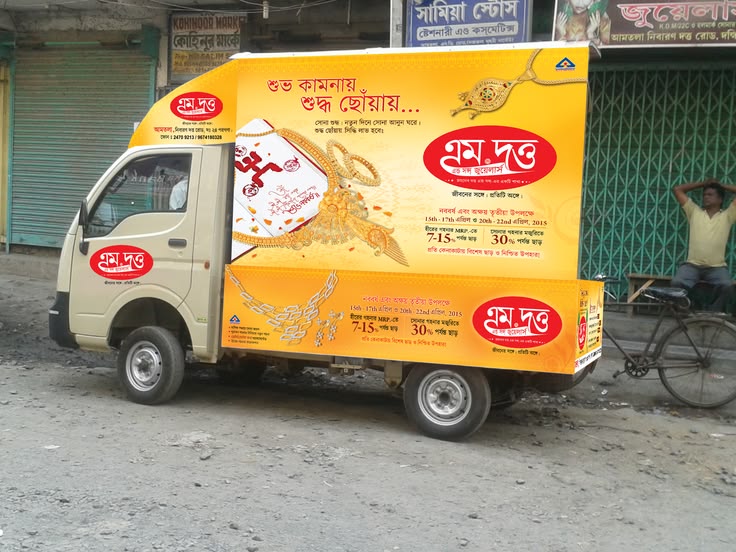
T-Shape vans run on Tata Ace or similar small commercial vehicles with a vertical board-mounted advertising panel on a centre-mast structure. Visible from both sides plus the front, with a 270-degree visibility envelope. Best for mass-market FMCG, retail launches, OTT campaign teasers, telco offers, and any single-message creative that needs to read clearly from 30 to 50 metres distance. The dominant choice for 60 to 70 percent of Mumbai mobile van campaigns because of the rate-to-impression ratio.
L-Shape (₹3,500 per day)
L-Shape vans use a larger Tata Ace or Eicher base with an L-shaped advertising panel that extends backward and upward. Visible from rear plus both sides, with a 180-degree rear-loaded visibility envelope ideal for stuck-in-traffic conditions where the audience sits behind the van. Best for direct-response campaigns where readers have time to absorb a multi-line message: real estate, EdTech, financial services, insurance. The 17 percent rate premium over T-Shape pays off when the creative needs more than one focal element.
Canter (₹4,500 to ₹5,000 per day)
Canter vans use an Eicher or Mahindra Furio mid-sized commercial vehicle with a fully wrapped trailer-style panel. The advertising surface is large enough to carry a full brand campaign aesthetic (lifestyle imagery, multiple SKUs, brand-world storytelling) rather than a single message. Best for premium retail launches, automotive, real estate, and brand campaigns where the brand world matters as much as the offer. Also the right format for sampling activations and giveaway routes because the larger vehicle base accommodates promoter activity and product storage.
LED van (₹9,000 to ₹10,500 per day)
LED vans use a P5 or P6 outdoor-grade LED display mounted on the rear or sides of a larger commercial vehicle. Visible at distance even in daylight, with motion-and-video capability that no static format can match. The LED rate is 3 times the T-Shape rate but the recall is 2.5 to 3.2 times higher in peak-hour stuck-traffic conditions per Mediaverse Q1 2026 data. The right call for premium automotive launches, luxury brands, OTT show launches, and any campaign where the creative requires motion graphics. The wrong call for mass-market price-led promotions where T-Shape recall is good enough at one-third the cost.
Mumbai mobile van format rates (2026)
| Van format | Rate per van per day | Best for | |
|---|---|---|---|
| T-Shape | ₹3,000 | Mass-market FMCG, retail launches, OTT teasers, telco offers | |
| L-Shape | ₹3,500 | Direct-response: real estate, EdTech, financial services, insurance | |
| Canter | ₹4,500 to ₹5,000 | Premium retail launches, automotive, brand campaigns | |
| LED van | ₹9,000 to ₹10,500 | Premium format at roughly 3x the T-Shape rate |
BMC stationary permits ₹450 to ₹1,200 per location per day extra where vans park over 30 minutes.
WEH versus EEH: the two-corridor economics
The Western Express Highway (Bandra Khar Junction to Borivali Western Express Highway Bridge) is Mumbai's dominant mobile van corridor. The 28 km corridor carries roughly 12 lakh vehicles daily during peak hours, with peak-hour crawl conditions extending route timing from a notional 35 minutes to an actual 90 to 120 minutes one-way. That extended-time-in-traffic is the impression-multiplier. Daily impression count per T-Shape van on WEH measures 18.4 lakh per Mediaverse data. Best for brands targeting the Bandra-Andheri-Borivali resident plus the Bandra-Borivali-Mira-Vasai outbound office commuter.
The Eastern Express Highway (Sion Junction to Thane Khopat) is the second corridor. The 24 km corridor carries lower absolute traffic (roughly 8 lakh vehicles daily during peak hours) but reaches a distinct corporate audience: PSU headquarters along Sion-Bhandup, IT corridor in Powai and Vikhroli, residential at Mulund and Thane. Daily impression count per T-Shape van on EEH measures 11.2 lakh, lower than WEH but with higher conversion-to-relevant-impression for B2B SaaS, EdTech targeting Powai professionals, and finance launches. For the right audience, EEH outperforms WEH on cost-per-relevant-impression despite lower absolute reach.
The Bandra-Worli Sea Link adds a third premium-route option. The 5.6 km cable-stayed bridge carries roughly 60,000 vehicles daily, all HNI and corporate-skewed because the toll structure (₹85 to ₹100 per crossing for cars) self-selects the audience. Mobile vans operating across the Sea Link as part of a Worli-Bandra circuit pay the toll on each crossing. The economics: a 30-day campaign with 8 crossings per day equals 240 crossings, equals ₹20,400 to ₹24,000 of toll-only cost. This is real cost and vendors that omit it from the per-day rate are under-quoting. For luxury, premium real estate, and HNI-targeted finance, the Sea Link route delivers the most concentrated HNI impressions in Mumbai despite the toll overlay.
BMC parking rules and permit complexity
BMC 2024 outdoor advertising regulations distinguish three operating modes for mobile vans. In-motion advertising (vehicle continuously moving along an approved route) requires only the standard commercial vehicle registration and no separate BMC permit. Stationary-under-30-minutes (vehicle stopped at traffic signals, intersections, or briefly at events) is treated as part of in-motion operations. Stationary-over-30-minutes (vehicle parked at a mall, corporate park, college, or event venue for extended advertising visibility) requires a BMC parking permit at the specific location, costing ₹450 to ₹1,200 per day per location depending on zone and time window.
Three location restrictions apply universally. No commercial vehicle advertising on the Marine Drive promenade between Pedder Road and Nariman Point, enforced by Mumbai Traffic Police and BMC Heritage Zone. No LED display operations within 200 metres of any heritage-zone classified building, which excludes most of South Mumbai south of Mahalaxmi. No mobile van advertising routes that interfere with daily local-train station access during peak hours (Andheri Station West, Borivali Station East specifically have route restrictions during 7-10 AM and 6-9 PM).
The South Mumbai security-zone permit adds 3 to 5 working days lead time. Any campaign operating south of Mahalaxmi (Worli, Lower Parel, Cuffe Parade, Marine Drive, Nariman Point, BKC) requires a Mumbai Traffic Police clearance on the route plus the standard BMC permit. The combined process takes 3 to 5 days for first-time advertisers and 1 to 2 days for vendors with active operating history in those zones. Campaigns booked with less than 5 days lead time south of Mahalaxmi will either start late or run partial routes.
Monsoon route reality (June-September)
Mumbai monsoon is the operational variable that distinguishes mobile van branding here from any other Indian metro. The Mediaverse monsoon audit across the 6 heaviest rain days of 2025 measured 22 percent of planned-route kilometres as temporarily inaccessible: Mahim Causeway flooding (WEH), Sion subway flooding (EEH), Andheri sub-route flooding, parts of SV Road, Powai-Vikhroli IT corridor sections, and the JVLR (Jogeshwari Vikhroli Link Road) middle stretch. Heavy-rain windows are typically 2 to 5 hours long, not all-day, but during those windows the vehicles cannot traverse the route safely or legally.
Three operational responses work in monsoon. Shift stuck operations to stationary-at-malls visibility: parking the van at Oberoi Mall (Goregaon), Phoenix Marketcity (Kurla), Inorbit Mall (Malad), R City Mall (Ghatkopar) for 4 to 6 hours during the flooding window recovers 70 to 85 percent of the lost impression count, since mall footfall during monsoon is itself elevated. Add a backup van to the campaign and route it via the alternative-corridor (if WEH is flooded, redirect to JVLR; if EEH is flooded, redirect to Eastern Freeway). The backup van costs ₹1,500 to ₹2,000 extra per day but recovers the impression count.
The cleanest economics come from shifting the campaign window. October to May (post-monsoon to pre-monsoon) delivers the best per-day cost-per-impression because the monsoon premium (15 to 22 percent) is avoided and route timing is predictable. For brands with monsoon-relevant offers (umbrellas, raincoats, monsoon-themed retail), the monsoon premium is justified. For everything else, time campaigns away from June-September.
The Mumbai mobile van vendor ecosystem
Mumbai mobile van branding runs through three vendor types. The fleet owner-operators (small operators with 3 to 12 vans each) offer the cheapest per-day rate but require the advertiser to handle BMC permits, route planning, monsoon contingencies, and creative-installation supervision separately. Suitable for advertisers with in-house OOH operations capability.
The metro mobile van specialists are the second category. They aggregate 80 to 300 vehicles across the four format types, handle permits and routing, provide GPS-tracked proof-of-execution, and offer monsoon contingency vehicles as part of the contract. The Mediaverse falls into this category with 1,140 vehicles under partner-operator agreements. Multi-vehicle multi-day campaigns above ₹1 lakh typically save 12 to 18 percent through specialist booking versus direct fleet-owner booking, plus the avoided cost of permit and contingency management.
The third vendor type is the experiential-marketing combine that includes mobile van as part of a multi-channel sampling or activation campaign. They charge premium rates but bundle promoters, sampling product handling, and integrated reporting. Suitable for FMCG sampling launches, OTT activation tours, and consumer brand campaigns where the van is the kit-of-parts for a broader activation rather than a standalone advertising medium.
A 2026 Mumbai mobile van campaign launch playbook
Walk through a real campaign brief. A premium real estate developer launching a new tower in Andheri West. ₹8 lakh all-in budget. Target audience: 30 to 55 year old HNI households across Bandra, Khar, Santa Cruz, Andheri West, and Powai. Goal: site-visit bookings during the 30-day launch window.
Step 1, working budget. ₹8,00,000 minus 18 percent GST = ₹6,77,966 ex-GST. Reserve ₹45,000 for creative production and brand-wrap installation. Reserve ₹75,000 for BMC permits across multiple zones and Mumbai Traffic Police clearance for South Mumbai segments. Working budget for fleet days: ₹5,57,966.
Step 2, vehicle mix. Real estate at this price point benefits from Canter for the brand-world creative plus T-Shape for the route coverage. Mix: 2 Canter vans (₹4,800 average per day) plus 4 T-Shape vans (₹3,000 per day) for 30 days = ₹2,88,000 (Canter) + ₹3,60,000 (T-Shape) = ₹6,48,000. Adjust to 2 Canters plus 3 T-Shape vans for 30 days = ₹2,88,000 + ₹2,70,000 = ₹5,58,000. This fits the budget with ₹9,966 buffer.
Step 3, route allocation. The 2 Canter vans run the premium Bandra-Worli Sea Link plus BKC corporate corridor circuit (Worli, Lower Parel, BKC, Bandra) capturing the Sea Link toll allowance (8 crossings per van per day, ₹100 per crossing, 30 days, 2 vans = ₹48,000 in toll fees already absorbed in the per-day rate). The 3 T-Shape vans run the WEH Bandra-Andheri-Borivali corridor plus internal Linking Road, SV Road, and Andheri Khar Link Road routes. Total daily impression count estimate: 5 vans times 15 lakh average impressions per van per day equals 75 lakh daily impressions. Over 30 days: 22.5 crore total impressions. With 12 percent unique-reach reach roughly 2.7 crore unique exposures.
Step 4, attribution. Apply unique QR codes to each van wrap (5 vans = 5 unique QRs) so daily reporting separates vehicle-level performance. Print a unique site-visit booking number on each van. Track GPS-route data daily for proof-of-execution. The Mediaverse provides daily geo-tagged photo reports plus weekly summary reports as part of the standard contract.
What separates a Mumbai campaign that works from one that does not
Three disciplines explain almost all the variance between Mumbai mobile van campaigns that hit their KPIs and ones that do not. First, format-matched-to-creative discipline: T-Shape for single-message mass-market, L-Shape for multi-line direct-response, Canter for brand-world premium, LED for motion-critical luxury. Mismatched format-to-creative under-converts by 30 to 50 percent regardless of route quality. Second, peak-hour-aware scheduling: 60 to 70 percent of daily impressions happen during the 6 PM to 9 PM stuck-traffic window plus the 8 AM to 11 AM commuter window, so route plans should concentrate van presence in those windows. Third, monsoon-aware contracting: campaigns booked in non-monsoon windows or with monsoon-contingency clauses outperform fixed-route monsoon campaigns by 25 to 40 percent on landed cost-per-impression. Brands that practice these three disciplines see 2 to 3 times the per-rupee response.
Bottom line for a 2026 Mumbai mobile van campaign
Pick your format first (T-Shape mass-market, L-Shape direct-response, Canter brand-world, LED motion-critical luxury). Pick your corridor second (WEH for mass western suburbs, EEH for eastern corporate, Sea Link for HNI premium, JVLR for east-west crossover). Pick your timing third, peak-hour-aware and monsoon-aware. Demand BMC permits and Mumbai Traffic Police clearance be itemised on the quote for South Mumbai segments. With these five disciplines your Mumbai mobile van campaign will outperform the same budget spent on any single digital channel for premium retail, real estate, automotive, and direct-response objectives by 2 to 4 times on landed cost-per-walk-in or site-visit conversion.
Is LED van worth the 3x premium over T-Shape in Mumbai?
For premium automotive launches, luxury brands, OTT show launches, and campaigns where motion graphics are essential to the creative, LED van at 3x the T-Shape rate delivers 2.5 to 3.2 times the recall per Mediaverse Q1 2026 data, which lands as comparable cost-per-recall but dramatically higher absolute recall. For mass-market FMCG, retail price promotions, and telco offers where a static single-message T-Shape recall is sufficient, the LED premium is overspend. The decision rule: if your creative requires motion to communicate, LED is worth it; if static communicates, T-Shape wins on landed cost.
Can I run a single-van mobile van campaign in Mumbai or do I need a fleet?
Single-van campaigns work for small geographic catchments (one suburb, one campus, one event window) at 7 to 21 day durations. For city-wide reach Mumbai needs minimum 3 vans across WEH plus 2 vans across EEH for the 5-vehicle floor that delivers credible reach across both eastern and western corridors. Below 5 vans, the unique-reach drops below 40 percent of target audience within the campaign window. Budget for at least 5 vans for any Mumbai-wide brand campaign and at least 2 vans for any single-corridor campaign.
How do I verify that my mobile van actually ran the routes the contract specified?
GPS-tracked route reporting is the standard for any Mumbai mobile van campaign above 5 days. The Mediaverse contracts include daily GPS exports showing kilometres covered, time-in-each-zone, route deviation alerts, and geo-tagged photo proof at 4 to 6 designated waypoints per day. Vendors that cannot provide GPS-tracked reporting should be treated as non-compliant on proof-of-execution and rejected. Even fleet owner-operators have to provide GPS data in 2026 because most BMC permits now require it for renewal.
Tags
Quick Answers
How much does mobile van branding cost in Mumbai in 2026?
Per-day per-van rates: T-Shape ₹3,000, L-Shape ₹3,500, Canter ₹4,500 to ₹5,000, LED van ₹9,000 to ₹10,500. South Mumbai operating zones (Marine Drive, Worli, Lower Parel, BKC) add 12 to 18 percent for the heritage and security-zone permit complexity. Monsoon-window operations (June-September) add 15 to 22 percent due to route-flooding contingency planning. A 30-day campaign with 4 T-Shape vans covering Bandra-Andheri-Borivali on WEH lands at roughly ₹4.2 lakh all-inclusive of GST.
Which Mumbai routes are best for mobile van branding?
Two corridors dominate. The Western Express Highway from Bandra through Andheri to Borivali carries the highest daily impression count (16 to 22 lakh per van per day during peak hours including stuck-in-traffic visibility). The Eastern Express Highway from Sion through Mulund to Thane carries lower absolute reach but reaches a distinct corporate-and-residential audience. The Bandra-Worli Sea Link route offers premium HNI exposure but with a ₹100 per crossing toll that multiplies across a 30-day campaign. For mass-market and FMCG, WEH delivers the best CPM. For premium and luxury, the Sea Link route plus Worli-Lower Parel premium loop outperforms despite the toll.
How does Mumbai monsoon affect mobile van branding campaigns?
June to September monsoon causes route-flooding on parts of WEH (Mahim Causeway, Andheri subway), EEH (Sion-Bandra link road), and many internal SV Road sub-routes. The Mediaverse field data across 32 monsoon Mumbai campaigns shows 18 to 24 percent of planned route kilometres become temporarily inaccessible during heavy rain weeks, with operations shifting to elevated highways and parking-lot stationary visibility at malls and corporate parks. Rates climb 15 to 22 percent during this window to fund contingency vehicles and revised routing. Plan campaigns to October-May for the cleanest economics, or build in the monsoon premium if the campaign window cannot shift.
Looking for professional Mobile Van Branding services?
The Mediaverse runs end-to-end mobile van branding campaigns across India with geo-tagged delivery and transparent, all-inclusive pricing.
Explore our Mobile Van Branding solutionsSummarize this guide with AI
Open this article in your favourite AI assistant
Related Guides
Written by

The Mediaverse Team
India's Leading Outdoor Advertising Agency
The Mediaverse is a national-level outdoor advertising and integrated marketing organization that provides complete OOH, ATL, BTL, retail, and transit media solutions across India. With years of experience executing high-performance campaigns for brands in FMCG, Real Estate, E-commerce, EdTech, Automotive, Healthcare, and Retail, The Mediaverse combines creativity, data-driven media planning, and flawless on-ground execution. As a full-stack outdoor advertising provider, The Mediaverse offers Auto Branding, Mobile Van Branding, Newspaper Insertion Advertising, Shop Name Board Branding, In-Store Branding, Hoardings, Transit Media, Kiosks, Mall Media, Activations, and all forms of Below-The-Line marketing. Known for its pan-India network, strategic route planning, premium print quality, and Cheqmate™ GPS-based verification, The Mediaverse ensures 100% transparent and result-oriented campaign delivery. The Mediaverse’s editorial team produces deeply researched, SEO-optimized, and generative-engine-friendly content to help businesses understand the power of outdoor advertising and make informed decisions that maximize brand visibility and ROI across urban, suburban, and rural markets.
Related Articles
Mobile Van Branding in Hyderabad (2026): Which Format, How Many Days, and How Far Ahead to Book
The live Hyderabad van card, what the 10 percent HITEC City and Banjara Hills premium adds by booking length, why the Old City and the IT arc need different vans, how many days BioAsia really needs, and the booking windows from 5 days to 21.
Mobile Van Branding in Ahmedabad (2026): Why Ten Days Can Cost Less Than Nine, and What Navratri Costs
On the Ahmedabad van card, ten L-Shape days cost Rs.1,500 less than nine and a tenth LED night after Navratri costs Rs.2,500. The live rates day by day, the three published scenarios landed with GST, the three-van starter fleet for a month, and what the card leaves unpriced.
Mobile Van Branding in Lucknow (2026): Rates, Routes and the E-Rickshaw Question
Lucknow van branding is fabrication plus a day rate: Rs.11,000 buys a single T-Shape day. The full 2026 card, why the LED truck is the cheap option for a one-day booking, what the published three-van and four-van budgets land at after GST, and how the format compares with a Lucknow auto on cost per view.