

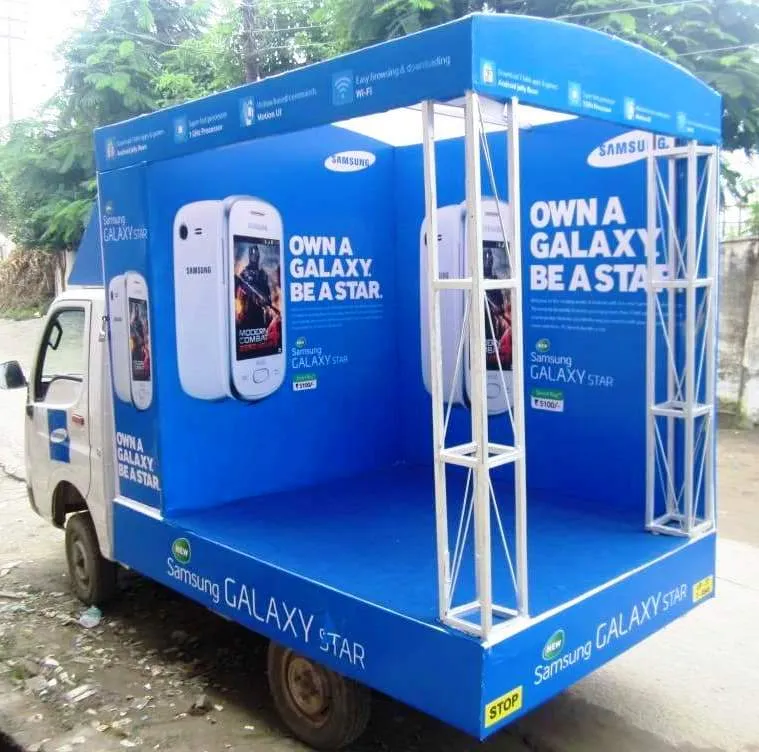
Mobile van branding in Chennai costs Rs.2,500 per van per day for a T-Shape centre board, Rs.3,000 for an L-Shape box van, and Rs.8,000 for an LED display truck. Those are all-inclusive day rates: design, Corporation of Chennai permits, marine-grade fabrication, GPS tracking, and a daily geo-tagged photo report are already in the number, and GST is the only thing added on top. Across the ten metros The Mediaverse operates in, van day rates run from Rs.2,200 in Kolkata to Rs.9,500 in Delhi NCR, but the more important difference between those cities is not the rate. It is that six of the ten quote a one-time fabrication charge separately and four do not, which changes what a short campaign actually costs.
How much does mobile van branding cost in Chennai in 2026?
Three formats, three published day rates. The T-Shape centre board is Rs.2,500 per van per day and is the workhorse for sustained residential and retail frequency. The L-Shape box van is Rs.3,000 per day and gives you more usable panel area for corridor work. The LED display truck is Rs.8,000 per day and is the only format that carries video, audio, and Tamil subtitles, which is why it is priced for events rather than for daily circulation. Worked out over real campaign lengths at those rates: one T-Shape van for 10 days is Rs.25,000, two T-Shape vans for 14 days is 28 van-days at Rs.70,000, and a single LED truck for a three day event window is Rs.24,000. All three figures are before GST at 18 percent.
Why does Chennai price below Bangalore and Delhi?
Chennai's T-Shape rate of Rs.2,500 sits Rs.500 below the Bangalore and Delhi NCR rate of Rs.3,000, and its LED rate of Rs.8,000 sits below Bangalore's Rs.9,000 and Delhi's Rs.9,500. The gap is an operating cost gap, not a quality gap: the same marine-grade production spec applies, and in Chennai it has to, because a van running OMR or ECR lives in salt-heavy sea air that strips ordinary vinyl. Only Kolkata prices lower, at Rs.2,200 for a T-Shape, and Kolkata is the one city with a published seasonal surcharge, 25 percent on Puja routes between 1 and 15 October. If you are choosing a South Indian test market on cost alone, Chennai is the cheaper of the two metros and the LED gap is the widest of the three formats.
What does a mobile van campaign cost across ten Indian metros?
The table below is The Mediaverse published 2026 van rate card across every metro it operates in, with the pricing structure shown alongside the rate, because the structure is what most multi-city budgets get wrong. Read the fabrication column first: in the six cities that carry one, the fabrication charge is a one-time build cost per van per campaign, not a daily one, so it is absorbed quickly on a long run and dominates a short one.
The Mediaverse mobile van rate card across 10 metros (2026)
| T-Shape per day | L-Shape per day | LED per day | One-time charge on the city page | |
|---|---|---|---|---|
| Kolkata | Rs.2,200 | Rs.2,800 | Rs.7,000 | None listed separately |
| Chennai | Rs.2,500 | Rs.3,000 | Rs.8,000 | None listed separately |
| Bangalore | Rs.3,000 | Rs.3,500 | Rs.9,000 | None listed separately |
| Delhi NCR | Rs.3,000 | Rs.3,500 | Rs.9,500 | None listed separately |
| Mumbai | Rs.3,000 | Rs.3,500 | Rs.7,500 | Rs.8,000 / Rs.20,000 / Rs.10,000 |
| Pune | Rs.3,000 | Rs.3,500 | Rs.7,500 | Rs.8,000 / Rs.20,000 / Rs.10,000 |
| Hyderabad | Rs.3,000 | Rs.3,500 | Rs.7,500 | Rs.8,000 / Rs.20,000 / Rs.10,000 |
| Ahmedabad | Rs.3,000 | Rs.3,500 | Rs.7,500 | Rs.8,000 / Rs.20,000 / Rs.10,000 |
| Jaipur | Rs.3,000 | Rs.3,500 | Rs.7,500 | Rs.8,000 / Rs.20,000 / Rs.10,000 |
| Lucknow | Rs.3,000 | Rs.3,500 | Rs.7,500 | Rs.8,000 / Rs.20,000 / Rs.10,000 |
All rates per van, GST extra, minimum booking 1 day. In the six cities that list a fabrication charge, bookings of 10 days or more drop the day rate to Rs.2,700 (T-Shape), Rs.3,000 (L-Shape), and Rs.7,000 (LED). Kolkata adds a 25 percent premium on Puja routes from 1 to 15 October. Source: the individual city van service pages on themediaverse.in. Note that the national mobile van hub page publishes a separate one-time setup scale of Rs.12,000 (T-Shape), Rs.15,000 (L-Shape), and Rs.20,000 (LED), which does not match the city page figures, so confirm the one-time charge against your specific city before budgeting.
Why do some cities quote fabrication separately and others do not?
This is the single most useful thing to know before briefing a multi-city van campaign, and it is not obvious from any single city page. Chennai, Kolkata, Bangalore, and Delhi NCR quote one all-inclusive day rate with the build absorbed into it. Mumbai, Pune, Hyderabad, Ahmedabad, Jaipur, and Lucknow quote a one-time fabrication charge per van, Rs.8,000 for a T-Shape, Rs.20,000 for an L-Shape, and Rs.10,000 for an LED truck, and then a day rate on top, with the day rate dropping from 10 days onward. The practical consequence is that the two structures cross over depending on campaign length.
Take one T-Shape van for 10 days. In Chennai that is 10 days at Rs.2,500, so Rs.25,000. In Mumbai it is Rs.8,000 to fabricate plus 10 days at the 10-day rate of Rs.2,700, so Rs.35,000. The published day rates differ by Rs.500, but the campaign differs by Rs.10,000, because the fabrication charge lands whole on a short run. Stretch the same Mumbai van to 30 days and the fabrication is spread across three times as many days: Rs.8,000 plus Rs.81,000, which is Rs.89,000, against Rs.75,000 for 30 days in Chennai. The gap is still there but it has shrunk from 40 percent of the bill to under 19 percent. Short pilots belong in the all-inclusive cities; long runs are where the fabrication cities stop being penalised.
One caveat worth carrying into any quote conversation, because it is a genuine inconsistency on the site rather than a subtlety. The ten individual city pages are the figures used throughout this post, and four of them list no separate build charge. The national mobile van hub page, however, publishes its own one-time setup scale of Rs.12,000 for a T-Shape, Rs.15,000 for an L-Shape, and Rs.20,000 for an LED van, and those numbers do not match the Rs.8,000, Rs.20,000, and Rs.10,000 fabrication charges on the city pages that do list one. The two pages disagree. Until that is reconciled, treat the city page as the operative rate card for a single-city campaign, and confirm the one-time charge explicitly in writing before you sign off a budget, whichever city you are booking.
How do you budget a three city pan-India van campaign?
Work city by city at the published rates rather than applying one national average, because the two pricing structures do not average cleanly. A concrete example: one T-Shape van for 10 days in each of Chennai, Bangalore, and Hyderabad. Chennai is 10 days at Rs.2,500, so Rs.25,000. Bangalore is 10 days at Rs.3,000, so Rs.30,000. Hyderabad is Rs.8,000 fabrication plus 10 days at the 10-day rate of Rs.2,700, so Rs.35,000. The three city total is Rs.90,000 before GST, and the cheapest and dearest city in that set differ by 40 percent on identical scope. Swap Hyderabad for Kolkata and the same three van, ten day campaign falls to Rs.77,000. That is arithmetic on published rates, not a quote, and volume terms on larger fleets are agreed per campaign.
Which Chennai routes are worth putting a van on?
Chennai gives a van two corridor types that behave very differently, so route choice should follow your audience rather than raw traffic count. OMR, the IT corridor running south from Adyar through Thoraipakkam and Sholinganallur, is captive weekday traffic at shift changes and suits B2B, recruitment, tech, and education. Anna Salai and T. Nagar are the retail and commercial spine with the city's heaviest pedestrian density, which suits FMCG, jewellery, and retail offers, and they peak at lunch hour and in the evening rather than at commute times. ECR is the weekend and lifestyle route toward Mahabalipuram. Tambaram, Chromepet, and Pallavaram along GST Road give mass residential reach at the lower end of the density scale. The Mediaverse runs routes across all 22 plus Corporation zones, and the route-level detail for each corridor is mapped in the dedicated Chennai OMR and Anna Salai guide.
What is genuinely extra on top of the Chennai day rate?
Less than most advertisers expect, and this is worth stating plainly because van pricing has a reputation for line-item surprises. In Chennai the published day rate already covers creative design, Corporation permits, marine-grade fabrication, GPS tracking, and a daily geo-tagged photo report. GST at 18 percent is extra. Beyond that, anything additional is scope you have chosen to add rather than a hidden fee, and it should be agreed in the brief rather than discovered on the invoice. In the six fabrication cities, the one-time build charge is the extra, and it is published up front rather than hidden. If a van quote from any vendor arrives with permit fees, tracking fees, or reporting fees itemised separately, that is a signal to ask what the headline day rate actually buys.
What does a Tamil-first creative brief require?
Chennai is the metro where out-of-state advertisers most often reuse a national English creative and lose the residential and retail routes with it. Tamil or bilingual Tamil and English artwork is the practical norm for Anna Salai, T. Nagar, Tambaram, and residential clusters, where Tamil is the everyday reading language. English-led bilingual work holds up on the OMR corridor, whose audience is a pan-Indian professional one. Creative design is inside the Chennai day rate, and Tamil and English creative integration is part of the standard production spec, including Tamil subtitle and voiceover work on LED trucks. Brief the language split by route at the planning stage, not after the vans are built, because artwork sign-off is what starts the 48 hour clock to go-live.
How do you run a campaign across several cities at once?
Five steps. First, pick cities by where your customers actually are, then price each one separately off the rate card rather than off a national average. Second, decide format per city: T-Shape for sustained frequency, L-Shape where you need panel area on corridors, LED only where an event or a video message justifies three times the day rate. Third, adapt language per city, Tamil for Chennai, Bengali for Kolkata, Marathi for Mumbai and Pune, Kannada for Bangalore, Gujarati for Ahmedabad, Hindi for Delhi, Jaipur, and Lucknow. Fourth, set campaign length with the structure in mind: if the plan is a short pilot, weight it toward the all-inclusive cities. Fifth, sign off all artwork together, since each city needs 48 hours from sign-off, which is what makes a simultaneous multi-city go-live realistic.
How much reach does one van actually deliver?
The Mediaverse publishes an estimate of 75,000 to 1,40,000 daily impressions per van in Chennai, and a cost per thousand in the region of Rs.10 to Rs.20. Treat both as planning estimates rather than measured outcomes: impression counts for a moving vehicle are modelled from route, dwell time, and traffic density, and the range is wide precisely because an OMR shift-change hour and a Tambaram residential afternoon are not the same exposure. What is not an estimate is the day rate and the daily geo-tagged photo report, which tells you where the van actually went. For response measurement, put a campaign-specific phone number, WhatsApp line, or QR code on the artwork, because a van is a frequency and recall medium and will not attribute itself through last-click reporting.
Frequently asked questions
Is GST included in mobile van branding rates?
No. Every published van rate on The Mediaverse city pages is exclusive of GST, which applies at 18 percent on top. So a Chennai T-Shape van at Rs.2,500 per day costs Rs.2,950 per day with GST, and a 10 day single van campaign at Rs.25,000 comes to Rs.29,500. What the day rate does already include in Chennai is creative design, Corporation permits, marine-grade fabrication, GPS tracking, and a daily geo-tagged photo report, so GST is the only routine addition to the headline number.
Does a Chennai van campaign need Tamil artwork?
For most routes, yes in practice. Anna Salai, T. Nagar, Tambaram, and residential clusters read in Tamil, and an English-only creative measurably underuses those routes. The OMR IT corridor is the exception, where its pan-Indian professional audience makes English-led bilingual artwork workable. Tamil and English creative integration is part of the standard production spec and design sits inside the day rate, including Tamil subtitle and voiceover work on LED trucks. Decide the language split by route during planning, not after fabrication.
How quickly can a mobile van campaign go live?
Vans are on the road within 48 hours of artwork sign-off. The clock starts at sign-off rather than at booking, so the variable that usually delays a campaign is creative approval, not vehicle availability or permits. For a multi-city launch this is the reason to approve every city's artwork in one pass: because each city needs the same 48 hours, simultaneous sign-off produces a simultaneous go-live across all of them rather than a staggered rollout over a week.
Is a short van campaign cheaper in Chennai than in Mumbai?
Yes, and by more than the day rates suggest. Chennai quotes an all-inclusive Rs.2,500 per day for a T-Shape van, while Mumbai quotes a one-time fabrication charge of Rs.8,000 plus a day rate. One van for 10 days is Rs.25,000 in Chennai and Rs.35,000 in Mumbai, a 40 percent difference on a day rate gap of only Rs.500. Over 30 days the same comparison narrows to Rs.75,000 against Rs.89,000, because the fabrication charge is one-time and spreads out.
Getting a van on the road
If Chennai is the market, the rate card is Rs.2,500, Rs.3,000, and Rs.8,000 per van per day by format, all-inclusive, GST extra, live 48 hours after artwork sign-off. If the plan spans several cities, price each one off its own page and check whether it quotes fabrication separately before you commit to a campaign length. The Mediaverse runs mobile van branding across all ten metros with one campaign manager and city-level route plans. Call for a quote against your actual city, format, and day count.
Tags
Quick Answers
How much does mobile van branding cost in Chennai in 2026?
Chennai van branding costs Rs.2,500 per van per day for a T-Shape centre board, Rs.3,000 for an L-Shape box van, and Rs.8,000 for an LED display truck. These are all-inclusive day rates covering creative design, Corporation of Chennai permits, marine-grade fabrication, GPS tracking, and a daily geo-tagged photo report, with GST at 18 percent extra and a minimum booking of one day. At those rates one T-Shape van for 10 days is Rs.25,000, two vans for 14 days is Rs.70,000, and an LED truck for a three day event is Rs.24,000, all before GST.
What does a mobile van campaign cost across multiple Indian cities?
Van day rates across The Mediaverse ten metros run from Rs.2,200 in Kolkata to Rs.9,500 in Delhi NCR, but they are not directly comparable because six cities add a one-time fabrication charge per van. A worked example: one T-Shape van for 10 days in Chennai, Bangalore, and Hyderabad costs Rs.25,000, Rs.30,000, and Rs.35,000 respectively, a three city total of Rs.90,000 before GST. Price each city off its own rate card rather than applying one national average, because the two pricing structures do not average cleanly.
Why do some cities charge a separate fabrication fee for van branding?
Four of the ten city pages quote one all-inclusive day rate: Chennai, Kolkata, Bangalore, and Delhi NCR. The other six, Mumbai, Pune, Hyderabad, Ahmedabad, Jaipur, and Lucknow, split the price into a one-time build charge per van, Rs.8,000 for a T-Shape, Rs.20,000 for an L-Shape, Rs.10,000 for an LED truck, plus a day rate that drops from 10 days onward. Because the build charge lands whole on a short run, one van for 10 days costs Rs.25,000 in Chennai against Rs.35,000 in Mumbai despite a day rate gap of only Rs.500.
Which Chennai routes work best for mobile van branding?
Four corridors carry most Chennai van campaigns and they behave differently. OMR, running south from Adyar through Thoraipakkam to Sholinganallur, is captive weekday IT traffic and suits B2B, recruitment, and education. Anna Salai and T. Nagar are the retail spine with the heaviest pedestrian density, peaking at lunch and evening rather than commute hours, which suits FMCG, jewellery, and retail offers. ECR is the weekend lifestyle route. Tambaram, Chromepet, and Pallavaram along GST Road deliver mass residential reach. Match the corridor to the audience rather than to raw traffic volume.
Looking for professional Mobile Van Branding services?
The Mediaverse runs end-to-end mobile van branding campaigns across India with geo-tagged delivery and transparent, all-inclusive pricing.
Explore our Mobile Van Branding solutionsSummarize this guide with AI
Open this article in your favourite AI assistant
Related Guides
Written by

The Mediaverse Team
India's Leading Outdoor Advertising Agency
The Mediaverse is a national-level outdoor advertising and integrated marketing organization that provides complete OOH, ATL, BTL, retail, and transit media solutions across India. With years of experience executing high-performance campaigns for brands in FMCG, Real Estate, E-commerce, EdTech, Automotive, Healthcare, and Retail, The Mediaverse combines creativity, data-driven media planning, and flawless on-ground execution. As a full-stack outdoor advertising provider, The Mediaverse offers Auto Branding, Mobile Van Branding, Newspaper Insertion Advertising, Shop Name Board Branding, In-Store Branding, Hoardings, Transit Media, Kiosks, Mall Media, Activations, and all forms of Below-The-Line marketing. Known for its pan-India network, strategic route planning, premium print quality, and Cheqmate™ GPS-based verification, The Mediaverse ensures 100% transparent and result-oriented campaign delivery. The Mediaverse’s editorial team produces deeply researched, SEO-optimized, and generative-engine-friendly content to help businesses understand the power of outdoor advertising and make informed decisions that maximize brand visibility and ROI across urban, suburban, and rural markets.
Related Articles
Mobile Van Branding in Lucknow (2026): Rates, Routes and the E-Rickshaw Question
Lucknow van branding is fabrication plus a day rate: Rs.11,000 buys a single T-Shape day. The full 2026 card, why the LED truck is the cheap option for a one-day booking, what the published three-van and four-van budgets land at after GST, and how the format compares with a Lucknow auto on cost per view.
LED Truck at Rs.8,000 a Day vs T-Shape Van at Rs.2,500: When the 3.2x Premium Pays (Chennai, 2026)
Chennai prices a T-Shape van at Rs.2,500 a day and an LED display truck at Rs.8,000, both with the same published 40 km route and 6 hour window. Here is what the extra Rs.5,500 a day buys, the three cases where it pays, and the arithmetic that shows when it does not.
The One-Day Campaign: Mobile Van Is the Only Outdoor Format You Can Book for a Single Day (2026)
Auto hoods start at 300 autos, no-parking boards at 1,000 and newspaper inserts at 50,000 copies. The mobile van is the only outdoor format The Mediaverse publishes with a minimum measured in days rather than units, and one day starts at Rs.2,200.