

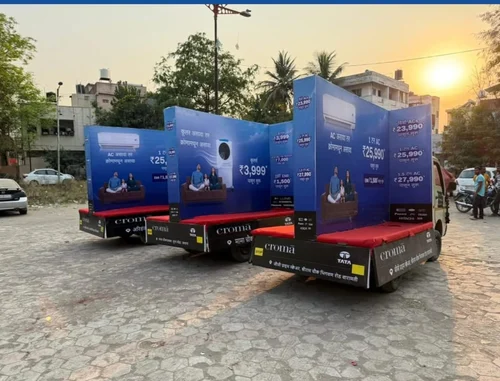
It is 6:30 AM on a Tamil Nadu Sunday and a T-Shape van is leaving Sholinganallur on OMR heading north toward Tidel Park. The driver has a printed brief inside the cab listing every Tamil-language compliance check the artwork passed in pre-print. The Chennai Corporation Tamil-script proportion. The state Department of Information Tamil-Nadu language-quota note. The Greater Chennai Corporation zonal officer sign-off on the artwork. Six checks in total, four of them specific to Tamil-language artwork requirements that Mumbai or Bangalore vans never encounter. That brief is the difference between a Chennai campaign that converts and one that quietly under-delivers because the artwork failed a check the brand did not know existed.
Mobile van branding in Chennai operates on three rules that distinguish it from Mumbai, Delhi, or even Bangalore. Tamil-language artwork is a Chennai Corporation enforcement priority, not optional polish. The northeast monsoon arrives October-December (not the June-September pattern that affects most of India). And the OMR IT Expressway's 36 kilometre length makes it South India's longest single mobile van corridor, with route-economic implications that no other South Indian city replicates. This guide unpacks the rules, rate, and routes for 2026.
Three regulators and the Tamil-language requirement
Chennai mobile van advertising operates under three regulators. Greater Chennai Corporation (GCC) governs the 200 wards across 15 zones from T.Nagar through Adyar to Velachery. Tambaram Municipal Corporation governs the southern suburbs from Tambaram through Pallavaram to Vandalur. Chennai Cantonment governs St. Thomas Mount and parts of Pallavaram with military-zone restrictions. Cross-jurisdiction routing (common for OMR or GST Road campaigns) requires permits from each authority touched.
The Tamil-language requirement is Chennai's distinctive regulatory variable. Greater Chennai Corporation 2024 advertising regulations require all commercial artwork to feature Tamil-language elements proportional to other languages. In practice this means Tamil typography must appear at equal or larger size than English when both are present, and Tamil-only or Tamil-primary artwork is preferred for any campaign targeting Tamil-speaking households (roughly 78 percent of Chennai residents). First-time non-Tamil-Nadu advertisers see roughly 18 percent artwork rejection on initial submission because they treat Chennai as a generic English-led metro. Tamil-language artwork pre-screening adds 2 to 4 working days to the lead time but avoids the rejection rate.
How is Chennai split into van pricing zones?
Zone A: OMR IT corridor (600119, 600096, 600100, 603103)
Sholinganallur (600119), Perungudi (600096), Thoraipakkam (600097), Navalur (603103), the OMR IT Expressway corridor from Madhya Kailash through to Mahabalipuram. Per-piece rates run 5 to 9 percent above the city average due to corridor density and IT-corporate audience quality. ₹3,100 to ₹3,300 per day for T-Shape, ₹3,600 for L-Shape, ₹5,400 for Canter, ₹9,200 for LED. The corridor reaches Chennai's IT and ITeS workforce: TCS, Infosys, Wipro, Cognizant, HCL, Capgemini, and the major MNC campuses spread across the OMR belt. For B2B SaaS, EdTech targeting working professionals, fintech, and corporate brand campaigns, the corridor delivers 2.9 times the relevant-impression conversion versus mass-market routes per Mediaverse Q1 2026 data.
Zone B: Anna Salai-T.Nagar retail belt (600002, 600017, 600006, 600034)
Anna Salai (Mount Road), T.Nagar (600017), Nungambakkam (600034), Egmore (600008), the Royapettah-Triplicane shopping belt. Per-piece rates run 7 to 11 percent above the city average for retail-density routing. ₹3,200 per day for T-Shape, ₹3,700 for L-Shape, ₹5,500 for Canter, ₹9,400 for LED. The corridor carries Chennai's highest retail-impression density with 16.4 lakh impressions per van per day across the 4 km T.Nagar shopping stretch alone. T.Nagar's Pondy Bazaar, Ranganathan Street, and Usman Road sub-stretch is the most retail-walk-in-converting kilometre of mobile van advertising in all of South India. For retail launches, jewellery, sarees, ethnic-wear, food delivery, and any offer-led campaign, this corridor outperforms OMR by 2.4 times on retail conversion.
Zone C: ECR-GST Road and mass-market suburbs
The East Coast Road through Besant Nagar, Thiruvanmiyur, ECR-Kanathur stretch, plus GST Road through Tambaram, Chromepet, Pallavaram. Per-piece rates track the city average within 4 to 6 percent at ₹3,000 T-Shape baseline. ECR specifically reaches South Chennai HNI plus the new-development residential audience between Adyar and Mahabalipuram. GST Road reaches mass-market households across Tambaram-Pallavaram-Chromepet. For HNI luxury, ECR. For mass-market FMCG and family-decision categories, GST Road. The combination covers South Chennai comprehensively at the rate baseline.
Chennai mobile van zone rates (2026)
| Zone | T-Shape | L-Shape | Canter | LED van | |
|---|---|---|---|---|---|
| Zone A: OMR IT corridor | ₹3,100 to ₹3,300 | ₹3,600 | ₹5,400 | ₹9,200 | |
| Zone B: Anna Salai-T.Nagar retail belt | ₹3,200 | ₹3,700 | ₹5,500 | ₹9,400 | |
| Zone C: ECR-GST Road and suburbs (city baseline) | ₹3,000 | ₹3,500 | ₹5,000 | ₹8,500 to ₹9,500 |
Rates per van per day; Zone B runs 7 to 11 percent above the city average.
OMR to Anna Salai: the connecting arc
The corridor from Sholinganallur through Tidel Park, Velachery, Adyar, and Mylapore to T.Nagar carries roughly 60 percent of Chennai mobile van impression volume. The Mediaverse 2026 rate map: Sholinganallur OMR (600119): ₹3,200 T-Shape. Thoraipakkam (600097): ₹3,200 T-Shape. Tidel Park (600113): ₹3,300 T-Shape. Velachery (600042): ₹3,100 T-Shape. Adyar (600020): ₹3,000 T-Shape. Mylapore (600004): ₹3,000 T-Shape. T.Nagar (600017): ₹3,200 T-Shape. The arc shows the unusual property that the middle of the corridor (Velachery, Adyar) is cheaper than either end, reflecting the lower density of corporate-and-retail audiences in the residential mid-belt.
Operationally, the arc has one quirk worth knowing. The OMR Madhya Kailash junction (where OMR meets the rest of Chennai south of Adyar) has peak-hour bottleneck conditions worse than any other junction in Chennai. Vans traversing this junction during 6 PM to 9 PM IT-departure peak can spend 45 to 70 minutes crossing 1.5 kilometres of road. This stuck-time delivers high stationary impressions per minute (roughly 22,000 per minute by Mediaverse audit) but means vehicle utilisation drops if the next destination is far. Plan OMR-to-T.Nagar routes to either accept the junction stop as part of the campaign value, or route via the ECR-Adyar bypass to avoid it.
GCC permits and Tamil-language pre-screening
Greater Chennai Corporation 2024 outdoor advertising regulations specify three operating modes for mobile vans. In-motion advertising requires only standard commercial vehicle registration. Stationary-under-30-minutes is included. Stationary-over-30-minutes requires a GCC parking permit at the specific location at ₹400 to ₹1,100 per day. The Tamil-language artwork requirement applies regardless of operating mode: every visible advertising element must include Tamil at proportional or larger size to English, with bilingual artwork acceptable and Tamil-only artwork preferred for residential-targeting campaigns.
Three location restrictions apply. No commercial advertising on Marina Beach Promenade between Kannagi Statue and Anna Square. No LED display operations within 200 metres of any heritage-zone classified building including Fort St. George, Chennai Central Heritage Block, and the Madras High Court. No mobile van advertising routes interfering with local-train station peak-hour access in Tambaram, Chromepet, and Egmore during 7-10 AM and 6-9 PM. The Tamil-language pre-screening process takes 3 to 5 working days for first-time advertisers and 1 to 2 days for repeat. Submit artwork in PDF format plus a Tamil-language summary for pre-screen.
Northeast monsoon and cyclone windows
Chennai's monsoon arrives in October-December (northeast monsoon) rather than the June-September pattern. Cyclone events during this window (Cyclone Michaung December 2023, Cyclone Mandous December 2022, and similar) can flood OMR low-lying sections (Velachery, Perungudi, Sholinganallur), the ECR coastal stretch, and the T.Nagar Pondy Bazaar drainage zones. The Mediaverse field data across 28 Chennai monsoon campaigns measures 16 to 22 percent of planned-route kilometres as temporarily inaccessible during heavy cyclone weeks. Cyclone Michaung specifically rendered OMR Velachery to Sholinganallur fully impassable for 3 to 5 days.
Three operational responses work for northeast-monsoon windows. First, shift campaigns to January-September windows for cleanest economics and avoid the cyclone window altogether. Second, build cyclone-contingency clauses: automatic fleet redirection to inland-route operations (Anna Salai-T.Nagar plus GST Road instead of OMR-ECR) when IMD issues cyclone alerts. Third, prefer Canter or LED vans for cyclone-window campaigns because larger vehicles handle waterlogging better than T-Shape Tata Ace base vehicles and maintain operational uptime when smaller fleets are sidelined.
Chennai vendor ecosystem
Three vendor types operate. The fleet owner-operators (4 to 16 vans each, often based in Ambattur, Guindy, or Tambaram industrial belts) offer the cheapest per-day rate but require the advertiser to handle GCC permits, Tamil-language pre-screening, and cyclone-contingency planning separately. The Chennai mobile van specialists aggregate 100 to 300 vehicles, hold active permits across GCC, Tambaram MC, and Chennai Cantonment, and handle Tamil-language artwork pre-screening as part of the contract. The Mediaverse covers 680 vehicles via partner agreements. Multi-vehicle multi-day campaigns above ₹1 lakh typically save 11 to 15 percent through specialist booking versus fleet-owner direct.
The third vendor type is the experiential-marketing combine that bundles mobile van with promoter activations, Tamil-language sampling collateral, and IT-corridor activation packages. Suitable for FMCG sampling at IT campuses on OMR, OTT activation at residential complexes in Velachery and Sholinganallur, and consumer brand activations targeting Tamil-speaking residential audiences with Tamil-primary creative.
A 2026 Chennai mobile van campaign launch playbook
A premium retail jewellery brand launching a flagship store on Usman Road, T.Nagar, for the August Aadi Perukku festival week. ₹5.5 lakh all-in budget. Target: 30 to 60 year old Tamil-speaking families across T.Nagar, Nungambakkam, Mylapore, Adyar, and the OMR residential belt. Goal: store walk-ins during the festival fortnight.
Step 1, budget. ₹5,50,000 minus 18 percent GST = ₹4,66,102 ex-GST. Reserve ₹35,000 for creative and Tamil-language artwork pre-screening. Reserve ₹45,000 for GCC permits across multiple zones. Working media budget: ₹3,86,102.
Step 2, vehicle mix. Premium retail-jewellery at festival peak benefits from Canter for brand-world creative plus T-Shape for route coverage. Mix: 1 Canter (₹5,400 per day) plus 4 T-Shape (₹3,100 per day) for 21 days = ₹1,13,400 (Canter) + ₹2,60,400 (T-Shape) = ₹3,73,800. Adjust to 1 Canter plus 3 T-Shape for 21 days giving ₹2,93,700 with ₹92,402 reserve for contingency.
Step 3, route allocation. The Canter runs the premium T.Nagar-Nungambakkam-Mylapore loop concentrated on Usman Road, Ranganathan Street, Cathedral Road, and Mylapore market. The 3 T-Shapes run the OMR Sholinganallur-Velachery-Adyar corridor in morning IT-departure hours then ECR-Adyar residential loop in evening. Daily impression count estimate: 4 vans times 14 lakh average equals 56 lakh daily impressions. Over 21 days: 11.8 crore total. With 9 percent unique-reach: 1.06 crore unique exposures across the Tamil-speaking jewellery-buying demographic.
Step 4, attribution. Print a Tamil-language missed-call number on each van wrap. Apply unique QR per vehicle routing to a Tamil-language jewellery-collection landing page. Issue Tamil-language festival-discount codes valid only on launch fortnight redemptions. Tamil QR-scan rate for jewellery in Chennai runs roughly 2.7 times the English QR-scan rate in this demographic, confirming the Tamil-primary positioning matches the audience.
What makes a Chennai campaign work
Three disciplines drive Chennai campaign success. First, Tamil-language-first artwork: campaigns with English-led creative under-convert by 30 to 45 percent in non-OMR residential zones because Tamil-speaking households respond preferentially to Tamil-primary messaging. Second, northeast-monsoon-aware scheduling: October-December campaigns absorb 12 to 18 percent cyclone-contingency premium, time-flexible campaigns shift to January-September. Third, corridor-matched-to-audience: OMR for B2B and tech, Anna Salai-T.Nagar for retail and offers, ECR-GST for HNI plus mass-market. Mismatch drops conversion by 30 to 50 percent. Brands practising these three see 2 to 3 times per-rupee response versus brands treating Chennai as a generic South Indian English-led metro.
Bottom line for a 2026 Chennai mobile van campaign
Pick your audience first (Tamil-speaking residential, IT-corridor professional, retail-shopping, HNI). Pick your corridor second (OMR tech, Anna Salai-T.Nagar retail, ECR-GST HNI plus mass). Pick your vehicle mix third. Pre-screen artwork for Tamil-language compliance 5 working days ahead. Time campaigns to January-September to avoid cyclone window. Demand cyclone-contingency clauses for October-December launches. With these five disciplines your Chennai mobile van campaign will outperform digital channels for retail, IT-corridor B2B, and direct-response objectives by 2 to 4 times on landed cost-per-walk-in or demo-conversion.
Should I run a Tamil-only campaign or use English-Tamil bilingual creative in Chennai?
For mass-market retail, FMCG, family-decision categories, jewellery, and any campaign targeting Tamil-speaking residential audiences (T.Nagar, Mylapore, Velachery, ECR residential), Tamil-only creative outperforms bilingual by 18 to 28 percent on landed cost-per-conversion because the artwork reads as authentic rather than translated. For B2B SaaS, EdTech, and corporate-targeting campaigns on OMR, bilingual Tamil-English creative captures the IT corridor's mixed-language audience optimally. English-only creative is almost never the right choice in Chennai because GCC enforcement triggers rejection and conversion suffers across all categories.
Does Chennai's IT-corridor weekend traffic differ from weekday for mobile van advertising?
Significantly. OMR weekday peak hours (8-11 AM and 6-9 PM) capture IT commuter traffic. Weekend traffic concentrates at Phoenix MarketCity Velachery, VR Mall Anna Nagar, and the OMR Sholinganallur-Navalur retail strip on Saturday afternoons. Brands targeting tech-corridor consumer audiences (not B2B) should over-weight weekend afternoon-evening routes (40 to 55 percent weekend allocation). Most generic mobile van plans miss this and over-allocate weekday IT-corridor commuter hours.
What is the smallest Chennai mobile van campaign that still works?
2-vehicle 7-day single-corridor campaigns are the practical floor. Below 2 vehicles, unique-reach for any of Chennai's three primary corridors drops below 35 percent of target audience. Below 7 days, brand-recall frequency does not build sufficient response. For pilots smaller than these floors, the Mediaverse recommends auto branding at ₹160 per auto per month in the target catchment pincode, which delivers comparable hyperlocal impressions at one-sixth the daily commitment of a mobile van campaign.
Tags
Quick Answers
How much does mobile van branding cost in Chennai in 2026?
Per-day per-van rates: T-Shape ₹3,000, L-Shape ₹3,500, Canter ₹4,800 to ₹5,500, LED van ₹8,500 to ₹9,500. OMR IT corridor zones (Sholinganallur to Navalur, 600119 to 603103) carry a 5 to 9 percent corridor-density premium. Northeast-monsoon window operations (October-December) add 12 to 18 percent for route-flooding contingency planning across the cyclone-vulnerable coastal stretch. A 30-day campaign with 4 T-Shape vans covering OMR plus Anna Salai-T.Nagar lands at roughly ₹4.2 lakh all-inclusive.
Which Chennai routes are best for mobile van branding?
Three corridors dominate. The OMR IT Expressway (Madhya Kailash to Navalur, 36 km) reaches the largest IT and corporate-professional audience in South India. The Anna Salai-T.Nagar retail-and-shopping corridor delivers the highest retail-impression density per kilometre. The ECR (East Coast Road) plus GST Road combination covers South Chennai HNI plus the Tambaram-Pallavaram mass-market belt. For B2B and tech, OMR. For retail launches and offer-led campaigns, Anna Salai-T.Nagar. For HNI and mass-market, ECR-GST.
How does Chennai northeast monsoon affect mobile van campaigns?
Chennai's monsoon arrives in October-December (northeast monsoon) rather than the June-September southwest monsoon that affects most of India. Cyclone events during this window can flood OMR (low-lying sections near Velachery, Perungudi, Sholinganallur), the ECR coastal stretch, and parts of T.Nagar drainage zones. The Mediaverse field data across 28 Chennai monsoon campaigns shows 16 to 22 percent of planned route kilometres become temporarily inaccessible during heavy cyclone weeks. Rates climb 12 to 18 percent during this window. Plan campaigns to January-September for cleanest economics, or build in cyclone-contingency clauses if launching October-December.
Looking for professional Mobile Van Branding services?
The Mediaverse runs end-to-end mobile van branding campaigns across India with geo-tagged delivery and transparent, all-inclusive pricing.
Explore our Mobile Van Branding solutionsSummarize this guide with AI
Open this article in your favourite AI assistant
Related Guides
Written by

The Mediaverse Team
India's Leading Outdoor Advertising Agency
The Mediaverse is a national-level outdoor advertising and integrated marketing organization that provides complete OOH, ATL, BTL, retail, and transit media solutions across India. With years of experience executing high-performance campaigns for brands in FMCG, Real Estate, E-commerce, EdTech, Automotive, Healthcare, and Retail, The Mediaverse combines creativity, data-driven media planning, and flawless on-ground execution. As a full-stack outdoor advertising provider, The Mediaverse offers Auto Branding, Mobile Van Branding, Newspaper Insertion Advertising, Shop Name Board Branding, In-Store Branding, Hoardings, Transit Media, Kiosks, Mall Media, Activations, and all forms of Below-The-Line marketing. Known for its pan-India network, strategic route planning, premium print quality, and Cheqmate™ GPS-based verification, The Mediaverse ensures 100% transparent and result-oriented campaign delivery. The Mediaverse’s editorial team produces deeply researched, SEO-optimized, and generative-engine-friendly content to help businesses understand the power of outdoor advertising and make informed decisions that maximize brand visibility and ROI across urban, suburban, and rural markets.
Related Articles
Mobile Van Branding in Jaipur (2026): Day Rates, Which Van for Which Road, and How Far Ahead to Book
The live Jaipur van card by format and booking length, which van fits the Walled City, what the October to March tourist-corridor premium adds, the page's wedding plan priced at Rs.11,42,800, and the booking dates that close this month.
Mobile Van Branding in Hyderabad (2026): Which Format, How Many Days, and How Far Ahead to Book
The live Hyderabad van card, what the 10 percent HITEC City and Banjara Hills premium adds by booking length, why the Old City and the IT arc need different vans, how many days BioAsia really needs, and the booking windows from 5 days to 21.
Mobile Van Branding in Ahmedabad (2026): Why Ten Days Can Cost Less Than Nine, and What Navratri Costs
On the Ahmedabad van card, ten L-Shape days cost Rs.1,500 less than nine and a tenth LED night after Navratri costs Rs.2,500. The live rates day by day, the three published scenarios landed with GST, the three-van starter fleet for a month, and what the card leaves unpriced.