

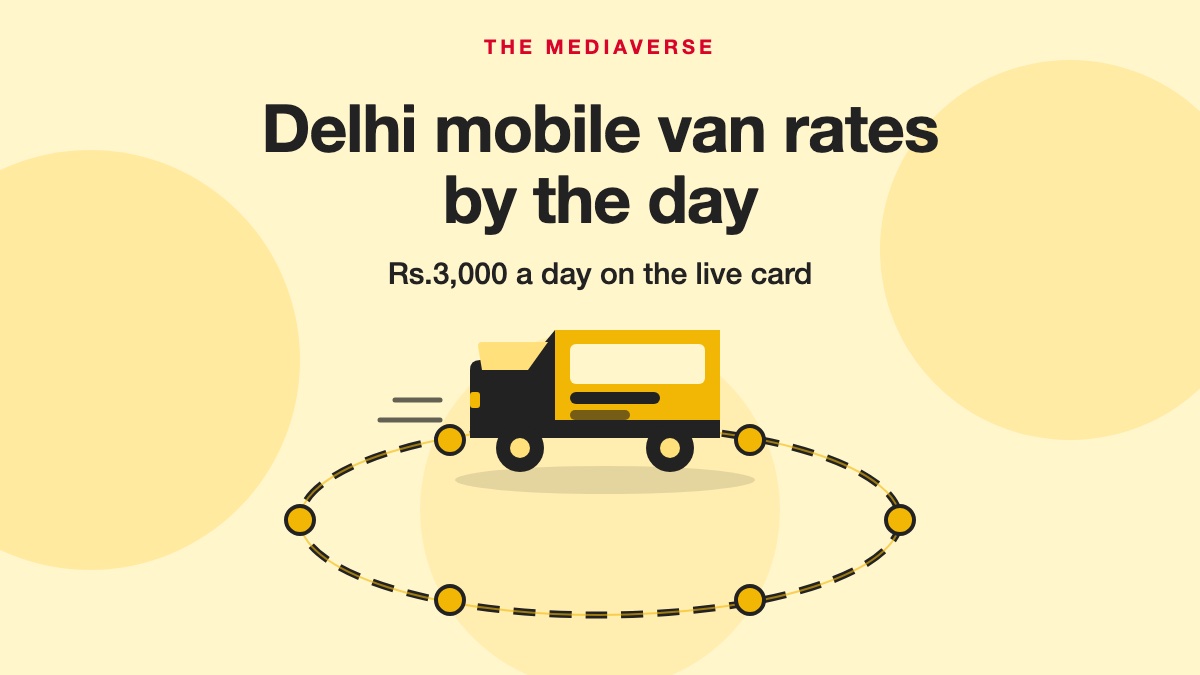
Rs.3,000 a day is the whole Delhi price for a T-Shape van on our live Delhi NCR mobile van page, with no fabrication line in front of it and no 10-day slab behind it. That is the first thing a buyer who has read our Jaipur or Lucknow van cards will notice, because those pages publish a one-time fabrication charge plus a day rate that drops from 10 days, and the Delhi page publishes neither. The three Delhi day rates are Rs.3,000 for a T-Shape centre board van, Rs.3,500 for an L-Shape box van and Rs.9,500 for an LED display truck, each covering a 45 km, 6 hour daily run with design, MCD and GNCTD permits, heat-resistant installation, GPS tracking and daily photo reports inside the rate. Book Delhi, Noida and Gurugram together and the page takes 15 percent off, to Rs.2,550, Rs.2,975 and Rs.8,075 per van per day. Everything here was read from the live Delhi van page on 26 October 2026; the GST totals, the van-day averages, the reconciliations and the dates are our arithmetic.
What does the Delhi van card charge per day, and what is not on it?
Three formats, three flat day rates. The page repeats them in its hero, its quick answer, its pricing table and its FAQ, and the figure never changes between those four places: Rs.3,000 for the T-Shape centre board van it sends on colony circuits through Rohini, Dwarka and the South Delhi residential belt, Rs.3,500 for the L-Shape box van it builds for Ring Road loops and flyover corridors, and Rs.9,500 for the LED display truck it reserves for Pragati Maidan trade fairs, the Republic Day window and video-led events. Each rate buys a 45 km, 6 hour daily route, and the page lists design, MCD and GNCTD permits, heat-resistant installation rated to 48°C, GPS tracking and daily photo reports as included. Setup is 48 hours from artwork approval in the hero and pricing sections, and 48 to 72 hours in the quick facts box.
T-Shape centre board van
One elevated panel above the cab, built to rise over three-wheeler traffic in Old Delhi and the colonies. The page calls it the workhorse for sustained colony circuits. One day: Rs.3,540 with GST.
L-Shape box van
Three branded faces on a Tata 407 or Eicher chassis, 12 mm sunboard and UV-coated vinyl rated to 48°C. The page builds it for Ring Road loops and 6-lane flyovers. One day: Rs.4,130 with GST.
LED display truck
P5 panels at 7,000 nits on an Eicher 14-footer, with 4K video and remote content switching. The page keeps it for Pragati Maidan fairs, Republic Day and election windows. One day: Rs.11,210 with GST.
The Mediaverse published Delhi NCR mobile van card, read from the live Delhi service page on 2026-10-26. Day rates are per van per day for a 45 km, 6 hour route. The NCR combo rate applies when Delhi, Noida and Gurugram are booked together. No fabrication charge and no long-booking slab are published. GST 18 percent extra; the with-GST figures are our arithmetic.
What is not on the card matters as much. Our Jaipur page charges Rs.8,000, Rs.20,000 and Rs.10,000 one-time fabrication before its Rs.3,000, Rs.3,500 and Rs.7,500 day rates, and our Lucknow page publishes the same two-part card with the same three fabrication lines, so a single Jaipur or Lucknow T-Shape day is Rs.11,000 where a Delhi one is Rs.3,000. The Delhi page also publishes no reduced rate from 10 days, where Jaipur and Lucknow drop to Rs.2,700, Rs.3,000 and Rs.7,000. Read literally, the Delhi card is the simplest of the three: one number per format, every day, with the wrap inside it. Read cautiously, a buyer should ask the written quote to confirm that fabrication is genuinely inside Rs.3,000 and not a line the page left out. We plan on the page as it stands and say so in the quote request.
Our arithmetic: one van in Delhi by booking length, Delhi-only rate, before GST
| Booking length | T-Shape | L-Shape | LED truck | |
|---|---|---|---|---|
| 1 day | Rs.3,000 | Rs.3,500 | Rs.9,500 | |
| 7 days | Rs.21,000 | Rs.24,500 | Rs.66,500 | |
| 14 days (the page's suggested first campaign) | Rs.42,000 | Rs.49,000 | Rs.1,33,000 | |
| 30 days | Rs.90,000 | Rs.1,05,000 | Rs.2,85,000 | |
| 30 days with 18 percent GST | Rs.1,06,200 | Rs.1,23,900 | Rs.3,36,300 | |
| 60 days | Rs.1,80,000 | Rs.2,10,000 | Rs.5,70,000 |
The table is flat because the card is flat: with no fabrication charge to amortise and no slab to cross, day 30 costs exactly what day 1 cost. That is the opposite of the Jaipur card, where the tenth T-Shape day is effectively free because the slab drops Rs.300 across all ten days. The page's own advice for a brand new to Delhi is a 14-day T-Shape campaign on the Outer Ring Road to gather loop data before adding Gurugram or Noida, and on the card that first fortnight is Rs.42,000 before GST, Rs.49,560 with it.
How much does the 15 percent NCR combo actually save?
The combo is the one discount on the page, and it is conditional: the pricing table and the FAQ both tie it to booking Delhi, Noida and Gurugram together, which the page describes as one brief, one invoice and one dashboard across three cities on cross-boundary permits. The 15 percent comes off each van's day rate, so the saving per van-day is Rs.450 on a T-Shape, Rs.525 on an L-Shape and Rs.1,425 on an LED truck. The page quotes the combo L-Shape at Rs.2,975 in its FAQ and all three combo rates in its pricing table, and the three figures reconcile exactly to 15 percent.
Our arithmetic: Delhi-only against the NCR combo, before GST
| Deployment | Delhi-only | NCR combo | Saving | |
|---|---|---|---|---|
| 1 L-Shape van, 14 days | Rs.49,000 | Rs.41,650 | Rs.7,350 | |
| 2 T-Shape vans, 30 days | Rs.1,80,000 | Rs.1,53,000 | Rs.27,000 | |
| 4 L-Shape vans, 30 days | Rs.4,20,000 | Rs.3,57,000 | Rs.63,000 | |
| 1 LED truck, 14 days | Rs.1,33,000 | Rs.1,13,050 | Rs.19,950 | |
| The page's 4-van ring package, 30 days | Rs.4,35,000 at the page's Rs.14,500 | Rs.3,57,000 at four combo L-Shape rates | Rs.78,000 |
Two cautions before planning on the saving. First, the combo is a three-city condition on the page, so a Delhi plus Gurugram run, which is how the page describes its own real estate deployment, is not promised the rate. Second, the combo divides a fleet across three cities; four vans on the combo are not four vans on the Outer Ring Road, they are one or two in Delhi and the rest on the Noida Expressway and NH-48. A brand that needs Delhi frequency should price the Delhi vans at the Delhi rate and treat the combo as a reach decision, not a discount to chase.
Does the 4-van ring package add up on the card?
The page's headline package is two vans looping the Outer Ring Road, one on NH-48 to Gurugram and one on the Noida Expressway, for an estimated 6.8 lakh daily impressions. It prices that package three ways. The pricing table and the FAQ say Rs.14,500 a day. The behavioural section says Rs.15,000 a day and Rs.0.022 per impression. The founder note says Rs.14,500 and Rs.0.021 per impression. On the card, the package is four L-Shape vans at Rs.3,500, which is Rs.14,000, or two L-Shape and two T-Shape vans at Rs.13,000, and the formats of the four vans are not stated in the package line. Rs.14,500 is therefore Rs.500 a day above four L-Shape vans and Rs.1,500 above the mixed fleet, with no line on the page that explains the difference.
Our arithmetic: the 4-van ring package against the card
| Line | Figure | Where it comes from | |
|---|---|---|---|
| Package price | Rs.14,500 a day | Pricing table, FAQ and founder note on the page | |
| Package price, second figure | Rs.15,000 a day | The page's ring-road behaviour section | |
| Four L-Shape vans on the card | Rs.14,000 a day | Our arithmetic: 4 x Rs.3,500 | |
| Two L-Shape plus two T-Shape | Rs.13,000 a day | Our arithmetic: 2 x Rs.3,500 + 2 x Rs.3,000 | |
| Four L-Shape vans on the NCR combo | Rs.11,900 a day | Our arithmetic: 4 x Rs.2,975; the package spans Delhi, Noida and Gurugram | |
| Impressions per van | 1,70,000 a day | Our arithmetic: 6,80,000 / 4, at the top of the page's 90,000 to 1,80,000 per-van band | |
| Cost per thousand impressions | Rs.21.3 | Our arithmetic: Rs.14,500 / 680; the page's own band is Rs.10 to Rs.22 | |
| 30 days at Rs.14,500 | Rs.4,35,000 | Rs.5,13,300 with GST, our arithmetic |
Two things follow. The package is honest at the top of its own ranges: 1.7 lakh impressions per van is the upper edge of the per-van band the page gives, and Rs.21.3 per thousand is the upper edge of the CPM band it gives, so the 6.8 lakh figure is a best case, not a floor. And because the package reaches into Noida and Gurugram, a buyer who qualifies for the combo should be quoted Rs.11,900 a day on the card's own logic, Rs.2,600 a day below the package price. Ask for the package as four itemised van lines rather than one figure.
Which Delhi junctions hold a van longest?
The page's most specific operational data is a table of five junctions with a peak-hour dwell time and a daily vehicle count for each. It labels the dwell figures as averages from its own experience, which is the right way to read them: they are the page's estimates, not a traffic authority's count. The point of the table is that a van on a Delhi loop is stationary for a meaningful share of its 6 hours, and the page's daily report format, which it quotes as a van completing 2.3 Outer Ring Road loops with a 38 minute dwell at ITO, is built around those stops.
The five junctions on the Delhi van page, with its own peak-hour dwell and vehicle figures
| Junction | Peak dwell | Vehicles a day | Who the page says is waiting there | |
|---|---|---|---|---|
| ITO | 40 minutes | 5 lakh | Ministries, the High Court and media houses within 1 km; the page's highest influence per contact | |
| Kashmere Gate ISBT | 30 minutes | 2 lakh | Inter-state passengers from UP, Haryana, Punjab and Uttarakhand; mass-market FMCG, telecom and scheme campaigns | |
| Dhaula Kuan flyover | 25 minutes | 3 lakh | Airport, NH-48 and Ring Road convergence; Gurugram-bound executives and travellers | |
| Ashram Chowk | 25 minutes | 4 lakh | Ring Road meets Mathura Road; Defence Colony, Lajpat Nagar, GK and Saket commuters | |
| Rajiv Chowk and Connaught Place | 20 minutes | 5 lakh | Commercial core and the busiest metro station; retail, banking and hospitality audiences |
Sum the five dwell figures and a van that touches every junction once sits for 140 minutes of its 6 hour run, which is why the page's comparison table counts 6 moving hours plus 2 to 3 junction hours of exposure. The practical use of the table is route order. A T-Shape on a government campaign wants ITO and Kashmere Gate in the morning peak; an L-Shape for a South Delhi retailer wants Ashram Chowk and the Connaught Place circle in the evening build-up the page describes from 5 PM. None of these dwell times is a reach guarantee, and the page does not present them as one.
Which van fits which Delhi zone?
The page sorts the city into five zone groups and, separately, gives each format a job. Put together they make a planning grid: the T-Shape for colony belts where the elevated board clears three-wheeler traffic, the L-Shape for the loops and flyovers where three faces earn the extra Rs.500 a day, and the LED truck for the handful of event windows that justify Rs.9,500. The grid below is ours; every zone, locality and format pointer in it is the page's.
Our planning grid from the page's five zone groups and three format roles
| Zone group | Localities the page lists | Format the page points to | Day rate | |
|---|---|---|---|---|
| Central Delhi | Connaught Place, Karol Bagh, ITO, Chandni Chowk, Paharganj, Barakhamba Road, Mandi House | L-Shape on the CP circle and ITO; T-Shape in Chandni Chowk, where the page says ground-level signage is blocked by three-wheelers | Rs.3,500 / Rs.3,000 | |
| South Delhi | Saket, Defence Colony, Lajpat Nagar, Hauz Khas, Green Park, GK I and II, Mehrauli, Vasant Kunj | T-Shape for colony blanketing, the page's D2C format at Rs.3,000; L-Shape on the Ashram to AIIMS stretch | Rs.3,000 / Rs.3,500 | |
| West Delhi | Dwarka Sectors 1 to 23, Janakpuri, Rajouri Garden, Punjabi Bagh, Patel Nagar, Tilak Nagar | L-Shape on the Dwarka Expressway for real estate launches; T-Shape inside the sectors | Rs.3,500 / Rs.3,000 | |
| North Delhi | Rohini Sectors 1 to 25, Pitampura, Model Town, Civil Lines, GTB Nagar, Mukherjee Nagar | T-Shape for coaching and admissions around Mukherjee Nagar and Rajinder Nagar; L-Shape on the GT Karnal Road wedding strip | Rs.3,000 / Rs.3,500 | |
| NCR extension | Noida Sectors 1 to 150, Greater Noida, Gurugram DLF and Cyber Hub, Faridabad, Ghaziabad, Indirapuram | L-Shape on NH-48 and the Noida Expressway; the combo rate when all three cities are booked | Rs.2,975 on the combo | |
| Event windows | Pragati Maidan approaches, Kartavya Path precinct, Chandni Chowk and South Extension at Diwali | LED display truck only | Rs.9,500 |
The page's Outer Ring Road claim is that one van covers all four quadrants in a single 6 hour shift, which is a route-planning statement rather than a reach one: the 45 km daily allowance is enough for the loop, not for the loop plus a Gurugram leg. A van that must be in two zone groups on the same day is two vans, or one van on alternate days, and the card prices both the same way.
What can still be booked between today and Republic Day?
The page publishes three booking rules and a seasonal calendar, and today's date turns them into deadlines. Ring Road loop positions want 7 days' notice, and carry a waitlist of around 7 days in peak season. Diwali LED positions at Chandni Chowk and South Extension sell out 14 days in advance. Go-live is 48 hours from artwork approval. The calendar then runs: the Diwali fortnight around Chandni Chowk, Sarojini Nagar, South Extension and Karol Bagh; the wedding season straight after on the Chattarpur farmhouse belt and the banquet strips along GT Karnal Road and Mahipalpur; November to January smog, fog and GRAP stages with a CNG and BS-VI backup fleet assigned at booking; Republic Day rehearsals through January and the Budget Session with Kartavya Path and Parliament perimeter closures re-plotted around.
Our arithmetic: the page's booking rules against the calendar from 26 October 2026
| Window | Date | Page rule | Status today | |
|---|---|---|---|---|
| Diwali LED positions, Chandni Chowk and South Extension | Diwali is 8 November | Sell out 14 days ahead | Closed on 25 October; ask for a waitlist, do not plan on it | |
| Ring Road loop van for the Diwali fortnight | Earliest start 2 November | 7 days' notice, 48 hours to go-live | Bookable today for 2 to 8 November and the run after | |
| Wedding season T-Shape circuit, Chattarpur, GT Karnal Road, Mahipalpur | Starts after 8 November | 7 days' notice | Book by 1 November for a start the week after Diwali | |
| Winter smog and GRAP window | November to January | Backup CNG and BS-VI vans assigned before launch | Confirm the backup plate in the written quote, not after a GRAP notification | |
| Parliament Winter Session | November to December on the page | Pre-approved alternate Ring Road segments | Central Delhi routes re-plotted the same day a closure activates | |
| Republic Day and Budget Session LED or L-Shape | Republic Day is 26 January 2027 | 7 days' notice; rehearsals through January | Book by 19 January; Kartavya Path closures already mapped |
One date on the page is stale and should not be planned on: the pricing section says Delhi Q2 2026 slots are limited because of pre-election and Pragati Maidan demand, and Q2 2026 has passed. The structural rule behind it still holds, that trade fair weeks and election windows pull on the same LED fleet, so a Pragati Maidan booking in any quarter should be made on the 14-day LED rule rather than the 7-day van rule.
What do the page's three Delhi deployments cost on the card?
The page publishes three example deployments with a duration, a fleet and an investment figure, and labels each as a ring-road loop example rather than a client result; no results are claimed and we claim none. Landing each one on the card is the quickest test of whether the published rates are the rates the examples were built on.
Our reconciliation: the three published Delhi deployments against the day rates
| Deployment on the page | Fleet and days | On the card | Published investment | Gap | |
|---|---|---|---|---|---|
| Dwarka Expressway 3-BHK township launch, 60 days, Delhi plus Gurugram | 10 L-Shape vans x 60 days x Rs.3,500 | Rs.21,00,000 | Rs.21,00,000 | Nil; Rs.3,15,000 lower if the combo applied | |
| South Delhi D2C fashion brand, 30-day Diwali window | 8 T-Shape vans x 30 days x Rs.3,000 | Rs.7,20,000 | Rs.9,00,000 | Rs.1,80,000 above the card, Rs.3,750 a van-day | |
| Noida EdTech at the Pragati Maidan education fair, 14 days | 3 LED trucks x 14 x Rs.9,500 plus 2 L-Shape x 14 x Rs.3,500 | Rs.4,97,000 | Rs.13,30,000 | Rs.8,33,000 above the card, Rs.19,000 a van-day |
The real estate example is the card exactly, 600 van-days at Rs.3,500, which is reassuring. The D2C example costs 25 percent more than eight T-Shape vans would, and the page gives nothing, no festive premium, no bilingual creative line, that accounts for the Rs.1,80,000. The trade fair example is the one to query hard: Rs.13,30,000 for 42 LED truck-days and 28 L-Shape van-days is 2.7 times the card, and the page's own LED rate would have to be Rs.29,000 a day for the arithmetic to close. Our reading is that the example predates the current card, and a buyer should price any trade fair plan from the Rs.9,500 line, not from the example.
What does the same money buy in the other Delhi formats?
The van is the only outdoor format on our cards with a one-day minimum, which is the real reason a Rs.3,000 T-Shape day exists at all. Every other format starts with a minimum order, and the Delhi floors on our published national cards are a useful scale for the van numbers above.
Our arithmetic: smallest bookable order per format, before and with GST
| Format | Published minimum and rate | Smallest order | With 18 percent GST | T-Shape van-days for the same money | |
|---|---|---|---|---|---|
| Mobile van, T-Shape | 1 day at Rs.3,000 | Rs.3,000 | Rs.3,540 | 1 | |
| No-parking boards | 1,000 boards at Rs.45 | Rs.45,000 | Rs.53,100 | 15 | |
| Newspaper insertion, A5 | 50,000 copies at Rs.1.25 | Rs.62,500 | Rs.73,750 | 21 | |
| Auto back panel, 24 x 6 inch | 500 panels at Rs.170 | Rs.85,000 | Rs.1,00,300 | 28 | |
| Auto hood branding | 300 autos at Rs.650 | Rs.1,95,000 | Rs.2,30,100 | 65 |
The last column is the comparison that matters for a Delhi buyer choosing between frequency on a loop and presence at a gate or on a hood. The auto hood minimum buys 65 T-Shape van-days, which is one van for two months or two vans for a month on the Outer Ring Road. The no-parking minimum buys a fortnight. Which is better depends on whether the brand's customers sit in traffic at ITO or walk past a society gate in Dwarka, and the page is clear that its van case rests on the first.
Which Delhi figures do we not plan on?
Six figures on the page are either estimates the page itself qualifies, or claims with no card behind them, and this guide leaves them out of every total above. The 90,000 to 1,80,000 daily impressions per van and the 6.8 lakh package figure are estimates, labelled as such in the page's own reporting format. The Rs.10 to Rs.22 CPM, and the comparison table that sets it against Rs.70 to Rs.200 for digital and Rs.35 to Rs.70 for hoardings, is marked indicative on the page and has no source. The 4.6 crore NCR population and the 15 to 40 minute junction dwells are the page's figures without a cited count. The claim of 50 plus political van campaigns since 2019 and the 270 plus colonies figure are unsourced. And the Q2 2026 scarcity line has expired. What we do plan on is the card: three day rates, the 15 percent combo, the 45 km and 6 hour route, the 7-day and 14-day booking rules, and 48-hour go-live.
Three Delhi van plans that are bookable on today's card
A Dwarka Expressway developer: two L-Shape vans for 30 days
Two L-Shape box vans, one looping Dwarka Sectors 21 to 23 and the Dwarka Expressway, one on NH-48 between Dhaula Kuan and the Gurugram border, 30 days at Rs.3,500: Rs.2,10,000 before GST, Rs.2,47,800 with it. This is the page's real estate pattern at a fifth of its 10-van example, and because it stays inside Delhi it is priced at the Delhi rate, not the combo. Book 7 days ahead; a 2 November booking is on the road for the second half of the wedding and festive quarter.
A Mukherjee Nagar coaching institute: one T-Shape van for 14 days
One T-Shape centre board van circuiting Mukherjee Nagar, GTB Nagar, Model Town and the North Campus approaches for 14 days at Rs.3,000: Rs.42,000 before GST, Rs.49,560 with it. The elevated board is the page's answer to the three-wheeler traffic on those roads, and 14 days is the page's own recommended first campaign length. Hindi-first creative with the enrolment number largest, which is the page's North Delhi calibration.
A Pragati Maidan exhibitor: one LED truck plus one L-Shape van for 5 days
One LED display truck on the Pragati Maidan approach roads and the ITO junction for the 5 days of a fair, Rs.47,500, plus one L-Shape van on the Noida Expressway for the same 5 days, Rs.17,500: Rs.65,000 before GST, Rs.76,700 with it. This is the page's trade fair pattern at the card rate rather than its Rs.13,30,000 example. Book the LED truck on the 14-day rule and ship the video file at artwork approval, because the 48-hour go-live clock starts there.
Frequently asked questions about mobile van branding in Delhi
Does the Delhi van rate include fabrication and permits?
The page says every rate includes design, MCD and GNCTD permits, heat-resistant installation rated to 48°C, GPS tracking and daily photo reports, and it publishes no separate fabrication charge, unlike our Jaipur and Lucknow van pages, which carry Rs.8,000 to Rs.20,000 one-time wrap lines. We plan on the Delhi page as written, Rs.3,000, Rs.3,500 and Rs.9,500 a day all-in, and ask the written quote to confirm fabrication is inside the rate before the artwork is approved.
Can one van cover all of Delhi in a day?
The page says a van looping the Outer Ring Road covers North, East, South and West Delhi in a single 6 hour shift, within the 45 km daily route each rate buys. That is loop coverage, not colony coverage: the same van cannot also work Dwarka's sectors or the Noida Expressway that day. A plan that needs the loop and a colony belt is two vans, or one van on alternate days, at the same day rate either way.
What happens to a Delhi van campaign on GRAP or odd-even days?
The page assigns backup CNG and BS-VI vans on alternate registration plates before a campaign goes live, and says the creative shifts to the compliant vehicle when GRAP Stage III or IV restrictions trigger, usually inside the November to January smog window. The day rate does not change. Ask for the backup plate numbers in the written quote so the switch is a routing step, not a negotiation after a notification.
Is an LED truck worth Rs.9,500 a day in Delhi?
On the card an LED day costs the same as 3.2 T-Shape days or 2.7 L-Shape days, and the page reserves it for specific windows: Pragati Maidan trade fairs, the Republic Day and Budget Session precinct, Diwali shopping corridors and election seasons, where video and a 7,000-nit self-lit panel cut through fog that flattens printed vinyl. For sustained colony or loop presence the page itself sends buyers to the T-Shape and L-Shape, and so do we.
How many impressions does the Delhi page claim per van?
The page estimates 90,000 to 1,80,000 impressions per van per day and 6.8 lakh a day for its 4-van ring package, which is 1,70,000 per van, the top of its own band. Its cost per thousand works out at Rs.21.3 on the Rs.14,500 package price, the upper edge of the Rs.10 to Rs.22 CPM it publishes. The page labels these as estimates from its own reporting, and we treat them as a best case rather than a floor.
Tags
Quick Answers
How much does mobile van branding cost in Delhi per day?
On our live 2026 Delhi NCR card a T-Shape centre board van is Rs.3,000 a day, an L-Shape box van Rs.3,500 and an LED display truck Rs.9,500, each for a 45 km, 6 hour route with design, MCD and GNCTD permits, installation, GPS tracking and daily photo reports included, plus 18 percent GST. The page publishes no separate fabrication charge and no reduced rate for longer bookings, so a 30-day T-Shape is Rs.90,000 before GST.
What is the NCR combo rate for a van across Delhi, Noida and Gurugram?
Booking all three cities together takes 15 percent off every day rate on the Delhi page: Rs.2,550 for a T-Shape, Rs.2,975 for an L-Shape and Rs.8,075 for an LED truck per van per day. On four L-Shape vans for 30 days that is Rs.3,57,000 against Rs.4,20,000 at the Delhi-only rate, a saving of Rs.63,000 before GST. The page ties the rate to the three-city booking, so a Delhi plus Gurugram run is not promised it.
How far ahead do you need to book a mobile van in Delhi?
The Delhi page gives three rules: Ring Road loop positions need 7 days' notice and carry a waitlist of around 7 days in peak season, Diwali LED positions on Chandni Chowk and South Extension sell out 14 days ahead, and go-live is 48 hours from artwork approval. From 26 October 2026 that means the Diwali LED window closed on 25 October, a Ring Road van booked today starts 2 November, and a Republic Day position should be booked by 19 January 2027.
How does the Delhi van card differ from the Jaipur and Lucknow cards?
The Delhi card is a flat day rate: Rs.3,000, Rs.3,500 and Rs.9,500 with the wrap inside it. Jaipur charges Rs.8,000, Rs.20,000 and Rs.10,000 one-time fabrication before day rates of Rs.3,000, Rs.3,500 and Rs.7,500, and both Jaipur and Lucknow drop to Rs.2,700, Rs.3,000 and Rs.7,000 from 10 days. So one T-Shape day is Rs.3,000 in Delhi and Rs.11,000 in Jaipur, while day 30 costs the same as day 1 in Delhi and less in the other two cities.
Looking for professional Mobile Van Branding services?
The Mediaverse runs end-to-end mobile van branding campaigns across India with geo-tagged delivery and transparent, all-inclusive pricing.
Explore our Mobile Van Branding solutionsSummarize this guide with AI
Open this article in your favourite AI assistant
Related Guides
Written by

The Mediaverse Team
India's Leading Outdoor Advertising Agency
The Mediaverse is a national-level outdoor advertising and integrated marketing organization that provides complete OOH, ATL, BTL, retail, and transit media solutions across India. With years of experience executing high-performance campaigns for brands in FMCG, Real Estate, E-commerce, EdTech, Automotive, Healthcare, and Retail, The Mediaverse combines creativity, data-driven media planning, and flawless on-ground execution. As a full-stack outdoor advertising provider, The Mediaverse offers Auto Branding, Mobile Van Branding, Newspaper Insertion Advertising, Shop Name Board Branding, In-Store Branding, Hoardings, Transit Media, Kiosks, Mall Media, Activations, and all forms of Below-The-Line marketing. Known for its pan-India network, strategic route planning, premium print quality, and Cheqmate™ GPS-based verification, The Mediaverse ensures 100% transparent and result-oriented campaign delivery. The Mediaverse’s editorial team produces deeply researched, SEO-optimized, and generative-engine-friendly content to help businesses understand the power of outdoor advertising and make informed decisions that maximize brand visibility and ROI across urban, suburban, and rural markets.
Related Articles
Mobile Van Branding in Lucknow (2026): Which Van on Which Zone, at Which Hour, and How Many Days to Book
Which van the live Lucknow page puts on Hazratganj, Gomti Nagar, Aminabad, the colonies and Charbagh, why its five time windows need two vans, what rotating one van costs against running three, the three published deployments landed with GST, and the Mahotsav booking rule.
Mobile Van Branding in Jaipur (2026): Day Rates, Which Van for Which Road, and How Far Ahead to Book
The live Jaipur van card by format and booking length, which van fits the Walled City, what the October to March tourist-corridor premium adds, the page's wedding plan priced at Rs.11,42,800, and the booking dates that close this month.
Mobile Van Branding in Hyderabad (2026): Which Format, How Many Days, and How Far Ahead to Book
The live Hyderabad van card, what the 10 percent HITEC City and Banjara Hills premium adds by booking length, why the Old City and the IT arc need different vans, how many days BioAsia really needs, and the booking windows from 5 days to 21.