

Picture 7.30 on a weekday evening in a Bangalore layout. The two chairs inside a beauty parlour are busy, the street outside is dark, and the shop sign is a flex sheet nobody can read after sunset. Two hundred metres away, a new apartment block has opened its gate to four hundred families who have never heard of the parlour. Neither problem is solved by a discount. Both are solved by putting the salon's name where the next client already walks, and our Bangalore rate cards price that exactly. A glow sign board costs Rs.260 to Rs.450 a sq ft, so an 8 by 3 ft sign is Rs.6,240 to Rs.10,800. A no-parking gate board costs Rs.45 with a 1,000-board minimum, Rs.53,100 for 1,000 with GST. A newspaper leaflet costs Rs.1.25 a copy in A5 with a 50,000-copy minimum, Rs.76,110 with one design and GST. This playbook turns those figures into three plans: one parlour, one parlour with a bridal-season push, and a three-branch salon. Rates were read from our live service pages on 22 November 2026. Totals, GST, per-year and per-visit figures are our arithmetic.
What does a salon sign cost per year of life in Bangalore?
Start with the sign, because a salon is judged from the street before anyone books. The Bangalore shop name board page publishes four materials with a price per sq ft and a life for each, and says the price includes design, fabrication, transportation and installation, with BBMP signage permits handled. It does not say whether GST is inside the rate, so the sign figures below are shown at the card rate. We use an 8 by 3 ft board, 24 sq ft, as an example size for a small parlour frontage. It is not a published package.
An 8 by 3 ft salon sign on the Bangalore card, and what it costs for each year it lasts
| Material | Rate per sq ft | Bill for 24 sq ft | Published life | Cost per year of life | |
|---|---|---|---|---|---|
| Non-lit flex or vinyl | Rs.85 to Rs.150 | Rs.2,040 to Rs.3,600 | 12 to 18 months | Rs.1,360 to Rs.3,600 | |
| GSB glow sign, lit from inside | Rs.260 to Rs.450 | Rs.6,240 to Rs.10,800 | 3 to 5 years | Rs.1,248 to Rs.3,600 | |
| ACP panel | Rs.690 to Rs.950 | Rs.16,560 to Rs.22,800 | 5 plus years | Rs.3,312 to Rs.4,560 at most | |
| ACP with 3D letters | Rs.850 to Rs.1,200 | Rs.20,400 to Rs.28,800 | Not given separately | Not worked out |
Rates and lives from the live Bangalore shop name board page, read 22 November 2026. The 24 sq ft size is an example. Bills and per-year figures are our arithmetic at the low and high end of each rate, before any GST. ACP is rated for 5 plus years, so its per-year figure is a ceiling.
Two things follow. First, the cheap sign is not the cheap option for long: at its lowest price the flex board costs Rs.1,360 a year against Rs.1,248 for the glow sign at its lowest, and the flex board is dark after sunset, which is when a salon that stays open late does part of its trade. Second, ACP looks the most premium but costs the most per year on these lives. The page calls Indiranagar a corridor of boutiques and salons where ACP with 3D letters is the standard, so the premium board is a positioning choice for that street, not a value choice. The card also notes that a GSB needs its LEDs replaced every 3 to 5 years and that non-lit boards need full replacement every 12 to 18 months.
Which plan fits your salon: one parlour, a bridal push or a chain?
Pick the branch that matches your business today, then read only that plan. Each one adds a format to the one before for a stated reason.
- One parlour with steady regulars: Plan A. A lit sign for the street and 1,000 gate boards in the societies around you. Nothing in it expires, so it suits a business whose offer does not change week to week.
- One parlour selling a bridal, party or festive package with a booking deadline: Plan B. Plan A plus one A5 leaflet run, because a dated offer is the one message a gate board should never carry.
- Two or more branches across the city: Plan C. A lit sign per branch, 1,000 gates per branch, and 500 auto back panels in the large size, because autos move between your branches and a fixed board does not.
- A home-visit beautician with no parlour at all: skip the sign and read our guide for home service businesses with no shopfront, which compares gate boards, back panels and leaflets for a phone number.
Three salon plans priced from the published Bangalore rate cards
Plan A, one parlour: a lit sign and 1,000 gates
For a parlour that is open and wants the homes around it to know its name and number, by day at the gate and by night at the door.
- 8 by 3 ft glow sign at Rs.260 a sq ft: Rs.6,240
- 1,000 no-parking boards at Rs.45: Rs.45,000
- Subtotal Rs.51,240, GST Rs.9,223
- No monthly rental on either line
Plan B, a bridal-season push: Plan A plus one leaflet run
For a parlour with a package to sell before a date: bridal, pre-wedding, party or festive. The leaflet carries the price and the deadline. The boards and the sign carry everything that does not change.
- Everything in Plan A: Rs.51,240
- 50,000 A5 leaflets at Rs.1.25: Rs.62,500
- One leaflet design: Rs.2,000
- Subtotal Rs.1,15,740, GST Rs.20,833
Plan C, three branches: signs, 3,000 gates and 500 large back panels
For a salon with branches in different localities. Each branch gets its own sign and 1,000 gates around it. The autos carry the brand name between the branches.
- Three 8 by 3 ft glow signs at Rs.260 a sq ft: Rs.18,720
- 3,000 no-parking boards at Rs.45: Rs.1,35,000
- 500 auto back panels, 24 by 18 inch, at Rs.270: Rs.1,35,000
- Subtotal Rs.2,88,720, GST Rs.51,970
Rates from the live Bangalore shop name board, Bangalore no-parking board, Bangalore auto branding and newspaper insertion pages, read 22 November 2026. Subtotals, GST at 18 percent on every line and landed totals are our arithmetic. The sign is priced at the low end of the glow sign band, Rs.260 a sq ft; at the top of the band, Rs.450, each sign adds Rs.4,560 before GST. The sign card does not state GST, so if its rate already includes GST, Plan A is Rs.59,340. No discount is assumed.
Plan C keeps every branch at 1,000 gates, so the chain buys 3,000 boards at Rs.45. The Rs.35 rate starts at 5,000 boards, which would cost Rs.1,75,000 before GST, Rs.40,000 more for 2,000 more gates. That is worth it only if a fourth or fifth locality is genuinely yours. The back panel is the large 24 by 18 inch size, because a salon name and number need more room than a 24 by 6 inch strip; the small strip costs Rs.170 an auto at 500 autos, Rs.85,000 before GST. Back panel stickers typically last 4 to 6 months on the Bangalore page, so this is the one line in any plan that wears out inside a year.
How many visits does each plan need to pay for itself?
Divide the landed bill by what one visit leaves you after product and staff costs. The three margins below are illustrations, not published figures: a basic service, a facial or colour service, and a bridal package. Use your own. The regulars column assumes a client who comes once a month at the Rs.300 margin, which is Rs.3,600 a year.
Visits or bookings needed to recover each plan
| Plan, landed | At Rs.300 a visit | At Rs.800 a visit | At Rs.5,000 a bridal booking | Monthly regulars for one year | |
|---|---|---|---|---|---|
| Plan A, Rs.60,463 | 202 visits | 76 visits | 13 bookings | 17 clients | |
| Plan B, Rs.1,36,573 | 456 visits | 171 visits | 28 bookings | 38 clients | |
| Plan C, per branch, Rs.1,13,563 | 379 visits | 142 visits | 23 bookings | 32 clients |
Landed totals from the plan table. Margins are illustrations. Counts are our arithmetic, rounded up, and are the number needed to recover the bill, not a forecast of what any plan will bring. No response rate is published or assumed.
The regulars column is the honest way to read a salon plan. The gate board and the glow sign are paid for once and keep working, so the payback does not have to arrive in the first month. Seventeen new clients who stay for a year recover Plan A. The leaflet in Plan B is different: it is one delivery on one morning, so the 28 bridal bookings or the 456 basic visits it implies have to come from that run and the weeks after it.
What should go on the sign, the gate board and the leaflet?
Each format has a different life, so each should carry a different message. Putting a price on a board that stays up for months is the commonest waste.
- Glow sign: the salon name, the services in three or four words, and the timings if you open late. In Bangalore the sign must also follow the Kannada signage rule, which our compliance playbook sets out.
- Gate board: the name, one phone or WhatsApp number, and the distance or landmark that tells a resident you are close. The board is 1 ft by 1.5 ft and must keep the no-parking notice readable, so there is room for little else.
- Leaflet: the package, its price, the booking deadline and a code to quote when booking, so the front desk can count leaflet bookings separately.
- Auto back panel: the brand name and the branch localities, since the auto passes more than one of them.
When do you need to order for a December leaflet run?
The dates below run from today, Sunday 22 November 2026, using the timelines on the live pages. The leaflet date is an example. Gate board installation speed is not published, so order the boards at the same time as the sign and confirm a date in writing.
Order-by dates for a Sunday 13 December 2026 leaflet run
| Line | Published timeline | Order or approve by | Ready by | |
|---|---|---|---|---|
| A5 leaflet, 50,000 copies | 7 to 10 days campaign setup | Thursday 3 December 2026, artwork and areas locked | Sunday 13 December 2026, in the newspaper | |
| Glow sign, 24 sq ft | 5 working days from design approval | Monday 30 November 2026, design approved | Monday 7 December 2026 | |
| Non-lit sign, if chosen | 3 working days | Wednesday 2 December 2026 | Monday 7 December 2026 | |
| 500 auto back panels, Plan C | 48 hours first batch, 5 to 7 days for 100 plus autos | Monday 30 November 2026 | Saturday 5 to Monday 7 December 2026 | |
| 1,000 gate boards per branch | Not published | Monday 30 November 2026, with the sign | Confirm in writing | |
| A second leaflet, Sunday 10 January 2027 | 7 to 10 days campaign setup | Thursday 31 December 2026 | Sunday 10 January 2027 |
Timelines from the live newspaper insertion, Bangalore shop name board and Bangalore auto branding pages, read 22 November 2026. The run date is an example and the dates are our arithmetic. Working days are counted Monday to Friday.
The point of the order is that the street formats are up before the leaflet lands. A reader who sees the package on Sunday morning and walks past a lit sign and a gate board with the same name that week has three reminders for the price of one booking.
How do you run the plan, step by step?
The steps branch at step 3. Follow the line for your plan.
Mark where your clients live before you buy anything
Take the last three months of appointments and write down the locality or pin code of every client you can. Draw a line where they thin out. Why it matters: the gate board minimum is 1,000 boards and the leaflet minimum is 50,000 copies, and both are wasted beyond the distance clients travel to you. Common mistake: buying the leaflet minimum for one parlour whose clients live inside 10,000 homes, which turns Rs.1.52 a copy into Rs.7.61.
Fix the sign first, because every other format points people to it
Decide between non-lit and glow sign on cost per year, not on the bill. Approve the design early enough to clear the 5 working day fabrication time. Why it matters: a client who finds you from a gate board or a leaflet arrives at the door, and a dark flex sign after sunset undoes the rest. Common mistake: choosing flex to save Rs.4,200 now and replacing it inside 18 months.
Branch by plan: gates only, gates and a leaflet, or gates and autos
Plan A: book 1,000 gate boards inside the line from step 1. Plan B: add one A5 leaflet run timed so the booking deadline falls 2 to 4 weeks after the run, and print a code on it. Plan C: book 1,000 gates around each branch and 500 large back panels for the whole city. Why it matters: each format does one job, and the plan should buy only the jobs you need. Common mistake: putting the offer price on the gate board, where it stays long after the offer ends.
Give every format its own way to be counted
Use a different WhatsApp number or extension for the gate boards, a booking code for the leaflet, and ask every new client one question at the front desk: where did you see us? Why it matters: without it you cannot tell which line paid back and which did not. Common mistake: counting walk-ins without asking, then renewing the wrong format.
Read the plan against the visits table after 90 days
Count new clients and repeat bookings by source, then compare them with the row for your plan. Why it matters: the boards and the sign keep working, so the decision at 90 days is whether to add a format, not whether to remove one. Common mistake: judging a one-time board order on its first month.
- Client localities listed from three months of appointments, with the line drawn.
- Sign material chosen on cost per year and design approved.
- Gate boards, leaflet or back panels booked to match the plan.
- A separate number, code or question for every format.
- A 90-day review date in the diary.
What do the rate cards not tell a salon?
- Whether GST is included in the Bangalore shop name board rate. The page lists what is included and does not mention GST.
- How fast gate boards are installed, and how long a board lasts. The national page says life depends on the printing method and local conditions.
- The auto-union fee that some areas charge on autos. The auto branding page says it is billed extra and gives no amount.
- Any response rate for any format. Nothing here forecasts bookings, which is why the visits table counts what is needed, not what will come.
Is a glow sign board worth it for a small beauty parlour?
On the Bangalore card, usually yes. An 8 by 3 ft glow sign costs Rs.6,240 to Rs.10,800 and lasts 3 to 5 years, which is Rs.1,248 to Rs.3,600 a year. A non-lit flex sign of the same size costs Rs.2,040 to Rs.3,600 but lasts 12 to 18 months, which is Rs.1,360 to Rs.3,600 a year, and it cannot be read after sunset. Both rates include design, fabrication and installation, with BBMP permits handled.
Can a single salon book fewer than 1,000 no-parking boards?
No. The Bangalore no-parking board page sets a minimum order of 1,000 boards at Rs.45 each, Rs.45,000 before GST and Rs.53,100 with it, and there is no rate for 200 or 500 boards, so those quantities cannot be booked. The rate is all-inclusive of board, printing, transport, gate-owner permission and installation, with no monthly rental. For one parlour, place all 1,000 inside the area where your clients actually live.
When should a salon use a newspaper leaflet instead of gate boards?
Only for an offer with an end date, such as a bridal, pre-wedding or festive package. A leaflet arrives once with the newspaper and can carry a price and a deadline, while a gate board stays up for months. The A5 rate is Rs.1.25 a copy with a 50,000-copy minimum, Rs.76,110 with one Rs.2,000 design and GST. Lock the artwork 7 to 10 days before the run.
Should a salon chain advertise on auto rickshaws?
For a chain with branches in different localities, autos are the one format that moves between them. On the Bangalore page the large 24 by 18 inch back panel costs Rs.270 an auto for 500 to 799 autos, with a 500-auto minimum, so 500 autos cost Rs.1,35,000 before GST and Rs.1,59,300 with it. Stickers typically last 4 to 6 months, and damaged ones are replaced within 48 hours at no extra cost.
How do I know whether my salon advertising is working?
Give each format its own way to be counted before it goes live. Use a separate WhatsApp number or extension on the gate boards, print a booking code on the leaflet, and ask every new client at the front desk where they saw you. After 90 days, compare new clients and repeat visits from each source with the bill for that format. No response rate is published, so your own count is the only evidence.
Tags
Quick Answers
What is the cheapest way to advertise a beauty parlour in Bangalore?
Start with the sign. An 8 by 3 ft glow sign on our Bangalore card costs Rs.6,240 to Rs.10,800 and lasts 3 to 5 years. The cheapest paid format beyond the door is 1,000 no-parking gate boards at Rs.45 each, Rs.53,100 with GST, paid once with no rental, in the societies where your clients live. Together they are Plan A, Rs.60,463 landed with GST.
How much does outdoor advertising cost for a salon?
On our published Bangalore cards, a single parlour pays Rs.60,463 with GST for a glow sign and 1,000 gate boards, Rs.1,36,573 if it adds a 50,000-copy A5 leaflet for a bridal or festive package, and a three-branch salon pays Rs.3,40,690 for three signs, 3,000 gate boards and 500 large auto back panels. All are one-time bills. The sign is priced at the low end of the Rs.260 to Rs.450 a sq ft band.
How many clients does a salon need to recover an advertising spend?
Divide the bill by what one visit leaves after costs. For Plan A at Rs.60,463, that is 202 visits at an illustrative Rs.300 margin, 76 at Rs.800, or 13 bridal bookings at Rs.5,000. Read another way, 17 new clients who come once a month for a year recover it. These margins are examples and the counts are what is needed, not a forecast of what will come.
Looking for professional Shop Name Board services?
The Mediaverse runs end-to-end shop name board campaigns across India with geo-tagged delivery and transparent, all-inclusive pricing.
Explore our Shop Name Board solutionsSummarize this guide with AI
Open this article in your favourite AI assistant
Related Guides
Written by

The Mediaverse Team
India's Leading Outdoor Advertising Agency
The Mediaverse is a national-level outdoor advertising and integrated marketing organization that provides complete OOH, ATL, BTL, retail, and transit media solutions across India. With years of experience executing high-performance campaigns for brands in FMCG, Real Estate, E-commerce, EdTech, Automotive, Healthcare, and Retail, The Mediaverse combines creativity, data-driven media planning, and flawless on-ground execution. As a full-stack outdoor advertising provider, The Mediaverse offers Auto Branding, Mobile Van Branding, Newspaper Insertion Advertising, Shop Name Board Branding, In-Store Branding, Hoardings, Transit Media, Kiosks, Mall Media, Activations, and all forms of Below-The-Line marketing. Known for its pan-India network, strategic route planning, premium print quality, and Cheqmate™ GPS-based verification, The Mediaverse ensures 100% transparent and result-oriented campaign delivery. The Mediaverse’s editorial team produces deeply researched, SEO-optimized, and generative-engine-friendly content to help businesses understand the power of outdoor advertising and make informed decisions that maximize brand visibility and ROI across urban, suburban, and rural markets.
Related Articles
Shop Name Boards Corridor by Corridor in Mumbai: Linking Road, Lokhandwala, Andheri, Dadar and Thane on One Card (2026)
One card and five corridors: what a shop board costs on Linking Road, in Lokhandwala, Andheri West, Dadar and Thane at our Mumbai page's per sq ft rates, why an 8 ft frontage changes the board's shape and not its price, which line is cheapest per year through the monsoon, what the page says about Marathi, and how its three installed jobs compare with its own card.
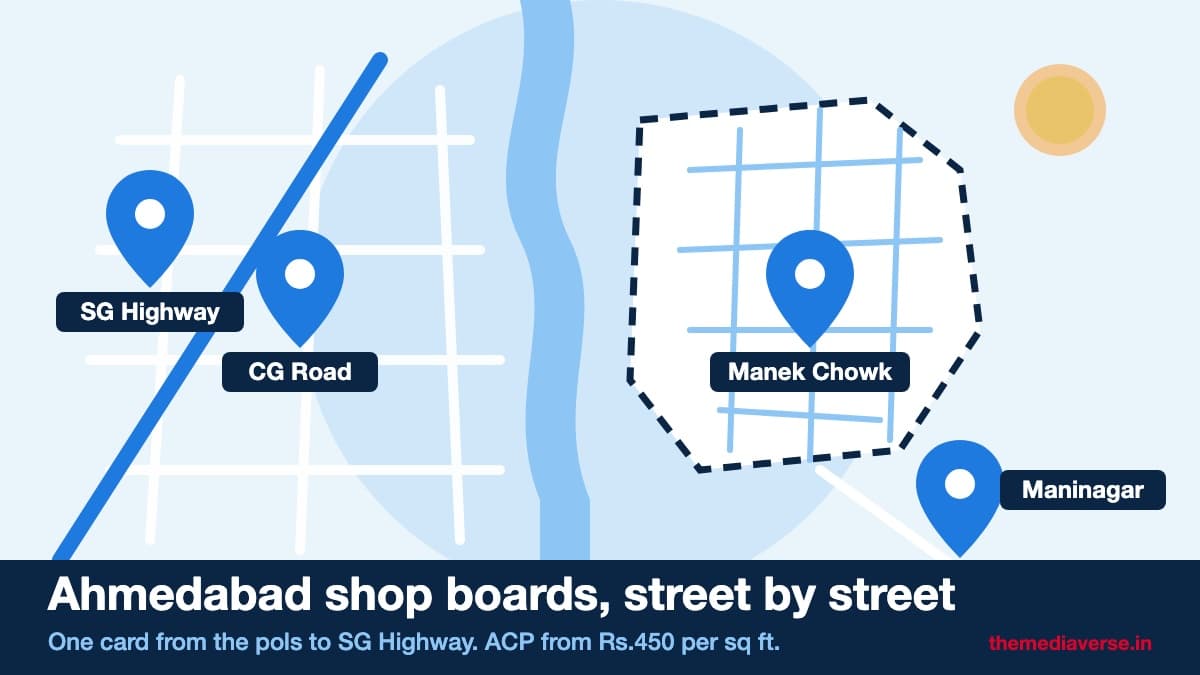
Shop Name Boards Street by Street in Ahmedabad: CG Road, Manek Chowk, SG Highway and Maninagar on One Card (2026)
One card, six zone groups and two rulebooks: what a shop board costs on CG Road, SG Highway, Satellite, Law Garden, Maninagar, Relief Road and inside the Manek Chowk pols at our Ahmedabad page's per sq ft rates, why the AMC caps cost area rather than rate, what the page publishes about fines and permits, why its Navratri overlay has no price, which of its three installed jobs matches its card, and which November dates a late-October brief can still make.

Shop Name Boards Street by Street in Kolkata: Gariahat, Park Street, Salt Lake and the KMC Rules the Page Publishes (2026)
One card, six zone groups: what a shop board costs on Gariahat, Burrabazar, College Street, Park Street, Salt Lake Sector V and in the south at our Kolkata page's per sq ft rates, what the Puja overlay and the three KMC rules the page publishes add, why none of its three installed jobs matches its card, and which November dates a late-October brief can still make.