

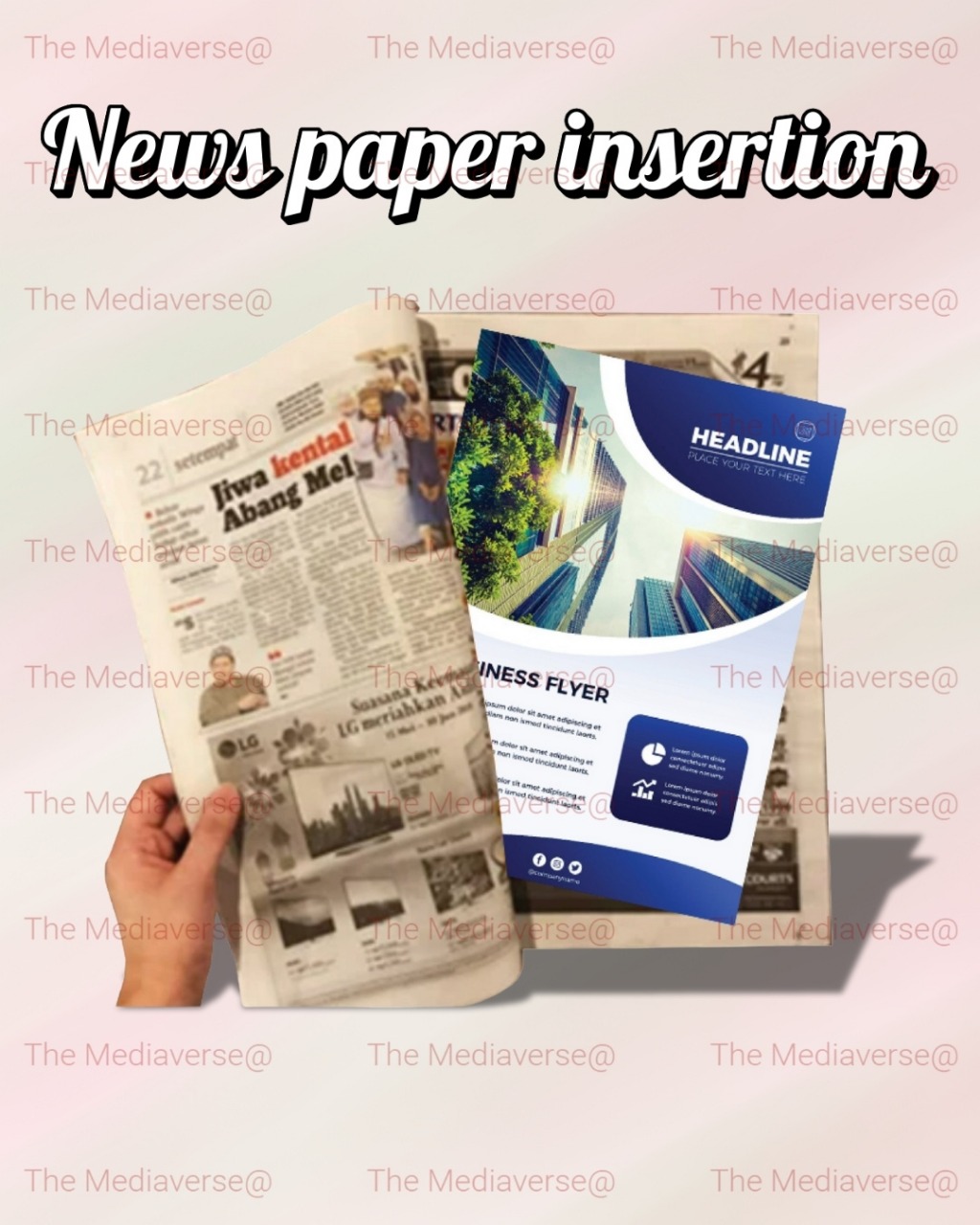
At an estimated Rs 1 to Rs 2.50 per home reached in 2026, newspaper insertion is among the lowest cost-per-contact ways to put a physical, keepable advertisement directly into the homes of the exact localities you choose. It is also the most precise offline-targeting format a local business has: because newspapers are delivered through dealers serving defined routes, an insert can be scoped from a whole city down to a single dealer route, so you pay only for the homes in your catchment, and the flyer cannot be blocked, skipped, or scrolled past. For a local shop, clinic, school, restaurant, or a real estate project, that combination of precision, low cost, and a tangible piece carrying an offer is hard to match. This complete guide covers what insertion is and why it works, its cost and pricing, how the targeting works, flyer design, the best uses, a step-by-step campaign process, how it compares with other formats, and how to measure it, so you can run an insertion campaign that delivers.
What is newspaper insertion, and why does it work?
Newspaper insertion places a printed flyer inside the morning paper, delivered to homes. Its power comes from the distribution structure: every copy goes to a known dealer route and area, so an insert can be placed into only the copies bound for your chosen pincodes, turning a mass medium into a hyperlocal one. The household receives a physical, keepable object, not a fleeting impression, that can be read at leisure, pinned up, or carried to the shop, and it cannot be blocked or skipped the way a digital ad can. Carrying an offer or coupon, it both sells and gives the reader a reason to act. For a footfall-driven local business, this means reaching the specific homes in its catchment with a tangible prompt, at a low cost per home, which is exactly what makes insertion one of the most effective and efficient offline formats for local marketing.
Newspaper insertion cost and pricing
Insertion is priced per home reached, so the total is simply that rate times the number of homes in your target pincodes. The table sets out what the per-piece rate depends on and how the total scales.
Newspaper insertion cost factors (2026)
| What it depends on | Effect on cost | |
|---|---|---|
| Per-piece rate | ~Rs 1 to 2.50 per home (2026 estimate) | Base rate, includes a basic flyer |
| Home count | Homes in your target pincodes | Total = rate x homes |
| Flyer size and paper | Basic vs premium or A2 | Larger or premium formats cost more |
| Volume | Small run vs large run | Larger runs lower the per-piece cost |
| City, paper, and edition | Varies by market and title | Confirm current rates per area |
2026 estimate; confirm current per-piece rates and the deliverable home count for your pincodes before booking. Premium formats such as an A2 insert cost more per piece.
How targeting works: the four levels
Insertion targeting comes in four broad levels, from the whole city down to a single dealer route, and choosing the tightest level that still covers your catchment is the key to efficiency. City-wide insertion, across all editions, suits brand launches or city-wide offers but wastes spend for a local shop. Edition or zone level narrows to a region of the city. Pincode or locality cluster targeting, the usual sweet spot for a single-location business, reaches the homes in your chosen localities with little waste. Dealer-route micro-targeting goes further, to specific streets, for the most hyperlocal reach. The work of targeting is in matching your pincode list to the editions and dealer routes that serve it, and getting the deliverable home count per area, which a distribution partner can do. Choosing the right level, and concentrating on the pincodes that matter rather than widening to chase a lower per-piece price, is what makes insertion so cost-effective.
Designing an insert that sells and measures
A good insert does two jobs: it sells, and it lets you measure. Lead with one clear, specific offer or reason to visit, in the language of the area, with a clean, legible layout rather than a cluttered brochure. Include the shop name and address, simple directions or a small map, a nearby landmark so it reads as local, and contact details including WhatsApp. Crucially, add a trackable element, a coupon code, QR code, or dedicated number, so the flyer both prompts action and lets you count it; varying the code by pincode lets you see which localities converted. Make the offer worth keeping the flyer for, so it stays in the home until used. For premium categories like real estate, a larger A2 insert reads as more considered and credible than a cheap-looking full page. A keepable, offer-led, locally worded, trackable flyer outperforms a generic design every time.
Best uses for newspaper insertion
Insertion suits several jobs particularly well. Local retail and services, shops, clinics, salons, restaurants, coaching centres, use it to drive footfall and offers from their own catchment. Real estate uses it heavily, often as a premium A2 insert that reads as credible to a property buyer and targets the right localities. Festive and sale offers land well as a keepable coupon in homes before the shopping days. New-store launches use it to announce an opening across the catchment. Service businesses use it to reach households with a seasonal or recurring offer. The common thread is a local, offer-driven, footfall or enquiry goal aimed at specific homes, where a tangible, targeted, keepable piece does more than a fleeting impression. Where the audience is purely online, or the goal is national brand-building, other formats fit better, but for local, neighbourhood-level marketing, insertion is a core tool.
How to run an insertion campaign: step by step
The process below takes an insertion campaign from a blank map to a measured result. The early steps, especially matching pincodes to dealer routes, win most of the precision and savings.
Define your catchment by pincode
List the pincodes and localities your customers actually come from, starting from your location and a realistic travel radius. If you have customer or delivery data, use it to confirm which pincodes convert. Targeting can only be as precise as the catchment you define, so this list is the foundation of the campaign.
Match pincodes to editions and dealer routes
For each target pincode, identify the newspaper editions and dealers and routes that serve it, so the insert goes only into the copies that reach your homes. A distribution partner can map your pincode list to editions and routes and give the deliverable home count per area, so you know exactly what you are buying. This is where the targeting is really made.
Choose the newspaper by language and readership
Within those editions, choose the paper or papers that best fit your target homes by language and readership, not just the largest title. In many localities a regional-language daily reaches more of the right households than the biggest English paper. Split across papers if the catchment is mixed. Choosing by who actually reads in your pincodes makes the insert land with the right audience.
Design an offer-led, trackable flyer
Design the flyer around one clear local offer, in the area's language, with your address, directions, a landmark, and contact details, plus a trackable coupon code, QR, or number, varied by pincode where useful. For premium categories, consider a larger A2 format. A keepable, offer-led, locally worded, trackable flyer both sells and measures.
Set volume, budget, and drop date
Set the quantity to the deliverable home count in your pincodes and the budget to that times the per-piece rate, and pick the drop date for when your audience reads and acts, weekends and festive or pay-day weeks often perform well. Book early for seasonal pushes, as drop dates fill up. Decide whether to cover the full catchment or test the strongest pincodes first.
Verify delivery and measure response
After the drop, verify delivery with the distributor, then count coupon redemptions, QR scans, or calls against inserts delivered per area to get a response rate. Compare which pincodes converted, reinvest into the ones that performed, and drop the ones that did not. This closes the loop and makes the next campaign an improvement on the last.
Newspaper insertion vs other formats
Insertion sits distinctively among formats. Against a city-wide newspaper advertisement, a pincode-targeted insert pays only for chosen homes and delivers a keepable flyer with an offer, rather than paying for the whole edition's readership. Against digital ads, insertion reaches offline and less-online households, particularly older and family homes, and cannot be blocked or skipped, while digital reaches online audiences by interest and intent; the two cover the offline and online halves of a local catchment and work well together with a shared coupon code. Against auto and van branding, which build broad moving awareness, insertion delivers a targeted, tangible offer into the home, so they complement rather than replace each other, the insert carries the offer, the vehicles carry the brand through the streets. Used in a layered plan, insertion is the precise, offer-led, household-level element.
Measuring an insertion campaign
Insertion is one of the more measurable offline formats, because the flyer itself can carry the tracking. Put a coupon code, QR, dedicated number, or show-this-flyer offer on the insert, vary it by pincode where useful, and count redemptions against inserts delivered in each area to get a response rate and a cost per response. That tells you which localities converted, so you can reinvest in the strong pincodes and drop the weak ones, turning a guess into a managed channel. Track consistently with the same method each campaign so you can compare and improve. Some of the value, the awareness of seeing the flyer even without redeeming, is not fully captured by coupons, so read redemptions alongside footfall and enquiry trends, but a disciplined coupon-and-count habit makes insertion genuinely accountable and steadily more efficient.
Common insertion mistakes to avoid
A few mistakes blunt insertion campaigns. The first is going too broad, dropping city-wide when a tight pincode cluster would reach the catchment for far less, wasting most of the spend on homes that cannot visit. The second is a weak flyer, a cluttered, generic, no-offer design that gives no reason to keep or act on it. The third is choosing the biggest paper rather than the one most read in the target pincodes. The fourth is skipping the trackable element, so there is no way to know what worked and the next drop repeats the same guesses. And the fifth is poor timing, dropping on a quiet day instead of aligning with readership and the buying window. Avoid these, target tightly, lead with a strong offer, choose the right paper, make it trackable, and time it well, and a modest insertion budget delivers a measurable, repeatable result.
Does anyone still read newspaper inserts in 2026?
Yes, a substantial share of households still take a newspaper, particularly older and family homes, and a physical insert with a clear offer gets noticed because it falls out of the paper into the reader's hands rather than competing in a crowded digital feed. Readership has shifted over the years, which is exactly why targeting matters: by inserting only into the pincodes where your customers live and read, you reach the households that still engage with print and avoid paying for those that do not. For reaching the offline and less-online segment of a local catchment with a tangible, hard-to-skip offer, a targeted insert remains effective, and pairing it with digital covers the online segment too.
How many inserts should a local business order?
Order to the deliverable home count in your target pincodes, not a round number. Map your catchment, get the home count per pincode and dealer route from your distributor, and cover the areas that matter, which for a single shop is often a few thousand to a few tens of thousands of homes. If the budget is tight or you are unsure, test the strongest two or three pincodes first, measure the response, and scale into what works rather than dropping city-wide. Resist widening the catchment just to lower the per-piece price, because the extra homes outside your radius are mostly waste. The right number is the homes in the localities that can realistically become customers.
What should a newspaper insert flyer include?
Lead with one clear, specific offer or reason to visit, in the language of the area, with a clean, legible layout. Include your shop name and address, simple directions or a small map, a nearby landmark so it reads as local, contact details and WhatsApp, and a trackable element, a coupon code, QR, or dedicated number, so it both sells and measures. Keep it to a single strong message rather than a cluttered brochure, and make the offer worth keeping the flyer for so it stays in the home until used. For premium categories such as real estate, a larger A2 format reads as more credible. A keepable, offer-led, locally worded, trackable flyer outperforms a generic one every time.
Should I use newspaper insertion or digital ads?
For most local businesses, both, because they reach different people. Insertion delivers a tangible, hard-to-skip flyer and offer into the homes of chosen pincodes, including offline and older households, while digital reaches online audiences by interest and intent and allows cheap testing and retargeting. They cover the offline and online halves of a local catchment, so running both on the same offer, tied by a shared coupon code, usually beats either alone and lets you compare them. If you must choose one, pick the channel that matches your audience: insertion for an offline, neighbourhood, footfall-driven business, digital for an online or intent-driven one. The two are complements, not substitutes.
Why do real estate brands use A2-size inserts?
Real estate brands often use a larger A2 insert because the size reads as premium and credible to a property buyer, which suits a high-value, considered purchase, whereas a full-page newspaper splash can feel like cheap mass advertising and undercut the brand. The A2 insert also targets the right localities and lands a tangible, keepable piece, with the project, price, and contact, in the homes of the catchment that matters. It costs more per piece than a basic flyer, but for a category where trust and perceived quality drive enquiries, the format and size signal as much as the message. So for real estate, an A2 insert often does more for the brand and the budget than a louder, cheaper-looking full page.
Tags
Quick Answers
What is newspaper insertion and how does it work?
Newspaper insertion is the delivery of a printed flyer, a leaflet or pamphlet, inside the morning newspaper to homes. Because newspapers are distributed through dealers who serve defined delivery routes, the insert can be placed into only the copies that go to chosen pincodes, localities, or even individual dealer routes, so a business reaches just the homes in its catchment. The flyer lands the next morning as a physical, keepable object that a household can read, pin up, or carry to the shop, often carrying an offer or coupon. This combination of precise local targeting and a tangible, hard-to-skip piece is what makes insertion the most precise offline-targeting format available, and it is why local businesses use it to drive footfall from their own neighbourhoods.
How much does newspaper insertion cost in India in 2026?
As a 2026 estimate, newspaper insertion costs roughly Rs 1 to Rs 2.50 per home reached, including a basic printed flyer, varying by city, by the newspaper and edition, by the flyer size and paper quality, and by the total volume, with larger runs costing less per piece. The total bill is simply that per-piece rate times the number of homes in your target pincodes, so a tightly targeted campaign of a few thousand homes is affordable for a single shop, while a city-wide drop runs much higher. Insertion is among the lowest cost-per-contact offline formats because you pay only for the homes you choose. Confirm the current per-piece rate and the deliverable home count for your pincodes before booking, and remember that premium or larger formats, such as an A2 insert, cost more per piece.
How precise can newspaper insertion targeting be?
Very precise. Insertion can be scoped at four broad levels: city-wide across all editions, edition or zone level, pincode or locality cluster, and dealer-route micro-targeting, which reaches down to specific streets in many areas. For a local business, pincode or dealer-route targeting concentrates the budget on the homes that can actually visit, with little waste on households outside the service radius. The practical limit is the deliverable home count in an area and which papers serve it, which a distribution partner can map for you. This level of offline precision, choosing the exact localities your flyer lands in, is the format's defining advantage over a city-wide newspaper advertisement or an untargeted leaflet drop, and it is what makes it so cost-effective for local marketing.
Is newspaper insertion still effective in 2026?
Yes, for the right job. A substantial share of households still take a newspaper, particularly older and family homes, and a physical insert with a clear offer gets noticed because it falls out of the paper into the reader's hands rather than competing in a crowded digital feed, and it cannot be blocked or skipped. Targeting is exactly why it remains effective: by inserting only into the pincodes where your customers live and read, you reach the households that still engage with print and avoid paying for those that do not. Insertion is not a replacement for digital, which reaches online audiences, but a complement that covers the offline and neighbourhood half of a catchment. For local footfall, coupon-led offers, and reaching less-online households, it remains one of the most cost-effective formats.
Looking for professional Newspaper Insertion services?
The Mediaverse runs end-to-end newspaper insertion campaigns across India with geo-tagged delivery and transparent, all-inclusive pricing.
Explore our Newspaper Insertion solutionsSummarize this guide with AI
Open this article in your favourite AI assistant
Related Guides
- newspaper insertion services
- the newspaper insertion pincode-targeting playbook
- newspaper insertion vs digital ads
- the complete guide to outdoor advertising in India
- the operator's take on which format fits your business
- how to plan your outdoor advertising budget
- the festive season booking calendar
- auto rickshaw branding services
Written by

The Mediaverse Team
India's Leading Outdoor Advertising Agency
The Mediaverse is a national-level outdoor advertising and integrated marketing organization that provides complete OOH, ATL, BTL, retail, and transit media solutions across India. With years of experience executing high-performance campaigns for brands in FMCG, Real Estate, E-commerce, EdTech, Automotive, Healthcare, and Retail, The Mediaverse combines creativity, data-driven media planning, and flawless on-ground execution. As a full-stack outdoor advertising provider, The Mediaverse offers Auto Branding, Mobile Van Branding, Newspaper Insertion Advertising, Shop Name Board Branding, In-Store Branding, Hoardings, Transit Media, Kiosks, Mall Media, Activations, and all forms of Below-The-Line marketing. Known for its pan-India network, strategic route planning, premium print quality, and Cheqmate™ GPS-based verification, The Mediaverse ensures 100% transparent and result-oriented campaign delivery. The Mediaverse’s editorial team produces deeply researched, SEO-optimized, and generative-engine-friendly content to help businesses understand the power of outdoor advertising and make informed decisions that maximize brand visibility and ROI across urban, suburban, and rural markets.
Related Articles
Newspaper Insertion in Hyderabad (2026): One 50,000 Order, Three Languages, Seven Papers
Hyderabad publishes seven partner dailies in two languages plus an Urdu creative option, and one 50,000 insert order reaches 12.5 to 16.7 percent of a single daily. The 2026 card, the title to belt map, the two delivery systems, and what a second language creative really adds.
Newspaper Insertion in Delhi NCR (2026): the Edition Map, Not the Pin Code
Delhi NCR publishes nine partner dailies across three state level jurisdictions, and a 50,000 insert minimum reaches only 5 to 6.25 percent of one daily's households. The 2026 rate card, the title to belt map, the cost of covering a paper once, and why an insert needs no municipal permission.
Newspaper Insertion in Chennai (2026): Rates, the 50,000 Slab, and the Tamil English Split
Chennai inserts carry a 50,000 minimum, and that exact quantity is the worst value on the card: the same Rs.62,500 buys 54,347 A5 inserts one band up. The 2026 rate card, the slab arithmetic, the Tamil and English split-run zones, and what the monsoon does to a Pongal booking.