

What is the smallest newspaper insertion campaign you can actually book in Chennai, and what does crossing that line do to the price? The minimum order is 50,000 inserts. At the published A5 rate of Rs.1.25 that is Rs.62,500 before GST, and the moment you go above 50,000 the rate drops to Rs.1.15. Run the arithmetic on that slab and something odd falls out: for the same Rs.62,500, a campaign booked just above the minimum buys 54,347 inserts instead of 50,000. The minimum order is the single most expensive quantity on the Chennai card, and almost every first-time brief lands exactly on it.
What does newspaper insertion actually cost in Chennai in 2026?
Three formats are published, each priced per insert, each with a rate above the 50,000 minimum. The A5 compact flyer is Rs.1.25, easing to Rs.1.15, printed on 90 GSM glossy and published as the workhorse for health camps, restaurant menus and coupon offers. The A4 standard brochure is Rs.1.70, easing to Rs.1.50, also 90 GSM glossy, published as the format T Nagar jewellers and admission-season institutes rely on. The A2 SNP poster is Rs.2.20, easing to Rs.2.00, printed on 45 GSM newsprint with a middle fold, published for OMR real estate launches and corporate campaigns. Every rate covers design, printing, physical insertion and proof of insertion, with three free design revisions, and GST at 18 percent sits on top.
A5 compact flyer
90 GSM glossy. Rs.62,500 at the 50,000 minimum. Published for health camps, restaurant menus and coupon offers, and the cheapest way into a Chennai home.
A4 standard brochure
90 GSM glossy. Rs.85,000 at the minimum. The steepest slab discount on the card at 11.8 percent. Published as the T Nagar jewellery and admission-season format.
A2 SNP poster
45 GSM newsprint with a middle fold. Rs.1,10,000 at the minimum. Published for OMR real estate launches and corporate campaigns, and the format that carries a floor plan legibly.
Published 2026 Chennai rate card. Minimum order 50,000 units per campaign, with the lower slab rate applying above 50,000. Rates cover design, printing, physical insertion and proof of insertion, with 3 free design revisions and creative in Tamil, English or both. GST 18 percent extra. Launch is published at 7 to 10 days, and Pongal and Akshaya Tritiya windows need 2 to 3 weeks of advance booking.
Why is ordering exactly 50,000 the worst value on the card?
Because the slab rate is not a discount on your whole order, it is a different price for a bigger order, and the two prices meet in an awkward place. Take the A5. Fifty thousand inserts at Rs.1.25 is Rs.62,500. Spend the identical Rs.62,500 at the above-slab rate of Rs.1.15 and you have bought 54,347 inserts. The extra 4,347 homes cost nothing, because you were already paying for them in the higher per-unit rate. The same trick is sharper on the A4: Rs.85,000 buys 50,000 at Rs.1.70 or 56,666 at Rs.1.50, which is 6,666 more households for the same invoice.
The size of the effect follows the size of the slab cut, and the three formats are not cut equally. The A4 drops Rs.0.20 off Rs.1.70, which is 11.8 percent, the steepest on the card. The A2 drops Rs.0.20 off Rs.2.20, or 9.1 percent. The A5 drops only Rs.0.10 off Rs.1.25, or 8 percent. Converted into free reach for the same money, that is 13.3 percent more A4 inserts, 10 percent more A2 and 8.7 percent more A5. This is our own arithmetic on the published card rather than a published offer, and the practical instruction is short: never sign off a Chennai brief at exactly 50,000 units without asking what the next band buys.
What the same money buys at the minimum against just above the slab, before GST
| Format | 50,000 at the minimum rate | Same spend at the slab rate | Extra homes for no extra money | Slab cut | |
|---|---|---|---|---|---|
| A5 compact flyer | Rs.62,500 | 54,347 inserts at Rs.1.15 | 4,347 more | 8 percent | |
| A4 standard brochure | Rs.85,000 | 56,666 inserts at Rs.1.50 | 6,666 more | 11.8 percent | |
| A2 SNP poster | Rs.1,10,000 | 55,000 inserts at Rs.2.00 | 5,000 more | 9.1 percent |
Which Chennai paper should carry your insert, and into which zone?
Chennai is two readerships sharing one city, and the pairing of paper to zone is published as the single biggest lever in a campaign here. The Tamil dailies, Daily Thanthi, Dinamalar, Dinamani and Dinakaran, own the residential heart: Mylapore, West Mambalam, the older streets behind T Nagar, Anna Nagar, Perambur and Kolathur. Daily Thanthi is published as the largest circulated Tamil newspaper in India, reaching 18 lakh or more readers. The English dailies, The Hindu, Times of India, The New Indian Express and Deccan Chronicle, carry a different Chennai: Nungambakkam, Adyar, Besant Nagar and the apartment belt feeding the OMR corridor from Thoraipakkam to Sholinganallur.
Match the format to that split and the brief writes itself. A Tamil A5 for a diagnostic camp goes into Dinamalar in Anna Nagar, where it reaches the person who books the family's doctor visits. An A2 poster for an OMR project launch or a hiring drive goes into The Hindu or Times of India, timed for the morning read before the commute starts. A jewellery A4 for Akshaya Tritiya runs Daily Thanthi into Mylapore and T Nagar, where families cross-check the offer against the gold rate printed two pages away.
Chennai zone, paper and format pairing from the published city plan
| Zone | Localities | Paper that reads there | Format that fits | |
|---|---|---|---|---|
| Central Chennai | T Nagar, Mylapore, Egmore, Nungambakkam | Tamil dailies on the residential streets, English on the commercial stretch | A4 glossy for jewellery and festival offers | |
| IT Corridor | OMR (Sholinganallur, Thoraipakkam), ECR, Tambaram | The Hindu and Times of India | A2 SNP poster for launches and hiring drives | |
| North Chennai | Perambur, Anna Nagar, Kolathur | Dinamalar and Daily Thanthi | A5 flyer for health camps and neighbourhood retail | |
| South Chennai | Adyar, Velachery, Guindy, Chromepet | English in Adyar, both in Velachery and Chromepet | A5 or A4 depending on the offer | |
| West Chennai | Vadapalani, Porur, Kilpauk | Both, with Porur reading across languages | A5 for automotive and family retail |
When should you run a split campaign instead of picking one language?
In the overlap zones, and Chennai publishes exactly which ones they are. Velachery, Porur and Tambaram households frequently take one Tamil paper and one English paper, so half the volume through Daily Thanthi and half through The Hindu in the same pin codes reaches both readers of the same house without doubling the spend. That is the whole tactic: the split is across papers inside one pin code, not across more pin codes.
T Nagar needs the same treatment for a different reason. The residential streets behind Usman Road read Tamil while the traders and showroom owners on the commercial stretch often take an English business paper as well, so a jewellery campaign serious about T Nagar runs both, with the Tamil version carrying the festival offer prominently. Note what a split run does to the slab arithmetic above. A 60,000-insert campaign split 30,000 Tamil and 30,000 English is still one order of 60,000 and still clears the minimum once. Two separate 30,000-unit bookings would clear it never, because 30,000 is below the published floor.
What does the monsoon do to a Chennai insert campaign?
It collides with the busiest booking season of the year, which is the part outside planners miss. The northeast monsoon runs October to December, and those are the same months that lead into the wedding season and the Pongal run-up. Chennai newspapers move by cycle and moped through wet streets and get tossed onto porches and balconies, so during monsoon weeks the published practice is to spec slightly heavier stock on A5 and A4 runs and to coordinate bagging with the distribution teams where vendors use covers. A soaked insert is a wasted insert, and at Rs.1.15 apiece a 10 percent write-off on a 60,000-unit run is Rs.6,900 of paper that never got read.
Festival demand pushes the other way at the same time. Pongal, Akshaya Tritiya, Tamil New Year and Deepavali are published as driving 2 to 3 times normal insert volumes, with advance booking of 2 to 3 weeks needed to guarantee placement in Daily Thanthi and Dinamalar. Set against a published standard launch of 7 to 10 days, that means a festival campaign needs roughly twice the lead time of an ordinary one. The planning consequence is blunt: if your Pongal insert is not booked by mid-December, you are booking into a queue in the middle of the rain.
What does it cost to cover the whole of Chennai once?
Daily household reach is published at 3 to 4 lakh Chennai homes, so the whole-city number is straightforward arithmetic on the published card. Three lakh A5 inserts at the slab rate of Rs.1.15 is Rs.3,45,000, and four lakh is Rs.4,60,000, both before GST. Add 18 percent and those land at Rs.4,07,100 and Rs.5,42,800. In A4 at Rs.1.50 the same coverage is Rs.4,50,000 to Rs.6,00,000 before tax. Against that, the 50,000-unit minimum reaches somewhere between 12.5 and 16.7 percent of the city's daily household reach in a single run, which is a useful way to size a first campaign honestly rather than calling it a Chennai launch.
One published figure deserves a caveat rather than a multiplication. The page publishes an estimated insert open rate of 70 to 80 percent, and it labels the figure as an estimate. Taken at face value it would put a 50,000-unit A5 run at 35,000 to 40,000 opened inserts, which is a cost per opened insert of Rs.1.56 to Rs.1.79 on a Rs.62,500 order. We publish no response-rate benchmark anywhere on this site, so treat that as arithmetic on an estimate and not as a forecast of enquiries. What is not an estimate is the proof: counts are reconciled at the early-morning vendor sorting stage, and every zone gets GPS-tagged delivery proof with same-day photo documentation.
Which Chennai industries does an insert actually work for?
Six sectors are published as the Chennai insert economy, and they do not all buy the same thing. Jewellery is the anchor: our page publishes the A4 glossy timed to Akshaya Tritiya or Pongal as practically a ritual for a T Nagar or Mylapore gold house, going out through Daily Thanthi and The Hindu as families fix their auspicious buying dates. Healthcare buys differently, pushing A5 screening-camp flyers through the Tamil dailies into the wards immediately around a hospital campus in Nungambakkam or Kilpauk, in a city published as India's medical tourism capital. Education fights admission season with A4 inserts aimed at the parents who make the final call, in a city that hosts IIT Madras and Anna University.
The other three run on the A2. OMR employers and manufacturers use the SNP poster inside Times of India and The Hindu for hiring drives and launches, reaching tech professionals at home before the commute in the one medium an office ad-blocker cannot touch. Real estate on ECR and off OMR runs the same format in English for the corridor and Tamil for the extended family who influence the decision. Automotive sits back on the A5, with showrooms in Porur and Tambaram using festive offers and year-end clearances aimed at suburban families. Read that list against the rate card and a pattern appears: the formats sort by how much information the decision needs, not by how much the buyer can afford.
Which day of the week should a Chennai insert run?
It depends on whether your reader is shopping or deciding. For retail and jewellery offers the published preference is weekend editions, when the household reads at leisure and a trip to T Nagar or Pondy Bazaar gets planned around the table. Admission-season education inserts are published as performing on weekdays, when parents are in decision mode rather than shopping mode. That is a real constraint on a festival plan, because the Pongal and Akshaya Tritiya windows already run at 2 to 3 times normal volume, and the weekend slots inside those windows are the first to fill.
The trust mechanism underneath all of this is the reason Chennai is planned as a print market first. Our page describes it as the Tamil breakfast table system: a Mylapore household has taken the same Tamil daily for decades, so an insert that falls out of that paper arrives carrying the publication's own credibility rather than asking for attention. It is why the three categories where trust is the actual purchase barrier, jewellery, healthcare and education, are the three that dominate the Chennai insert market. That is a published observation about buyer behaviour, not a measured lift, and we publish no figure claiming print out-converts digital by any particular multiple.
What is the minimum newspaper insertion order in Chennai?
Fifty thousand inserts per campaign, and it applies whatever format you pick. At the published A5 rate that is Rs.62,500 before GST, at A4 Rs.85,000 and at A2 Rs.1,10,000. A split run across a Tamil and an English paper still counts as one order, so 30,000 plus 30,000 clears the floor while two separate 30,000 bookings would not. Anything below 50,000 is not on the published card.
Which insert format is cheapest per household in Chennai?
The A5 compact flyer at Rs.1.25, or Rs.1.15 above the 50,000 minimum, printed on 90 GSM glossy. It is roughly half the cost of the A2 SNP poster at Rs.2.20 and about a third cheaper than the A4 at Rs.1.70. It is published as the format for health camps, restaurant menus and coupon offers, which is where a short message and a big footprint matter more than the space to lay out a floor plan.
Should a Chennai campaign run in Tamil or English?
Usually both, zone by zone. Tamil dailies are published as owning the residential heart, Mylapore, West Mambalam, Anna Nagar, Perambur and Kolathur, while English dailies carry Nungambakkam, Adyar, Besant Nagar and the OMR apartment belt. Velachery, Porur and Tambaram take one of each paper per household, so a split run across both papers in the same pin codes reaches two readers in one home without doubling the budget.
How far ahead do you need to book a Pongal or Akshaya Tritiya insert?
Two to three weeks of advance booking is published for those windows, against a standard launch of 7 to 10 days. Festival demand is published at 2 to 3 times normal volumes, so slots in Daily Thanthi and Dinamalar fill early. The practical deadline for a Pongal campaign is mid-December, which also falls inside the northeast monsoon, so the stock and bagging decisions get made at the same time as the booking.
How do you prove the inserts were actually delivered in Chennai?
Counts are reconciled at the vendor sorting stage, which starts well before dawn across hundreds of early-morning vendor points, and that is what makes zone-level proof possible instead of a citywide estimate. Every zone then gets GPS-tagged delivery proof with same-day photo documentation on WhatsApp and email, plus zone-wise reporting. QR tracking can be added on the creative if you want scan analytics alongside the delivery record.
The short version for anyone briefing a Chennai campaign this quarter: pick the format from the message, not the budget, then size the order just above 50,000 rather than exactly on it, then split the paper by zone before you split the budget. The slab, the two readerships and the monsoon calendar are the three things this city will charge you for if you plan it like any other metro.
Tags
Quick Answers
How much does newspaper insertion cost in Chennai in 2026?
Chennai inserts are priced per unit with a 50,000 minimum. The A5 compact flyer is Rs.1.25, the A4 brochure Rs.1.70 and the A2 SNP poster Rs.2.20, each dropping to Rs.1.15, Rs.1.50 and Rs.2.00 above 50,000 units. At the minimum that is Rs.62,500, Rs.85,000 and Rs.1,10,000 before GST at 18 percent. Every rate covers design, printing, physical insertion and proof of insertion, with three free design revisions.
Why should you never order exactly 50,000 inserts in Chennai?
Because the minimum quantity carries the highest per-unit rate on the card. Fifty thousand A5 inserts at Rs.1.25 is Rs.62,500, and the same Rs.62,500 spent just above the slab at Rs.1.15 buys 54,347 inserts instead. That is 4,347 extra Chennai homes for no extra money. On the A4 the gap is wider still, 56,666 inserts against 50,000 for the same Rs.85,000. This is our arithmetic on the published card.
Which Chennai zones need a Tamil and English split run?
Velachery, Porur and Tambaram, where households are published as frequently taking one Tamil paper and one English paper. Running half the volume through Daily Thanthi and half through The Hindu in the same pin codes reaches both readers of one home without doubling spend. T Nagar needs the same handling for a different reason: the residential streets behind Usman Road read Tamil while the commercial stretch often takes an English business paper too.
What does it cost to reach every Chennai household once?
Daily household reach is published at 3 to 4 lakh homes. At the A5 slab rate of Rs.1.15 that is Rs.3,45,000 to Rs.4,60,000 before GST, or Rs.4,07,100 to Rs.5,42,800 with 18 percent added. In A4 at Rs.1.50 the same coverage runs Rs.4,50,000 to Rs.6,00,000 before tax. A 50,000-unit minimum order therefore reaches between 12.5 and 16.7 percent of the city in one run.
Looking for professional Newspaper Insertion services?
The Mediaverse runs end-to-end newspaper insertion campaigns across India with geo-tagged delivery and transparent, all-inclusive pricing.
Explore our Newspaper Insertion solutionsSummarize this guide with AI
Open this article in your favourite AI assistant
Related Guides
Written by

The Mediaverse Team
India's Leading Outdoor Advertising Agency
The Mediaverse is a national-level outdoor advertising and integrated marketing organization that provides complete OOH, ATL, BTL, retail, and transit media solutions across India. With years of experience executing high-performance campaigns for brands in FMCG, Real Estate, E-commerce, EdTech, Automotive, Healthcare, and Retail, The Mediaverse combines creativity, data-driven media planning, and flawless on-ground execution. As a full-stack outdoor advertising provider, The Mediaverse offers Auto Branding, Mobile Van Branding, Newspaper Insertion Advertising, Shop Name Board Branding, In-Store Branding, Hoardings, Transit Media, Kiosks, Mall Media, Activations, and all forms of Below-The-Line marketing. Known for its pan-India network, strategic route planning, premium print quality, and Cheqmate™ GPS-based verification, The Mediaverse ensures 100% transparent and result-oriented campaign delivery. The Mediaverse’s editorial team produces deeply researched, SEO-optimized, and generative-engine-friendly content to help businesses understand the power of outdoor advertising and make informed decisions that maximize brand visibility and ROI across urban, suburban, and rural markets.
Related Articles
Newspaper Inserts vs WhatsApp and SMS Blasts for Local Reach (2026)
The two channels are not competing for the same rupee. Published insert rates at Rs.1.25, Rs.1.70 and Rs.2.20 per copy, the Rs.1,475 per thousand benchmark, the per-message price where a blast wins, and the reach ceiling that decides it for most businesses.
How to plan a newspaper insertion campaign in India: the 2026 step-by-step guide
What does newspaper insertion cost, how precise is the targeting, and how do you run a campaign? The complete 2026 guide to newspaper insertion in India, from pincode targeting to measurement.
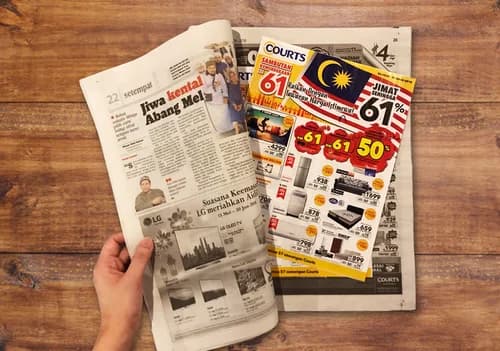
Print inserts or digital ads for a local business: the 2026 budget-split decision guide
Is newspaper insertion still worth it against digital ads in 2026? A decision guide with a spec table, when each wins, how to combine them, and a checklist for local businesses.