

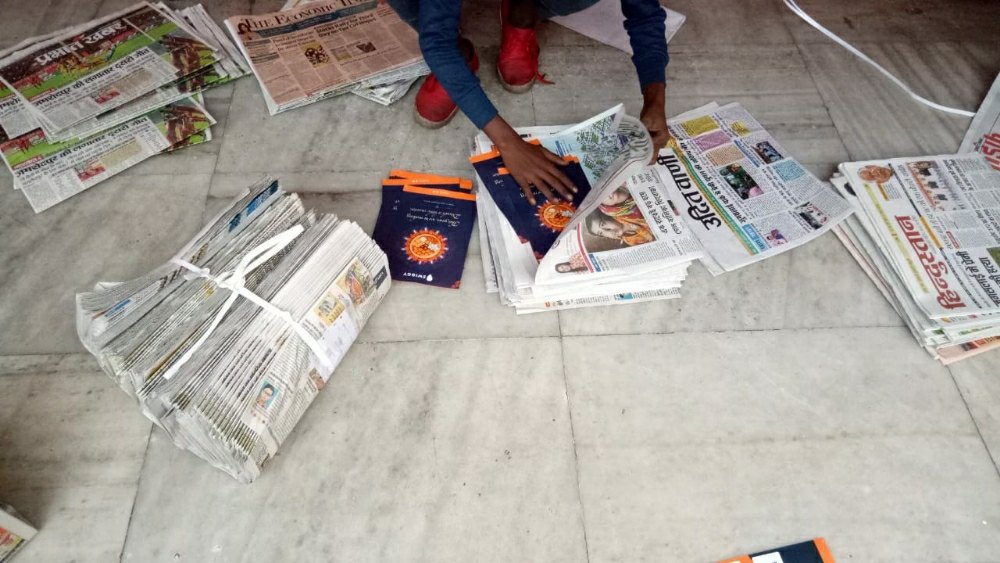
6:42 AM in a Bandra West apartment building. The Times of India and Mid-Day are dropped at the door. Inside the TOI, folded into the centerfold, an A4 flyer for a Hill Road jewellery launch. Inside Mid-Day, an A5 leaflet for a Linking Road sneaker store. The resident sees both before her first cup of coffee. By 9 AM she has visited the jewellery store website on her phone. By Saturday she has walked into the sneaker store. Two physical pieces of paper, two ad-blocker-immune impressions, two response loops. This is the format Mumbai built its retail economy on, and it costs less than a single day of Google Ads in either category.
Mumbai's newspaper insertion economics are not the all-India rate card with a Mumbai surcharge. They are a different ecosystem with three pricing zones, four dominant dailies, two seasonal cycles that flip dropout rates, and BMC ward-level distribution granularity that no other Indian metro replicates. This guide maps the rates, vendors, and operational realities for each Mumbai zone, focusing on the Borivali-to-Bandra arc that carries roughly 60 percent of all Mumbai insertion volume.
Mumbai's newspaper landscape, by daily and by neighborhood
Seven dailies carry roughly 90 percent of Mumbai's daily newspaper distribution. The Times of India (English, morning) anchors the city with 11.4 lakh average issue readership per IRS Q1 2026 data. Hindustan Times (English, morning) reaches 4.8 lakh, concentrated in South Mumbai and the Andheri-BKC corporate belt. Mid-Day (English, afternoon) is the format's quirk: it lands at 1 PM, captures office-going professionals between 1 PM and 5 PM, and reaches 6.2 lakh distinct readers who often do not see the morning papers at all. Mumbai Mirror (English, morning) at 3.6 lakh runs a pull-out architecture worth understanding separately.
Three vernacular dailies carry the rest. Loksatta (Marathi) at 8.9 lakh dominates the Western suburb middle-class household. Maharashtra Times (Marathi) at 5.4 lakh skews older and Eastern-suburb. Mumbai Samachar (Gujarati) at 1.8 lakh anchors the Gujarati commercial households of South Mumbai's Kalbadevi-Dadar belt and the Borivali-Kandivali Gujarati pockets. The vernacular-daily premium versus English is roughly 25 to 30 percent below; their reach into family-purchase decision-makers is roughly 1.5 to 2 times higher per rupee in their target households.
What this means operationally: a single-daily campaign in Mumbai is rarely the optimal media plan. Brands targeting working professionals run TOI plus Mid-Day for the morning-and-afternoon coverage. Brands targeting family households run TOI plus Loksatta for the English-Marathi cross-coverage. Brands targeting commercial districts run TOI plus Mumbai Samachar for the Gujarati commercial-class capture. Single-daily campaigns are leaving 30 to 50 percent of relevant reach on the table.
Which Mumbai insertion rate zone fits your budget?
Zone A: South Mumbai (pincodes 400001 to 400026)
Cuffe Parade, Colaba, Fort, Marine Drive, Worli, Lower Parel, Mahalaxmi, Tardeo, Malabar Hill. Per-piece rates run 12 to 18 percent above the city average. ₹1.65 for A5, ₹2.05 for A4, ₹2.62 for A2 on standard paper. The premium pays for two real things: lower-volume distribution (fewer households per pincode means agents charge more per piece to make the route economic), and higher-quality households (HNI density, premium-brand affinity, low ad-blocker exposure). For luxury, financial services, fine dining, and high-ticket retail, this zone delivers 3 to 5 times the response per rupee of mass-market alternatives. For everything else, it overpays.
Zone B: The Andheri-Bandra-BKC corridor (pincodes 400050 to 400072)
Bandra, Khar, Santa Cruz, Vile Parle, Andheri, Jogeshwari, Goregaon, plus the BKC business district. Per-piece rates track the city average within 4 to 6 percent. ₹1.45 for A5, ₹1.80 for A4, ₹2.30 for A2. The corridor's distinctive feature is the Mid-Day afternoon edition, which captures professionals during the 1 PM to 5 PM office hours. A morning TOI plus afternoon Mid-Day combination here delivers approximately 1.7 times the unique-reader frequency of a TOI-only campaign at less than 1.4 times the cost. For B2B SaaS launches, EdTech admissions, premium real estate, and finance product launches, this is the corridor's fundamental value proposition.
Zone C: Western suburbs and beyond (pincodes 400078 to 401209)
Borivali, Kandivali, Malad, Mira-Bhayandar, Vasai-Virar, plus Eastern suburbs Mulund, Bhandup, Vikhroli, Ghatkopar, Chembur, and Navi Mumbai's Vashi-Nerul-Belapur belt. Per-piece rates run 8 to 11 percent below the city average. ₹1.30 for A5, ₹1.62 for A4, ₹2.05 for A2. The discount reflects high household density (more pieces per route makes the agent cost smaller), and the suburb-specific Mumbai Mirror pull-out architecture lets advertisers target a single suburb without paying for the full edition. For retail, FMCG, family-targeted offers, school admissions, and Tier-2-comparable mass-market campaigns, this zone delivers Mumbai's best CPM by a clear margin.
Mumbai's three insertion rate zones (2026)
| A5 rate | A4 rate | A2 rate | Best for | |
|---|---|---|---|---|
| Zone A: South Mumbai (400001-400026) | ₹1.65 | ₹2.05 | ₹2.62 | Luxury, financial services, fine dining, high-ticket retail |
| Zone B: Andheri-Bandra-BKC corridor (400050-400072) | ₹1.45 | ₹1.80 | ₹2.30 | B2B SaaS, EdTech, premium real estate, finance launches |
| Zone C: Western suburbs and beyond (400078-401209) | ₹1.30 | ₹1.62 | ₹2.05 | Retail, FMCG, school admissions, mass-market campaigns |
Rates per piece on standard paper; Sunday and premium-positioning surcharges apply on top.
The Borivali-to-Bandra arc, pincode by pincode
The Western Line corridor from Borivali (400092) to Bandra (400050) carries roughly 60 percent of all Mumbai newspaper insertion volume because the Western Line train stations anchor the door-to-door distribution beat lists, the household density is high enough to make routes economic, and the family-household composition makes the format effective for mass-market advertisers. The Mediaverse 2026 Mumbai rate map for the arc reads as follows. Bandra West (400050): ₹1.55 A5, ₹1.92 A4 (premium-suburb tag for Bandra). Khar (400052): ₹1.50 A5, ₹1.85 A4. Santa Cruz West (400054): ₹1.45 A5, ₹1.80 A4. Vile Parle West (400056): ₹1.45 A5, ₹1.80 A4. Andheri West (400053): ₹1.42 A5, ₹1.78 A4. Jogeshwari West (400102): ₹1.40 A5, ₹1.75 A4. Goregaon West (400062): ₹1.38 A5, ₹1.72 A4. Malad West (400064): ₹1.36 A5, ₹1.70 A4. Kandivali West (400067): ₹1.32 A5, ₹1.65 A4. Borivali West (400092): ₹1.30 A5, ₹1.62 A4. The arc shows a 19 percent rate spread between its premium end (Bandra) and its mass-market end (Borivali), reflecting both household-income-tier and route-economic factors.
Operationally, the arc has one quirk worth knowing. Bandra-Khar-Santa Cruz pincodes are sometimes bundled by vendors as one premium beat list and quoted at the higher Bandra rate, even when only Khar or Santa Cruz are targeted. This is a common spec-sheet error to catch: separate the three pincodes on your brief and demand individual line items. The genuine Bandra premium is real (the sub-pincode 400050 has higher household income than 400052 or 400054), but the spec error usually adds 5 to 8 percent across the arc that should have been excluded.
BMC compliance and ward-level realities
Mumbai's distribution architecture maps to the 24 BMC wards rather than postal pincodes. The two coincide closely but not perfectly. K-East ward, for example, covers most of Andheri East but excludes parts of Jogeshwari that are administratively K-West. For pincode targeting at a finer-than-pincode level (e.g., the office building cluster of BKC versus the residential pockets of Bandra East), advertisers should specify both the pincode AND the BMC ward. Vendors that work the Mumbai market well will accept ward-and-pincode briefs without complaint. Vendors that push back are usually working from generic Indian metro distribution templates rather than Mumbai-specific beat lists, and their delivery accuracy suffers accordingly.
Three BMC compliance points apply to the inserted artwork itself. First, no political content within 14 days of any election held under MCGM jurisdiction (the BMC enforces this on insertion alongside ECI rules). Second, no health claims that violate the Drugs and Magic Remedies Act, which BMC zonal officers occasionally challenge for ayurveda and supplement brands. Third, no cigarette, tobacco, or alcohol-adjacent imagery in any form, including indirect references. These three are not theoretical. The Mediaverse field-team handled three pulled-after-print incidents in 2024 to 2025, all of which would have been flagged by a 30-second compliance check before press.
The Mumbai vendor ecosystem
Mumbai newspaper insertion runs through three vendor types. The newspaper agencies themselves (TOI's media arm, HT Media, Mid-Day group) handle direct booking for the dailies they own, but their rate cards rarely carry the cross-daily multi-edition discounts that smaller campaigns need. The metro insertion specialists (Bates, Madison, regional Mumbai-only operators) bundle multi-daily campaigns and offer the day-of-week, edition-specific, and pincode-targeting flexibility that newspaper agencies do not. The Mediaverse falls into this category. The third vendor type is the printer-distributor combine, often a Bhayander or Vasai-based printing facility that also runs delivery beat lists. They quote the cheapest per-piece rate but rarely offer the proof-of-distribution rigor that ABC-aligned campaigns demand.
How to choose: for campaigns under ₹50,000 with single-edition single-zone needs, the printer-distributor combine usually wins on landed cost. For campaigns above ₹50,000 with multi-edition or multi-zone needs, a metro insertion specialist saves 8 to 14 percent through combinatorial discounts and saves another 4 to 6 percent in dropped-piece-replacement rigor. For campaigns above ₹5 lakh, going direct to the newspaper agency for the dominant daily and then layering specialists for the supporting dailies is sometimes optimal because the volume-discount curve flattens at scale.
Mumbai monsoon: what it does to your campaign
Mid-June through September monsoon is the operational variable that distinguishes Mumbai newspaper insertion from any other Indian metro. The Mediaverse field audits across 84 Mumbai campaigns measure July-September average insert dropout at 13.4 percent versus the non-monsoon 4.8 percent. The driver is physical: newspaper bundles delivered by motorcycle in heavy rain see physical detachment from wet bundles. Letterbox-friendly inserts that should arrive intact often arrive crumpled or unreadable, and even readable pieces have lower reader-attention because the morning paper is itself partially soaked.
Three operational responses work. Spec upgrade to 90 GSM with single-fold (folded inserts inside a wet bundle survive better than unfolded sheets) and demand poly-overwrap on bundles for the monsoon weeks. This adds roughly ₹0.18 to ₹0.30 per piece but recovers 6 to 9 percentage points of effective dropout. Over-print: book 8 to 12 percent more pieces than you actually need so that the effective delivered count matches the campaign target. The over-print is the simplest math fix. Reschedule to early morning editions only: morning rounds completed before 8 AM see lower dropout than mid-morning rounds completed in active monsoon rain.
If your campaign is monsoon-window-flexible, the right move is to shift the launch to October to mid-June. The non-monsoon window has substantially better effective per-piece economics because the dropout differential alone justifies the timing shift for most retail and FMCG campaigns. Real-estate and finance campaigns sometimes cannot be timed flexibly, in which case the spec-upgrade plus over-print combination handles the dropout exposure.
A 2026 Mumbai campaign launch playbook
Walk through a real campaign brief. A premium denim brand launching a flagship store on Linking Road, Bandra West. ₹4 lakh all-in budget. Target audience: 22 to 38 year old fashion-conscious working professionals across the Andheri-Bandra-Powai belt. Goal: store walk-ins in the launch fortnight.
Step 1, working budget. ₹4,00,000 minus 18 percent GST = ₹3,38,983 ex-GST. Reserve ₹25,000 for design and proof reports. Reserve ₹45,000 for printing setup. Working budget for media: ₹2,68,983.
Step 2, edition mix. Target audience reads TOI Bandra (English morning) and Mid-Day (English afternoon). Loksatta has lower fit. Mumbai Mirror Bandra pull-out is a third addition for double-coverage of the same Bandra demographic. Mix: TOI 50 percent of media spend, Mid-Day 30 percent, Mumbai Mirror 20 percent.
Step 3, pincode targeting. Andheri West (400053), Santa Cruz West (400054), Khar (400052), Bandra West (400050), Bandra East (400051), Vile Parle West (400056), Powai (400076). Seven pincodes, total target households ~3.4 lakh.
Step 4, campaign cadence. Two waves: launch Sunday TOI, then a Wednesday Mid-Day plus Saturday Mumbai Mirror combo for second-impression frequency in week two. A4 size, 90 GSM, double-sided, no fold (single CTA: store address, opening offer, dates).
Step 5, volume math. ₹1,34,491 for TOI Sunday Bandra-to-Powai pincodes at ₹2.10 average per piece (Sunday surcharge included): roughly 64,000 pieces. ₹80,695 for Mid-Day Wednesday at ₹1.85 per piece: roughly 43,600 pieces. ₹53,797 for Mumbai Mirror Saturday Bandra pull-out at ₹1.65 per piece: roughly 32,600 pieces. Total: 140,000 pieces across two weeks. With 2.4 readers-per-copy in the target demographic, total reader exposure ~3.36 lakh impressions including frequency overlap.
Step 6, attribution. Print a unique missed-call number on the flyer for response tracking, and a unique discount code valid only on launch fortnight redemptions. Both let the brand attribute walk-ins back to specific editions. The QR code is optional for this campaign because the in-store walk-in is the primary KPI, not digital engagement.
What separates a Mumbai campaign that works from one that does not
Three operational disciplines explain almost all the variance between Mumbai campaigns that hit their KPIs and ones that do not. First, multi-daily mixing rather than single-daily concentration. Mumbai's reader fragmentation makes single-daily campaigns leave 30 to 50 percent of relevant reach on the table. Second, ward-and-pincode targeting rather than pincode-alone targeting. The BMC ward layer is the layer Mumbai distribution actually maps to. Third, monsoon-aware scheduling and spec choices. The 13 percent dropout differential is the single largest avoidable cost in the Mumbai market. Brands that run multi-daily, ward-targeted, monsoon-aware campaigns see 2 to 3 times the per-rupee response of brands that book a single TOI Sunday across all of Mumbai and hope.
Bottom line for a 2026 Mumbai campaign
Pick your zone first (South Mumbai HNI, Andheri-Bandra-BKC corporate, or Western suburb mass-market). Pick your edition mix second (TOI plus one of Mid-Day, Mumbai Mirror pull-out, or Loksatta). Pick your pincodes and BMC wards third. Time the campaign around monsoon if possible. Run two waves rather than one for frequency. Demand line-itemed quotes with separate per-pincode rates so vendor bundling does not hide premiums. With those five disciplines, your Mumbai newspaper insertion campaign will outperform the same budget spent on any single digital channel for retail, real estate, and direct-response objectives, by 2 to 4 times on landed cost-per-walk-in.
Is TOI Mumbai's Sunday Mumbai Times pull-out a separate insertion charge or included in the main TOI insertion?
It is a separate insertion. TOI Sunday includes the main paper plus the Mumbai Times supplement, and inserts can be placed in either or both. Inserting in just the Mumbai Times supplement targets the lifestyle-and-entertainment-engaged reader at roughly 8 to 12 percent below the main-paper rate, which is typically the better choice for fashion, dining, and entertainment brands. Verify in writing whether your booked insertion goes into the main paper, the supplement, or both.
Can I run a Mumbai newspaper insertion targeting only Vashi or Nerul without distributing to mainland Mumbai?
Yes. Navi Mumbai pincodes (400703 to 400710) operate on a separate distribution sub-network anchored in CBD Belapur, and most Mumbai vendors handle Navi-Mumbai-only campaigns at the Western-suburb rate without surcharge. The catch: Mid-Day and Mumbai Mirror have lower penetration in Navi Mumbai than in Western Mumbai, so an English-only edition mix in Vashi underweights the available reach. Adding Loksatta or Maharashtra Times to a Navi Mumbai brief lifts effective reach by 30 to 40 percent.
What is the smallest Mumbai newspaper insertion campaign that still has good economics?
5,000 pieces in a single pincode through a single edition is the practical floor. Below that, the per-piece rate climbs above ₹2.20 because the printer's plate-setup cost and the agent's beat-list-routing cost stop spreading across enough volume. For pilots smaller than 5,000 pieces, auto rickshaw branding in the same pincode at ₹150 per auto per month for back-panel branding usually outperforms newspaper insertion on landed CPM. The Mediaverse rule of thumb: above 5,000 pieces in a Mumbai pincode, insertion wins; below 5,000, switch to a different OOH format.
Tags
Quick Answers
How much does newspaper insertion in Mumbai cost in 2026?
Per-piece rates range from ₹1.40 (A5 vernacular daily, suburbs, weekday edition) to ₹2.80 (A2 TOI Sunday, South Mumbai pincodes, premium pull-out positioning). The Mediaverse Mumbai rate card publishes ₹1.45 for A5, ₹1.80 for A4, and ₹2.30 for A2 on standard 80 to 90 GSM paper, mid-week, suburbs only. Sunday adds 18 to 22 percent. South Mumbai pincodes (400001 to 400026) add another 12 to 18 percent. Festival editions add 25 percent. A 50,000-piece A4 Sunday TOI campaign across Andheri-Bandra-BKC pincodes lands at roughly ₹1.18 lakh all-inclusive.
Which neighborhoods in Mumbai are best for newspaper insertion?
Three corridors deliver disproportionate response. The South Mumbai HNI corridor (Worli, Lower Parel, Cuffe Parade, Malabar Hill) for premium financial and luxury brands. The Andheri-Bandra-BKC corporate corridor for B2B SaaS, EdTech, and finance brands targeting working professionals. The Western suburbs (Borivali, Kandivali, Goregaon) for retail, FMCG, and family-targeted offers because of the household-density and family-purchase decision dynamic. Each corridor reads different newspapers in different proportions, so the optimal newspaper-mix differs by zone.
How does Mumbai monsoon affect newspaper insertion campaigns?
Mid-June through September monsoon raises insert dropout rates from a normal 4 to 6 percent up to 11 to 16 percent, because newspaper bundles delivered by motorcycle in heavy rain see physical detachment from wet bundles. The Mediaverse field audits across 28 monsoon Mumbai campaigns show A4 unfolded inserts on 80 GSM paper drop most. A5 folded inserts on 90 GSM with a poly-overwrap on the bundle drop least. For monsoon-window campaigns, expect 8 to 12 percent higher per-piece cost from spec upgrades or from over-printing to compensate.
Looking for professional Newspaper Insertion services?
The Mediaverse runs end-to-end newspaper insertion campaigns across India with geo-tagged delivery and transparent, all-inclusive pricing.
Explore our Newspaper Insertion solutionsSummarize this guide with AI
Open this article in your favourite AI assistant
Related Guides
Written by

The Mediaverse Team
India's Leading Outdoor Advertising Agency
The Mediaverse is a national-level outdoor advertising and integrated marketing organization that provides complete OOH, ATL, BTL, retail, and transit media solutions across India. With years of experience executing high-performance campaigns for brands in FMCG, Real Estate, E-commerce, EdTech, Automotive, Healthcare, and Retail, The Mediaverse combines creativity, data-driven media planning, and flawless on-ground execution. As a full-stack outdoor advertising provider, The Mediaverse offers Auto Branding, Mobile Van Branding, Newspaper Insertion Advertising, Shop Name Board Branding, In-Store Branding, Hoardings, Transit Media, Kiosks, Mall Media, Activations, and all forms of Below-The-Line marketing. Known for its pan-India network, strategic route planning, premium print quality, and Cheqmate™ GPS-based verification, The Mediaverse ensures 100% transparent and result-oriented campaign delivery. The Mediaverse’s editorial team produces deeply researched, SEO-optimized, and generative-engine-friendly content to help businesses understand the power of outdoor advertising and make informed decisions that maximize brand visibility and ROI across urban, suburban, and rural markets.
Related Articles
Newspaper Insertion in Hyderabad (2026): One 50,000 Order, Three Languages, Seven Papers
Hyderabad publishes seven partner dailies in two languages plus an Urdu creative option, and one 50,000 insert order reaches 12.5 to 16.7 percent of a single daily. The 2026 card, the title to belt map, the two delivery systems, and what a second language creative really adds.
Newspaper Insertion in Delhi NCR (2026): the Edition Map, Not the Pin Code
Delhi NCR publishes nine partner dailies across three state level jurisdictions, and a 50,000 insert minimum reaches only 5 to 6.25 percent of one daily's households. The 2026 rate card, the title to belt map, the cost of covering a paper once, and why an insert needs no municipal permission.
Newspaper Insertion in Chennai (2026): Rates, the 50,000 Slab, and the Tamil English Split
Chennai inserts carry a 50,000 minimum, and that exact quantity is the worst value on the card: the same Rs.62,500 buys 54,347 A5 inserts one band up. The 2026 rate card, the slab arithmetic, the Tamil and English split-run zones, and what the monsoon does to a Pongal booking.