

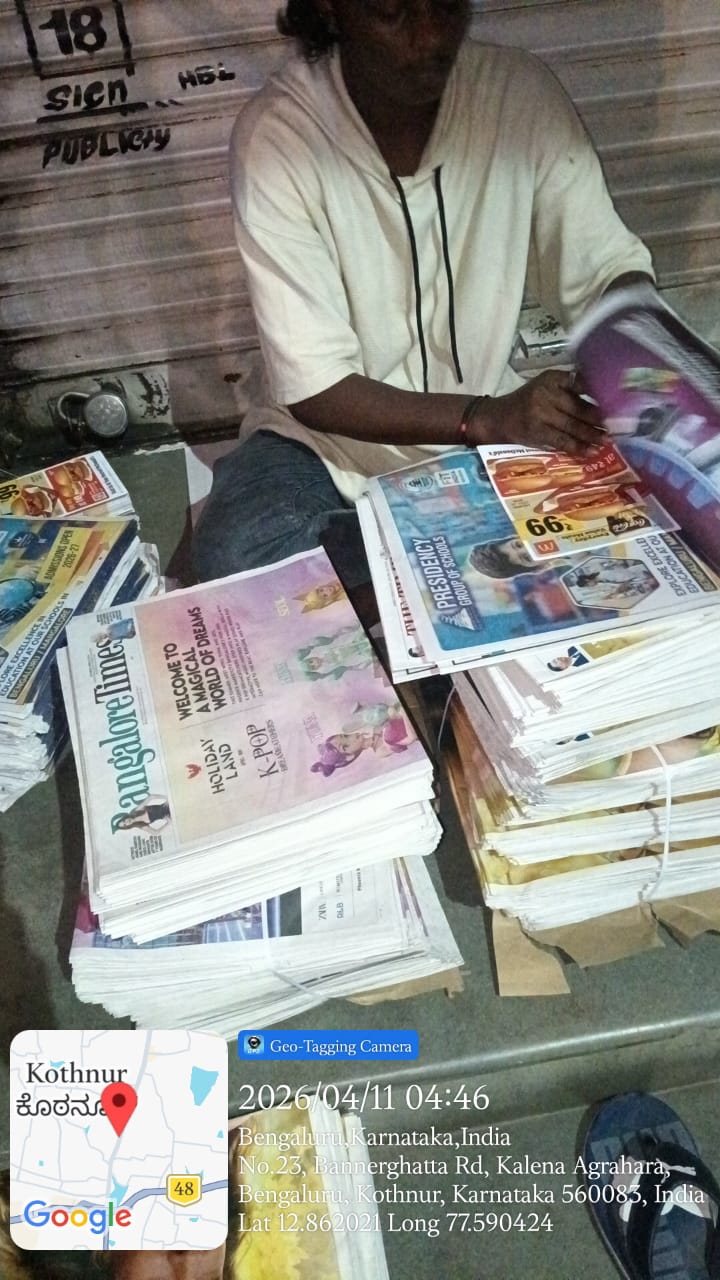
Pamphlet insertion across the ten largest Indian newspaper markets in 2026 costs ₹1.25 to ₹2.20 per piece for the three standard sizes on standard paper grades. The headline rate is the easy part. The landed cost on a finalised invoice almost always lands ₹0.40 to ₹0.90 higher per piece, and that gap is where most first-time campaigns lose their margin. This guide unpacks every line item, in the order it actually appears on a 2026 vendor quote.
The 2026 rate card, before any modifiers
Three sizes carry roughly 85 percent of all newspaper-insertion volume in India. The Mediaverse 2026 rate card publishes A5 (148 by 210 mm) at ₹1.25 per piece, A4 (210 by 297 mm) at ₹1.70, and A2 (420 by 594 mm folded once) at ₹2.20. Volumes above 50,000 pieces drop to ₹1.15, ₹1.50, and ₹2.00 respectively. These are mid-week rates on 80 to 90 GSM paper for city-wide drops in the top 10 metros, GST extra. Vernacular dailies in the same metros run roughly 25 to 30 percent below this. English Sunday editions in the same metros run 15 to 20 percent above. Tier-2 cities such as Indore, Surat, and Coimbatore run roughly 10 to 15 percent below the metro card.
Three numbers explain the 2x spread between A5 and A2: paper area, folding labour, and the per-piece weight that determines whether the bundled paper still drops through letterboxes. A2 inserts also cost more to print because the press changeover from standard A4 plates is non-trivial. If a vendor quotes the same per-piece rate for A4 and A2, treat it as a red flag — it usually means the A2 quote omitted folding or the A4 quote padded margin.
2026 pamphlet insertion rate card by size
| Rate at 50,000 pieces | Rate above 50,000 pieces | |
|---|---|---|
| A5 (148 x 210 mm) | ₹1.25 | ₹1.15 |
| A4 (210 x 297 mm) | ₹1.70 | ₹1.50 |
| A2 (420 x 594 mm, folded once) | ₹2.20 | ₹2.00 |
Mid-week metro rates on 80-90 GSM paper; GST extra. Vernacular dailies run 25-30 percent below, English Sunday editions 15-20 percent above.
Five drivers that shift the per-piece rate
1. Paper grade and finish
The base rate assumes 80 to 90 GSM offset paper. Upgrading to 130 GSM art paper for premium feel adds ₹0.40 to ₹0.60 per piece. Glossy lamination on top of 130 GSM adds another ₹0.20 to ₹0.35. Double-sided full-colour printing is included in the base rate; one-sided prints rarely save more than ₹0.10 because the press setup cost dominates. If your campaign needs the pamphlet to survive being passed around (real estate site visits, school admission brochures), the 130 GSM upgrade is non-negotiable. For coupons that get cut and used once, 80 GSM is the right call.
2. Edition day
Sunday is the highest-priced edition because circulation peaks (TOI Sunday adds roughly 14 to 18 percent over the weekday print run in metros) and reader dwell time peaks (Sunday papers stay on the breakfast table for two to four hours versus 30 to 50 minutes on weekdays). Saturday tracks Sunday but at half the surcharge. Wednesday is the cheapest weekday in most cities because mid-week ad volumes peak there, which means newspaper agents have spare capacity. The Mediaverse field data across 187 campaigns shows Sunday inserts deliver 2.1 to 3.4 times the redemption rate of mid-week inserts for retail and FMCG offers, more than offsetting the 15 to 20 percent rate premium.
3. Pincode targeting versus city-wide
Pincode-level targeting adds ₹0.20 to ₹0.40 per piece because the distribution chain has to break the city run into smaller bundles routed to specific delivery agents. The cost is real, not artificial markup. The economics flip when your audience is geographically concentrated: a SaaS launch hitting only the IT corridor pincodes (Whitefield 560066, Bellandur 560103, Marathahalli 560037 in Bangalore) at a ₹0.30 premium over city-wide is significantly cheaper on a relevant-impression basis than dumping the same flyer across every Bangalore pincode at the lower rate.
4. Volume bracket
The standard minimum order is 50,000 pieces per campaign. At 50,000 you pay rate-card. Between 50,000 and 1 lakh, the volume slab drops the rate to ₹1.15 for A5, ₹1.50 for A4, and ₹2.00 for A2 (roughly 5 to 9 percent off). Above 1 lakh in a single city, expect 10 to 15 percent off. The kink at 50,000 is sharp because it is the volume at which the printer's plate setup cost stops mattering on a per-piece basis.
5. Lead time
Standard lead time for a confirmed insertion is 5 to 7 working days from artwork final-approval. Compress to 72 hours and most vendors add ₹0.25 to ₹0.40 per piece. Compress to 24 hours (single-edition emergency drops, often for tax-deadline ads or court orders) and the surcharge can reach 60 to 80 percent of the base rate. The cost is real because newspaper distribution slots get pre-booked: a late insertion has to displace a planned one or use a fall-back capacity tier.
Hidden costs almost every quote understates
Three line items consistently appear on the final invoice but rarely on the headline quote. First, GST at 18 percent on the entire invoice including the per-piece rate, the design fee, and any premiums. On a ₹75,000 ex-GST quote, you owe ₹13,500 in GST. Some Tier-2 vendors quote inclusive of GST and forget to mention it; some Tier-1 vendors quote exclusive and surface it only at PO. Always demand the GST treatment in writing before signing.
Second, design and artwork. A free design promise usually covers a templated layout with text and logo swaps, and one round of revisions. Anything beyond that runs ₹3,500 to ₹12,000 per pamphlet design depending on complexity. If you need bilingual versions (English plus Hindi for North Indian metros, English plus Kannada for Bangalore, English plus Tamil for Chennai), expect to pay for each language version separately or accept a templated translation that may carry typos. The third hidden line is proof-of-distribution. Reputable vendors include geo-tagged distribution photos, signed delivery sheets, and pincode-wise reconciliation reports. Cheap vendors quote without it. The reconciliation report alone is worth ₹3,000 to ₹8,000 in delivered transparency, and not having it means you have no proof if response rates underperform.
Spec a campaign that lands at your target budget
Working backwards from a budget rather than forwards from a brief is the discipline that consistently produces tight campaigns. Start with the all-in rupee number you can spend including GST. Strip 18 percent for GST. Strip another 4 to 7 percent for design and proof-of-distribution buffers. Strip ₹15,000 to ₹25,000 for printing setup and changeover. The remainder divided by the per-piece rate gives the achievable volume. Then check if that volume hits the household reach you actually need: at roughly 2.4 readers per print copy in metro English dailies, 50,000 inserts reach approximately 120,000 readers. Below that, response rates often fall below the breakeven for retail offers because exposure frequency drops.
Worked example. A jewellery retailer in Pune with a ₹1.5 lakh all-in budget for a Diwali campaign. After 18 percent GST, the working budget is roughly ₹1.27 lakh. Reserve ₹15,000 for design and reports. Reserve ₹20,000 for setup and proofs. The remaining ₹92,000 buys 61,300 A4 inserts at ₹1.50, or roughly 50,000 A4 inserts at the Sunday-edition rate of ₹1.83. Targeted to PCMC and Kothrud pincodes (high household income, jewellery-buying age skew), and routed through one Sunday plus one Saturday edition for frequency, the campaign reaches roughly 117,000 unique households. Compared to a ₹1.5 lakh Google Ads spend in the same week, this delivers significantly higher walk-in conversion for a Tier-2 retail brand on a high-consideration purchase.
Negotiation tactics that actually move the rate
The headline per-piece rate has roughly 4 to 8 percent of negotiation room above 50,000 pieces, more if you commit to a multi-month series. Three tactics consistently work in 2026. First, bundle multi-city: a brand running insertions in Mumbai, Delhi, and Bangalore in the same campaign month can usually secure 6 to 10 percent off the rate-card by giving the agency one consolidated PO instead of three. Second, lock a 12-month series: monthly Sunday-edition slots booked across a year can shave another 5 to 7 percent because vendors price predictability into the discount. Third, request open-book printing: instead of a bundled per-piece rate, ask for separate line items for printing, paper, and distribution. This rarely lowers the total but it surfaces where the markup sits and gives you grounds to challenge any single line.
Two tactics that look promising but rarely work in 2026. Threatening to switch vendors mid-bid sounds powerful but most agencies have already absorbed competitor undercutting in their initial quote. Asking for a benchmark against the National Reader Survey readership cost-per-thousand impressions sounds analytical but newspaper agents do not price against IRS data, they price against print-run economics, and the conversation will go in circles.
When pamphlet insertion is the wrong choice
Pamphlet insertion underperforms in three scenarios. First, audiences below 5,000 pieces per pincode: the per-piece rate climbs above ₹2.00 and you are better served by auto rickshaw back-panel branding (₹150 per auto per month, hyperlocal repeat exposure) or shop-front signage at the destination. Second, pure-D2C launches without any local pickup or fulfilment: the insertion drives intent but conversion happens on the brand's website, and the friction of typing a URL from a paper flyer kills 70 to 85 percent of intent. QR codes help but introduce their own friction. Third, audiences with very low newspaper-reading penetration: Gen Z metros under 25 read approximately one-third the newspapers per capita that the 35-plus age group reads, and even high-income Gen Z households often have no paper subscription. For those audiences, Instagram or YouTube outperforms paper insertion by 2 to 4 times on cost-per-action.
Where it consistently outperforms in 2026: real estate site-visit acquisition (the 35 to 65 age group, high household income, geographically dense), school and tuition admissions (parents of school-age children, who still over-index on newspaper reading), retail launches and store opens (households within a 3 km catchment), and Tier-2 city campaigns where digital ad costs have inflated faster than print rates between 2024 and 2026.
What to put in the spec sheet you send to vendors
A clean spec sheet eliminates 80 percent of price disputes. Six fields are non-negotiable. Insert size and orientation, with mm dimensions specified rather than format names because vendors interpret A4 inconsistently. Paper grade in GSM and finish (gloss, matt, art paper). Single-sided or double-sided printing. Quantity per pincode and total quantity, listed by pincode. Edition list with day-of-week and newspaper title for each insertion. Required deliverables (geo-tagged distribution photos, pincode-wise reconciliation report, signed agent acknowledgement). With those six fields, three competitive quotes from three different agencies will be directly comparable. Without them, every quote is a different campaign and the cheapest is rarely cheapest.
Bottom line
The right per-piece rate for your campaign is ₹1.25 to ₹2.20 plus the modifier stack that matches your brief. The wrong move is to optimise for the lowest headline number. The right move is to demand line-item transparency, bundle the right edition mix, lock a series for the discount, and refuse any quote that hides GST. If you are inside a metro with above 50,000 pieces and a clear weekend skew, you have a campaign with healthy economics and a vendor with healthy capacity. If you are below 5,000 pieces in a single pincode, this format is not the right fit for 2026 and a different OOH channel will outperform on landed CPM.
Can I insert a pamphlet in only one edition of a newspaper, or do I have to commit to a series?
Single-edition insertions are widely available in 2026. You can book a single Sunday TOI insertion in Bangalore for 50,000 pieces with no commitment to a future edition. Series bookings are simply a discount mechanism, not a vendor mandate. The trade-off is that single-edition spot rates are typically 4 to 7 percent above the series rate, so first-time advertisers pay slightly more for the optionality.
Does the newspaper take responsibility for the pamphlet content, or do I?
The advertiser owns full content responsibility under Indian law. Newspapers reserve the right to refuse insertion of pamphlets that violate ASCI guidelines, contain misleading claims, or carry political content too close to an election date. Most agencies pre-screen artwork against these triggers, but the legal accountability sits with the brand. Always retain a copy of the approved artwork and the insertion confirmation as a paper trail.
How do I measure the response from a newspaper insertion campaign?
Three measurement methods work in 2026. A unique discount code printed on the pamphlet that customers redeem in store or online lets you attribute walk-ins and orders directly. A unique phone number for missed-call inquiries lets you track call volume by edition and city. A QR code with a UTM-tagged landing page tracks digital response, though typed URLs from paper see roughly 70 percent drop-off compared to scanned QRs. Use at least two of the three for a campaign of 50,000 pieces or more.
Tags
Quick Answers
How much does pamphlet insertion in a newspaper cost in India in 2026?
Per-piece rates run ₹1.20 for A5 (148 by 210 mm), ₹1.50 for A4 (210 by 297 mm), and ₹1.90 for A2 (420 by 594 mm) on 80 to 90 GSM paper. Sunday and festival editions add 15 to 25 percent. Pincode-targeted distribution adds another ₹0.20 to ₹0.40 per piece versus city-wide drops. Add 18 percent GST on the entire invoice. A 50,000-piece A4 Sunday Bangalore campaign in The Times of India lands at roughly ₹89,000 all-inclusive.
Is pamphlet insertion cheaper than printing a quarter-page newspaper ad?
On a per-impression basis it is dramatically cheaper. A quarter-page colour ad in TOI Bangalore costs roughly ₹2.4 to ₹3.2 lakh and reaches the same reader inside the same paper. An A4 insertion to 50,000 of those readers lands at ₹89,000. The trade-off is share of voice. The display ad sits on the page whether or not the reader handles it. The insertion lands physically on their breakfast table. Direct-response brands consistently see higher walk-in conversion from inserts. Brand-builders prefer the display ad.
What is the minimum order quantity for pamphlet insertion in India?
Most metro vendors enforce a 5,000-piece per-pincode minimum for targeted distribution and 25,000 pieces for city-wide. Below those numbers the per-piece rate climbs by 20 to 35 percent because the printer's setup cost and the distribution agent's run cost become per-job-fixed rather than per-piece-variable. For pilots smaller than 5,000 pieces, leaflet handouts at metro stations or auto rickshaw back-panel branding usually outperforms newspaper insertion on landed CPM.
Looking for professional Newspaper Insertion services?
The Mediaverse runs end-to-end newspaper insertion campaigns across India with geo-tagged delivery and transparent, all-inclusive pricing.
Explore our Newspaper Insertion solutionsSummarize this guide with AI
Open this article in your favourite AI assistant
Related Guides
Written by

The Mediaverse Team
India's Leading Outdoor Advertising Agency
The Mediaverse is a national-level outdoor advertising and integrated marketing organization that provides complete OOH, ATL, BTL, retail, and transit media solutions across India. With years of experience executing high-performance campaigns for brands in FMCG, Real Estate, E-commerce, EdTech, Automotive, Healthcare, and Retail, The Mediaverse combines creativity, data-driven media planning, and flawless on-ground execution. As a full-stack outdoor advertising provider, The Mediaverse offers Auto Branding, Mobile Van Branding, Newspaper Insertion Advertising, Shop Name Board Branding, In-Store Branding, Hoardings, Transit Media, Kiosks, Mall Media, Activations, and all forms of Below-The-Line marketing. Known for its pan-India network, strategic route planning, premium print quality, and Cheqmate™ GPS-based verification, The Mediaverse ensures 100% transparent and result-oriented campaign delivery. The Mediaverse’s editorial team produces deeply researched, SEO-optimized, and generative-engine-friendly content to help businesses understand the power of outdoor advertising and make informed decisions that maximize brand visibility and ROI across urban, suburban, and rural markets.
Related Articles
Newspaper Insertion in Hyderabad (2026): One 50,000 Order, Three Languages, Seven Papers
Hyderabad publishes seven partner dailies in two languages plus an Urdu creative option, and one 50,000 insert order reaches 12.5 to 16.7 percent of a single daily. The 2026 card, the title to belt map, the two delivery systems, and what a second language creative really adds.
Newspaper Insertion in Delhi NCR (2026): the Edition Map, Not the Pin Code
Delhi NCR publishes nine partner dailies across three state level jurisdictions, and a 50,000 insert minimum reaches only 5 to 6.25 percent of one daily's households. The 2026 rate card, the title to belt map, the cost of covering a paper once, and why an insert needs no municipal permission.
Newspaper Insertion in Chennai (2026): Rates, the 50,000 Slab, and the Tamil English Split
Chennai inserts carry a 50,000 minimum, and that exact quantity is the worst value on the card: the same Rs.62,500 buys 54,347 A5 inserts one band up. The 2026 rate card, the slab arithmetic, the Tamil and English split-run zones, and what the monsoon does to a Pongal booking.