

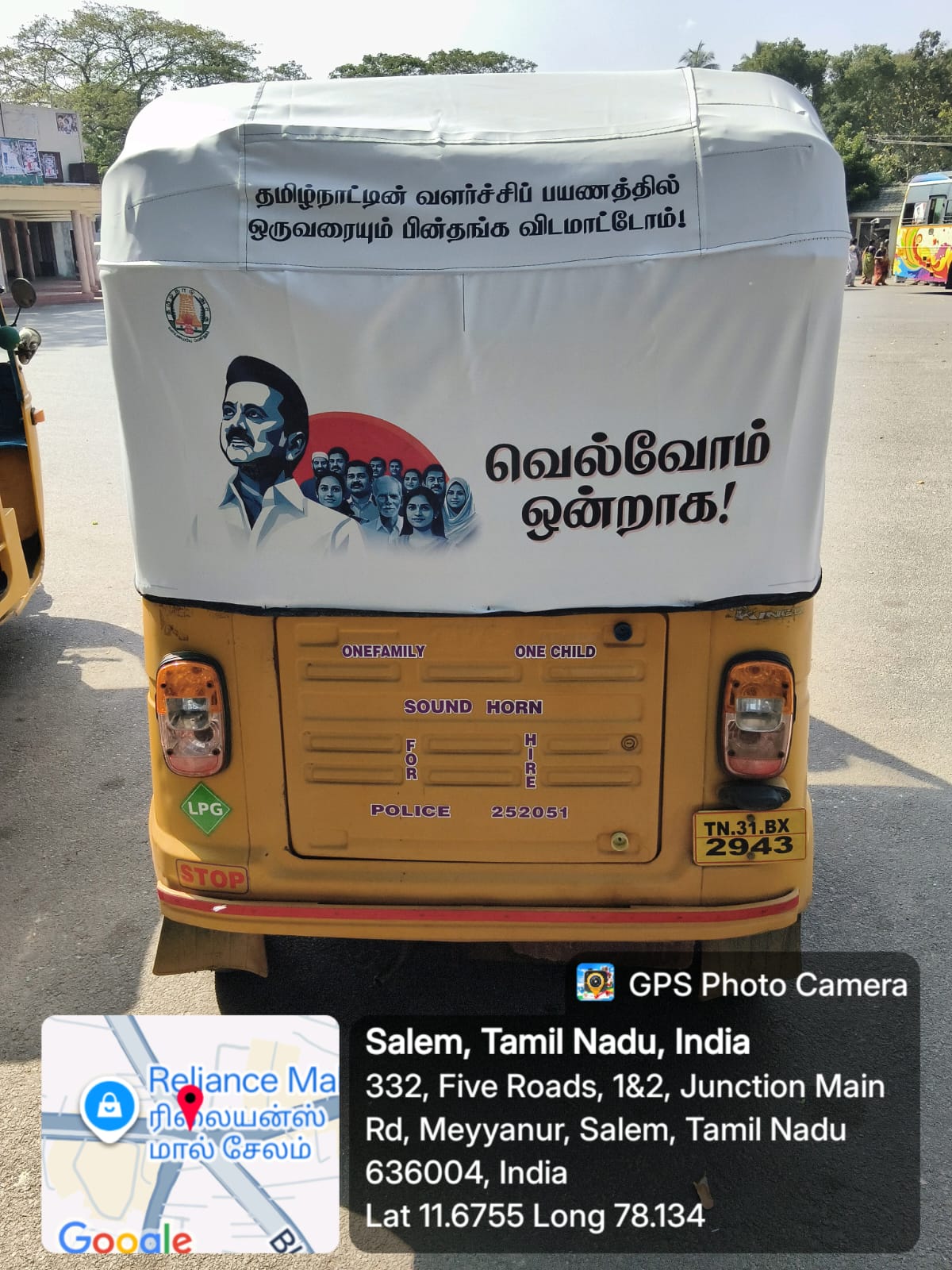
How much does auto branding cost in Lucknow, and why is it one of the best-value outdoor buys in North India? Full hood branding runs ₹500 to ₹600 per auto per month, among the lowest rates of any major North Indian city, with back-panel stickers at ₹150 to ₹180 and full wraps at ₹2,000 to ₹2,400, all inclusive of design, printing, installation, and maintenance. Lucknow has an estimated 40,000 registered auto-rickshaws plus a large e-rickshaw fleet, and a single branded auto generates an estimated 24,000 to 34,000 daily impressions at a cost-per-thousand of roughly ₹3 to ₹6. But the price is only half the story. Lucknow is really two cities for an advertiser, the dense traditional old city and the planned new city, and as Uttar Pradesh's capital it carries a government and election-driven demand cycle that no other Tier-2 city matches. This guide covers the rates, the two-Lucknows map, LMC rules, the capital factor, and the campaign math for 2026.
Auto branding in Lucknow at a glance: the numbers that matter
Seven numbers anchor a Lucknow auto plan in 2026. Fleet size: an estimated 40,000 registered auto-rickshaws plus a large e-rickshaw fleet across the LMC area. Hood branding rate: ₹500 to ₹600 per auto per month, the lowest band of any major North Indian city. Back-panel rate: ₹150 to ₹180. Full-wrap rate: ₹2,000 to ₹2,400. Daily impressions per auto: an estimated 24,000 to 34,000. Cost-per-thousand impressions: roughly ₹3 to ₹6. Recommended minimum for one catchment: 25 to 30 autos for 30 days. The defining feature is structural rather than numeric: Lucknow is two distinct advertising markets, the old city and the new city, and you brief them differently.
Lucknow's auto fleet: large, affordable, and genuinely citywide
Lucknow's roughly 40,000 auto-rickshaws, supplemented by a large e-rickshaw fleet, give advertisers excellent availability and a genuinely citywide footprint. The e-rickshaws matter more here than in most cities: they thread the narrow lanes of the old city around Aminabad and Chowk where full-size autos struggle, extending reach into dense markets that other formats cannot touch. This healthy supply is also why Lucknow rates stay low; with fleet capacity comfortably ahead of advertiser demand, vendors compete on price, and a campaign rupee buys more autos here than in Delhi NCR or any metro. For advertisers, that means you can run a meaningful 30-auto campaign in Lucknow for the price of a far smaller fleet in a Tier-1 city.
Two Lucknows: the old city and the new city
The single most useful idea for a Lucknow campaign is that the city is two markets with different audiences, densities, and buying behaviour. Treat them separately and brief the fleet accordingly.
Old Lucknow: Hazratganj, Aminabad, Chowk
Hazratganj is Lucknow's historic premier shopping district, a colonial-era high street that still carries heavy retail footfall. Aminabad and Chowk are the dense traditional and wholesale markets, with narrow lanes, packed pedestrian traffic, and a mass-market, value-driven shopper. This old-city belt suits traditional retail, jewellery, apparel, food, wholesale, and any brand chasing high-frequency exposure to a large, price-sensitive audience. Use a mix of autos on the main arteries and e-rickshaws for the inner lanes, and keep creative simple and Hindi-led for instant readability in a busy, cluttered streetscape.
New Lucknow: Gomti Nagar and the Shaheed Path corridor
Gomti Nagar is the planned new commercial and residential hub, home to corporate offices, malls, premium retail, and a younger, higher-income demographic, with the Shaheed Path expressway corridor anchoring newer development and connectivity. This new-city belt suits corporate, real estate, premium retail, education, healthcare, and lifestyle brands. Audiences here respond to cleaner, more aspirational creative and bilingual Hindi-English messaging works well. Rates remain low by metro standards, so Gomti Nagar offers a rare combination of an affluent target audience at Tier-2 media prices.
The residential and arterial belts: Aliganj, Indira Nagar, Alambagh, Faizabad Road, Kanpur Road
Between the old and new cities sit Lucknow's large residential and arterial catchments. Aliganj and Indira Nagar are established residential belts with strong neighbourhood retail; Alambagh anchors the southern mass-market and transport hub near Charbagh; the Faizabad Road and Kanpur Road approaches carry commuter and highway traffic in and out of the city. These belts suit FMCG, healthcare, education, home services, and value retail targeting settled households, and they deliver the lowest effective cost per impression of any Lucknow catchment because vendor rates here sit at the bottom of the band.
Hood, back-panel, or full wrap for a Lucknow campaign
Hood branding is the Lucknow default and the best value: at ₹500 to ₹600 it sits at eye level for the pedestrians, cyclists, and two-wheeler riders who fill Lucknow's roads and markets. Back-panel stickers at ₹150 to ₹180 are the cheapest way to add reach or run a simple offer-led message, and they pair well with hoods for a layered campaign. Full wraps at ₹2,000 to ₹2,400 are best reserved for a small hero fleet in Gomti Nagar or Hazratganj where a striking wrap stands out. Because Lucknow rates are so low, advertisers can often afford a larger hood fleet than in other cities for the same budget, and fleet size plus frequency is what drives recall, so scale the hood count rather than over-investing in a few wraps.
Lucknow auto branding format rates (2026)
| Format | Rate (per auto per month) | Best use | |
|---|---|---|---|
| Full hood | ₹500 to ₹600 | Default format at eye level for pedestrians and two-wheeler riders | |
| Back-panel sticker | ₹150 to ₹180 | Cheapest add-on reach and offer-led messages; pairs with hoods | |
| Full wrap | ₹2,000 to ₹2,400 | Hero fleet for launches |
Rates inclusive of design, printing, installation, and maintenance; GST extra.
LMC rules and Hindi-Urdu creative
Auto advertising is legal across Lucknow subject to standard conditions: owner and driver consent, no obstruction of the registration plate, permit, fare card, or driver visibility, and compliance with Lucknow Municipal Corporation outdoor norms and Uttar Pradesh Motor Vehicle rules. There is no state rate ceiling, so pricing is market-set. A reputable vendor handles owner and driver consent and keeps placement within the legal envelope; confirm this in writing before signing.
On creative, Hindi leads in Lucknow, but there is a local nuance worth respecting. Lucknow is the City of Nawabs, with a deep Hindi-Urdu cultural register and a famous tradition of courteous, refined language, or tehzeeb. Hindi-first artwork converts best across the old city and the residential belts, and a touch of that local warmth and refinement in tone lands better than a flat, transactional metro creative. Bilingual Hindi-English works for Gomti Nagar and the corporate new-city audience. The costly out-of-state error is importing an English-only creative; lead with Hindi, write for a Lucknawi sensibility, and add English only where the new-city audience expects it.
The capital factor: government, administration, and the election cycle
Lucknow is the capital of Uttar Pradesh, India's most populous state, and that shapes its advertising market in a way no other Tier-2 city shares. The concentration of state government, administration, and public bodies drives steady demand for scheme communication, public-information campaigns, and government-linked messaging, much of which uses high-reach, low-cost formats like auto branding to blanket the city. For agencies and brands working on government, public-sector, or civic-awareness mandates, Lucknow's auto fleet is a natural fit: cheap, citywide, and credible in local neighbourhoods.
On top of that baseline sits the election cycle. State elections, by-elections, and civic polls in UP drive periodic, sometimes intense, surges in outdoor and auto-branding demand, and during active campaign windows prime fleet capacity tightens sharply and rates can move. Commercial advertisers planning a campaign should check the election calendar: book early if your window overlaps a major poll, or schedule around it to avoid the capacity crunch and the cluttered messaging environment that elections bring to Lucknow's streets.
Why Lucknow is North India's value play for auto branding
Put the pieces together and Lucknow's value case is clear. Hood rates at ₹500 to ₹600 are below Delhi NCR and the metros; the fleet is large, keeping supply ahead of demand; the cost-per-thousand of ₹3 to ₹6 is among the lowest in the country; and the two-market structure lets you target either a huge price-sensitive old-city audience or an affluent new-city one at the same low media cost. For a brand entering Uttar Pradesh, or a national advertiser seeking efficient reach in a major state capital, Lucknow delivers more branded auto-kilometres per rupee than almost anywhere else. One value lever is unique to this market: Lucknow and the wider Hindi belt have among the highest newspaper readerships in the country, so a low-cost auto fleet pairs naturally with newspaper insertion in dailies like Hindustan, Dainik Jagran, and Amar Ujala. Running the two together, autos for citywide frequency and inserts for a targeted offer drop, compounds reach at a total cost that would buy only a fraction of the equivalent campaign in a metro. The discipline that turns that value into results is the same everywhere: concentrate the fleet, match it to one of the two Lucknows, and run long enough for recall to compound.
Measuring ROI on a Lucknow auto campaign
Treat auto branding as a frequency-and-recall medium and measure it over weeks, not days. Put a campaign-specific phone or WhatsApp number and a QR-linked landing page on the artwork, and add a simple in-store source question during the campaign window. Benchmark against the cost-per-thousand: at ₹3 to ₹6 per thousand impressions, a 30-auto hood campaign in one catchment delivers an estimated 22 to 30 lakh impressions a month for roughly ₹15,000 to ₹16,500 before GST, the lowest big-fleet cost of any major city. Because Lucknow is so affordable, the smart move is to buy a longer run, 60 to 90 days, rather than a single month; the incremental cost is small and recall builds substantially over a longer window.
Your Lucknow auto branding playbook
Five steps for a Lucknow campaign that works. First, decide which Lucknow you are targeting, the traditional old city or the planned new city, because the audience and creative differ sharply. Second, pick one catchment within it (Hazratganj-Aminabad-Chowk, Gomti Nagar-Shaheed Path, or a residential belt like Aliganj or Indira Nagar) and saturate it with 25 to 35 autos, adding e-rickshaws for the old-city lanes. Third, lead with hood branding and exploit the low rates to buy a larger fleet for the same budget. Fourth, brief Hindi-first creative with a Lucknawi sensibility, adding English only for the new-city audience. Fifth, check the election calendar, book early if it overlaps a poll, and run for 60 to 90 days to let recall compound. Get those right and Lucknow gives you metro-scale reach at a fraction of metro cost.
Why is auto branding cheaper in Lucknow than in Delhi or the metros?
Two reasons. First, Lucknow has a large auto-rickshaw fleet plus a big e-rickshaw fleet, so supply comfortably exceeds advertiser demand and vendors compete on price. Second, Lucknow's Tier-2 cost structure, lower operator costs, parking, and overheads, keeps rates down. Hood branding runs ₹500 to ₹600 per auto per month, below Delhi NCR and the metros, with a cost-per-thousand of roughly ₹3 to ₹6, among the lowest in the country. For the same budget you can run a meaningfully larger fleet in Lucknow than in a Tier-1 city, which is why it is one of the best value-for-reach auto markets in India.
Should I target old Lucknow or new Lucknow for my campaign?
It depends on your audience. Old Lucknow, Hazratganj, Aminabad, and Chowk, delivers dense, high-frequency footfall and a large, value-driven, mass-market shopper, ideal for traditional retail, jewellery, apparel, food, and wholesale. New Lucknow, Gomti Nagar and the Shaheed Path corridor, reaches a younger, more affluent, corporate audience, ideal for real estate, premium retail, education, healthcare, and lifestyle brands. The two are genuinely different markets with different creative needs, so pick the one that matches your customer and saturate it rather than splitting a small fleet thinly across both.
How does the UP election cycle affect auto branding in Lucknow?
As the capital of Uttar Pradesh, Lucknow sees periodic surges in outdoor and auto-branding demand around state elections, by-elections, and civic polls. During active campaign windows, prime fleet capacity tightens sharply, rates can move, and the streets carry heavy political messaging clutter. If your campaign window overlaps a major poll, book your fleet early to lock capacity, or deliberately schedule around the election to avoid the crunch and the cluttered environment. Outside election windows, Lucknow has ample, affordable capacity year-round, including steady government and public-scheme advertising that uses the same auto fleet.
Tags
Quick Answers
How much does auto rickshaw branding cost in Lucknow in 2026?
Full hood branding costs ₹500 to ₹600 per auto per month in Lucknow, among the most competitive rates of any major North Indian city. Back-panel vinyl stickers cost ₹150 to ₹180 per auto per month, and a full-body wrap costs ₹2,000 to ₹2,400 per auto per month. All rates include design, printing, installation, and monthly maintenance. Volume discounts apply at 50 plus autos (around 10 percent) and 200 plus autos (around 20 percent). A 30-auto hood campaign across the Hazratganj and Gomti Nagar belts for 30 days lands at roughly ₹15,000 to ₹16,500 before GST, lower than the equivalent campaign in any metro.
How many auto-rickshaws are there in Lucknow?
Lucknow runs an estimated 40,000 registered auto-rickshaws across the Lucknow Municipal Corporation area, alongside a large and growing e-rickshaw fleet that serves the narrower lanes of the old city and the residential colonies. Together they give advertisers strong availability and genuine citywide reach, from the dense traditional markets of Aminabad and Chowk to the planned commercial corridors of Gomti Nagar and Shaheed Path. The large fleet is one reason Lucknow auto rates stay low: supply is healthy relative to advertiser demand.
Which Lucknow areas are best for auto rickshaw branding?
It depends on which Lucknow you are targeting. For traditional retail, wholesale, and mass-market reach, the old city of Hazratganj, Aminabad, and Chowk delivers the densest footfall. For corporate, premium retail, real estate, and a younger audience, the new city of Gomti Nagar and the Shaheed Path corridor is the catchment. The residential and arterial belts of Aliganj, Indira Nagar, Alambagh, and the Faizabad and Kanpur road approaches cover household and commuter targeting. Match the fleet to one of these markets rather than blanketing the city.
Is auto rickshaw advertising worth it in Lucknow?
Yes, and the value case is unusually strong. With hood rates at ₹500 to ₹600, a large fleet, and a cost-per-thousand of roughly ₹3 to ₹6, Lucknow is one of the cheapest auto-branding markets in India for the reach delivered. It suits retail, real estate, education, healthcare, FMCG, and government or scheme communication. The caveat is the same as any city: concentrate the fleet in one catchment matched to your audience, and run long enough for recall to build, rather than spreading a small fleet thinly across both the old and new city.
Looking for professional Auto Branding services?
The Mediaverse runs end-to-end auto branding campaigns across India with geo-tagged delivery and transparent, all-inclusive pricing.
Explore our Auto Branding solutionsSummarize this guide with AI
Open this article in your favourite AI assistant
Related Guides
Written by

The Mediaverse Team
India's Leading Outdoor Advertising Agency
The Mediaverse is a national-level outdoor advertising and integrated marketing organization that provides complete OOH, ATL, BTL, retail, and transit media solutions across India. With years of experience executing high-performance campaigns for brands in FMCG, Real Estate, E-commerce, EdTech, Automotive, Healthcare, and Retail, The Mediaverse combines creativity, data-driven media planning, and flawless on-ground execution. As a full-stack outdoor advertising provider, The Mediaverse offers Auto Branding, Mobile Van Branding, Newspaper Insertion Advertising, Shop Name Board Branding, In-Store Branding, Hoardings, Transit Media, Kiosks, Mall Media, Activations, and all forms of Below-The-Line marketing. Known for its pan-India network, strategic route planning, premium print quality, and Cheqmate™ GPS-based verification, The Mediaverse ensures 100% transparent and result-oriented campaign delivery. The Mediaverse’s editorial team produces deeply researched, SEO-optimized, and generative-engine-friendly content to help businesses understand the power of outdoor advertising and make informed decisions that maximize brand visibility and ROI across urban, suburban, and rural markets.
Related Articles
Auto Branding for Restaurant and Cloud Kitchen Launches: The Delivery-Radius Zone Playbook (2026)
Auto branding is priced and deployed by zone, which makes it the outdoor format that can be pointed at a restaurant or cloud kitchen's own delivery radius. Published rates, worked launch-campaign totals, and a five-step zone mapping process.
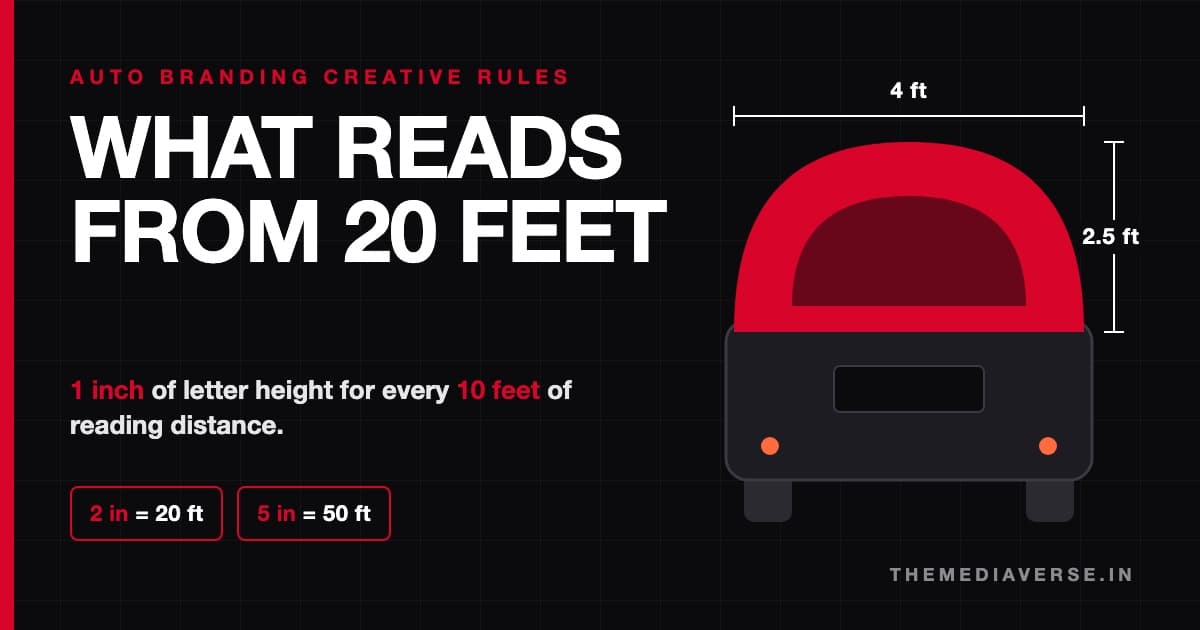
Auto branding creative rules: what actually reads from 20 feet at a signal (2026 playbook)
An auto hood is 4 ft by 2.5 ft and reads at roughly 1 inch of letter height per 10 feet. Eight creative rules ranked by what a reprint on 300 autos costs, plus the paper test to run before the print run.
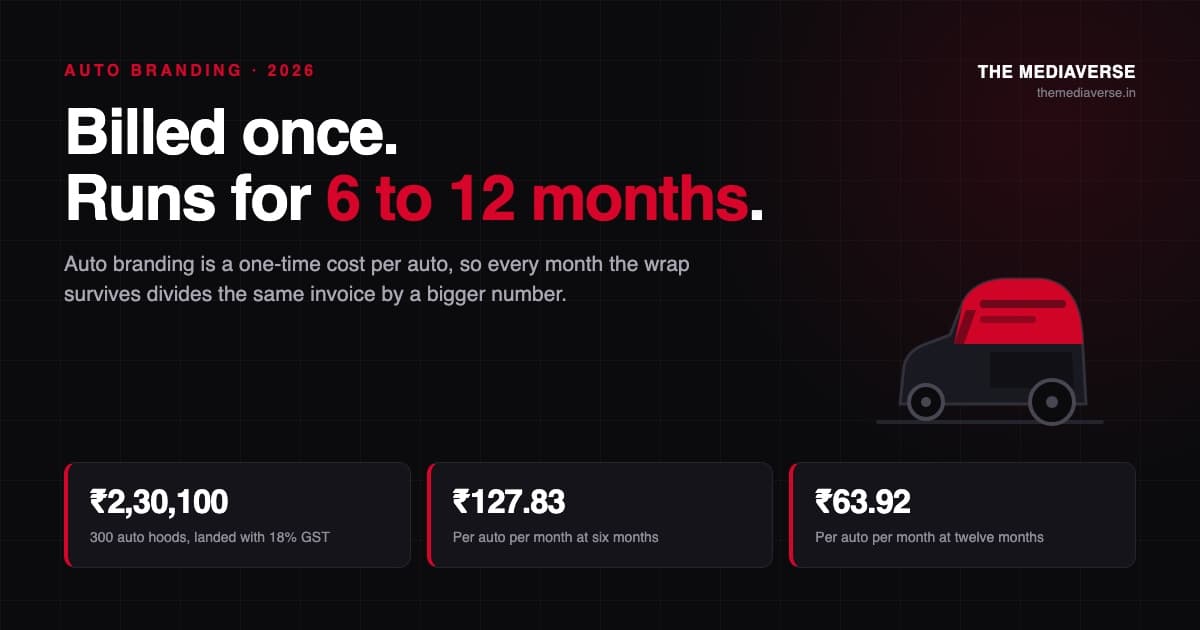
How long should an auto branding campaign run? The material-life math for 2026
Auto branding is billed once per auto, and the published vinyl life is 6 to 12 months. A 300-hood fleet at ₹2,30,100 landed is ₹767 per auto for one month and ₹127.83 per auto per month at six. The full arithmetic, and what really ends a campaign.