

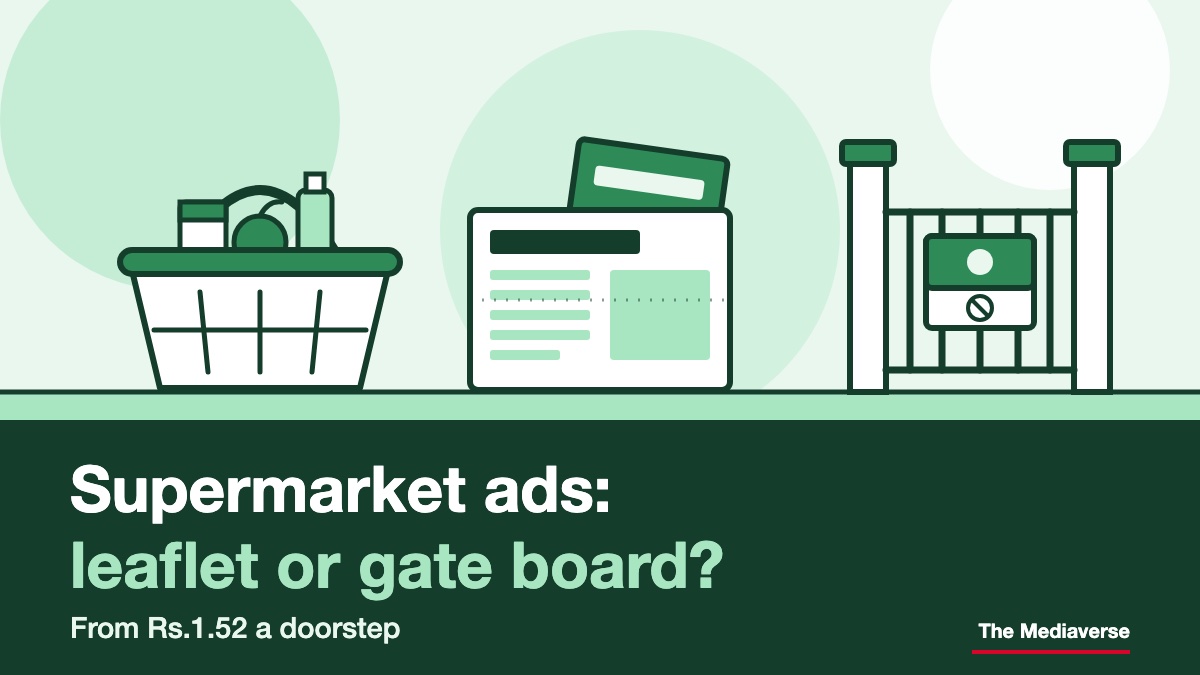
What does a supermarket need from paid advertising that a gym or a preschool does not? Repetition. A gym sells one membership a year and a preschool fills one seat, but a grocery store earns its money from the same households coming back every week, and its offer changes every week too. That splits the job in two, and our rate cards price the two halves very differently. A newspaper leaflet costs Rs.1.25 a copy in A5 with a 50,000-copy minimum: Rs.64,500 with one design, Rs.76,110 with GST, which is Rs.1.52 a doorstep. A no-parking gate board costs Rs.45 with a 1,000-board minimum: Rs.45,000 before GST, Rs.53,100 with it, which is Rs.53.10 a gate, paid once. One gate board costs the same as about 35 leaflets. This playbook sets out which message belongs on which format, what a single store and a five-store chain pay, and how many regular households each plan has to win. Rates were read from our live service pages on 20 November 2026. Totals, GST, per-household figures and dates are our arithmetic.
What does it cost a supermarket to reach one household?
Every format on our cards has a floor, and for a store that sells to households the useful way to read each floor is per home. The newspaper insertion page prices three leaflet sizes at a 50,000-copy minimum, with a lower rate once the run goes above 50,000. The no-parking board advertising page prices a 1 ft by 1.5 ft board at Rs.45 for orders under 5,000 and Rs.35 from 5,000, and the Bangalore page for the same service states the 1,000-board minimum. The table puts them side by side with the two formats that do not count in households at all.
Smallest order on each rate card, and what it costs per household
| Smallest order | Bill before GST | With 18% GST | Per household or unit, landed | |
|---|---|---|---|---|
| A5 leaflet in the newspaper | 50,000 copies at Rs.1.25, plus Rs.2,000 design | Rs.64,500 | Rs.76,110 | Rs.1.52 a doorstep |
| A4 pamphlet in the newspaper | 50,000 copies at Rs.1.70, plus Rs.2,000 design | Rs.87,000 | Rs.1,02,660 | Rs.2.05 a doorstep |
| A2 flyer in the newspaper | 50,000 copies at Rs.2.20, plus Rs.2,000 design | Rs.1,12,000 | Rs.1,32,160 | Rs.2.64 a doorstep |
| No-parking gate board | 1,000 boards at Rs.45 | Rs.45,000 | Rs.53,100 | Rs.53.10 a gate |
| No-parking gate board, 5,000 slab | 5,000 boards at Rs.35 | Rs.1,75,000 | Rs.2,06,500 | Rs.41.30 a gate |
| Auto back panel, 24 by 6 inch | 500 autos at Rs.170 | Rs.85,000 | Rs.1,00,300 | Rs.200.60 an auto, not a household measure |
| Glow sign name board | 40 sq ft at Rs.260, our example size | Rs.10,400 | Rs.12,272 | One frontage |
Rates from the live newspaper insertion, no-parking board advertising, Bangalore no-parking, auto branding and shop name board pages, read on 20 November 2026. Bills, GST and per-household figures are our arithmetic, rounded to the paisa. The 40 sq ft sign is an example size, not a published package. A gate can stand in front of one house or a whole apartment block, so a gate is not always one household.
Two readings. A leaflet is the cheapest doorstep on the card by a wide margin, but it is one morning: it arrives folded inside the paper and is read or thrown away that day. A gate board costs 35 times as much per gate and then stays where it was fixed, with no rental. The page publishes no lifespan for a board and says only that life depends on the printing method and local conditions, so we do not divide its cost by months here. The single-colony version of this comparison is worked in gate board against newspaper insert.
Which message belongs on the leaflet, and which on the gate board?
This is the decision supermarkets get wrong most often, so it comes before any budget. The rule we plan by: what changes weekly goes on paper, what never changes goes on the gate. A board is fixed with the consent of a house owner or a residents society and is not taken down when your offer ends. A leaflet is printed for one date.
What to print where
| On the newspaper leaflet | On the gate board | |
|---|---|---|
| Prices and offers | Yes. The whole reason for the leaflet | No. The board will outlive the price |
| Offer dates | Yes, with the last day in large type | No |
| Store name and logo | Yes | Yes, the largest thing on the board after the no-parking notice |
| Home delivery number or app | Yes | Yes. This is the board's working line |
| Distance or landmark | Optional | Yes, in three or four words |
| Opening hours | Optional | Yes, if they do not change |
| Tracking | A coupon the till can collect, or a QR code | A short code for the delivery call, or a QR code |
Our planning rule, not a published specification. The newspaper insertion page describes A5 as the most cost-effective size for coupons and offers and A4 as suited to detailed information. The no-parking page says the advertisement takes the main visual area while the no-parking message stays clearly visible.
Does one store have 50,000 newspaper doorsteps it can use?
Often not, and this is the honest limit of the format for a single store. The minimum order is 50,000 copies. The page says the run can be matched to newspapers and circulation zones by pin code and residential society, and that within the minimum it can be split across subscriber zones. It does not say how small a zone can be. So before booking, count how many of the 50,000 copies would land inside the distance you deliver to or people will drive from. Copies beyond that line are paid for and wasted. The table shows what a useful copy really costs.
One 50,000-copy A5 run (Rs.76,110 landed): cost per copy that lands inside your reach
| Copies inside your reach | Cost per useful copy | |
|---|---|---|
| All of the run | 50,000 | Rs.1.52 |
| Three fifths of the run | 30,000 | Rs.2.54 |
| Two fifths of the run | 20,000 | Rs.3.81 |
| One fifth of the run | 10,000 | Rs.7.61 |
Our arithmetic: Rs.76,110 divided by the copies inside your reach. The shares are illustrations. There is no rate for 10,000 or 20,000 copies booked alone, and those quantities cannot be booked. They exist here only as the useful part of a 50,000 run.
A chain reads the same minimum the other way. Two stores in different parts of a city can split one 50,000 run by zone and pay Rs.38,055 each with GST. And the card rewards going higher: above 50,000 copies the A5 rate is Rs.1.15, and the page's own example bills a 60,000-copy run entirely at the bulk rate. So 60,000 A5 copies with one design cost Rs.71,000 before GST and Rs.83,780 with it, which is 10,000 more copies for Rs.7,670 more. A five-store chain taking 1,00,000 copies pays Rs.1,17,000 before GST and Rs.1,38,060 with it, Rs.27,612 a store for 20,000 copies each. On the same wording a run just above the minimum is cheaper than the minimum: 52,000 copies at Rs.1.15 come to Rs.59,800 against Rs.62,500 for 50,000 at Rs.1.25. Ask for that line on the quote before relying on it. The other order sizes that behave this way are mapped in our guide to volume price breaks.
What do three supermarket plans cost from the rate cards?
Three plans, each at or above every published minimum, with GST at 18 percent. A supermarket trades after dark, so the frontage line uses the glow sign rate from the shop name board page, Rs.260 a square foot, and not the Rs.85 non-lit rate. These are illustrations built from the cards, not campaigns we ran for a client.
Three supermarket plans priced from the published rate cards
Plan A, one running store: 1,000 gates and a lit name board
For a store that is already open and wants the homes around it to hold its delivery number. No leaflet, because one store rarely has 50,000 useful doorsteps.
- 1,000 no-parking boards at Rs.45: Rs.45,000
- 40 sq ft glow sign at Rs.260 a sq ft: Rs.10,400
- Subtotal Rs.55,400, GST Rs.9,972
- Boards alone: Rs.53,100 landed
- Municipal display licence for the name board is extra and varies by city
Plan B, a store opening: gates, one leaflet run and the name board
For an opening week or a relaunch, when the news is worth telling to a wider ring once and the boards keep the name in place afterwards.
- 1,000 no-parking boards at Rs.45: Rs.45,000
- 50,000 A5 leaflets at Rs.1.25: Rs.62,500
- One leaflet design: Rs.2,000
- 40 sq ft glow sign at Rs.260 a sq ft: Rs.10,400
- Subtotal Rs.1,19,900, GST Rs.21,582
Plan C, five stores in one city: 5,000 gates and 1,00,000 leaflets
Both formats cross their price break when five stores order together: boards at Rs.35 and leaflets at Rs.1.15.
- 5,000 no-parking boards at Rs.35: Rs.1,75,000
- 1,00,000 A5 leaflets at Rs.1.15: Rs.1,15,000
- One leaflet design listing all five stores: Rs.2,000
- Subtotal Rs.2,92,000, GST Rs.52,560
- Per store: 1,000 gates and 20,000 leaflets for Rs.68,912
Rates from the live service pages, read on 20 November 2026. Subtotals, GST, landed totals and per-store figures are our arithmetic. No discount is assumed. The 40 sq ft sign is an example size. The chain plan leaves out name boards, which are priced per store.
Compare Plan C with Plan A. A store in the chain gets 1,000 gates and 20,000 leaflets for Rs.68,912, only Rs.3,540 more than a lone store pays for gates and a sign with no leaflet at all. Autos are left out of all three on purpose. The auto branding rate card starts at 500 back panels, Rs.85,000 before GST and Rs.1,00,300 with it, and an auto travels across the city while a grocery customer comes from a few streets.
How many regular households does each plan need to win?
We publish no response or redemption rate for any outdoor format, so this section does not predict footfall. It asks the question the other way round: how many households would have to become regulars before the bill is recovered? Work out what one regular household leaves you: average monthly bill, multiplied by your gross margin, multiplied by the number of months you are willing to count. A household that spends Rs.5,000 a month at a 10 percent margin leaves Rs.500 a month, Rs.3,000 over six months. Those inputs are an illustration, not a market figure. Use your own from the till.
Regular households needed to recover each plan
| If one household leaves Rs.1,500 | If it leaves Rs.3,000 | If it leaves Rs.6,000 | |
|---|---|---|---|
| Plan A, Rs.65,372 | 44 households | 22 households | 11 households |
| Plan B, Rs.1,41,482 | 95 households | 48 households | 24 households |
| Plan C, per store, Rs.68,912 | 46 households | 23 households | 12 households |
Our arithmetic: landed cost divided by the margin one regular household leaves over the period you count, rounded up. The three margin figures are illustrations. The result is a recovery count, not a forecast.
Read Plan A per gate. At Rs.3,000 a household, 22 new regulars recover it, which is one from about every 45 gates. At Rs.6,000 it is 11, one from about every 91. Whether your streets can deliver that is a judgment only you can make. Write the number down before the campaign and count against it after.
When do you have to book for a mid-January festival week?
The harvest festivals fall in the middle of January: Lohri, Makar Sankranti and Pongal, on dates that differ by state and calendar, so check yours. A leaflet for that week goes out on Sunday 10 January 2027, which is 51 days from 20 November 2026. The published lead times are short, but Christmas and New Year sit inside them.
Latest dates for a campaign in homes by Sunday 10 January 2027
| Published lead time | Latest date to act | Why that date | |
|---|---|---|---|
| No-parking gate boards | Design and printing in a few days, then phased, permission-led installation. No daily rate is published | Monday 14 December, our advice | Four weeks for consent and fixing. Ask for the installation phasing in writing |
| Leaflet slot in the newspaper | Festival-season insertions are booked 3 to 4 weeks ahead. The page names Diwali, Dussehra, Onam, Eid and Christmas | 13 to 20 December | The harvest festivals are not on the page's list, but Christmas week is inside the lead, so confirm the slot early |
| Leaflet artwork and locations | Setup takes 7 to 10 business days from final design and locations | Thursday 24 December | Ten business days back with Friday 25 December and Friday 1 January both treated as closed. If your printer works on 1 January, Monday 28 December |
| Glow sign name board | Installed within 7 days of design approval, plus 3 to 5 working days where a municipal permit is needed | Thursday 24 December | Seven days plus five working days back from 10 January, with the same two holidays |
Lead times from the live service pages, read on 20 November 2026. Dates are our arithmetic and leave no slack for a late approval. The gate board date is our recommendation, because the page publishes no installation rate.
How do you run it, in the order things go wrong?
Five steps, ranked by how often each one sinks a store campaign, not by the calendar. The first costs nothing.
Count the doorsteps inside your reach before you pick a format
Take your home delivery addresses, or the pin codes from loyalty cards, and mark where they thin out. Count houses and apartment gates inside that line, then ask which newspaper zones cover it. Why it matters: the leaflet minimum is 50,000 copies and the board minimum is 1,000 gates, and both are wasted beyond the distance people shop from. Common mistake: booking the 50,000 minimum for one store whose reach holds 10,000 homes, which turns Rs.1.52 a copy into Rs.7.61.
Split the message: prices on paper, the delivery number on the gate
Write the leaflet around this week's prices with the last date of the offer in large type. Write the board around the store name, the delivery number and a landmark, and leave the no-parking notice clear so the household wants it on the gate. Why it matters: a board is paid for once and stays up. Common mistake: printing a festival price on 1,000 boards that will still be on the gates in March.
Order to the price break, not to the first estimate
Check the quantity against the slab before you sign. 4,000 boards at Rs.45 cost Rs.1,80,000, which is more than 5,000 at Rs.35. Above 50,000 copies the A5 leaflet rate falls from Rs.1.25 to Rs.1.15. Why it matters: a chain that lets each store order alone pays the higher rate on both cards. Common mistake: five stores of one group placing five separate orders in the same month.
Print something the till can count
Put a coupon on the leaflet that the cashier collects, and a short code on the board that the delivery desk asks for. The newspaper page says inserts can carry QR codes, barcodes and coupons, and the no-parking page suggests a coupon code, QR code or dedicated number. Why it matters: with no published response rate, your own count is the only measure. Common mistake: one phone number on everything, which hides which format worked.
Book in lead-time order, then stock the shelf
Order the boards first, confirm the newspaper slot second, lock the artwork third. Then make sure every item on the leaflet is in stock at the printed price on the morning it lands. Why it matters: the boards need consent gate by gate and cannot be hurried, and a leaflet that sends a household to an empty shelf costs you the second visit. Common mistake: approving artwork on a holiday eve and losing the date.
What do the rate cards not tell a supermarket owner?
Five things. No response, redemption or footfall rate is published for any format, which is why the household table works backward from your bill. The no-parking page gives no installation rate per day and no board lifespan. The newspaper page does not say how small a subscriber zone can be, or whether one run can carry a different leaflet for each store, and every extra design is Rs.2,000. The display licence for a name board is a municipal fee that varies by city and board size: the shop name board page quotes Rs.500 to Rs.2,000 a year for Bangalore. And none of our pages names supermarkets as a category. The newspaper page lists retail and FMCG for coupons and seasonal promotions, and the no-parking page lists jewellery and retail, and restaurants that want repeat orders from nearby homes. The counting method is set out in our outdoor ROI measurement playbook, and the same ring-first approach for another neighbourhood business is in the gym and fitness studio playbook.
The till-side checklist
- Reach line drawn from delivery addresses or loyalty pin codes, with the gate count and the newspaper zones written beside it.
- Recovery number at the top of the sheet: regular households needed to cover the landed bill.
- Leaflet coupons collected in one box at each till and counted every evening for 14 days after the insertion date.
- Board code asked for on every delivery call, with a tally column in the order book.
- Insertion date, newspaper and zones on file, with the publisher certificate and photo proof when they arrive.
- Geo-tagged placement report checked against the reach line, lane by lane.
- Landed total on file with its GST, plus any display licence fee actually paid.
Supermarket and grocery store advertising questions
Can a single supermarket book fewer than 50,000 newspaper inserts?
No. The published minimum is 50,000 copies for each leaflet size, and there is no rate for 10,000 or 20,000 copies, so those quantities cannot be booked. The page says a run can be split across subscriber zones within the minimum, which helps a chain more than a single store. If fewer than half of the 50,000 copies would land inside the distance you deliver to, the 1,000 gate board minimum at Rs.53,100 with GST is usually the better first order.
Should a supermarket print offer prices on a no-parking board?
We advise against it. A gate board is fixed with the owner's consent, is paid for once at Rs.45 and has no monthly rental, so it stays in place long after a weekly offer has ended. Print the store name, the home delivery number, a landmark and the hours if they are stable, and keep the no-parking notice clearly visible. Prices and offer dates belong on the newspaper leaflet, which is printed for a single morning.
Which leaflet size suits a supermarket offer: A5, A4 or A2?
The newspaper insertion page describes A5 as the most cost-effective size for coupons and offers, A4 as suited to detailed information and A2 as the highest visual impact. At the 50,000 minimum with one design they cost Rs.76,110, Rs.1,02,660 and Rs.1,32,160 with GST. A weekly price list with a dozen items fits A5. A festival catalogue with many categories is the case for A4, which costs Rs.26,550 more for the same 50,000 homes.
Is auto rickshaw branding worth it for a supermarket?
Rarely for one store. The smallest auto order is 500 back panels at Rs.170, Rs.85,000 before GST and Rs.1,00,300 with it, and the smallest hood order is 300 autos at Rs.650, Rs.1,95,000 before GST. Autos move across a city, while a grocery customer comes from nearby streets. The same Rs.1,00,300 covers 1,000 gate boards with Rs.47,200 to spare. Autos start to fit a chain with stores across one city, where most people who see the auto live near a branch.
What kind of name board does a supermarket need?
A lit one, because a supermarket trades after dark. The shop name board page prices a glow sign at Rs.260 a square foot, a non-lit board at Rs.85 and ACP at Rs.690. For a 40 square foot board, our example size, that is Rs.12,272, Rs.4,012 and Rs.32,568 with GST. Installation is within 7 days of design approval, with 3 to 5 working days more where a municipal permit is needed. The display licence is a separate municipal fee.
Tags
Quick Answers
How much does it cost to advertise a supermarket locally in India?
On our published rate cards the smallest order that fits one store is 1,000 no-parking gate boards at Rs.45 each: Rs.45,000 before GST and Rs.53,100 with it, one time. Adding a 40 square foot glow sign name board at Rs.260 a square foot brings the plan to Rs.65,372. A store opening that adds one 50,000-copy A5 leaflet run with design comes to Rs.1,41,482. Five stores ordering together pay Rs.3,44,560, which is Rs.68,912 a store.
Is a newspaper insert or a no-parking board better for a grocery store?
They do different jobs. An A5 newspaper leaflet costs Rs.1.52 a doorstep with GST and design at the 50,000 minimum, and lasts one morning, so it suits prices and offer dates. A no-parking gate board costs Rs.53.10 a gate at the 1,000 minimum, about 35 leaflets, and stays fixed with no rental, so it suits the store name and delivery number. One store usually starts with boards. A chain can use both.
Can a supermarket chain share one newspaper insert order across stores?
Yes, when it is placed as one run. The newspaper insertion page says a run can be split across subscriber zones, and the A5 rate falls from Rs.1.25 to Rs.1.15 above 50,000 copies. Five stores taking 1,00,000 copies with one design pay Rs.1,17,000 before GST and Rs.1,38,060 with it, Rs.27,612 a store for 20,000 copies each. The page does not say whether each store can have its own leaflet in one run, and every extra design is Rs.2,000.
How many new regular customers does a supermarket campaign need to pay for itself?
Divide the landed bill by what one regular household leaves you: monthly bill, multiplied by gross margin, multiplied by the months you count. As an illustration, a household leaving Rs.3,000 over six months means 22 new regulars recover a Rs.65,372 plan of 1,000 gate boards and a name board, about one household from every 45 gates. We publish no response rate for any format, so this is a recovery count and not a forecast.
Looking for professional Newspaper Insertion services?
The Mediaverse runs end-to-end newspaper insertion campaigns across India with geo-tagged delivery and transparent, all-inclusive pricing.
Explore our Newspaper Insertion solutionsSummarize this guide with AI
Open this article in your favourite AI assistant
Related Guides
Written by

The Mediaverse Team
India's Leading Outdoor Advertising Agency
The Mediaverse is a national-level outdoor advertising and integrated marketing organization that provides complete OOH, ATL, BTL, retail, and transit media solutions across India. With years of experience executing high-performance campaigns for brands in FMCG, Real Estate, E-commerce, EdTech, Automotive, Healthcare, and Retail, The Mediaverse combines creativity, data-driven media planning, and flawless on-ground execution. As a full-stack outdoor advertising provider, The Mediaverse offers Auto Branding, Mobile Van Branding, Newspaper Insertion Advertising, Shop Name Board Branding, In-Store Branding, Hoardings, Transit Media, Kiosks, Mall Media, Activations, and all forms of Below-The-Line marketing. Known for its pan-India network, strategic route planning, premium print quality, and Cheqmate™ GPS-based verification, The Mediaverse ensures 100% transparent and result-oriented campaign delivery. The Mediaverse’s editorial team produces deeply researched, SEO-optimized, and generative-engine-friendly content to help businesses understand the power of outdoor advertising and make informed decisions that maximize brand visibility and ROI across urban, suburban, and rural markets.
Related Articles
Newspaper Inserts in Delhi This Winter: The 50,000 Minimum, the Nursery Admission Window and Approval Dates From 11 November (2026)
The Delhi insertion card is the same all year, 50,000 copies at Rs.1.25 to Rs.2.20 each. What changes is the calendar: the nursery admission window and the fog mornings open in the next three weeks. The approval date for each winter drop, which paper reaches which colony, and four plans that clear the minimum.
50,000 Newspaper Inserts in Bangalore: The Rs.62,500 Minimum, Seven English and Kannada Dailies and Five Zone Groups (2026)
The smallest Bangalore insertion order is 50,000 copies at Rs.1.25 to Rs.2.20 each. Which of the seven English and Kannada dailies fits which part of the city, how thin the minimum gets across 19 localities, the drop dates still open from today, and four plans that clear the minimum.
50,000 Newspaper Inserts in Mumbai: The Rs.62,500 Minimum, Nine Dailies and Which Paper Fits Which Pocket (2026)
The smallest Mumbai insertion order is 50,000 copies at Rs.1.25 to Rs.2.20 each. Which of the nine dailies fits which pocket of the city, how far the minimum goes across the five zone groups, the Friday drops a brief approved this week can still make, and three plans that clear the minimum.