

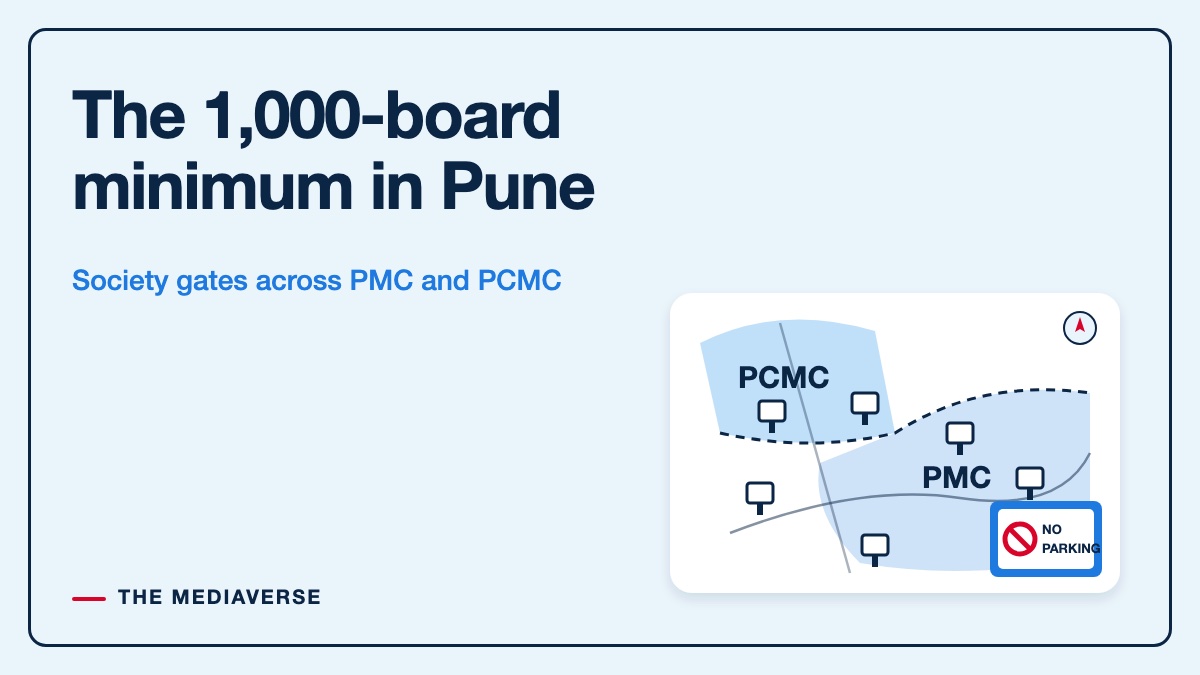
Rs.45,000 is the smallest no-parking board campaign Pune will take: 1,000 boards at Rs.45 each, Rs.53,100 with 18 percent GST, with the board, printing, transport and installation included and no monthly rental afterwards. Our Pune no parking board page prices every order under 5,000 boards at Rs.45 and drops to Rs.35 only from 5,000, so the Rs.35 in its headline is a volume rate, not an entry rate. What makes the Pune minimum worth a post of its own is the page's planning section. It treats the city as three markets, the western IT belt of township gates, the low-rise Peth core and the separate civic territory of PCMC, and 1,000 boards behave very differently in each. This guide works the minimum through those three markets, the page's six placement areas, its monsoon and admissions timing and its consent rule. Every figure is from the live Pune page and our other Pune rate pages as read on 22 October 2026; totals and per-area splits are our arithmetic and are marked as ours.
What do 1,000 no-parking boards cost in Pune?
The card has two slabs and one minimum. From 1,000 to 4,999 boards the rate is Rs.45 a board; from 5,000 it is Rs.35. The rate is all-inclusive, the board, the print, transport to the locality and installation at the gate, with no monthly rental, and GST is charged extra on the invoice. At 18 percent GST the minimum comes to Rs.53,100, which is our arithmetic on the page's card. The page's own sizing puts a tight Hinjewadi IT-belt push or a Kothrud education push in the low thousands of boards, and a full Pune-plus-PCMC residential sweep past the Rs.35 slab.
Minimum order
Rs.45,000 before GST, Rs.53,100 with GST. The page says a single locality such as Wakad alone or Sadashiv Peth alone clears this comfortably.
One belt
Rs.90,000 to Rs.1,35,000 before GST, Rs.1,06,200 to Rs.1,59,300 with GST. The page's "low thousands" for a tight IT-belt or Kothrud education push.
Pune plus PCMC sweep
Rs.1,75,000 before GST, Rs.2,06,500 with GST at exactly 5,000. The page says a full Pune-plus-PCMC residential sweep crosses into this slab.
The Pune no parking board card as published on the live city page on 22 October 2026: Rs.45 per board for 1,000 to 4,999 boards, Rs.35 from 5,000, minimum 1,000, all-inclusive, no monthly rental, GST extra. The sizing phrases are the page's own; with-GST totals and the 2,000 to 3,000 band are our arithmetic at 18 percent.
Two lines on the page deserve a second read. The hero says "from Rs.35 a board", but Rs.35 applies only from 5,000 boards, which is five times the minimum. And because Rs.45 times 3,889 already exceeds Rs.1,75,000, every order between 3,889 and 4,999 boards pays more than 5,000 boards would, by our arithmetic; if a plan lands in that band, round it up. The page also lists what moves a final quotation beyond the card: quantity, the mix of PMC and PCMC localities, printing method, permissions and any customisation. Our 45 versus 35 break-even post works the national version of that crossover.
Why do 1,000 boards stretch differently across Pune's three markets?
Because a board is fixed to a gate, and the page says Pune's gates come in three geometries. In the western IT belt of Hinjewadi, Wakad, Baner and Balewadi, housing is built as large gated townships: one imposing main gate often serves several hundred flats, security cabins control entry, and residents are young, salaried and mostly reading English. The page's advice there is fewer, bigger clusters, because each gate carries heavy morning and evening footfall of cab pickups, food deliveries and office shuttles, and the belt's high renter churn keeps delivering new residents with no fixed loyalties. In the old core of Kothrud, Sadashiv Peth, Narayan Peth and the Deccan side, housing runs low-rise: four-to-eight flat buildings, wadas and independent bungalows, which the page says means far more gates per square kilometre and smaller footfall per gate. PCMC, the third market, mixes long-settled industrial workforce colonies in Pimpri, Chinchwad, Akurdi and Nigdi with new towers rising along the metro line.
The arithmetic follows from the page's own descriptions and is ours. If the Peth core is four-to-eight flat buildings, 1,000 boards on 1,000 such gates sit in front of 4,000 to 8,000 flats, fewer where the gates belong to bungalows and wadas. In the IT belt the constraint flips: when one gate serves several hundred flats, the number of homes behind 1,000 boards is not the limit, the number of big gates is, so an IT-belt order is better planned as a named set of townships across Hinjewadi, Wakad, Baner and Balewadi than as 1,000 scattered points. PCMC is where the page says density makes the 5,000-plus slab at Rs.35 very efficient for mass categories, so it reads less as a 1,000-board market than as the second order.
How 1,000 boards behave in Pune's three markets (from our Pune page, read 22 October 2026)
| Market | Localities the page names | Gate geometry the page describes | What 1,000 boards means | Copy the page advises | |
|---|---|---|---|---|---|
| Western IT belt | Hinjewadi, Wakad, Baner, Balewadi | Large gated townships; one main gate often serves several hundred flats; security cabins; fewer, bigger clusters | Bound by the number of big gates, not by board count; a named set of townships, by our reading | English, for a young salaried renter population | |
| Old Peth core | Kothrud, Sadashiv Peth, Narayan Peth, Deccan | Four-to-eight flat buildings, wadas, bungalows; far more gates per sq km; smaller footfall per gate | Roughly 4,000 to 8,000 flats behind 1,000 gates, our arithmetic; a board that stays up is how a new name breaks in | Marathi-first, which the page says earns a warmer reception | |
| PCMC | Pimpri, Chinchwad, Akurdi, Nigdi | Industrial workforce colonies plus new towers along the metro line; mapped separately from PMC | A first order for a local catchment; the page names PCMC density as where the 5,000-plus slab at Rs.35 pays | Not assigned by the page |
Market descriptions, localities and language guidance as published on the live Pune no parking board page on 22 October 2026. The 4,000 to 8,000 flat range is our arithmetic on the page's four-to-eight flat buildings; the page publishes no gate, building or society count for any locality.
Which of Pune's six placement areas should get the first 1,000 boards?
The page lists six placement areas. Spread evenly, 1,000 boards would put about 167 on each, our arithmetic, which is too thin to own any of them. The page's own sizing points the other way: a tight Hinjewadi IT-belt push or a Kothrud education push sits in the low thousands of boards, and it says a single locality, Wakad alone or Sadashiv Peth alone, clears the minimum comfortably. The honest reading is that 1,000 boards is one area, or at most two adjacent ones, and the table shows what each area is for, matched to the industries the page lists.
Pune's six placement areas against a 1,000-board order (areas and audiences from our Pune page, read 22 October 2026)
| Area | Localities the page names | Who is behind the gate, per the page | Category fit from the page's industries list | Fit for 1,000 boards, our reading | |
|---|---|---|---|---|---|
| Hinjewadi and IT belt | Hinjewadi Rajiv Gandhi Infotech Park, Wakad, Baner | The young tech workforce that rents and lives there | Restaurants and cafes, banks | One cluster of named townships; English copy | |
| East Pune IT corridor | Kharadi, Viman Nagar, Magarpatta along Nagar Road | Newer premium towers and township-style societies | Restaurants and cafes, premium retail | One cluster; the page cites a Magarpatta township cluster as a carpet example | |
| Student and education hubs | Deccan, Shivajinagar, FC Road, Kothrud | Colleges, coaching classes, PGs and parents | Coaching, colleges and schools before admissions | The clearest 1,000-board fit; Marathi-first; install in May | |
| Central and premium pockets | Koregaon Park, Aundh, Camp | Affluent society and bungalow gates | Jewellery, premium retail, restaurants | Bungalow gates mean many consents per 1,000 boards | |
| Pimpri-Chinchwad (PCMC) | Pimpri, Chinchwad, Akurdi, Nigdi | Dense worker and family societies suited to blanket saturation | Builders, hospitals, mass categories | A first order; the page expects PCMC to grow past 5,000 | |
| South and commercial pockets | Hadapsar, Swargate, Camp market lanes | Shop and office gates in busy trade belts | Banks, trade and retail | Shop gates rather than homes; a different reader |
Areas, localities and audience descriptions as published on the live Pune page on 22 October 2026. The 167-per-area figure is our arithmetic. The page publishes no gate count for any area.
Should the 1,000 boards sit in PMC or PCMC?
The page is unusual among our city pages in insisting that the twin city be mapped as two. PCMC sits under a separate civic body, so its societies are mapped independently of PMC, and the mix of PMC and PCMC localities is one of the five things the page says moves a quotation. For a 1,000-board order that is a planning rule more than a cost rule. The card is the same on both sides of the boundary, Rs.45 under 5,000 boards, so splitting 500 and 500 across Wakad and Pimpri does not change the invoice, but it does split the field work into two mapping exercises for an order the page already describes as a single-locality size. The page also notes that the hoardings most Pune advertisers price first, on the Mumbai-Pune Expressway, University Road and Nagar Road, are regulated by PMC and PCMC separately, which is part of why it steers catchment buyers to gates instead.
Our reading: keep the first 1,000 on one side. A PMC order fits the IT belt, the Peth core or the eastern corridor. A PCMC-only order fits a builder, hospital or mass brand whose catchment is Pimpri, Chinchwad, Akurdi or Nigdi and who plans to grow it past 5,000 boards later, because the page names PCMC density as where the Rs.35 slab earns its keep. Both routes sit under the same Pune outdoor advertising hub, and the national no parking board page describes the same 1 ft by 1.5 ft Sunpack board and consent process on either side of the boundary.
When should Pune boards go up, around the monsoon and admissions?
The page gives two timing rules and they meet in June. For education, it says to time Kothrud, Deccan and FC Road legs to the May-to-July window when parents and students are actively deciding, and its industries list puts coaching, colleges and schools on those gates in the weeks before admissions. For durability, it calls the June-to-September monsoon the real test: it prints on weather-resistant inks, uses rust-resistant fasteners on gates and prefers to schedule installation drives in dry windows so boards go up clean and stay legible through the rains. Put together, an admissions order should be installed in May, before the first rain, and then left to run through the window.
This post is published on 22 October 2026, so the next admissions window is May 2027. The page publishes no installation lead time, and it names no festival for boards specifically; its retail line is only that jewellery and retail should lock in the neighbourhood ahead of the festive and wedding calendar. With Diwali on 8 November 2026, a festive order placed this week would have 17 days for consent, printing and installation, with no published lead time to check it against, so we would not promise it. Builders, hospitals, clinics and banks, which the page describes as year-round categories, are the natural October-to-April buyers.
The Pune timing calendar for a 1,000-board order (rules from our Pune page, read 22 October 2026)
| Window | What the page says | What it means for 1,000 boards, our reading | |
|---|---|---|---|
| May to July | Time Kothrud, Deccan and FC Road legs to this window, when parents and students are deciding | Install the education order in May, before the rain; the next window is May 2027 | |
| June to September | The monsoon is the real durability test; weather-resistant inks, rust-resistant fasteners, installation drives in dry windows | Avoid starting an installation drive mid-monsoon; a May install runs through it | |
| October to April | No board-specific dates; jewellery and retail should lock in ahead of the festive and wedding calendar | Builders, clinics and banks book year-round; a Diwali 2026 order has 17 days and no published lead time |
Timing language as published on the live Pune page on 22 October 2026. The page gives no installation lead time and no festival dates for boards; Diwali 2026 on 8 November and the 17-day count are ours.
Who gives consent for a board on a Pune gate?
Every board sits on private property, so the page says nothing goes up until the field team has a yes from the bungalow owner or the society managing committee, gate by gate. It adds a Pune-specific reason the format lasts: managing committees here take gate upkeep seriously and want clear parking notices, so a well-finished board tends to stay up for the whole campaign instead of being pulled down in a week. The national page adds the mechanics: a 1 ft by 1.5 ft Sunpack board, fixed to the gate or compound wall after permission from the house owner or residents' society, with every board geo-tagged and photographed so you receive proof of where each one is live. For a 1,000-board order in the Peth core that can mean several hundred separate consents; in the IT belt it is a shorter list of committees, each controlling a bigger gate. The page lists permissions among its quote factors; it does not cite any PMC or PCMC permit for a gate board.
What should a Pune board say, and in which language?
The page names three languages, Marathi, Hindi and English, and ties them to the markets. The IT belt reads mostly English; the Peth core gives Marathi-first copy a noticeably warmer reception. PCMC is not assigned a language by the page, and its mix of long-settled workforce colonies and new metro-line towers argues for Marathi with a Hindi line, which is our suggestion rather than the page's rule. A 1 ft by 1.5 ft board holds a name, one line and a phone number, so a 1,000-board order that straddles Kothrud and Baner needs two artworks, not one. The page's other creative rule is implicit in its consent story: the board must still read as a parking notice, because that is what the committee agreed to put on its gate.
Is a gate board cheaper than a Pune newspaper insert or an auto hood?
On entry cost, yes, by some distance. The table puts the smallest order on each of our Pune rate pages side by side, with GST added by us at 18 percent. The board minimum is the cheapest way to buy a full locality-level campaign; only a single van-day is cheaper, and that buys one vehicle for one day. The comparison is about the first invoice, not value: a hood moves with the auto, an insert reaches 50,000 households once, and a board stays at one gate for the campaign.
Smallest bookable order on our Pune rate pages (read 22 October 2026)
| Format | Smallest order | Rate | Before GST | With GST, our arithmetic | |
|---|---|---|---|---|---|
| No-parking boards | 1,000 boards | Rs.45 per board | Rs.45,000 | Rs.53,100 | |
| Newspaper insertion, A5 | 50,000 inserts | Rs.1.25 per insert | Rs.62,500 | Rs.73,750 | |
| Auto back panel, 24 x 6 inch | 500 autos | Rs.170 per auto one-time | Rs.85,000 | Rs.1,00,300 | |
| Auto hood | 300 autos | Rs.650 per auto one-time | Rs.1,95,000 | Rs.2,30,100 | |
| Mobile van, T-Shape | 1 van for 1 day | Rs.8,000 fabrication plus Rs.3,000 a day | Rs.11,000 | Rs.12,980 |
Rates and minimums from the live Pune no parking board, newspaper insertion, auto branding and mobile van branding pages on 22 October 2026: A5 Rs.1.25 (Rs.1.15 above 50,000), minimum 50,000; hood Rs.650 for 300 to 499 autos and Rs.630 from 500, minimum 300; back panel 24 x 6 inch Rs.170 for 500 to 799 and Rs.140 from 800, minimum 500; T-Shape van Rs.8,000 fabrication plus Rs.3,000 a day, minimum 1 day. GST totals are ours at 18 percent.
The Pune newspaper insertion page and the Pune auto branding page carry the full cards behind those rows, including the Rs.1.15 A5 rate above 50,000 and the Rs.630 hood rate from 500 autos.
What does our Pune page not publish?
Five gaps matter for a 1,000-board plan. First, gate or society counts: the page describes township gates serving several hundred flats and Peth buildings of four to eight flats, but gives no count for any locality, so our 4,000 to 8,000 flat figure is an illustration of the geometry, not a census. Second, installation lead time: there is no number of days from order to boards up, which matters for the May admissions deadline and rules out a confident Diwali promise. Third, campaign duration: the page says there is no monthly rental and that committees tend to leave boards up for the whole campaign, but it does not define how long a campaign is or what a reprint costs. Fourth, the hoarding comparison is unquantified: the page calls Expressway and Nagar Road rentals steep without a figure. Fifth, the page separates hoarding regulation by PMC and PCMC but cites no civic rule for gate boards; what it requires is the gate owner's consent.
Which 1,000-board plan should you book in Pune?
Three plans fit the minimum without stretching it. A coaching institute or college books the Peth core: 1,000 boards across Kothrud, Deccan and FC Road gates, installed in May for the admissions window, Marathi-first, Rs.53,100 with GST. A restaurant, cafe or bank with a Baner or Wakad catchment books one IT-belt cluster: 1,000 boards across a named set of township gates in Wakad and Baner, English copy, timed to any dry month. A builder or hospital with a PCMC catchment books Pimpri and Chinchwad alone and plans the second order to cross 5,000 boards at Rs.35, Rs.2,06,500 with GST, which the page names as the slab where PCMC density pays. What none of the three should do is split 1,000 boards across all six areas, because 167 boards an area owns nothing, or land between 3,889 and 4,999 boards, where 5,000 is cheaper.
For how the same minimum behaves in a city of paras and towers, see the Kolkata 1,000-board guide; the older Pune no parking board guide covers committee approval and the Hinjewadi tenant map in more depth.
What is the minimum order for no parking boards in Pune?
1,000 boards. Our Pune page prices them at Rs.45 each for any order from 1,000 to 4,999, so the minimum costs Rs.45,000 before GST and Rs.53,100 with 18 percent GST, by our arithmetic. The rate covers the board, printing, transport and installation, with no monthly rental. The Rs.35 rate in the page headline starts only at 5,000 boards, which cost Rs.1,75,000, or Rs.2,06,500 with GST.
Can 1,000 no parking boards cover a single Pune locality?
Yes, and the page says so directly: because the minimum is 1,000 boards, a single-locality leg, Wakad alone or Sadashiv Peth alone, clears it comfortably. It also says a tight Hinjewadi IT-belt or Kothrud education push sits in the low thousands, so 1,000 boards is one locality or belt done properly rather than six areas done thinly. Its carpet examples are one large township cluster in Wakad or Magarpatta, or every gate through a belt like Kothrud.
Should Pune no parking boards be in Marathi, Hindi or English?
The page names all three and ties them to the market. The western IT belt of Hinjewadi, Wakad, Baner and Balewadi reads mostly English. The Peth core of Kothrud, Sadashiv Peth and Narayan Peth gives Marathi-first copy a noticeably warmer reception. PCMC is not assigned a language on the page. A 1,000-board order that crosses from the Peth core into the IT belt therefore needs two artworks, and the board must still read as a parking notice.
When is the best time to install no parking boards in Pune?
For education, May, by our reading of the page: it times Kothrud, Deccan and FC Road legs to the May-to-July admissions window and prefers installation drives in dry windows ahead of the June-to-September monsoon, which it calls the real durability test. For year-round categories such as builders, hospitals and banks, any dry month works. The page publishes no installation lead time, so festive orders, including Diwali on 8 November 2026, carry no published promise.
How many boards does it take for the Rs.35 rate to apply in Pune?
5,000. The Rs.45 rate runs from 1,000 to 4,999 boards and Rs.35 applies from 5,000, so 5,000 boards cost Rs.1,75,000 before GST. By our arithmetic, 3,889 boards at Rs.45 already cost Rs.1,75,005, which means any order from 3,889 to 4,999 boards pays more than 5,000 would and should be rounded up. The page names a full Pune-plus-PCMC residential sweep as the kind of order that crosses into the Rs.35 slab.
Tags
Quick Answers
How much do 1,000 no parking boards cost in Pune?
Rs.45,000 before GST and Rs.53,100 with 18 percent GST. Our Pune page prices boards at Rs.45 each for orders from 1,000 to 4,999 and Rs.35 from 5,000, minimum 1,000, with the board, printing, transport and installation included and no monthly rental. The page says a single locality such as Wakad alone or Sadashiv Peth alone clears the minimum comfortably.
Where do no parking boards go in Pune?
On society and bungalow gates across three markets our Pune page describes: the western IT belt of Hinjewadi, Wakad, Baner and Balewadi, where one township gate often serves several hundred flats; the low-rise Peth core of Kothrud, Sadashiv Peth and Narayan Peth, with far more gates per square kilometre; and PCMC, mapped separately under its own civic body. The page lists six placement areas, from Hinjewadi to Hadapsar.
Do no parking boards in Pune need PMC or PCMC permission?
Our Pune page does not cite a PMC or PCMC permit for gate boards. What it requires is consent from the bungalow owner or the society managing committee for every gate before installation, because each board sits on private property, and it lists permissions among the factors that move a quotation. It does say PMC and PCMC regulate hoarding sites separately, which is one reason it steers catchment buyers to gates.
Looking for professional No Parking Board Advertising services?
The Mediaverse runs end-to-end no parking board advertising campaigns across India with geo-tagged delivery and transparent, all-inclusive pricing.
Explore our No Parking Board Advertising solutionsSummarize this guide with AI
Open this article in your favourite AI assistant
Related Guides
Written by

The Mediaverse Team
India's Leading Outdoor Advertising Agency
The Mediaverse is a national-level outdoor advertising and integrated marketing organization that provides complete OOH, ATL, BTL, retail, and transit media solutions across India. With years of experience executing high-performance campaigns for brands in FMCG, Real Estate, E-commerce, EdTech, Automotive, Healthcare, and Retail, The Mediaverse combines creativity, data-driven media planning, and flawless on-ground execution. As a full-stack outdoor advertising provider, The Mediaverse offers Auto Branding, Mobile Van Branding, Newspaper Insertion Advertising, Shop Name Board Branding, In-Store Branding, Hoardings, Transit Media, Kiosks, Mall Media, Activations, and all forms of Below-The-Line marketing. Known for its pan-India network, strategic route planning, premium print quality, and Cheqmate™ GPS-based verification, The Mediaverse ensures 100% transparent and result-oriented campaign delivery. The Mediaverse’s editorial team produces deeply researched, SEO-optimized, and generative-engine-friendly content to help businesses understand the power of outdoor advertising and make informed decisions that maximize brand visibility and ROI across urban, suburban, and rural markets.
Related Articles
1,000 No-Parking Boards in Ahmedabad: The Rs.45,000 Minimum Across Bungalow Schemes, Tower Societies and Pols (2026)
The smallest Ahmedabad no-parking order is 1,000 boards at Rs.45, a third to a half of the page's typical first campaign. How it fits bungalow schemes, tower societies and pols, which language each belt reads, which festival it can still make, and when Gandhinagar tips it to Rs.35.
1,000 No-Parking Boards in Kolkata: The Rs.45,000 Minimum Across Paras, Salt Lake and New Town (2026)
The smallest Kolkata no-parking order is 1,000 boards at Rs.45. How the page plans them across old paras, Salt Lake blocks and New Town towers, which of six areas fit, Bengali or English artwork, who consents and when to book.
1,000 No-Parking Boards in Lucknow: The Rs.45,000 Minimum Across LDA Sectors and Old-City Lanes (2026)
The smallest Lucknow no-parking order is 1,000 boards at Rs.45. How the page plans them on the LDA grid and in the old city, which of six groups to pick, who consents, Hindi-first artwork and the gaps.