

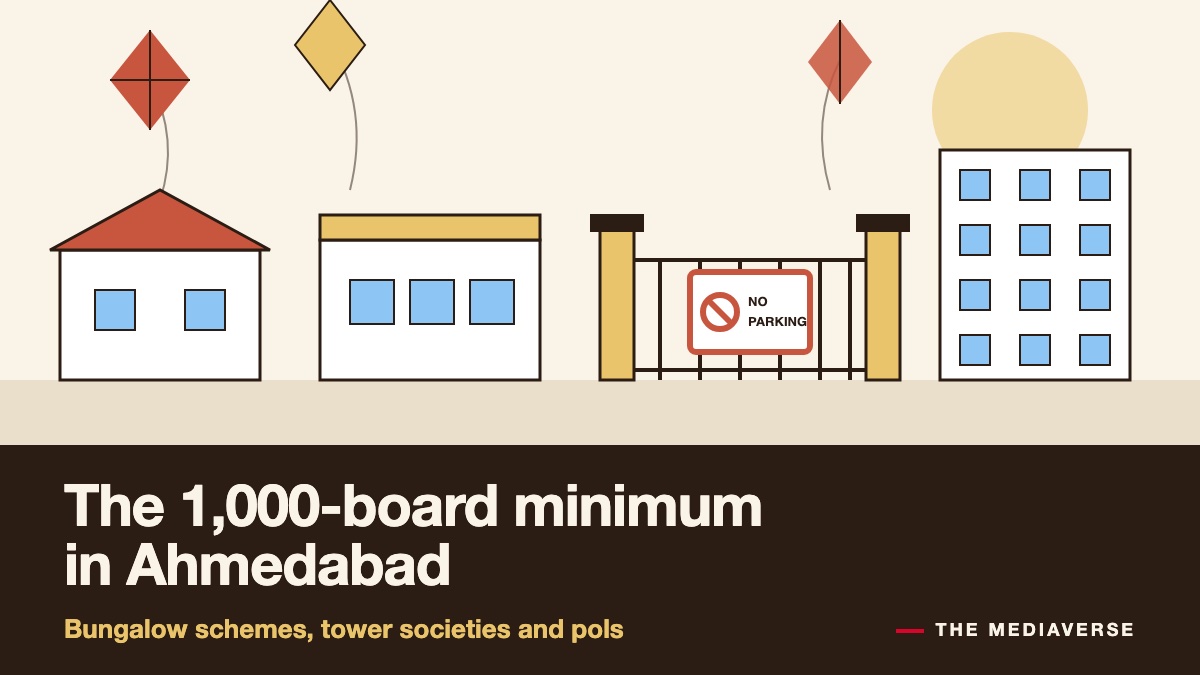
Walk the lane behind the Satellite crossroads at nine on a weekday morning and the gates open one after another: a bungalow owner backing a car out, a scooter leaving for the school run, a delivery rider waiting at a scheme gate, and on almost every one of those gates a no-parking sign that nobody reads twice. Our Ahmedabad no parking board page opens on that same walk, through Satellite, Bopal and Maninagar, and its point is that Ahmedabad lives behind gates: bungalow schemes, tower societies, row houses and the old-city pols around Manek Chowk. The smallest order that puts a brand on those signs is 1,000 boards at Rs.45 each, Rs.45,000 before GST and Rs.53,100 with it, by our arithmetic. The page calls a typical first campaign 2,000 to 3,000 boards, so the minimum is a third to a half of what it expects most buyers to order. This guide works the minimum through the four kinds of gate the page names, its six placement areas, its three-language rule, the festival calendar as it stands on 23 October 2026, and the Gandhinagar extension it says tips an order into the Rs.35 slab. Every figure is from the live Ahmedabad page and our other Ahmedabad rate pages as read on 23 October 2026; totals, per-area splits and dates are our arithmetic and are marked as ours.
What kinds of Ahmedabad gates do 1,000 boards go on?
Four kinds, on the page's own description, and they behave differently for a small order. Western Ahmedabad grew gate by gate: bungalow schemes in Bopal and South Bopal, tower societies along SG Highway, row houses in Gota and Chandkheda. East of the river and inside the walled city the gate is a pol entrance, the lane communities around Manek Chowk, Kalupur and Raipur that the page describes as the oldest reference network in the city. The page says nearly every one of those gates already carries a no-parking sign, and that scheme committees keep their gates in order and treat a clean parking notice as a service to the scheme rather than an intrusion, which is why it says boards stay up for the full campaign instead of vanishing within a week. What it does not publish is a gate count for any scheme, society or pol, so the table describes the geometry, not a census.
The four kinds of Ahmedabad gate a 1,000-board order can sit on (from our Ahmedabad page, read 23 October 2026)
| Gate type | Localities the page names | Who consents, per the page | What 1,000 boards means, our reading | |
|---|---|---|---|---|
| Bungalow-scheme gates | Bopal, South Bopal, Satellite, Prahlad Nagar | The bungalow owner or the scheme committee, location by location | The page's own carpet example is every gate in South Bopal; many consents, one artwork, one pocket | |
| Tower-society gates | SG Highway belt: Thaltej, Bodakdev, Bopal towers | The society committee | Fewer, bigger gates with heavy daily footfall; a named list of societies rather than 1,000 scattered points | |
| Row-house gates | Gota, Chandkheda, the northern growth belt | The house owner or the scheme committee | Dense, fast-filling schemes the page reserves for blanket saturation at the Rs.35 slab, which 1,000 boards cannot reach | |
| Pol gates | Manek Chowk, Kalupur, Raipur, the walled city | The pol's own representatives | Gujarati-first copy; the page times these gates to Uttarayan, when the kite markets fill |
Gate types, localities and consent routes as published on the live Ahmedabad no parking board page on 23 October 2026. The page publishes no gate, scheme or household count for any locality; the reading in the last column is ours.
What do 1,000 no-parking boards cost in Ahmedabad?
The card has two slabs and one minimum. From 1,000 to 4,999 boards the rate is Rs.45 a board; from 5,000 it is Rs.35. The rate covers the board, the print, transport and installation at the gate, there is no monthly rental afterwards, and GST is charged extra, which at 18 percent puts the minimum at Rs.53,100 by our arithmetic. The page describes a focused push around Satellite or the SG Highway schemes as a few thousand boards and a citywide residential campaign across the western corridor, the north and the old-city belts as the order that crosses into the Rs.35 slab. Its own definition of a typical first campaign is 2,000 to 3,000 boards concentrated around one catchment, Satellite plus Bopal, or the trader belts of Maninagar.
Minimum order
Rs.45,000 before GST, Rs.53,100 with GST. One pocket: a slice of Maninagar, a set of Satellite schemes or a named list of SG Highway societies.
Typical first campaign
Rs.90,000 to Rs.1,35,000 before GST, Rs.1,06,200 to Rs.1,59,300 with GST. The page's own example is Satellite plus Bopal, or the trader belts of Maninagar.
Citywide or with Gandhinagar
Rs.1,75,000 before GST, Rs.2,06,500 with GST at exactly 5,000. The page says a citywide residential sweep, or an Ahmedabad order extended into Gandhinagar, crosses into this slab.
The Ahmedabad no parking board card as published on the live city page on 23 October 2026: Rs.45 per board for 1,000 to 4,999 boards, Rs.35 from 5,000, minimum 1,000, all-inclusive of board, printing, transport and installation, no monthly rental, GST extra. The sizing phrases are the page's own; with-GST totals are our arithmetic at 18 percent.
Two lines on the page need a second read. The hero and the FAQ both say "from Rs.35 a board", and the hoarding FAQ describes a few thousand gate boards "at Rs.35 to Rs.45 each", but Rs.35 applies only from 5,000 boards, five times the minimum; every order under 5,000 pays Rs.45. And because 3,889 boards at Rs.45 already cost Rs.1,75,005, any order from 3,889 to 4,999 boards pays more than 5,000 boards would, by our arithmetic, so a plan that lands in that band should be rounded up. Our 45 versus 35 break-even post works the national version of that crossover. The page lists what moves a final quotation beyond the card: quantity, the schemes and localities selected, printing method, permissions and any customisation.
Why does the page call 2,000 to 3,000 boards a typical first campaign?
Because its planning unit is a catchment, not a board count. The page says it plans Ahmedabad scheme by scheme rather than zone by zone, and its worked examples are "every gate in South Bopal", Satellite plus Bopal, or a chosen slice of Maninagar. It also says a jeweller in Maninagar or a clinic in Vastrapur has customers within three kilometres of the shop, and that the format exists so they stop paying CG Road and Ashram Road hoarding rents to talk to the whole city. A catchment of that size, on the page's own numbers, runs to 2,000 or 3,000 gates. The minimum of 1,000 is therefore not the page's idea of a campaign; it is the smallest order it will take, and the honest way to spend it is to shrink the catchment rather than thin the coverage. Spread across the six placement areas the page lists, 1,000 boards would put about 167 on each, our arithmetic, and own none of them.
Which of Ahmedabad's six placement areas fit a 1,000-board order?
The page lists six placement areas and matches each to the categories it serves. Read against the minimum, three of them are natural single-pocket orders, two are halves of the page's typical first campaign, and one is a Rs.35-slab market that 1,000 boards should not try to carry.
Ahmedabad's six placement areas against a 1,000-board order (areas and audiences from our Ahmedabad page, read 23 October 2026)
| Area | Localities the page names | Who is behind the gate, per the page | Category fit from the page | Fit for 1,000 boards, our reading | |
|---|---|---|---|---|---|
| SG Highway belt | Bopal, Thaltej, Bodakdev | Premium bungalow schemes and tower societies, where new-Ahmedabad money lives | Real estate before a launch weekend, premium retail | A named list of societies; English-led copy with a Gujarati line | |
| Satellite and Prahlad Nagar | Satellite, Prahlad Nagar | Settled, affluent family schemes | Jewellers, premium clinics, banks | The clearest 1,000-board fit; the page pairs it with Bopal for a 2,000 to 3,000 order | |
| CG Road and Navrangpura | CG Road, Navrangpura | Shop, office and apartment gates with heavy shopper and student footfall | Retailers, coaching classes | One pocket; bilingual Gujarati plus English artwork | |
| Maninagar and Ashram Road | Maninagar, Ashram Road, Raipur | Dense trader-family pockets on the eastern side | Textile and wholesale trade, jewellers | The page's own example of a slice done properly; Gujarati-first | |
| Vastrapur and Ambawadi | Vastrapur, Ambawadi, the lake-side lanes | Coaching classes, hospitals, residential lanes | Education and healthcare | One pocket, timed to admission season for coaching | |
| Gota, Chandkheda and Paldi | Gota, Chandkheda, Paldi | Fast-filling new schemes in the north plus settled Paldi lanes | Builders chasing first-home buyers, mass categories | The page reserves this mix for blanket saturation at the Rs.35 slab, which needs 5,000 boards |
Areas, localities and audience descriptions as published on the live Ahmedabad page on 23 October 2026, with the category fit drawn from its industries list. The 167-per-area figure and the fit column are our arithmetic and reading. The page publishes no gate count for any area.
Should the board be in Gujarati, English or both?
The page answers this by geography rather than by category, and it is the most specific language rule on any of our no-parking city pages. East of the river and in the old city, Maninagar, Raipur, Kalupur and the pol belts, it wants a Gujarati-first board with the offer and the phone number in large numerals, because there a board reads as a neighbourhood business talking to its own people. Around CG Road and Navrangpura it advises a bilingual Gujarati-plus-English layout for the mixed shopper, student and office crowd. On the SG Highway and Bopal corridor English can lead, but the page still asks for a Gujarati line, on the grounds that even new-Ahmedabad households respond to a brand that speaks the city's language at their own gate. One rule holds everywhere: the phone number and the locality name must be readable from a moving two-wheeler. A 1 ft by 1.5 ft board holds a name, one line and a number, so a 1,000-board order that stays in one pocket needs one artwork, and one that crosses the river needs two.
The page's language rule by area (from our Ahmedabad page, read 23 October 2026)
| Belt | Localities the page names | Copy the page advises | Artworks for a 1,000-board order, our reading | |
|---|---|---|---|---|
| East of the river and the old city | Maninagar, Raipur, Kalupur, the pols | Gujarati-first, offer and phone number in large numerals | One Gujarati artwork | |
| Central retail and office heart | CG Road, Navrangpura | Bilingual Gujarati plus English | One bilingual artwork | |
| Western growth corridor | SG Highway, Bopal, Thaltej, Bodakdev | English can lead, with a Gujarati line | One English-led artwork with a Gujarati line |
Language guidance exactly as published on the live Ahmedabad page on 23 October 2026. The artwork-count column is our reading of the 1 ft by 1.5 ft board on the national page.
Which festival can a 1,000-board order still make from 23 October 2026?
The page gives one timing rule and four windows. The rule is that retail, jewellery and textile boards should be installed two to three weeks before the festival, so the name is familiar at the gate before the spending starts. The windows are Navratri, which the page calls the opening of Ahmedabad's biggest spending stretch; Diwali; the December-to-February wedding season, which it names as the single best window for jewellers, caterers and banquet businesses; and Uttarayan in mid-January, when families stream to the kite and firki markets of the old city and stock up in their own neighbourhoods, so boards around Kalupur, Raipur and the dense residential pockets meet the city at street level. The page publishes no installation lead time of its own; the national page says design and printing take a few days, followed by phased, permission-led installation. Put the rule against today's date and the calendar reads as follows, our arithmetic throughout.
Ahmedabad festival windows for a 1,000-board order, counted from 23 October 2026 (timing rule from our Ahmedabad page)
| Window | What the page says | Boards should be up by, our arithmetic | Status on 23 October 2026 | |
|---|---|---|---|---|
| Navratri 2026 | Opens the biggest spending stretch; boards up before the first garba night | Passed | The 2026 garba nights are over; the next Navratri is autumn 2027 | |
| Diwali, 8 November 2026 | Momentum carries from Navratri through Diwali | 18 to 25 October 2026 | Sixteen days out; the three-week deadline has passed and the two-week one is two days away, with no published lead time, so we would not promise it | |
| Wedding season, December to February | The single best window for jewellers, caterers and banquet businesses | Late November 2026 for a December start | Bookable now; the natural target for a jeweller's first 1,000 boards | |
| Uttarayan, 14 January 2027 | Families stream to kite and firki markets in the old city and stock up in their own neighbourhoods | 24 to 31 December 2026 | The first festival a new order can honestly target; Kalupur, Raipur and the pols, Gujarati-first |
The two-to-three-week installation rule and the four windows are the page's. Diwali on 8 November 2026, Uttarayan on 14 January 2027 and the install deadlines are our arithmetic; the page publishes no festival dates and no installation lead time.
For the categories the page describes as year-round, hospitals and clinics holding the Satellite and Vastrapur pockets that feed their OPD, banks building branch-level recall, builders blanketing the gates around a sales office before a launch weekend, the calendar matters less than the consent round. Coaching and schools have their own window: the page puts them at parents' gates in Navrangpura, Maninagar and Ambawadi through admission season, and our Ahmedabad mobile van branding page dates that season June to August for the coaching brands it runs through the university belt.
When does adding Gandhinagar push the order to the Rs.35 slab?
The page makes a point no other city page of ours makes: campaigns rarely need to stop at the city limit. Gandhinagar's residential sectors and the societies of Kudasan, Sargasan and Randesan house a growing base of government employees and GIFT City professionals who commute the corridor daily, and the page says extending an Ahmedabad order into Gandhinagar often pushes the total past 5,000 boards, moving the whole campaign to the Rs.35 slab while adding a second catchment for the same creative. The arithmetic, ours, is the useful part. An Ahmedabad order of 3,500 boards at Rs.45 costs Rs.1,57,500. Add 1,500 Gandhinagar boards and the order becomes 5,000 at Rs.35, Rs.1,75,000: the extra 1,500 gates cost Rs.17,500, about Rs.12 a board at the margin. A 1,000-board order cannot use this; it is the second or third order's move, and the page's own sequencing, a first campaign of 2,000 to 3,000 boards and a citywide sweep later, is what leads to it.
Who gives consent on an Ahmedabad scheme gate or a pol?
Every board sits on private property, and the page says permission is taken always, and before anything is printed for a gate. The field team meets the bungalow owner or the scheme committee for each location, and in the walled city it works through the pol's own representatives. The page adds the Ahmedabad reason refusals are uncommon: a crisp no-parking notice is genuinely useful to a scheme, so installed boards tend to stay undisturbed for the full campaign. The national no parking board page adds the mechanics: a 1 ft by 1.5 ft Sunpack board, fixed to the gate or compound wall after permission from the house owner or residents' society, with every board geo-tagged and photographed so you receive a placement report, and the Ahmedabad page closes on the same geo-tagged proof. For 1,000 boards on bungalow-scheme gates in Satellite that can mean a long list of individual owners; on the SG Highway towers it is a shorter list of committees, each controlling a bigger gate; in a pol it is one set of representatives for a whole lane. The page lists permissions among its quote factors and says the AMC keeps arterial hoarding inventory tight, but it cites no AMC rule for a board on a private gate; what it requires is the gate owner's consent. The Ahmedabad outdoor advertising hub lists the other formats that do go through AMC permits.
Is a gate board cheaper than an Ahmedabad newspaper insert or an auto hood?
On entry cost, yes, by a wide margin. The table puts the smallest order on each of our Ahmedabad rate pages side by side, with GST added by us at 18 percent. The board minimum is the cheapest full-campaign entry on our Ahmedabad pages; only a single van-day is cheaper, and that buys one vehicle for one day. This is a comparison of first invoices, not of value: an insert reaches 50,000 households once through Gujarat Samachar, Divya Bhaskar or Sandesh, a hood moves with the auto through the pol lanes, and a board stays on one gate for the campaign.
Smallest bookable order on our Ahmedabad rate pages (read 23 October 2026)
| Format | Smallest order | Rate | Before GST | With GST, our arithmetic | |
|---|---|---|---|---|---|
| No-parking boards | 1,000 boards | Rs.45 per board | Rs.45,000 | Rs.53,100 | |
| Newspaper insertion, A5 | 50,000 inserts | Rs.1.25 per insert | Rs.62,500 | Rs.73,750 | |
| Auto back panel, 24 x 6 inch | 500 autos | Rs.170 per auto one-time | Rs.85,000 | Rs.1,00,300 | |
| Auto hood | 300 autos | Rs.650 per auto one-time | Rs.1,95,000 | Rs.2,30,100 | |
| Mobile van, T-Shape | 1 van for 1 day | Rs.8,000 fabrication plus Rs.3,000 a day | Rs.11,000 | Rs.12,980 |
Rates and minimums from the live Ahmedabad no parking board, newspaper insertion, auto branding and mobile van branding pages on 23 October 2026: A5 Rs.1.25 (Rs.1.15 above 50,000), minimum 50,000; hood Rs.650 for 300 to 499 autos and Rs.630 from 500, minimum 300; back panel 24 x 6 inch Rs.170 for 500 to 799 and Rs.140 from 800, minimum 500; T-Shape van Rs.8,000 fabrication plus Rs.3,000 a day, minimum 1 day. GST totals are ours at 18 percent.
The Ahmedabad newspaper insertion page and the Ahmedabad auto branding page carry the full cards behind those rows, including the Rs.1.15 A5 rate above 50,000, the Rs.630 hood rate from 500 autos and the 24 x 18 inch back panel at Rs.270.
What does our Ahmedabad page not publish?
Six gaps matter for a 1,000-board plan. First, gate or scheme counts: the page names four gate types and six areas but gives no count for any of them, so the fit column in the tables above is our reading of the geometry, not a census. Second, an installation lead time: the page's two-to-three-week rule says when boards should be up, not how long they take to go up, and the national page's "a few days" for design and printing plus phased installation is the only timing anywhere. Third, campaign duration and reprint cost: the page says there is no monthly rental and that boards stay up for the full campaign, but never defines the campaign or prices a replacement. Fourth, the hoarding comparison is unquantified: the page calls the cost per exposure a fraction of an AMC-regulated hoarding's without a hoarding rate. Fifth, the "from Rs.35" headline and the FAQ's "Rs.35 to Rs.45" phrasing sit beside a card on which every order under 5,000 boards pays Rs.45. Sixth, the page separates AMC-regulated hoardings from gate boards but cites no civic rule for a board on a private gate; consent from the owner, committee or pol is the whole process it describes.
Which 1,000-board plan should you book in Ahmedabad?
Three plans fit the minimum without stretching it. A jeweller or premium clinic books Satellite alone: 1,000 boards across settled scheme gates in Satellite and the edge of Prahlad Nagar, English-led with a Gujarati line, installed in late November so the name is familiar before the December wedding season, Rs.53,100 with GST. A textile showroom or wholesale brand books a slice of Maninagar: 1,000 Gujarati-first boards with the offer and phone number in large numerals on trader-family gates between Maninagar and Raipur, installed between 24 and 31 December so they are up two to three weeks before Uttarayan. A coaching class books Navrangpura and Ambawadi: 1,000 bilingual boards on the parents' gates the page names, timed to the June-to-August admission season. What none of the three should do is split 1,000 boards across all six areas, because 167 boards an area owns nothing, or land between 3,889 and 4,999 boards, where 5,000 is cheaper. A builder who wants Gota and Chandkheda should plan the Rs.35 order the page describes, 5,000 boards for Rs.2,06,500 with GST, rather than a 1,000-board sample of a blanket.
For how the same minimum behaves in a city of paras and towers, see the Kolkata 1,000-board guide; for a city of schemes with a wedding calendar of its own, the Jaipur 1,000-board guide. The older Ahmedabad no parking board guide covers the Sunpack board itself, the hoarding comparison and the permission process in more depth.
What is the minimum order for no parking boards in Ahmedabad?
1,000 boards. Our Ahmedabad page prices them at Rs.45 each for any order from 1,000 to 4,999, so the minimum costs Rs.45,000 before GST and Rs.53,100 with 18 percent GST, by our arithmetic. The rate covers the board, printing, transport and installation at the gate, with no monthly rental. The Rs.35 rate in the page headline starts only at 5,000 boards, which cost Rs.1,75,000, or Rs.2,06,500 with GST.
Can 1,000 no parking boards cover a single Ahmedabad scheme or locality?
Yes, and that is how the page plans: scheme by scheme, not zone by zone. Its own examples are every gate in South Bopal, Satellite plus Bopal, or a chosen slice of Maninagar, and it sizes a typical first campaign at 2,000 to 3,000 boards around one catchment. A 1,000-board order is therefore one pocket done properly, Satellite alone or a slice of Maninagar, rather than six areas at about 167 boards each, which is our arithmetic on the page's six placement areas.
Should an Ahmedabad no parking board be in Gujarati or English?
It depends on which side of the river the gate is on, according to the page. In Maninagar, Raipur, Kalupur and the pols it advises Gujarati-first copy with the offer and phone number in large numerals. Around CG Road and Navrangpura it advises bilingual Gujarati plus English. On the SG Highway and Bopal corridor English can lead, but the page still asks for a Gujarati line. Everywhere, the phone number and locality name must read from a moving two-wheeler.
When is the best time to install no parking boards in Ahmedabad?
Two to three weeks before the festival you are selling into, which is the page's rule for retail, jewellery and textile boards. Counted from 23 October 2026, that makes Diwali on 8 November too close to promise with no published lead time, the December-to-February wedding season bookable now with boards up in late November, and Uttarayan on 14 January 2027 the first festival a new order can honestly target, with boards up between 24 and 31 December, by our arithmetic. Coaching boards belong to the June-to-August admission season.
How does extending into Gandhinagar change the Ahmedabad board rate?
The page says an Ahmedabad order extended into Gandhinagar, to Kudasan, Sargasan and Randesan, often pushes the total past 5,000 boards, which moves the whole campaign from Rs.45 to Rs.35 a board. By our arithmetic, 3,500 Ahmedabad boards cost Rs.1,57,500 at Rs.45, and 5,000 boards split with Gandhinagar cost Rs.1,75,000 at Rs.35, so the extra 1,500 gates cost Rs.17,500. The same rule means any order between 3,889 and 4,999 boards should be rounded up to 5,000.
Tags
Quick Answers
How much do 1,000 no parking boards cost in Ahmedabad?
Rs.45,000 before GST and Rs.53,100 with 18 percent GST. Our Ahmedabad page prices boards at Rs.45 each for orders from 1,000 to 4,999 and Rs.35 from 5,000, minimum 1,000, with the board, printing, transport and installation at the gate included and no monthly rental. The page calls a typical first campaign 2,000 to 3,000 boards around one catchment, Rs.90,000 to Rs.1,35,000 before GST by our arithmetic.
Where do no parking boards go in Ahmedabad?
On the four kinds of gate the page names: bungalow schemes in Bopal and South Bopal, tower societies along SG Highway, row houses in Gota and Chandkheda, and the pols around Manek Chowk, Kalupur and Raipur. The page lists six placement areas, from the SG Highway belt and Satellite to Maninagar, Vastrapur and the northern schemes, and plans campaigns scheme by scheme, with Gandhinagar's Kudasan, Sargasan and Randesan as an extension.
Do no parking boards in Ahmedabad need AMC permission?
Our Ahmedabad page does not cite an AMC permit for a board on a private gate. What it requires is consent, taken before anything is printed, from the bungalow owner or the scheme committee for each location, and in the walled city from the pol's own representatives. The page says the AMC keeps arterial hoarding inventory tight, which is one reason it steers catchment buyers to gates, and it lists permissions among the factors that move a quotation.
Looking for professional No Parking Board Advertising services?
The Mediaverse runs end-to-end no parking board advertising campaigns across India with geo-tagged delivery and transparent, all-inclusive pricing.
Explore our No Parking Board Advertising solutionsSummarize this guide with AI
Open this article in your favourite AI assistant
Related Guides
Written by

The Mediaverse Team
India's Leading Outdoor Advertising Agency
The Mediaverse is a national-level outdoor advertising and integrated marketing organization that provides complete OOH, ATL, BTL, retail, and transit media solutions across India. With years of experience executing high-performance campaigns for brands in FMCG, Real Estate, E-commerce, EdTech, Automotive, Healthcare, and Retail, The Mediaverse combines creativity, data-driven media planning, and flawless on-ground execution. As a full-stack outdoor advertising provider, The Mediaverse offers Auto Branding, Mobile Van Branding, Newspaper Insertion Advertising, Shop Name Board Branding, In-Store Branding, Hoardings, Transit Media, Kiosks, Mall Media, Activations, and all forms of Below-The-Line marketing. Known for its pan-India network, strategic route planning, premium print quality, and Cheqmate™ GPS-based verification, The Mediaverse ensures 100% transparent and result-oriented campaign delivery. The Mediaverse’s editorial team produces deeply researched, SEO-optimized, and generative-engine-friendly content to help businesses understand the power of outdoor advertising and make informed decisions that maximize brand visibility and ROI across urban, suburban, and rural markets.
Related Articles
1,000 No-Parking Boards in Pune: The Rs.45,000 Minimum Across PMC and PCMC Societies (2026)
The smallest Pune no-parking order is 1,000 boards at Rs.45. How the page stretches them across IT-belt townships, the Peth core and PCMC, which of six areas fit, when the monsoon and admissions windows collide, who consents and which plan to book.
1,000 No-Parking Boards in Kolkata: The Rs.45,000 Minimum Across Paras, Salt Lake and New Town (2026)
The smallest Kolkata no-parking order is 1,000 boards at Rs.45. How the page plans them across old paras, Salt Lake blocks and New Town towers, which of six areas fit, Bengali or English artwork, who consents and when to book.
1,000 No-Parking Boards in Lucknow: The Rs.45,000 Minimum Across LDA Sectors and Old-City Lanes (2026)
The smallest Lucknow no-parking order is 1,000 boards at Rs.45. How the page plans them on the LDA grid and in the old city, which of six groups to pick, who consents, Hindi-first artwork and the gaps.