

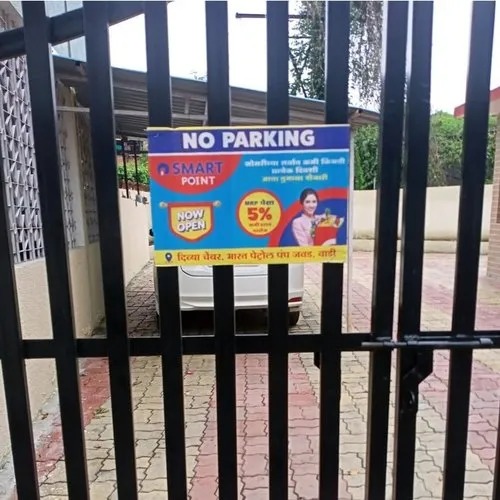
In the field, the single thing that decides whether a board stays up for months is not the print quality or the design — it is how our team asks for permission. We learned early that a gate board put up without the right person's consent comes down within a week, and the household remembers it the wrong way. So the approach that works starts before anyone touches a gate: figure out who actually controls that surface, and give them a reason to say yes that is genuinely in their interest.
This is a practical playbook for getting RWA permission for advertising and homeowner consent for a gate board. It is the same sequence our team runs at independent houses and inside gated societies across Delhi, Mumbai, Bangalore, Hyderabad, Chennai, Kolkata, Pune, Ahmedabad, Jaipur and Lucknow. No legal jargon, no invented shortcuts — just the order of operations that gets a yes and keeps the board up.
Why is permission the real bottleneck in gate advertising?
A gate board is one of the easiest advertising formats to physically place — it is a 1ft x 1.5ft Sunpack sheet, rigid and weatherproof, that fixes to a gate or compound wall in minutes. The hard part is never the installation. It is the permission. A board fixed to someone's gate without consent is a board that comes down, and worse, it sours the household on the format entirely.
That is why our process treats permission as the campaign, not a formality before it. When you are placing boards across hundreds or thousands of gates, the difference between a 30-second ask that works and one that triggers suspicion compounds quickly. The framing below — board as genuine No Parking notice first — is what makes the ask land. If you want the wider context on the format, the complete 2026 guide to No Parking board advertising covers materials, printing and process in full.
Who actually decides — the homeowner or the RWA?
Every gate has an owner of the decision. Getting this wrong is the most common reason a board comes down: you got a yes, but not from the person whose yes counts.
Independent houses
The gate belongs to the family. The decision-maker is the homeowner — whoever answers at the gate and can speak for the household. The conversation is direct and quick. You are not navigating a committee; you are giving one family a useful notice that happens to carry a brand. Most of the friction here is simply suspicion of a stranger at the gate, which the No Parking framing dissolves.
Gated societies
The entry gate and boundary walls are common property. No single flat owner can authorise a board there — that surface belongs to all residents and is managed by the Resident Welfare Association. You approach the RWA managing committee: usually the secretary or the office-bearer who handles facilities, security and the gate. A society yes is slower than a homeowner yes, but it is also more durable, because once the committee approves, the board is sanctioned for everyone.
What is the dual-purpose pitch, and why does it work?
The pitch that changes everything is honest and simple: this is a genuine No Parking notice that also carries a brand. The message stays fully visible — delivery riders, visitors and domestic staff read 'No Parking' at the gate, exactly as the household wants — while the main visual area carries the advertiser. The family or society gets a real, functional notice for free, fixed, weatherproof and clear. The advertiser gets the placement.
This reframes the ask from 'rent me your wall' to 'let me give your gate a useful notice.' People who would refuse a plain advertisement on their boundary wall will often welcome a No Parking board, because parking is a genuine daily irritation at most gates. That is the whole psychology of the approach, and it is why our team always leads with the notice and never with the brand.
What is the step-by-step permission playbook?
Run these five steps in order at every gate. Skipping any one of them is where boards come down or disputes start.
Identify the decision-maker before you knock
Action: Decide whether this is an independent house (talk to the homeowner) or a gated society (talk to the RWA managing committee — usually the secretary or facilities office-bearer). Why: Only the person who controls that gate or wall can grant valid permission. Common mistake: Getting a 'yes' from a single flat owner for a society's shared entry gate — that surface is common property, so their consent is not theirs to give and the board can be removed by the committee.
Lead with the dual-purpose No Parking pitch
Action: Open by offering a genuine No Parking notice for the gate, then explain the board also carries a brand in the main visual area while the notice stays fully visible. Why: It reframes the ask from renting wall space to giving the household something useful, which is far easier to approve. Common mistake: Leading with the advertisement. The moment it sounds like 'paid ad on my wall,' suspicion rises and the easy yes disappears.
Get written consent and a placement agreement
Action: Record a short written consent — who agreed, which gate or wall, the 1ft x 1.5ft board, and that it is a dual-purpose No Parking notice. For societies, note the managing-committee approval. Why: Written consent protects both sides and prevents 'I never agreed' disputes. Common mistake: Settling for a verbal yes at the gate, which is easy to forget or deny later and gives the installer no record of what was authorised.
Install the board at eye level
Action: Fix the board on the authorised gate or compound wall at eye level, where both the No Parking message and the brand read clearly to people approaching on foot or by two-wheeler. Why: Eye-level placement keeps the notice functional and the advertising legible, which is what justified the permission in the first place. Common mistake: Mounting it too high or too low to fit available space, where the message is squinted at or missed entirely, undermining the dual-purpose promise.
Capture a geo-tagged record of every install
Action: Photograph each installed board with its location tagged, and compile it into a proof-of-delivery report. Why: A geo-tagged record confirms the board sits exactly where consent was given and settles any later question about what was agreed or where. Common mistake: Skipping the record on small runs — then having no way to prove the board was authorised, or to show the advertiser which gates were actually covered.
On the written-consent step, it is worth understanding the wider picture of what is and is not allowed — see is No Parking board advertising legal in India for how consent and placement fit together. If you would rather hand the whole permission-and-install process to a team, you can request a free gate advertising quote and we run the sequence above end to end.
How does approaching a house differ from approaching a society?
The two paths share the dual-purpose pitch but differ in who you approach, what they care about, and the objection you should expect. This table is the cheat sheet our team carries into both.
Independent house owner vs society RWA: how to approach each
| Independent house owner | Society RWA (managing committee) | |
|---|---|---|
| Who you approach | The homeowner or family member at the gate | The RWA secretary or facilities office-bearer who controls the shared gate |
| What they care about | A tidy, useful gate notice and not being hassled by strangers | Common property being used responsibly, resident benefit, and committee accountability |
| Typical objection | 'I don't want an advertisement on my wall' | 'We can't allow ads on common society property' |
| How the dual-purpose board resolves it | It is a genuine No Parking notice first — useful to the family, with the brand as a secondary visual | It is framed and approved as a functional No Parking notice for the gate, sanctioned for all residents, not a rented ad space |
| Speed of decision | Fast — one conversation at the gate | Slower but more durable — needs committee sign-off, then valid for everyone |
Both paths use the same board (1ft x 1.5ft Sunpack) and the same dual-purpose pitch — only the decision-maker and the objection change.
How much does a gate board campaign cost?
One reason permission is easier than people expect: there is no monthly rental to negotiate. The pricing is a flat, all-inclusive per-board figure that covers the board, printing, transport and installation. That means when our team asks for permission, there is nothing to haggle over with the household — the cost is the advertiser's, and the gate gets its notice for free.
No Parking board pricing (all-inclusive, no monthly rental)
Standard
For campaigns under 5,000 boards. Board, printing, transport and installation included.
- 1ft x 1.5ft Sunpack board
- Dual-purpose No Parking + brand
- Print + transport + install included
- No monthly rental
- Geo-tagged proof of delivery
Bulk
For campaigns of 5,000 boards and above — the break-even point where the per-board rate drops.
- Everything in Standard
- Lower per-board rate at scale
- Best for multi-locality coverage
- No monthly rental
- Geo-tagged proof of delivery
Worked examples: 1,000 boards is roughly ₹45,000; 5,000 boards at the bulk rate is about ₹1,75,000; 10,000 boards is about ₹3,50,000. The 5,000-board mark is the break-even where the rate steps down from ₹45 to ₹35. For how this stacks up against other outdoor formats, see how No Parking board advertising compares to other formats.
What objections come up at the gate, and how do you handle them?
The objections are predictable, which means they are answerable. In Delhi, Mumbai, Bangalore and the other cities our team works in, the same handful come up again and again — and the dual-purpose framing handles all of them. You can read city-specific notes for No Parking board advertising in Delhi and gate board advertising in Bangalore.
'I don't want an ad on my wall.' — The board is a No Parking notice first; the brand is the secondary visual, and the notice itself is useful to the household. 'Who's going to take it down later?' — It is fixed neatly and we keep a geo-tagged record of every install. 'We can't allow ads on society property.' — Take it to the managing committee as a functional gate notice for all residents, not a rented ad. 'Will it look ugly?' — It is a clean, weatherproof 1ft x 1.5ft board sized to sit unobtrusively at eye level on the gate.
Frequently asked questions
Can one flat owner in a society give permission for a gate board?
No. A society's entry gate and boundary walls are common property managed by the RWA, so a single flat owner cannot validly authorise a board there. Valid permission for a shared gate comes from the managing committee. A flat owner can only grant consent for surfaces that are genuinely their own private property.
How long does it take to get RWA approval for a gate board?
It varies by society and depends on how the managing committee meets and decides. An independent homeowner can say yes in a single conversation at the gate, while a society generally needs the committee to review and sign off, which takes longer. The trade-off is durability: once the RWA approves, the board is sanctioned for all residents rather than resting on one person's word.
What should the written placement agreement actually cover?
Keep it short and specific: who consented, the exact gate or compound wall, the board size (1ft x 1.5ft), and a line stating it is a dual-purpose No Parking notice that also carries a brand. For a society, add that the managing committee approved it. That is enough to record what was agreed and to prevent a later dispute about whether consent was given.
Do you handle the permission process, or just supply the boards?
Our team runs the full sequence — identifying the right decision-maker, making the dual-purpose pitch, securing consent, installing at eye level, and handing over a geo-tagged proof-of-delivery report. The pricing is all-inclusive at ₹45 per board under 5,000 units and ₹35 per board at 5,000 and above, covering board, printing, transport and installation with no monthly rental.
What happens if a household asks for the board to be removed later?
Because consent is recorded in writing and every install is geo-tagged, removal is straightforward and uncontested — the record shows exactly which gate was authorised. The dual-purpose framing also means fewer removal requests in the first place, since the household keeps a genuinely useful No Parking notice rather than a plain advertisement they may resent.
Tags
Quick Answers
Do you need RWA permission to put up a No Parking board for advertising?
Yes. For a board fixed to a society's entry gate or shared compound wall, you need consent from whoever controls that surface — usually the RWA managing committee. For an independent house, you need the homeowner's permission. The approach that works is to present the board as a genuine No Parking notice that also carries a brand, get a written placement agreement before installing, and keep a geo-tagged record of the install so there is no dispute later.
Who do you approach for gate advertising permission — the homeowner or the RWA?
It depends on who controls the gate. At an independent house, the homeowner or family decides, so you speak to them directly. Inside a gated society, the entry gate and boundary walls are common property managed by the RWA, so you approach the managing committee — typically the secretary or the office-bearer who handles facilities. Approaching a single flat owner for a society's shared gate will not give you valid permission, because that surface is not theirs to grant.
Why is a No Parking board easier to get approved than a plain advertisement?
Because it is genuinely useful to the household. A 1ft x 1.5ft Sunpack board on the gate keeps the No Parking message visible to delivery riders, visitors and domestic staff, so the family gets a real benefit, not just a paid ad on their wall. That changes the conversation from 'rent me your wall' to 'I'll give your gate a clear notice that also carries a brand.' The notice stays readable while the main visual area carries the advertiser.
Should gate advertising permission be in writing?
Yes, always. A short written placement agreement records who consented, which gate or wall the board sits on, the board size (1ft x 1.5ft), and that it is a dual-purpose No Parking notice. For a society, it also notes the managing-committee approval. Written consent protects the homeowner or RWA and the advertiser equally: it prevents 'I never agreed to this' disputes and gives the installer a clear, geo-tagged record of what was authorised and where.
Looking for professional No Parking Board Advertising services?
The Mediaverse runs end-to-end no parking board advertising campaigns across India with geo-tagged delivery and transparent, all-inclusive pricing.
Explore our No Parking Board Advertising solutionsSummarize this guide with AI
Open this article in your favourite AI assistant
Related Guides
- No Parking board advertising service
- complete 2026 guide to No Parking board advertising
- is No Parking board advertising legal in India
- No Parking board advertising in Delhi
- gate board advertising in Bangalore
- how No Parking board advertising compares to other formats
- request a free gate advertising quote
Written by

The Mediaverse Team
India's Leading Outdoor Advertising Agency
The Mediaverse is a national-level outdoor advertising and integrated marketing organization that provides complete OOH, ATL, BTL, retail, and transit media solutions across India. With years of experience executing high-performance campaigns for brands in FMCG, Real Estate, E-commerce, EdTech, Automotive, Healthcare, and Retail, The Mediaverse combines creativity, data-driven media planning, and flawless on-ground execution. As a full-stack outdoor advertising provider, The Mediaverse offers Auto Branding, Mobile Van Branding, Newspaper Insertion Advertising, Shop Name Board Branding, In-Store Branding, Hoardings, Transit Media, Kiosks, Mall Media, Activations, and all forms of Below-The-Line marketing. Known for its pan-India network, strategic route planning, premium print quality, and Cheqmate™ GPS-based verification, The Mediaverse ensures 100% transparent and result-oriented campaign delivery. The Mediaverse’s editorial team produces deeply researched, SEO-optimized, and generative-engine-friendly content to help businesses understand the power of outdoor advertising and make informed decisions that maximize brand visibility and ROI across urban, suburban, and rural markets.
Related Articles
Gate-to-street saturation: no-parking boards plus auto hoods in one catchment, the worked plan (2026)
The entry ticket for one catchment covered from gate to street is ₹2,83,200 landed: 1,000 gate boards plus 300 auto hoods. Seven steps, the timings for both formats, three priced plans and the honest list of what the rate card leaves out.
Outdoor advertising for clinics, pharmacies and diagnostic centres: formats, compliance and catchment (2026)
A pharmacy plan of 1,000 gate boards plus a glow sign board is ₹56,168 landed; a clinic plan of 2,000 boards plus 50,000 A5 inserts is ₹1,79,950; a diagnostic centre plan with 300 auto hoods is ₹5,36,900. Plus the rules on what a medical board may say and how far each facility's catchment reaches.
No Parking Board Advertising vs Hoardings: Which Wins for One Locality in 2026?
A hoarding looks like the premium buy — but for dominating ONE locality, it usually loses to no parking gate boards. Here is the honest, side-by-side comparison on cost model, reach, exposure and targeting, plus a clear verdict and decision checklist.