

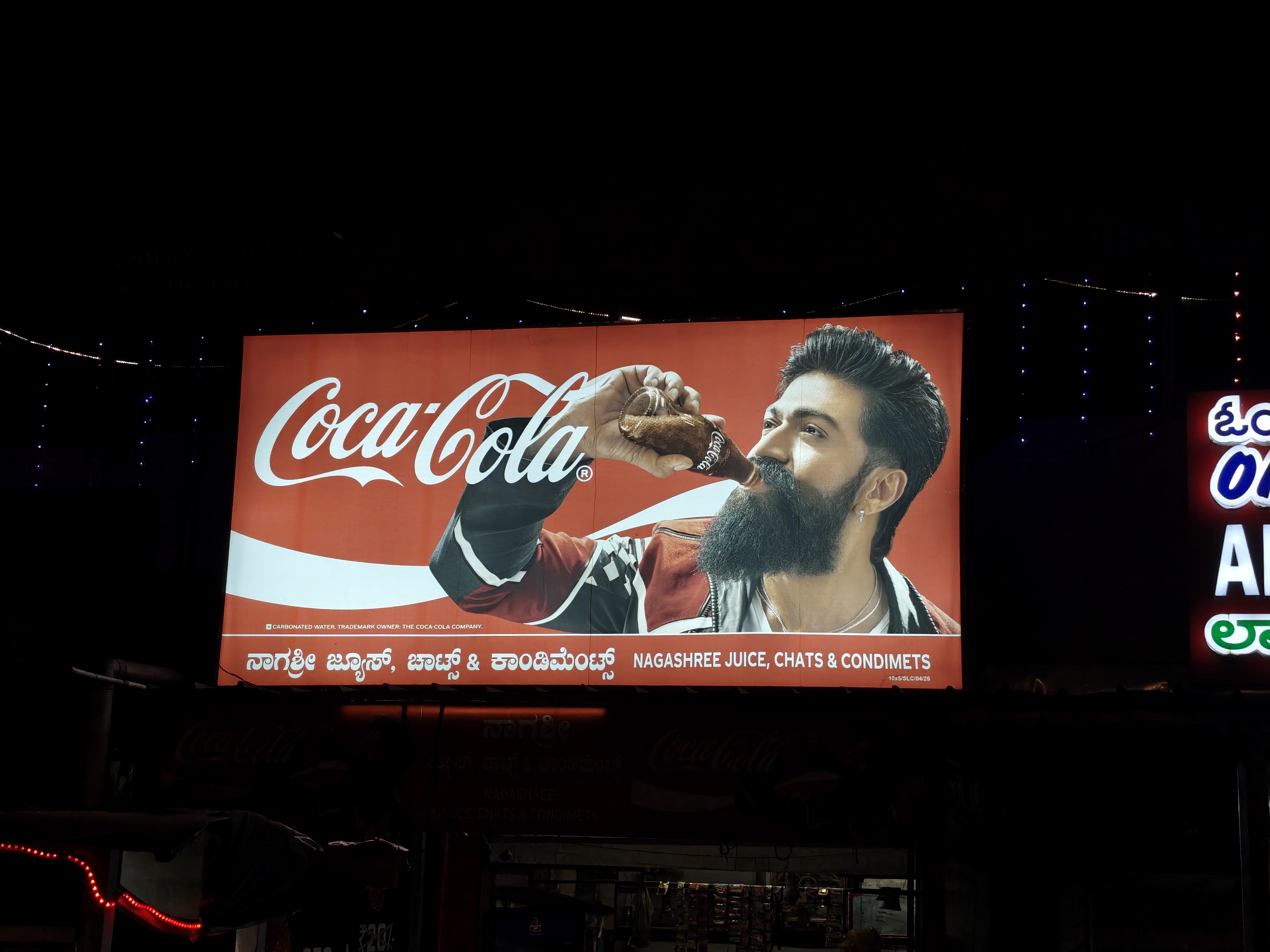
Here is the verdict before the detail: most shops are choosing between the same ACP panel lit or unlit, so the real question is not ACP versus LED but whether you need your name to glow after dark. Choose a non-lit ACP board, from about Rs 180 per square foot, if you trade mainly in daylight, watch the budget, or sit on a well-lit street. Choose an LED sign board, an illuminated LED-backlit ACP board from about Rs 350 to 450 per square foot, if your market trades into the evening, the competition is fierce, or night visibility matters. For most Indian retail that trades past dusk, the LED board earns its extra cost; for daytime or budget shops, the non-lit board is the smarter value. The rest of this guide gives the costs, an apples-to-apples table, when each wins, our recommendation, and a checklist.
ACP board vs LED sign board at a glance
Both boards are usually built on the same aluminium composite panel, so they share daytime legibility and the durability of ACP. The non-lit ACP board is cheaper to buy and run and has fewer parts to fail. The LED sign board adds backlighting so the name glows after dark, at roughly double the upfront cost plus a small ongoing electricity and occasional LED-maintenance cost. The decision therefore turns almost entirely on your trading hours and how competitive your street is, not on the base material. The spec table below sets the two side by side.
Spec comparison: non-lit ACP board vs LED sign board
ACP board vs LED sign board (2026)
| Non-lit ACP board | LED sign board (illuminated) | |
|---|---|---|
| Cost per sq ft (installed) | From Rs 180 | Rs 350 to 450 |
| Typical 40 sq ft board | ~Rs 7,200 | ~Rs 14,000 to 18,000 |
| Daytime visibility | Good | Good |
| Night / evening visibility | Low (needs street light) | Excellent (self-lit) |
| Running cost | None | Small monthly power + occasional LED upkeep |
| Best for | Daytime trade, budget, value retail | Evening trade, high competition, night visibility |
2026 starting points installed, before any municipal advertisement fee; actuals vary by size, height, structure and electrical work. Both are typically ACP-based. Request a free site quote.
When a non-lit ACP board wins
A non-lit ACP board is the better choice in three clear cases. First, daytime trade: if your shop does most of its business in daylight hours and closes by early evening, you are paying for illumination you would rarely use. Second, budget: at around Rs 180 per square foot with no running cost, the non-lit board is the most economical durable option, roughly half the upfront cost of an LED board and cheaper to own. Third, a well-lit street: if your storefront sits under strong street or mall lighting that already makes the board readable at night, the case for self-illumination weakens. In all three, you still get the durability and clean daytime legibility of ACP, just without the lighting premium. It is the value pick, not the compromise pick.
When an LED sign board wins
An LED sign board wins whenever visibility after dark drives footfall. First, evening trade: most Indian markets stay busy well into the evening, and a self-lit board keeps the shop legible when a non-lit one fades out, effectively buying extra visible hours every day. Second, high competition: on a crowded market street where dozens of boards compete, illumination is one of the cheapest ways to stand out after sunset, and during the festive season, when evening footfall peaks, a bright board pays back fastest. Third, night-time categories: restaurants, pharmacies, salons, and any shop whose customers come after work benefit most from a glow that says open and findable. The extra upfront and running cost is real, but for these shops it is buying the hours that matter most.
Edge cases: where flex and acrylic 3D letters fit
Two other options sit around this decision. Flex glow signs are cheaper than both ACP boards, but they are far less durable, warping in heat and trapping moisture in damp, so they suit short-term, temporary, or very tight-budget signage rather than a multi-year board. If budget is the only constraint, a non-lit ACP board is usually a more durable choice than flex at a similar entry level. At the other end, acrylic 3D letters are the premium, design-led option, often used in boutiques, showrooms, and premium high streets, and can be combined with LED for a backlit or halo-lit effect. They cost more than a standard ACP or LED board but deliver a higher-end look. So the full ladder runs flex (budget, short-term), non-lit ACP (value, durable), LED sign board (evening visibility), and acrylic 3D (premium).
Our recommendation
For most Indian retail, our recommendation is an LED-backlit ACP sign board, because the majority of shops trade into the evening on competitive streets, and the extra cost over a non-lit board buys the visible hours that win footfall, peaking in the festive season. Treat the difference, roughly Rs 7,000 to 11,000 on a typical 40 square foot board, as an advertising investment rather than a fabrication cost. The clear exceptions are daytime-only shops, quieter or already well-lit locations, and genuinely tight budgets, where a non-lit ACP board is the smarter value and still gives years of durable daytime presence. Whichever you choose, specify a quality ACP panel, sealed edges for your city's climate, and, for lit boards, weatherproofed electricals and good LED, because build quality decides how long either board lasts. If you want a quick view tailored to your street and trading hours, we are happy to quote both side by side.
Decision checklist: which should you pick?
Run through these questions to decide. Does your shop trade into the evening, past dusk? If yes, lean LED sign board. Is your street crowded with competing boards? If yes, lean LED. Are your customers mostly evening or night-time (food, pharmacy, salon)? If yes, lean LED. Is your budget tight, with no room for running cost? If yes, lean non-lit ACP. Is your storefront already brightly lit by street or mall lighting at night? If yes, a non-lit ACP board may be enough. Do you close by early evening? If yes, non-lit ACP. If your answers split, weight the trading-hours question most, because that is what illumination actually buys. And in every case, match the build and sealing to your city's climate, the single biggest factor in how long the board lasts.
Can a non-lit ACP board be upgraded to an LED sign board later?
In many cases yes, but it is rarely a simple swap. Converting a non-lit ACP board to a backlit LED board usually means rebuilding the board with a translucent face, an internal LED arrangement, and an electrical connection, which can cost as much as fitting an LED board from the start, plus the labour of removal and refitting. If you think you will want illumination within a year or two, it is usually cheaper to install the LED sign board now than to retrofit later. If illumination is genuinely uncertain, start with a quality ACP board and budget separately for a future LED board rather than a partial upgrade.
Does an LED sign board cost a lot to run?
No, the running cost is modest. Modern LED modules are energy-efficient, so the monthly electricity for a typical shop board is small relative to the value of staying visible after dark, and far lower than older neon or fluorescent signage. The main ongoing items are the electricity and occasional maintenance of the LED modules or driver over the years, which is why weatherproofed electricals and quality components matter, especially in humid or monsoon-prone cities. Budget a small monthly power cost and an occasional service, and the LED sign board remains an efficient way to buy evening visibility.
Is flex cheaper than ACP, and is it worth it?
Flex glow signs are usually the cheapest option, below a non-lit ACP board, but they are far less durable. Flex warps in heat, traps moisture in damp, and discolours faster, so it suits short-term, temporary, or very tight-budget signage rather than a multi-year board. For most shops, a non-lit ACP board is a better buy than flex at a similar entry level, because it lasts far longer and looks sharper. Use flex when the board is genuinely temporary or the budget truly cannot stretch; otherwise the small step up to ACP pays for itself in durability.
What about acrylic 3D letters compared with ACP and LED boards?
Acrylic 3D letters are the premium, design-led option, individual raised letters often used in boutiques, showrooms, and premium high streets, and they can be combined with LED for a backlit or halo-lit effect. They cost more than a standard ACP or LED-backlit board and give a higher-end, modern look, but they are not always the most legible at a distance in a crowded mass-market street, where a clear backlit ACP board can read better. Choose acrylic 3D when the look and the brand positioning justify the premium; choose ACP or LED-backlit ACP when value, durability, and at-a-glance legibility matter most.
Tags
Quick Answers
What is the difference between an ACP board and an LED sign board?
An ACP board is a shop name board made from an aluminium composite panel (ACP) with a printed or vinyl face, usually non-illuminated by default. An LED sign board is an illuminated board, most often the same ACP panel with LED backlighting behind a translucent face so the name glows after dark, though acrylic faces are also used. So the core difference is not the base material, which is frequently ACP in both, but illumination: the LED sign board is self-lit and stays visible at night, while the non-lit ACP board relies on daylight or external street lighting. That single difference drives most of the cost and the use-case gap between them.
Which is cheaper, an ACP board or an LED sign board?
A non-lit ACP board is cheaper, starting around Rs 180 per square foot installed, while an LED sign board (LED-backlit ACP) starts around Rs 350 to 450 per square foot installed, because of the LED modules, the translucent face, and the electrical work. For a typical 10-foot by 4-foot board (40 square feet), that is roughly Rs 7,200 for the non-lit ACP board versus about Rs 14,000 to 18,000 for the LED sign board, before any municipal advertisement fee. The LED board also carries a small ongoing electricity and occasional maintenance cost. So the non-lit ACP board wins on upfront and running cost; the LED board costs more but adds night visibility.
Which lasts longer, an ACP board or an LED sign board?
Both last a long time because both are usually built on durable ACP, which holds its shape and wipes clean. The non-lit ACP board has fewer parts to fail, so it is the most maintenance-free option. The LED sign board is equally durable in its panel, but its LED modules and electrical connections need occasional maintenance over the years and should be weatherproofed, especially in humid or monsoon-prone cities. Neither should be confused with flex, which is far less durable than both. In short, the non-lit ACP board is marginally lower-maintenance, while a well-built LED sign board lasts just as long in the body with some upkeep of the lighting.
Which gives better ROI for a shop, ACP or LED?
For most Indian retail that trades into the evening, an LED sign board delivers better return, because it keeps the shop visible after dark and through grey or festive evenings when a non-lit board fades out, and those extra visible hours win footfall in competitive markets. For a shop that trades mainly in daylight, in a quieter location, or on a tight budget, a non-lit ACP board delivers better value, since it avoids the extra upfront and running cost for illumination you would rarely use. The right ROI answer depends on your trading hours and how competitive your street is.
Looking for professional Shop Name Board services?
The Mediaverse runs end-to-end shop name board campaigns across India with geo-tagged delivery and transparent, all-inclusive pricing.
Explore our Shop Name Board solutionsSummarize this guide with AI
Open this article in your favourite AI assistant
Related Guides
Written by

The Mediaverse Team
India's Leading Outdoor Advertising Agency
The Mediaverse is a national-level outdoor advertising and integrated marketing organization that provides complete OOH, ATL, BTL, retail, and transit media solutions across India. With years of experience executing high-performance campaigns for brands in FMCG, Real Estate, E-commerce, EdTech, Automotive, Healthcare, and Retail, The Mediaverse combines creativity, data-driven media planning, and flawless on-ground execution. As a full-stack outdoor advertising provider, The Mediaverse offers Auto Branding, Mobile Van Branding, Newspaper Insertion Advertising, Shop Name Board Branding, In-Store Branding, Hoardings, Transit Media, Kiosks, Mall Media, Activations, and all forms of Below-The-Line marketing. Known for its pan-India network, strategic route planning, premium print quality, and Cheqmate™ GPS-based verification, The Mediaverse ensures 100% transparent and result-oriented campaign delivery. The Mediaverse’s editorial team produces deeply researched, SEO-optimized, and generative-engine-friendly content to help businesses understand the power of outdoor advertising and make informed decisions that maximize brand visibility and ROI across urban, suburban, and rural markets.
Related Articles
Who Are the Best Shop Name Board Manufacturers in Bangalore and How Much Do They Cost in 2026?
Looking for reliable shop name board manufacturers in Bangalore? This in-depth guide explains pricing, materials, BBMP rules, installation timelines, and ROI insights based on real execution experience from The Mediaverse.
How to choose a shop name board in India: the 2026 decision guide
How much does a shop name board cost, what material lasts, do you need permission, and which board should you choose? The complete 2026 guide to shop name boards in India.
Shop name boards in Lucknow: 2026 cost, Nagar Nigam and Hazratganj rules, Hindi signage, and durability
What does a shop board cost in Lucknow, are there special rules in Hazratganj, is Hindi required, and which material lasts through the seasons? A 2026 guide to costs, rules, language, and the market map.