

"Pick the print method to match the weather it will face and how long the campaign runs — not the other way round," is how our production team frames it. A board that hangs at a family's gate for two months in peak summer is a different brief from a board that has to carry a launch burst for two weeks.
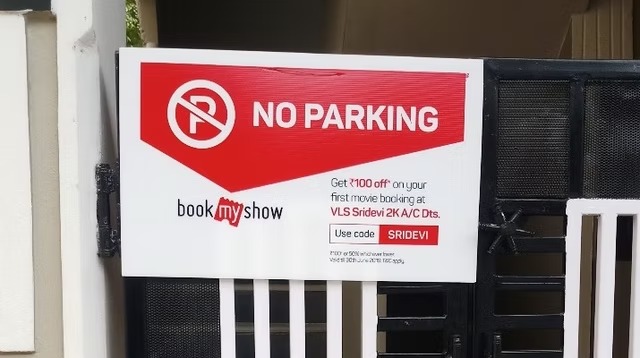
A branded No Parking board is a single 1ft×1.5ft Sunpack (sunboard) sheet that does two jobs at once: it stays a genuine "No Parking" notice and it carries your brand. It hangs on house gates and at society entry points where homeowners, domestic staff, delivery riders and visitors see it every day. The board, the size and the all-inclusive price stay the same no matter which way you print it. What changes is how well the artwork survives sun, rain and handling over the life of the campaign. That is the whole reason this comparison exists — and why the cheapest method is not always the right one.
Which four printing methods are we actually choosing between?
All four print onto the same rigid, lightweight, weatherproof Sunpack sheet. They differ in how the ink is laid down and cured, which is what drives durability, fade resistance and cost at scale. Here is each one in plain terms.
UV printing — the premium, most resilient finish
UV is the most fade- and scratch-resistant of the four. The ink is cured hard onto the board, so the artwork holds up best against direct sun and rough handling. That resilience is exactly why it is the premium option: you choose it when the board has to look sharp the longest, in the harshest spot. For a short campaign it is more durability than you need to pay for.
Eco-solvent — the clean, weatherproof sweet spot
Eco-solvent is the one our production team reaches for first on gate boards. It gives a clean, weatherproof finish that handles mixed Indian weather — sun then rain then dust — without stepping up to a premium process. For the typical multi-week campaign at a family's gate, it is the right balance of durability and value, which is why we treat it as the default.
Solvent — the serviceable durable option
Plain solvent lays durable, weatherproof ink and survives outdoors well. It is a perfectly serviceable choice. The practical reason we still lead with eco-solvent for these boards is that eco-solvent is the cleaner option and sits more comfortably in the weatherproof-yet-tidy sweet spot for a board hanging at someone's gate.
Digital — the cheapest for big volume, short windows
Digital is the most economical path when you are printing a very large number of boards for a short window. If your campaign is a launch burst or a ward-level election push that only needs to live for a couple of weeks, digital lets the volume work in your favour. It trades some of the long-haul durability of UV or eco-solvent for lowest cost at scale — a fair trade when the boards do not need to survive a full season.
How do the four methods compare head to head?
No Parking board printing methods compared
| Method | Durability / fade resistance | Weatherproofing | Relative cost | Best campaign length | Environmental profile | |
|---|---|---|---|---|---|---|
| UV | Highest — most fade and scratch resistant | Excellent | Premium | Long / high-exposure runs | Hard-cured premium process | |
| Eco-solvent | High and clean | Excellent | Standard (default) | Typical multi-week campaigns | Cleaner of the solvent options | |
| Solvent | Durable and serviceable | Strong | Standard | General-purpose outdoor runs | Standard solvent process | |
| Digital | Good for short-life use | Good | Cheapest at big volume | Big volume, short windows | Volume-oriented short-run |
All four print onto the same 1ft×1.5ft Sunpack sheet. The method changes durability and finish — not the all-inclusive board price, which is set by volume (see pricing below).
How much does a No Parking board cost, and does the method change it?
Pricing is all-inclusive and set by volume, not by print method. Printing is already bundled into every board — along with the board itself, transport and installation — and there is no monthly rental. So the method you choose does not move the number below; it only changes how the artwork ages.
All-inclusive No Parking board pricing (printing included)
Standard
All-inclusive: board + printing + transport + installation. No monthly rental.
- 1ft×1.5ft Sunpack board
- Printing included (UV / solvent / eco-solvent / digital)
- Transport + installation included
- Example: 1,000 boards ≈ ₹45,000
Bulk
Bulk rate kicks in at the 5,000-board break-even. Same all-inclusive bundle.
- Everything in Standard
- Lower per-board rate at scale
- Example: 5,000 ≈ ₹1,75,000
- Example: 10,000 ≈ ₹3,50,000
The 5,000-board mark is the break-even where the bulk rate begins. Because the rate is the same across methods, a high-volume buyer can pick digital for a short window or UV for a long one without the headline price changing — the decision stays about durability versus exposure.
How do you decide which method to choose? A quick checklist
Run your campaign through these four questions and the method usually picks itself.
- Not sure / typical multi-week run in mixed weather? Choose eco-solvent — the clean, weatherproof default.
- Long campaign or heavy direct sun (south-facing gates, open entrances, peak summer)? Choose UV for the best fade and scratch resistance.
- Very large volume for a short window (launch burst, ward-level push)? Choose digital for the lowest cost at scale.
- Want a durable general-purpose outdoor finish without the premium step? Solvent is a serviceable fallback to eco-solvent.
Bottom line: eco-solvent on Sunpack is the practical default for most buyers, UV is the upgrade for long or high-sun runs, and digital wins on big-volume short windows. If you tell us your locality, campaign length and volume, we will recommend the method and get you a free quote.
No Parking board printing: common questions
Is eco-solvent really good enough for boards left outdoors all season?
Yes. Eco-solvent gives a clean, weatherproof finish on the Sunpack sheet that handles mixed Indian weather, which is why our production team treats it as the default for gate-mounted boards. If your run is unusually long or the boards face heavy direct sun the whole time, UV is the more resilient upgrade — but for a normal multi-week campaign, eco-solvent is built for the job.
Why would I pay for UV if the price is the same?
The all-inclusive ₹45/₹35 rate is the same across methods, so choosing UV is about durability, not budget. You pick UV when the artwork has to survive the longest and harshest exposure — long campaigns, south-facing gates, peak summer — because it is the most fade- and scratch-resistant. For short or sheltered runs, that extra resilience is more than the campaign needs.
Is digital printing lower quality than the others?
Not for the job it is meant for. Digital is the most economical method for very large volumes over a short window, and it reads cleanly on the board for that life. The trade-off is long-haul durability: it is not the choice for a board that must survive a full season of sun and rain. For a launch burst or a ward-level push that only needs a couple of weeks, it is the right call.
Do all four methods print on the same board and size?
Yes. Every method prints onto the same 1ft×1.5ft Sunpack (sunboard) sheet — rigid, lightweight and weatherproof. The board, the size and the dual No Parking-plus-brand purpose stay identical. Only the ink-and-cure process differs, which is what changes durability, fade resistance and cost at scale between UV, solvent, eco-solvent and digital.
Can I mix methods across one large order?
It is reasonable to match the method to where each batch goes — for example UV for a set of high-sun society entrances and eco-solvent for the rest — because the all-inclusive per-board rate does not change with method. Tell us the split of localities, exposure and campaign length, and our team will map the right method to each batch in a single quote.
Tags
Quick Answers
Which printing method is best for a No Parking board?
For most gate-mounted No Parking boards, eco-solvent on a Sunpack sheet is the practical default — it gives a clean, weatherproof finish that handles mixed Indian weather without paying a premium. Choose UV instead when the campaign runs long and the boards face heavy direct sun, because UV is the most fade- and scratch-resistant. Choose digital when you need very large volumes for a short window, such as a launch burst or ward-level push, where lowest cost per board matters more than maximum lifespan.
Does the printing method change the price of a No Parking board?
No. Our pricing is all-inclusive and tier-based on volume, not on the print method. It is ₹45 per board for orders under 5,000 boards and ₹35 per board at 5,000 boards and above, and that figure already includes the board, printing, transport and installation — there is no monthly rental. So whether you pick UV, solvent, eco-solvent or digital, the headline price stays the same; the method choice is about matching artwork durability to how long and how harshly your boards will live outdoors.
What is the difference between solvent and eco-solvent printing?
Both lay durable, weatherproof ink onto the Sunpack board, so both survive outdoors well. The practical difference is that eco-solvent is the cleaner option and sits in the sweet spot for these gate boards — a weatherproof, tidy finish without going to a premium process. Plain solvent is a serviceable durable option too, but for a board that hangs at a family's gate, eco-solvent is the one we reach for first. If you need maximum fade and scratch resistance beyond either, that is where UV comes in.
When should you pick UV printing for outdoor boards?
Pick UV when the artwork has to survive the longest and the harshest exposure. UV is the most fade- and scratch-resistant of the four methods, which makes it the premium choice for long campaigns and boards mounted in heavy direct sun — south-facing gates, open society entrances, peak-summer runs. If your boards only need to look sharp for a short burst, UV's extra resilience is more than you need, and eco-solvent or digital will serve the same campaign at a better fit.
Looking for professional No Parking Board Advertising services?
The Mediaverse runs end-to-end no parking board advertising campaigns across India with geo-tagged delivery and transparent, all-inclusive pricing.
Explore our No Parking Board Advertising solutionsSummarize this guide with AI
Open this article in your favourite AI assistant
Related Guides
Written by

The Mediaverse Team
India's Leading Outdoor Advertising Agency
The Mediaverse is a national-level outdoor advertising and integrated marketing organization that provides complete OOH, ATL, BTL, retail, and transit media solutions across India. With years of experience executing high-performance campaigns for brands in FMCG, Real Estate, E-commerce, EdTech, Automotive, Healthcare, and Retail, The Mediaverse combines creativity, data-driven media planning, and flawless on-ground execution. As a full-stack outdoor advertising provider, The Mediaverse offers Auto Branding, Mobile Van Branding, Newspaper Insertion Advertising, Shop Name Board Branding, In-Store Branding, Hoardings, Transit Media, Kiosks, Mall Media, Activations, and all forms of Below-The-Line marketing. Known for its pan-India network, strategic route planning, premium print quality, and Cheqmate™ GPS-based verification, The Mediaverse ensures 100% transparent and result-oriented campaign delivery. The Mediaverse’s editorial team produces deeply researched, SEO-optimized, and generative-engine-friendly content to help businesses understand the power of outdoor advertising and make informed decisions that maximize brand visibility and ROI across urban, suburban, and rural markets.
Related Articles
Gate-to-street saturation: no-parking boards plus auto hoods in one catchment, the worked plan (2026)
The entry ticket for one catchment covered from gate to street is ₹2,83,200 landed: 1,000 gate boards plus 300 auto hoods. Seven steps, the timings for both formats, three priced plans and the honest list of what the rate card leaves out.
Outdoor advertising for clinics, pharmacies and diagnostic centres: formats, compliance and catchment (2026)
A pharmacy plan of 1,000 gate boards plus a glow sign board is ₹56,168 landed; a clinic plan of 2,000 boards plus 50,000 A5 inserts is ₹1,79,950; a diagnostic centre plan with 300 auto hoods is ₹5,36,900. Plus the rules on what a medical board may say and how far each facility's catchment reaches.
No Parking Board Advertising vs Hoardings: Which Wins for One Locality in 2026?
A hoarding looks like the premium buy — but for dominating ONE locality, it usually loses to no parking gate boards. Here is the honest, side-by-side comparison on cost model, reach, exposure and targeting, plus a clear verdict and decision checklist.