

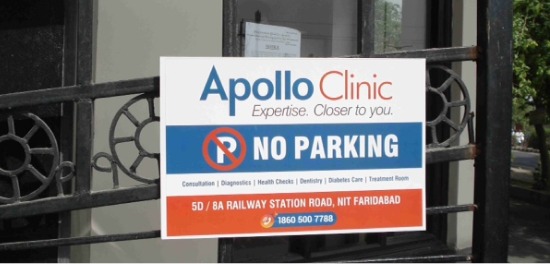
The number to anchor every Delhi plan on is ₹45 — that is the all-inclusive price of one no parking board for orders under 5,000 units, dropping to ₹35 per board once you cross 5,000. In a city where almost every colony gate is managed by a Resident Welfare Association and residents walk past the same entrance several times a day, that ₹45 buys you a real No Parking notice and a brand surface fixed exactly where Delhi households actually look. This guide breaks down what the format is in a Delhi context, what it costs, which colonies and RWA-heavy zones work, how MCD and NDMC areas differ, and how to plan a colony campaign without guesswork.
What is no parking board advertising in Delhi?
A no parking board is a branded sign installed on the gates and compound walls of independent houses and at the entry gates of housing societies. It does two jobs at once. It is a working No Parking notice — so residents actually want it on their gate and it stays up — and the main visual area is your advertisement. Each board measures 1ft × 1.5ft and is printed on Sunpack, a rigid, lightweight, weatherproof sunboard sheet that holds up to Delhi's dust, harsh summers and monsoon spells.
Delhi makes this format unusually effective for one structural reason: the city is built around colonies and RWAs. Whether it is a South Delhi kothi block, a DDA flats cluster, a gated condominium in Dwarka or a walk-up colony in Laxmi Nagar, residents flow through a defined set of gates every single day. The audience at those gates is concrete — homeowners and families, domestic staff, delivery riders, visitors and the RWA office-bearers who run the colony. Your brand sits at eye level in that flow, not glanced at from a moving car.
You can print boards four ways depending on budget and durability. UV is the most fade- and scratch-resistant and the premium choice for long Delhi exposure. Eco-solvent is the clean, weatherproof sweet spot for most campaigns. Solvent is a sturdy mid option, and digital is the cheapest for big-volume, short-window runs — useful for a quick ward-level election push. For the full national picture on the format, sizes and methods, see the complete 2026 guide to no parking board advertising in India.
How much does no parking board advertising cost in Delhi?
Pricing is deliberately simple and there is no monthly rental. You pay once and the boards stay up. The rate is ₹45 per board for any order under 5,000 boards, and it falls to ₹35 per board the moment your order reaches 5,000. That single price already includes the Sunpack board, your printing, transport across Delhi and installation on the gate — there is no separate line for design runs, logistics or labour.
Delhi no parking board rates (2026, all-inclusive)
Standard
Best for a focused South Delhi, West Delhi or single-zone Dwarka/Rohini run.
- 1ft × 1.5ft Sunpack board
- Printing included (UV/solvent/eco-solvent/digital)
- Transport across Delhi included
- Gate installation included
- No monthly rental
Bulk
Best for city-wide Delhi saturation across South, West, East and outer sectors.
- Everything in Standard
- Lower per-board rate at scale
- Ideal for multi-colony saturation
- Break-even point for mass reach
- Single geo-tagged proof report
Worked examples make the maths obvious. A tight 1,000-board run — say covering chosen Saket and Greater Kailash blocks — is about ₹45,000. Step up to 5,000 boards for a multi-zone Delhi saturation and you hit the bulk rate, roughly ₹1,75,000. A full 10,000-board city-wide programme works out to about ₹3,50,000. The 5,000-board mark is the break-even worth planning toward: it is where the per-board rate drops and where Delhi's sheer colony count starts paying off. Pricing details for the city sit on the no parking board advertising in Delhi service page.
Which Delhi areas work best for a colony campaign?
Delhi is not one market — it is dozens of distinct residential belts, and the right choice depends on who you sell to. The smart move is to match the housing type of an area to the advertiser, then decide between deep saturation of a few zones or a thinner spread across many.
South Delhi: premium kothis and condominiums
Saket, Greater Kailash and Vasant Kunj are the homes of South Delhi's independent kothis and upmarket condominiums. These are the gates for premium advertisers — jewellery and retail brands, private hospitals and diagnostics, wealth and banking products, and high-end real estate. RWAs here are well organised, which makes gated-society placement clean and predictable.
Dwarka and Rohini: planned sub-cities built for saturation
Dwarka and Rohini are planned sub-cities laid out sector by sector, with Pitampura and Janakpuri rounding out the outer-west grid. That structure is a gift for saturation: you can cover sector after sector of gated societies and DDA flats in a clean, efficient sweep, getting maximum board density for a single team's travel. Home services, schools and coaching, restaurants and cloud kitchens, and mid-market real estate all do well in this volume play.
West Delhi trader belts and East Delhi colonies
Rajouri Garden and Janakpuri anchor West Delhi's prosperous trader-and-family belt — good for retail, jewellery, home improvement and local services that want business-owning households. Across the Yamuna, Laxmi Nagar and Preet Vihar are dense East Delhi colonies with heavy foot flow and strong walk-up density, where boards rack up daily impressions cheaply. Central and old Delhi pockets like Connaught Place fringes, Karol Bagh, Lajpat Nagar and Chandni Chowk add commercial-residential mixes and high churn. Nehru Place leans commercial, so treat it as a spillover catchment rather than a colony core.
Coaching hubs: a special-case audience
Delhi's coaching ecosystem concentrates students and parents in identifiable pockets — Mukherjee Nagar in the north and Laxmi Nagar in the east are the obvious ones. For coaching institutes, ed-tech, hostels, libraries and student services, gate boards in the surrounding residential colonies and PG-heavy streets put your message exactly where the student-and-parent audience lives.
Match the Delhi area type to your advertiser
| Area type / examples | Housing | Who you reach | Best fit advertiser | |
|---|---|---|---|---|
| South Delhi (Saket, GK, Vasant Kunj) | Kothis & premium condos | Affluent families, drivers, staff | Jewellery, private hospitals, banking, premium real estate | |
| Planned sub-cities (Dwarka, Rohini) | Gated societies & DDA flats | Mass middle-class households | Home services, schools, restaurants, mid-market real estate | |
| Outer-west grid (Pitampura, Janakpuri) | Society & independent mix | Settled families, business owners | Retail, home improvement, local services | |
| Trader belt (Rajouri Garden) | Owner-occupied family homes | Business-owning households | Jewellery, retail, NBFCs, premium services | |
| East Delhi (Laxmi Nagar, Preet Vihar) | Dense walk-up colonies | High-footfall families, students | Coaching, clinics, restaurants, value retail | |
| Central/old Delhi (Karol Bagh, Lajpat Nagar, Chandni Chowk) | Commercial-residential mix | Traders, residents, visitors | Retail, wholesale brands, local commerce |
Connaught Place and Nehru Place are commercial cores — use their residential fringes as spillover catchments, not colony saturation targets.
Do you need MCD, NDMC or RWA permission in Delhi?
This is the question every Delhi advertiser asks first, and the answer is reassuringly simple because of where the boards go. A no parking board is fixed on a private house gate or a society's compound entrance — not on public land, not on a roadside pole, and not on a municipal hoarding site. That placement is what keeps it clean.
Most of Delhi's residential areas fall under the Municipal Corporation of Delhi (MCD), while the central zone around Connaught Place and the Lutyens area is governed by the New Delhi Municipal Council (NDMC). That MCD-versus-NDMC split matters a great deal for big roadside hoardings, which need municipal licensing and carry rental. It matters far less for gate boards, precisely because those boards never touch municipal property — the gatekeeper is the resident, not the corporation.
In practice, permission works at two levels. For an independent house, the homeowner's consent is all that is needed, and our team secures it at the point of install. For RWA-managed colonies and gated societies — which is most of Delhi — the Resident Welfare Association office-bearers control the entry gates, so we take their permission before fixing anything. Delhi's strong, well-organised RWA culture actually helps here: there is a clear person to ask, and once an RWA says yes, you get clean placement at the main gate that the whole colony passes through.
How do you plan a Delhi colony campaign step by step?
Map your target Delhi localities
Decide who you sell to, then pick area types to match — Saket/GK for premium, Dwarka/Rohini for saturation, Rajouri Garden/Janakpuri for trader families, Laxmi Nagar/Preet Vihar for dense reach. We group your chosen colonies on an internal coverage map so the run is even and nothing overlaps.
Design the dual-purpose board
Keep a clear, readable No Parking notice so residents and RWAs welcome it, and give your brand the main visual area with a single message, your logo and a contact or WhatsApp number. One clean idea reads better at a gate than a cluttered layout.
Choose printing for Delhi weather
Pick UV for premium long-exposure durability against Delhi dust and sun, eco-solvent for the clean weatherproof sweet spot, or digital for a cheap, high-volume short-window push such as a ward-level election run.
Secure owner and RWA permission, then install
Our team takes homeowner consent at independent houses and RWA office-bearer permission at gated societies, then fixes the Sunpack board securely on the gate or compound wall at the main entry point.
Get a geo-tagged proof-of-delivery report
After install we hand over a geo-tagged proof-of-delivery report listing every Delhi gate covered, so you can verify counts across South, West, East and outer sectors and see exactly where your spend went.
Who advertises on no parking boards in Delhi?
The format suits any business whose customers are households. Real estate and builders use it to push projects into target colonies. Hospitals, clinics and diagnostics build neighbourhood recall right at the gate. Coaching institutes and schools reach the student-and-parent audience in Mukherjee Nagar, Laxmi Nagar and surrounding colonies. Banks and NBFCs promote loans and accounts to homeowners. Jewellery and retail land near festival and wedding spend in trader belts like Rajouri Garden. Restaurants and cloud kitchens drive local orders in Dwarka and Rohini. Home services — plumbing, pest control, solar, water purifiers — reach exactly the homes that need them.
There is also a distinctly Delhi seasonal pattern worth planning around: ward-level political and election demand. Candidates and parties want their name on every gate in a ward during campaign windows, which makes residential media unusually busy in those periods. If your run overlaps an election cycle, book early — the same colonies are in high demand. To compare formats and plan a wider footprint, the main no parking board advertising service lays out the full menu, and no parking board advertising in Gurgaon extends the same model across NCR.
Retail and signage advertisers often pair a gate-board run with permanent storefront branding; our shop name board and signage services cover that side for Delhi traders.
Delhi no parking board advertising FAQs
What is the minimum order for a Delhi campaign?
There is no fixed minimum to get started — you can run a focused colony campaign and pay ₹45 per board. The number that matters is 5,000 boards, because that is where the rate drops to ₹35 and where city-wide Delhi saturation becomes most cost-efficient.
How long do the boards stay up in Delhi?
There is no monthly rental, so once a board is installed it stays on the gate. Sunpack is rigid and weatherproof, and UV or eco-solvent printing is chosen to withstand Delhi's dust, summer heat and monsoon, keeping your message visible well beyond a typical short-rental hoarding window.
Can I target only South Delhi or only Dwarka?
Yes. We map your campaign to the exact area types you want — premium South Delhi blocks like Saket and Greater Kailash, or sector-by-sector saturation in planned sub-cities such as Dwarka and Rohini. You choose the catchment and we plan the colony list around it.
Will the RWA actually allow it?
Usually yes, because the board is a genuine No Parking notice the colony benefits from, not just an ad. Delhi's RWA culture is well organised, so there is a clear office-bearer to approach, and we take their permission before installing anything at the society gate.
How do I verify the boards actually went up across Delhi?
After installation you receive a geo-tagged proof-of-delivery report listing every gate covered, plus geo-tagged field photos. You can confirm counts and locations across South, West, East and outer-Delhi sectors rather than taking the coverage on trust.
Is this cheaper than a hoarding in Delhi?
It spends differently. Instead of paying licensing and monthly rental for one large MCD or NDMC hoarding, a single all-inclusive payment puts your brand on hundreds or thousands of colony gates with no recurring cost — spreading the same budget across far more household-level touch-points.
Get a Delhi quote
Tell us which Delhi belts you want — premium South Delhi, saturated Dwarka or Rohini sectors, West Delhi trader colonies, or a city-wide push toward the 5,000-board bulk rate — and we will map the colonies, design the dual-purpose board and handle owner and RWA permissions and installation end to end. Request a free quote or message us on WhatsApp at wa.me/9580088540 to start your Delhi colony campaign.
Tags
Quick Answers
How much does no parking board advertising cost in Delhi?
In Delhi the rate is ₹45 per board for orders under 5,000 boards and ₹35 per board once you cross 5,000. That price is all-inclusive — the 1ft × 1.5ft Sunpack board, your printing, transport across the city and installation on the gate — with no monthly rental afterwards. A focused South Delhi or Dwarka run of 1,000 boards works out to about ₹45,000, while a city-wide 5,000-board saturation drops to roughly ₹1,75,000 at the bulk rate, which is also the break-even point worth planning around.
Which Delhi areas are best for no parking board advertising?
Pick by housing type and who you want to reach. Saket, Greater Kailash and Vasant Kunj suit premium advertisers targeting South Delhi kothis and condominiums. Dwarka and Rohini, being planned sub-cities, let you saturate sector by sector for mass reach. Rajouri Garden, Janakpuri and Pitampura cover West Delhi's trader and family belt, while Laxmi Nagar and Preet Vihar reach East Delhi's dense walk-up colonies. RWA-managed societies almost anywhere give you clean, permission-friendly gate placement.
Do you need MCD or RWA permission to put up no parking boards in Delhi?
For boards fixed on a private house gate, the homeowner's consent is what matters and our team secures it at install. In RWA-managed colonies and gated societies, the Resident Welfare Association office-bearers control the entry gates, so we take their permission before fixing anything. Because these boards sit on private gates and compound walls rather than on public MCD or NDMC land or roadside poles, they avoid the licensing and rental that municipal hoardings attract — the gatekeepers are the residents themselves.
Is no parking board advertising better than a hoarding in Delhi?
They do different jobs. One Delhi hoarding is a single large surface a commuter glances at while driving past. A no parking board run puts your brand on hundreds or thousands of individual colony gates, sitting at eye level where families, domestic staff, delivery riders and visitors pass daily on foot. For household-level, locality-by-locality penetration across Delhi's RWA colonies, gate boards spread your spend over far more touch-points than a single hoarding ever could.
Looking for professional No Parking Board Advertising services?
The Mediaverse runs end-to-end no parking board advertising campaigns across India with geo-tagged delivery and transparent, all-inclusive pricing.
Explore our No Parking Board Advertising solutionsSummarize this guide with AI
Open this article in your favourite AI assistant
Related Guides
Written by

The Mediaverse Team
India's Leading Outdoor Advertising Agency
The Mediaverse is a national-level outdoor advertising and integrated marketing organization that provides complete OOH, ATL, BTL, retail, and transit media solutions across India. With years of experience executing high-performance campaigns for brands in FMCG, Real Estate, E-commerce, EdTech, Automotive, Healthcare, and Retail, The Mediaverse combines creativity, data-driven media planning, and flawless on-ground execution. As a full-stack outdoor advertising provider, The Mediaverse offers Auto Branding, Mobile Van Branding, Newspaper Insertion Advertising, Shop Name Board Branding, In-Store Branding, Hoardings, Transit Media, Kiosks, Mall Media, Activations, and all forms of Below-The-Line marketing. Known for its pan-India network, strategic route planning, premium print quality, and Cheqmate™ GPS-based verification, The Mediaverse ensures 100% transparent and result-oriented campaign delivery. The Mediaverse’s editorial team produces deeply researched, SEO-optimized, and generative-engine-friendly content to help businesses understand the power of outdoor advertising and make informed decisions that maximize brand visibility and ROI across urban, suburban, and rural markets.
Related Articles
Gate-to-street saturation: no-parking boards plus auto hoods in one catchment, the worked plan (2026)
The entry ticket for one catchment covered from gate to street is ₹2,83,200 landed: 1,000 gate boards plus 300 auto hoods. Seven steps, the timings for both formats, three priced plans and the honest list of what the rate card leaves out.
Outdoor advertising for clinics, pharmacies and diagnostic centres: formats, compliance and catchment (2026)
A pharmacy plan of 1,000 gate boards plus a glow sign board is ₹56,168 landed; a clinic plan of 2,000 boards plus 50,000 A5 inserts is ₹1,79,950; a diagnostic centre plan with 300 auto hoods is ₹5,36,900. Plus the rules on what a medical board may say and how far each facility's catchment reaches.
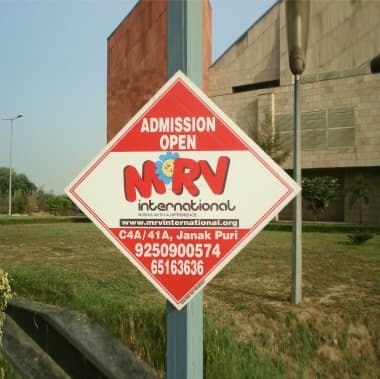
No Parking Board Advertising vs Hoardings: Which Wins for One Locality in 2026?
A hoarding looks like the premium buy — but for dominating ONE locality, it usually loses to no parking gate boards. Here is the honest, side-by-side comparison on cost model, reach, exposure and targeting, plus a clear verdict and decision checklist.