

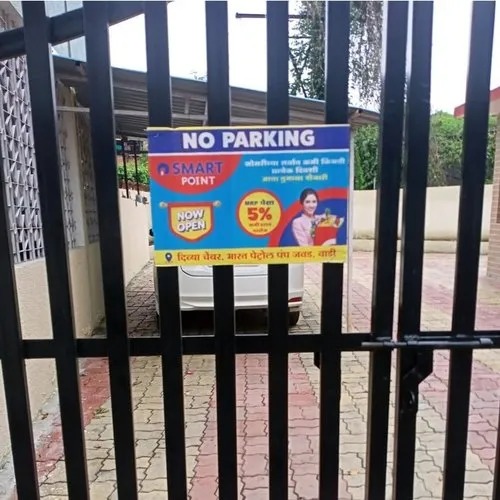
It starts with two numbers: ₹45 and ₹35. No parking board advertising is priced per board, all-inclusive — ₹45 for any order under 5,000 boards, and ₹35 once you cross 5,000 boards. That single rate already covers the board, the printing, transport and installation on the gate, with no monthly rental on top. Almost every other question people ask flows from that fact, so this page collects the real answers in one place: pricing, the board and material, printing methods, permissions, campaign coverage and which cities we run in.
This is a reference FAQ — read it top to bottom once, or jump to the theme you need. Each answer sticks to the real specs of the product, with no invented figures.
Quick answers to the most-asked questions
If you only read one section, read this. These four cover what most people search for first — price, what the product is, the spec, and whether it is allowed. The themed sections below go deeper on each.
No parking board advertising pricing (all-inclusive)
Standard
Per-board rate for orders below 5,000 boards. Covers board, printing, transport and gate installation.
- 1ft × 1.5ft Sunpack board
- Printing included
- Transport included
- Gate installation included
- No monthly rental
Bulk
Per-board rate once you order 5,000 boards or more. Same all-inclusive scope at a lower unit cost.
- 1ft × 1.5ft Sunpack board
- Printing included
- Transport included
- Gate installation included
- No monthly rental
- Best per-board economics at scale
Pricing & cost
Is there any monthly rental or recurring fee?
No. The price you pay is a one-time, per-board cost that already includes the board, printing, transport and installation. There is no monthly rental, site fee or renewal charge layered on top. You pay ₹45 per board under 5,000 units, or ₹35 per board at 5,000 and above, and that is the full cost of getting each board printed and fixed to a gate.
Why does the price drop from ₹45 to ₹35?
The drop is a bulk break-even. At 5,000 boards and above, the per-unit economics of printing, transport and installation improve enough to pass through a lower rate, so the price falls from ₹45 to ₹35 per board. Below 5,000 you stay at ₹45. In practice that makes the 5,000-board mark the point worth planning around — for example, 5,000 boards at the bulk rate is roughly ₹1,75,000 versus ₹45,000 for 1,000 boards at the standard rate.
What does the per-board price actually include?
Four things: the physical 1ft × 1.5ft Sunpack board, the printing of your design onto it, transport to the target localities, and installation on the gate with permission taken. Nothing in that list is billed separately. The only variable is how many boards you order, which decides whether you pay the ₹45 or ₹35 rate.
Board & material
No parking board: quick-reference spec
| Specification | Detail | |
|---|---|---|
| Size | 1ft × 1.5ft | |
| Material | Sunpack (sunboard) — rigid, lightweight, weatherproof | |
| Printing options | UV, Solvent, Eco-Solvent, Digital | |
| Function | Dual-purpose: real 'No Parking' notice + brand visual | |
| Pricing tiers | ₹45/board under 5,000 · ₹35/board at 5,000+ | |
| Installation | On home gates or society entry gates, permission taken, all-inclusive |
All-inclusive per-board pricing — board, printing, transport and installation. No monthly rental.
Why Sunpack and not flex or metal?
Sunpack is rigid, lightweight and weatherproof, which is the right combination for a small gate board that has to survive sun and rain for a long time. It holds printed colour cleanly, does not sag like loose flex, and is light enough to fix securely on a residential gate without heavy framing. Metal would add weight, cost and corrosion risk for no real benefit at this 1ft × 1.5ft size.
Can the board still work as a genuine No Parking sign?
Yes — that is the whole design. The board keeps the 'No Parking' message clearly legible so it remains useful to the household and visitors, while the larger visual area carries your brand, offer and contact number. Residents accept it because it serves a real purpose at their gate, and that acceptance is exactly what keeps your brand on display every day.
Is 1ft × 1.5ft big enough to be seen?
For its placement, yes. The board sits at eye level on a gate that the same people — residents, domestic staff, delivery riders, visitors — pass repeatedly. At that distance a 1ft × 1.5ft board comfortably carries a clear brand visual plus a phone number, and the repeated daily exposure does the heavy lifting rather than sheer size. A larger board would only add clutter and make owners less willing to host it.
Printing
Which printing methods are available?
Four: UV, solvent, eco-solvent and digital. UV printing is the most fade- and scratch-resistant, making it the premium, longest-lasting choice. Eco-solvent is the clean, weatherproof sweet spot for most outdoor campaigns. Solvent is a durable workhorse option. Digital is the cheapest, best suited to large volumes or a short campaign window where ultimate longevity matters less than unit cost.
Which printing method should I choose?
Match it to your campaign window and budget. If the board needs to look sharp for a long time outdoors, choose UV for the best fade and scratch resistance. For most standard outdoor runs, eco-solvent gives you clean, weatherproof results without paying the full UV premium. If you are printing a very large volume or running a short campaign, digital keeps the per-board cost lowest. Solvent sits in between as a dependable middle option.
Does the printing choice change how long the board lasts outdoors?
Yes. All four methods are made for outdoor use on Sunpack, but they differ in durability. UV resists fading and scratching the longest, so colours stay crisp through more sun and rain. Eco-solvent and solvent hold up well for typical campaign lifespans. Digital is the most economical but is best reserved for short windows or very high volumes where you are optimising for unit cost over maximum longevity.
Permissions & legality
Who gives permission — the homeowner or the society?
It depends on the location. On an independent house, the homeowner gives consent before their gate is used. At a housing society, permission is arranged through the Resident Welfare Association or the relevant office-bearers at the entry gate. Either way, a board only goes up where someone with authority over that gate has agreed, which is what keeps the campaign clean and the boards in place.
How do I know my boards were actually installed where promised?
You receive a geo-tagged proof-of-delivery report at the end of the campaign. It records each installed board with its location, so you can verify that the boards went up across your target localities and not somewhere else. That report, together with the on-gate installation photos our field team takes, is your confirmation before and after you pay.
What happens if a household or RWA later objects to a board?
Because every board is placed only after consent is taken, objections are rare — the household or RWA has already agreed to host it, and the genuine No Parking function gives them a reason to keep it. Where consent is the basis for installation, any concern is handled with the same owner or office-bearer who approved it. Keeping placement consent-first is exactly what protects both the advertiser and the resident.
Campaign & coverage
How does a campaign actually get planned and delivered?
It runs in five steps: we map the target localities to your catchment, design the dual-purpose board so the No Parking notice and your brand both read clearly, print it on Sunpack using your chosen method, secure owner or RWA permission and install on the gate, and finally hand over a geo-tagged proof-of-delivery report. The locality mapping comes first on purpose, so boards land where your real customers live rather than at random addresses.
Which businesses get the most out of this?
Any business whose customers are local households. That includes real estate and builders, hospitals, clinics and diagnostics, coaching centres and schools, banks and NBFCs, jewellery and retail, restaurants and cloud kitchens, home services like plumbing, pest control, solar and water purifiers, and ward-level political or election campaigns. The common thread is that the gate audience — families and the people who serve them — is exactly who they want to reach.
Is there a minimum order?
Pricing is structured around volume rather than a hard minimum: you pay ₹45 per board under 5,000 units and ₹35 per board at 5,000 and above. Smaller runs are perfectly workable at the ₹45 rate — for instance, 1,000 boards is about ₹45,000 — while the bulk rate rewards larger saturation campaigns. The right quantity depends on how many localities you want to cover; the quote page can size it to your catchment.
Cities
Which cities is no parking board advertising available in?
Coverage spans ten major cities: Delhi, Mumbai, Bangalore, Hyderabad, Chennai, Kolkata, Pune, Ahmedabad, Jaipur and Lucknow. In each, campaigns are planned around the specific residential localities you want to reach, so the same dual-purpose board and the same ₹45/₹35 all-inclusive pricing apply whether you are saturating one neighbourhood or running across a whole city.
Does the price change from city to city?
The per-board rate is the same everywhere: ₹45 under 5,000 boards and ₹35 at 5,000 and above, inclusive of board, printing, transport and installation. What varies between cities is which localities you choose to cover and how many boards that takes — not the unit price. So your budget scales with quantity and coverage rather than with the city you pick.
Can I run one campaign across several cities at once?
Yes. Because the board spec, printing options and pricing are consistent across all ten cities, a multi-city campaign is simply a larger locality map split across those cities. Ordering at that scale also makes it easier to reach the 5,000-board mark and the ₹35 bulk rate. Each city's boards are installed with local permission taken and reported back in the same geo-tagged proof-of-delivery report.
Still have a question?
If your question is about your specific catchment, board count or city mix, the fastest way to a real number is a quote sized to your localities. Share where you want to advertise and how many gates you want to cover, and we will map it against the ₹45/₹35 pricing. For the full strategic walkthrough behind these answers, read the complete 2026 guide to no parking board advertising.
Tags
Quick Answers
How much does no parking board advertising cost?
It is priced per board, all-inclusive. You pay ₹45 per board for any order under 5,000 boards, and ₹35 per board once you order 5,000 boards or more. That single rate covers the board itself, the printing, transport and installation on the gate — there is no monthly rental on top. So 1,000 boards works out to about ₹45,000, while 5,000 boards at the bulk rate is roughly ₹1,75,000. The 5,000-board mark is where the cheaper rate kicks in.
What exactly is a no parking board advertisement?
It is a branded board fixed to the gate or compound wall of a home, or at a housing-society entry gate, that does two jobs at once. It still reads as a genuine 'No Parking' notice so the message stays useful to residents, while the main visual area carries your brand, offer and contact details. Because it sits at eye level on a gate people pass every day — homeowners, domestic staff, delivery riders and visitors — it behaves like a permanent, hyperlocal billboard rather than a passing ad.
What size and material is the board?
Each board measures 1ft × 1.5ft and is made from Sunpack, also called sunboard — a rigid, lightweight, weatherproof sheet. That size is large enough for a clear brand visual plus a phone number, yet small enough to mount neatly on a residential gate without looking like clutter. Sunpack is chosen because it holds print well, survives sun and rain outdoors, and stays light enough to fix securely without heavy framing or hardware.
Do I need permission to put up the board?
Yes, and getting it is part of the service. For an independent house, the homeowner's consent is taken before the board goes on their gate. For a housing society, permission is arranged through the Resident Welfare Association or the relevant office-bearers at the entry gate. Boards are only installed where consent has been given, and you receive a geo-tagged proof-of-delivery report afterwards so you can confirm where each board actually went up.
Looking for professional No Parking Board Advertising services?
The Mediaverse runs end-to-end no parking board advertising campaigns across India with geo-tagged delivery and transparent, all-inclusive pricing.
Explore our No Parking Board Advertising solutionsSummarize this guide with AI
Open this article in your favourite AI assistant
Related Guides
Written by

The Mediaverse Team
India's Leading Outdoor Advertising Agency
The Mediaverse is a national-level outdoor advertising and integrated marketing organization that provides complete OOH, ATL, BTL, retail, and transit media solutions across India. With years of experience executing high-performance campaigns for brands in FMCG, Real Estate, E-commerce, EdTech, Automotive, Healthcare, and Retail, The Mediaverse combines creativity, data-driven media planning, and flawless on-ground execution. As a full-stack outdoor advertising provider, The Mediaverse offers Auto Branding, Mobile Van Branding, Newspaper Insertion Advertising, Shop Name Board Branding, In-Store Branding, Hoardings, Transit Media, Kiosks, Mall Media, Activations, and all forms of Below-The-Line marketing. Known for its pan-India network, strategic route planning, premium print quality, and Cheqmate™ GPS-based verification, The Mediaverse ensures 100% transparent and result-oriented campaign delivery. The Mediaverse’s editorial team produces deeply researched, SEO-optimized, and generative-engine-friendly content to help businesses understand the power of outdoor advertising and make informed decisions that maximize brand visibility and ROI across urban, suburban, and rural markets.
Related Articles
Gate-to-street saturation: no-parking boards plus auto hoods in one catchment, the worked plan (2026)
The entry ticket for one catchment covered from gate to street is ₹2,83,200 landed: 1,000 gate boards plus 300 auto hoods. Seven steps, the timings for both formats, three priced plans and the honest list of what the rate card leaves out.
Outdoor advertising for clinics, pharmacies and diagnostic centres: formats, compliance and catchment (2026)
A pharmacy plan of 1,000 gate boards plus a glow sign board is ₹56,168 landed; a clinic plan of 2,000 boards plus 50,000 A5 inserts is ₹1,79,950; a diagnostic centre plan with 300 auto hoods is ₹5,36,900. Plus the rules on what a medical board may say and how far each facility's catchment reaches.
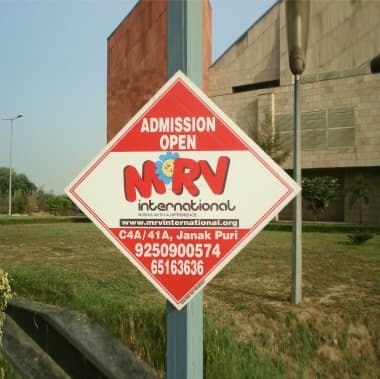
No Parking Board Advertising vs Hoardings: Which Wins for One Locality in 2026?
A hoarding looks like the premium buy — but for dominating ONE locality, it usually loses to no parking gate boards. Here is the honest, side-by-side comparison on cost model, reach, exposure and targeting, plus a clear verdict and decision checklist.