

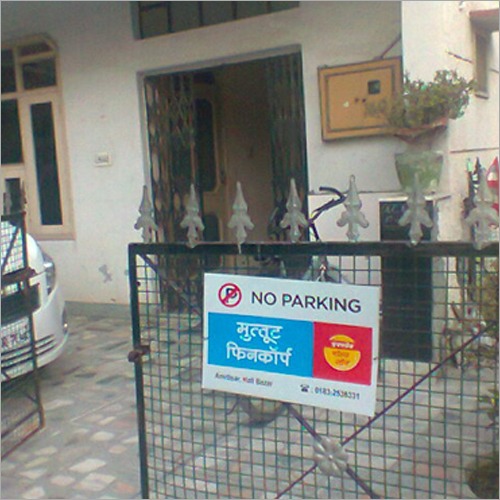
A builder in a mid-sized city sat across the table with a competitor's hoarding invoice in one hand and our rate card in the other, looking genuinely puzzled. The hoarding quote ran into recurring monthly numbers he had to keep paying just to stay on the wall. Our number was a single figure per board, paid once. "So what's the catch — where's the rental?" he asked. There isn't one. That conversation is the whole reason this page exists: no parking board advertising is priced on one all-inclusive per-board rate, with no monthly rental, and once you understand the ₹45 and ₹35 tiers, budgeting a campaign becomes simple arithmetic.
This guide is a plain-English 2026 rate card. We will lay out the two price tiers, define exactly what "all-inclusive" covers, work through real campaign budgets at 1,000, 5,000 and 10,000 boards, show when the cheaper ₹35 rate kicks in, and give you a five-step method to size your own spend before you ever ask for a quote.
How much does no parking board advertising cost in 2026?
Two numbers cover almost every campaign. For any order under 5,000 boards, the price is ₹45 per board. For orders of 5,000 boards and above, it is ₹35 per board. Both figures are all-inclusive — they already contain the board, the printing, transport to your localities, and installation on the gates. There is no separate media rental, so the per-board figure is genuinely the total you pay per board, not a starting point that grows later.
Because there is no rental, the model rewards volume in a way hoardings do not. A bigger order does not just buy more boards — at 5,000 units it also lowers the per-board rate. The rate card below is the entire pricing story; everything else in this guide is about applying it to your campaign.
No Parking Board Advertising Rate Card 2026 (all-inclusive, no rental)
Standard
The default rate for smaller and pilot campaigns. One-time, all-inclusive per board.
- 1ft × 1.5ft Sunpack board included
- Printing included (UV / Solvent / Eco-Solvent / Digital)
- Transport to your localities included
- Installation on house and society gates included
- No monthly rental, ever
Bulk
The bulk rate that unlocks at 5,000 boards and above — the campaign break-even point.
- Everything in the Standard tier
- Lower per-board rate across the whole order
- Best value for multi-locality and multi-city campaigns
- 5,000 boards ≈ ₹1,75,000; 10,000 boards ≈ ₹3,50,000
- No monthly rental, ever
What does "all-inclusive" actually cover — and what's not in it?
"All-inclusive" is the single most important phrase on this page, so let us be precise about it. One per-board rate — ₹45 or ₹35 — bundles four things together:
- The board — a rigid, weatherproof 1ft × 1.5ft Sunpack (sunboard) sheet.
- The printing — your dual-purpose design (brand visual plus the 'No Parking' message), in your chosen method.
- Transport — moving the printed boards to your target localities.
- Installation — securing owner or RWA permission and fixing the board on the gate.
What is deliberately not in the price is anything recurring. There is no monthly rental, because you are not renting media space — the board belongs on the gate as a genuine 'No Parking' notice, so residents keep it up rather than asking for it to come down. That is why a one-time per-board payment makes sense: the board keeps working long after the install, without a meter running. The honest test for any quote is simple — ask for it as a single 'all-inclusive per-board, no-rental' line. If a recurring charge appears, it is not the model described here.
What do real campaign budgets look like at 1,000, 5,000 and 10,000 boards?
Because the rate is a flat per-board figure, a budget is just board count times rate. The table below works through three common campaign sizes. Note how the per-board rate itself changes the moment you reach 5,000 boards — that is the only place the maths bends.
Worked No Parking Board Campaign Budgets (2026)
| Campaign size | Per-board rate | Approx total | Typical use | |
|---|---|---|---|---|
| 1,000 boards | ₹45 per board | ≈ ₹45,000 | A pilot in a few localities or one neighbourhood cluster | |
| 5,000 boards | ₹35 per board (bulk) | ≈ ₹1,75,000 | Full-city or multi-locality push at the bulk break-even | |
| 10,000 boards | ₹35 per board (bulk) | ≈ ₹3,50,000 | Multi-city or sustained saturation campaign |
All totals are all-inclusive (board + printing + transport + installation) with no monthly rental. The ₹35 bulk rate applies from 5,000 boards upward.
Read the table left to right and the logic is clear. A 1,000-board pilot at ₹45 lands around ₹45,000 — small enough to test a few localities. At 5,000 boards you cross into the ₹35 rate, so the whole order is cheaper per board and the total is roughly ₹1,75,000. Double that to 10,000 boards and the rate holds at ₹35, putting you near ₹3,50,000 for a multi-city footprint.
When does the cheaper ₹35 per board rate apply?
The ₹35 rate switches on at exactly 5,000 boards. Order 4,999 boards and every one is ₹45; order 5,000 and the entire batch is ₹35. That makes 5,000 the break-even number worth planning around. If your locality map naturally lands you at, say, 4,200 boards, it is usually worth checking whether widening to a few more societies pushes you over 5,000 — because at that point the lower rate applies to all of them, not just the extra ones.
This is the single most useful planning lever in the format, and it is worth a dedicated read on its own. If your budget sits in the grey zone between the tiers, see the ₹45 vs ₹35 break-even, explained, which works through exactly when sizing up pays for itself.
How do you budget a no parking board campaign step by step?
You do not need a quote to ballpark your spend. Work through these five steps and you will arrive at a board count and a rate tier before you ever pick up the phone.
Set your goal and pick target localities
Start with what you want the campaign to do — launch a new clinic, push a coaching admission window, build builder awareness in a corridor — then list the specific localities and housing societies where your audience lives. The list of areas, not a vague city name, is what your budget is built on.
Estimate board density per locality
For each locality, estimate how many independent-house gates and society entry gates you want a board on. A handful of streets and a few society gates per locality adds up quickly. Multiply average gates per locality by the number of localities to get a rough total board count.
Size the campaign against the 5,000-board break-even
Compare your rough count to the 5,000-board threshold. If you are comfortably under, budget at ₹45 per board. If you are close, decide whether adding localities to cross 5,000 is worth dropping the whole order to ₹35. If you are already over, you are in bulk territory at ₹35.
Pick a printing method for the longevity you need
The printing method is bundled in the rate, but it affects how long the board stays sharp. Choose UV for the most fade- and scratch-resistant finish, eco-solvent for a clean weatherproof balance, or digital for the cheapest option on big-volume, shorter-window pushes. This is a longevity decision, not a separate line item.
Request a single all-inclusive quote
Take your board count to the vendor and ask for one all-inclusive, no-rental per-board figure covering board, print, transport and installation. Confirm there is no recurring charge and that you will receive a geo-tagged proof-of-delivery report after install, so the spend maps to boards that actually went up.
Does the printing method change the price?
No — and this trips people up. The four printing methods (UV, Solvent, Eco-Solvent and Digital) all sit inside the same per-board rate. What changes between them is durability, not the headline number. UV is the most fade- and scratch-resistant and is the premium choice for boards you want looking crisp for a long time. Eco-solvent is the clean, weatherproof sweet spot for most campaigns. Digital is the cheapest to produce and suits very high volumes on a shorter window. So when you choose a method, you are choosing how long the board stays sharp, not paying a different rate per board.
For the full picture of the format — materials, placement, audience and process — the complete 2026 guide to no parking board advertising covers everything beyond pricing, and the no parking board advertising service page is where you start a campaign.
Frequently asked questions about no parking board advertising cost
Is there any monthly or annual rental on a no parking board?
No. The ₹45 or ₹35 per-board rate is a one-time, all-inclusive payment. There is no monthly or annual rental and no recurring media fee. Because the board doubles as a genuine 'No Parking' notice on the gate, residents keep it up, so you do not pay to stay visible the way you would for a rented hoarding.
Is there a minimum order to advertise on no parking boards?
The two published rates are tied to volume rather than a hard minimum: anything under 5,000 boards is billed at ₹45 each, and 5,000 boards or more drops to ₹35 each. A small pilot of around 1,000 boards (about ₹45,000) is a common starting point, while larger multi-locality or multi-city campaigns cross into the ₹35 bulk tier.
What is the difference in total cost between 1,000 and 5,000 boards?
A 1,000-board campaign is roughly ₹45,000 at the ₹45 standard rate. A 5,000-board campaign is roughly ₹1,75,000 because crossing 5,000 boards moves the entire order to the ₹35 bulk rate. So five times the boards costs under four times the money — the bulk threshold is what makes the larger campaign more efficient per board.
Does the price include design and installation?
Installation is always included in the per-board rate, along with the board, printing and transport. The standard dual-purpose layout — your brand visual plus the 'No Parking' message — is printed as part of the rate. The price you are quoted is meant to be all-inclusive, so the figure on the rate card is what gets your boards printed, delivered and fixed on gates.
How do I confirm a quote has no hidden costs?
Ask for the quote as a single 'all-inclusive per-board, no-rental' figure that covers board, printing, transport and installation, and confirm there is no recurring charge. Also ask for a geo-tagged proof-of-delivery report after install. If the quote matches the ₹45 (under 5,000) or ₹35 (5,000+) rate and carries no rental line, there are no hidden costs.
Ready to turn a board count into a number? Request an all-inclusive quote and we will size your campaign against the ₹45 and ₹35 tiers, no rental attached.
Tags
Quick Answers
How much does no parking board advertising cost in India in 2026?
In 2026, no parking board advertising costs ₹45 per board for orders under 5,000 boards and ₹35 per board for 5,000 boards and above. That rate is all-inclusive — it covers the Sunpack board, printing, transport to the locality, and installation on house gates or society entry gates. There is no monthly rental, so you pay once per board and the board stays up. Practically, 1,000 boards works out to roughly ₹45,000, while a 5,000-board campaign at the bulk rate is roughly ₹1,75,000.
What does the all-inclusive no parking board rate cover?
All-inclusive means one per-board price covers four things: the 1ft × 1.5ft Sunpack board itself, the printing of your dual-purpose design, transport of the printed boards to your target localities, and installation on the gates with owner or RWA permission. There is no separate rental, no recurring media fee, and no add-on for delivery proof. You pay ₹45 (or ₹35 in bulk) per board once. Because the board doubles as a genuine 'No Parking' notice, residents keep it up, so you are not paying month after month to stay visible.
When does the ₹35 per board rate apply?
The ₹35 per-board rate applies the moment your order reaches 5,000 boards or more. Below that, every board is ₹45. The 5,000-board mark is the break-even point: a 4,999-board order is billed at ₹45 each, but crossing to 5,000 drops the entire order to ₹35 each. So a 5,000-board campaign at the bulk rate is roughly ₹1,75,000, and 10,000 boards is roughly ₹3,50,000. If your plan lands close to 5,000, it is usually worth sizing up to qualify for the lower per-board rate.
Is there a monthly rental or hidden cost with no parking board advertising?
No. Unlike hoardings or billboards, no parking boards carry no monthly rental and no recurring media charge. The ₹45 or ₹35 per-board price is a one-time, all-inclusive figure that already bundles board, printing, transport, and installation. There is no separate design fee for a standard dual-purpose layout, no delivery-proof surcharge, and no site-rent. The honest way to confirm this on any quote is to ask for an 'all-inclusive per-board, no-rental' line — if a vendor adds recurring costs, it is not the model described here.
Looking for professional No Parking Board Advertising services?
The Mediaverse runs end-to-end no parking board advertising campaigns across India with geo-tagged delivery and transparent, all-inclusive pricing.
Explore our No Parking Board Advertising solutionsSummarize this guide with AI
Open this article in your favourite AI assistant
Related Guides
- no parking board advertising service
- complete 2026 guide to no parking board advertising
- the ₹45 vs ₹35 break-even, explained
- no parking board advertising in Delhi
- no parking board advertising in Bangalore
- shop name board and signage services
- request an all-inclusive quote
- how to measure outdoor advertising ROI
Written by

The Mediaverse Team
India's Leading Outdoor Advertising Agency
The Mediaverse is a national-level outdoor advertising and integrated marketing organization that provides complete OOH, ATL, BTL, retail, and transit media solutions across India. With years of experience executing high-performance campaigns for brands in FMCG, Real Estate, E-commerce, EdTech, Automotive, Healthcare, and Retail, The Mediaverse combines creativity, data-driven media planning, and flawless on-ground execution. As a full-stack outdoor advertising provider, The Mediaverse offers Auto Branding, Mobile Van Branding, Newspaper Insertion Advertising, Shop Name Board Branding, In-Store Branding, Hoardings, Transit Media, Kiosks, Mall Media, Activations, and all forms of Below-The-Line marketing. Known for its pan-India network, strategic route planning, premium print quality, and Cheqmate™ GPS-based verification, The Mediaverse ensures 100% transparent and result-oriented campaign delivery. The Mediaverse’s editorial team produces deeply researched, SEO-optimized, and generative-engine-friendly content to help businesses understand the power of outdoor advertising and make informed decisions that maximize brand visibility and ROI across urban, suburban, and rural markets.
Related Articles
Gate-to-street saturation: no-parking boards plus auto hoods in one catchment, the worked plan (2026)
The entry ticket for one catchment covered from gate to street is ₹2,83,200 landed: 1,000 gate boards plus 300 auto hoods. Seven steps, the timings for both formats, three priced plans and the honest list of what the rate card leaves out.
Outdoor advertising for clinics, pharmacies and diagnostic centres: formats, compliance and catchment (2026)
A pharmacy plan of 1,000 gate boards plus a glow sign board is ₹56,168 landed; a clinic plan of 2,000 boards plus 50,000 A5 inserts is ₹1,79,950; a diagnostic centre plan with 300 auto hoods is ₹5,36,900. Plus the rules on what a medical board may say and how far each facility's catchment reaches.
No Parking Board Advertising vs Hoardings: Which Wins for One Locality in 2026?
A hoarding looks like the premium buy — but for dominating ONE locality, it usually loses to no parking gate boards. Here is the honest, side-by-side comparison on cost model, reach, exposure and targeting, plus a clear verdict and decision checklist.