

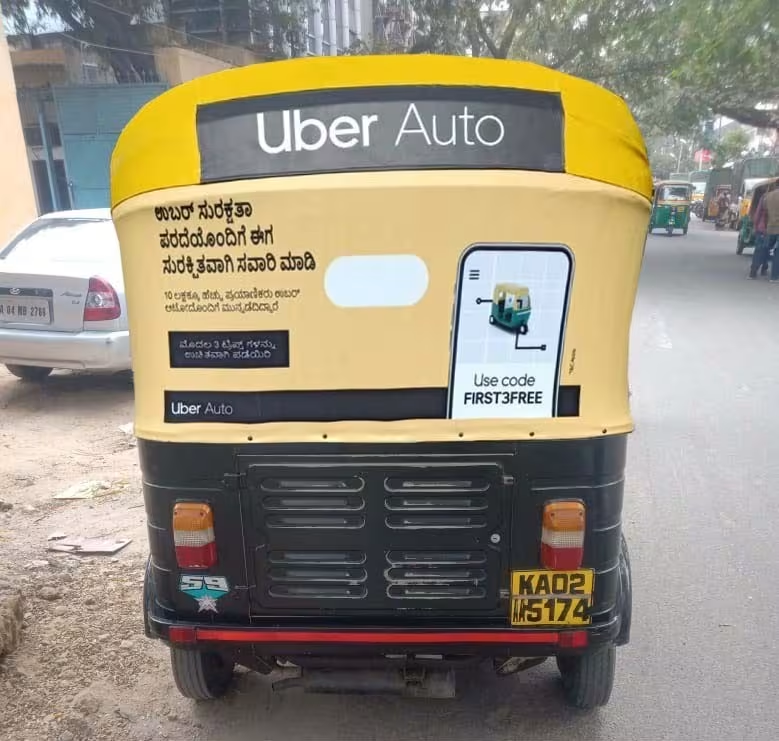
If you have already run a basic auto rickshaw branding campaign (50–100 autos, single zone, 1–3 months), this guide is your next level. Advanced auto branding strategy covers multi-zone orchestration, seasonal campaign stacking, A/B design testing, and Karnataka state-wide expansion. If you are new to auto branding, start with our campaign planning fundamentals guide first, then return here for scaling strategies. This content is designed for marketing managers and brand heads spending Rs.1 lakh+ per month on transit advertising.
Strategy 1: Multi-Zone Orchestration at Scale
The basic 3-Zone Model (40-35-25 split) works for 100 autos. At 200+ autos, you need multi-zone orchestration — treating Bangalore as 5 campaign clusters with distinct messaging per cluster. IT Corridor Cluster (Whitefield + Electronic City + Marathahalli): 30% of fleet, corporate messaging, B2B focus. Startup Hub Cluster (Koramangala + HSR + BTM): 25% of fleet, D2C and consumer messaging. Transit Hub Cluster (Majestic + KR Puram + Yeshwanthpur): 20% of fleet, mass-reach FMCG messaging. Premium Residential Cluster (Indiranagar + Jayanagar + Sadashivanagar): 15% of fleet, premium brand positioning. Emerging Growth Cluster (Sarjapur + Bellandur + Hebbal): 10% of fleet, awareness seeding for future expansion zones.
Each cluster can have different creative designs optimised for that audience. The IT cluster shows corporate credentials. The startup cluster shows pricing. The mass cluster shows the product. Same brand, 5 different entry points.
Strategy 2: Seasonal Campaign Stacking
Bangalore has 4 advertising seasons with distinct auto branding opportunities. Q1 (Jan–Mar): New year budgets, admission season, real estate launch window. Layer education and property campaigns. Q2 (Apr–Jun): Summer hiring, startup funding season. Layer B2B SaaS and recruitment campaigns. Q3 (Jul–Sep): Monsoon reduces outdoor visibility but competition drops 40% — run brand awareness campaigns at lower effective CPM. Q4 (Oct–Dec): Dasara, Diwali, year-end sales. Highest auto usage and footfall. Layer retail and FMCG campaigns. Advanced strategy: Run a continuous 100-auto base campaign year-round for brand recall, then stack additional 50–100 autos during your peak season. This gives you permanent presence plus seasonal amplification.
Strategy 3: A/B Design Testing Framework
Split your fleet into two equal groups with different designs. Run for 30 days with zone-specific QR codes tracking each design. Measure: QR scan rate per design, promo code redemption per design, and brand recall per design via quick street surveys. The winning design gets deployed across the full fleet for the remaining campaign. Variables worth testing: colour scheme (red vs blue background), message framing (price-led vs benefit-led), CTA type (QR scan vs phone call vs website URL), and language (English only vs Kannada+English bilingual). For design science principles, see our hood branding visibility and colour psychology guide.
Unique Framework: The Campaign Flywheel Effect
The Mediaverse has observed a compounding effect in long-running auto branding campaigns that we call the Campaign Flywheel. Month 1: Initial exposure. Brand recall builds at 1.5x baseline. QR scans start trickling. Month 2: Frequency threshold hit. The same commuters have seen your brand 30+ times. Recall jumps to 2x. QR scans accelerate as trust builds. Month 3: Flywheel effect kicks in. Brand is now familiar. QR scans peak as customers actively seek your brand. Word-of-mouth begins. Month 4-6: Compounding returns. Cost per lead drops 30–40% compared to Month 1 while lead volume increases. The brand is now part of the commuter landscape. Month 7-12: Brand permanence. Even after campaign ends, recall persists for 2–3 months. Brands that ran 6+ month campaigns report sustained lead flow for 60–90 days post-campaign. This flywheel is why 1-month campaigns show poor ROI and 6-month campaigns show exceptional ROI. The medium rewards patience and consistency.
Strategy 4: Karnataka State-Wide Expansion
After proving ROI in Bangalore, expand auto branding to Karnataka Tier-2 cities. Mysore: 25,000+ autos, strong tourist and student audience, costs 20–30% lower than Bangalore. Hubli-Dharwad: 15,000+ autos, commercial hub of North Karnataka, Kannada-only designs required. Mangalore: 12,000+ autos, coastal commercial centre, bilingual Tulu-Kannada audience. Belgaum: 10,000+ autos, industrial city near Maharashtra border, Hindi-Kannada bilingual. The Mediaverse operates auto branding services across all Indian cities with consistent quality and reporting standards.
Strategy 5: Integrated Transit + Print Campaign
The highest-ROI campaigns combine multiple Mediaverse services. Auto branding (lane-level daily visibility) + mobile van branding (highway and event visibility) + newspaper insertion (household breakfast table penetration) + shop name boards (storefront conversion point). This creates a complete offline marketing ecosystem: awareness on roads, reinforcement at breakfast tables, and conversion at storefronts.
Enterprise ROI Benchmarks
For enterprise campaigns (200+ autos, 6+ months): Average ROI: 400–600% (vs 300–400% for standard campaigns). Cost per lead drops 30–40% by Month 4 due to flywheel effect. Brand recall at 6 months: 4–5x baseline. Recommended budget: Rs.1.5–3 lakh/month for comprehensive city coverage. For detailed measurement frameworks, read our auto branding ROI measurement guide.
Frequently Asked Questions — Advanced Auto Branding Strategy
How many autos do I need for city-wide coverage in Bangalore?
200–300 autos across 5 cluster zones provides comprehensive Bangalore coverage. The multi-zone orchestration model divides the city into IT Corridor, Startup Hub, Transit Hub, Premium Residential, and Emerging Growth clusters.
Should I run auto branding during monsoon season in Bangalore?
Yes, strategically. Monsoon (Jul–Sep) reduces outdoor visibility but competition drops 40%. Lower competition means lower effective CPM. Use monsoon months for brand awareness campaigns with monsoon-grade UV materials.
How do I A/B test auto branding designs?
Split your fleet into two equal groups with different designs. Use zone-specific QR codes to track each design separately. Run for 30 days, then deploy the winning design across the full fleet. Test one variable at a time: colour, message, CTA type, or language.
Can I expand auto branding beyond Bangalore to other Karnataka cities?
Yes. Mysore (25K+ autos), Hubli-Dharwad (15K+), Mangalore (12K+), and Belgaum (10K+) are all serviceable. Costs are 20–30% lower than Bangalore. The Mediaverse operates across all Karnataka cities.
What is the Campaign Flywheel effect in auto branding?
The Flywheel is a compounding effect where brand recall and lead generation accelerate over time. Month 1 is exposure, Month 3 is frequency threshold, Month 4–6 sees cost per lead drop 30–40% while volume increases. This is why 6-month campaigns dramatically outperform 1-month campaigns.
Scale Your Auto Branding to Enterprise Level
Ready to move beyond basic campaigns? The Mediaverse designs enterprise auto branding strategies with multi-zone orchestration, seasonal stacking, and integrated transit+print campaigns. Get your enterprise campaign strategy.
Updated Pricing for Scaling Campaigns (2026)
Scaling budget framework at current rate-card prices (one-time per auto, 18% GST extra). Phase 1 Pilot: 500 autos with 24 x 6 inch back-panel stickers at Rs.170 each = Rs.85,000 (stickers carry a 500-auto minimum). Phase 2 Expansion: 300 hood covers at Rs.650 each = Rs.1,95,000 (hood minimum is 300 autos). Phase 3 Dominance: 500 hoods at Rs.630 plus 500 24 x 18 inch stickers at Rs.240 = Rs.4,35,000; the volume rates (Rs.630 hood, Rs.140 and Rs.240 stickers) apply automatically at 500+ autos. On annual contracts, negotiate 10-15 percent discounts.
Auto branding scaling phases at 2026 rate-card prices
Phase 1: Pilot
500 autos with 24 x 6 inch back-panel stickers at Rs.170 each (500-auto sticker minimum). Tests zone fit before scale-up.
- 500 back-panel stickers
- 2 test zones
- Zone-specific QR tracking
Phase 2: Expansion
300 hood covers at Rs.650 each (300-auto hood minimum), concentrated in the winning zones from the pilot.
- 300 hood covers
- Winning-zone concentration
- A/B tested creative
Phase 3: Dominance
500 hoods at Rs.630 plus 500 24 x 18 inch stickers at Rs.240; volume rates apply automatically at 500+ autos.
- 500 hoods plus 500 large stickers
- Multi-zone orchestration
- 10-15% annual contract discounts
What budget do I need to dominate a zone with auto branding?
Zone dominance requires 200+ autos concentrated in 2-3 zones. At rate-card prices, 300 hoods cost Rs.1,95,000 plus GST one-time, and 500 hoods plus 500 large 24 x 18 inch stickers cost Rs.4,35,000 plus GST. Plan a 6-month commitment minimum. At this scale, your brand becomes synonymous with the zone. Negotiate 10-15 percent annual contract discounts.
Key Insight: The biggest scaling mistake is going from 50 autos directly to 300. Data from Phase 1 pilot tells you WHICH zones work and WHICH format converts. Skipping this step means scaling the wrong strategy at high cost.
Quick Answers
How to scale auto branding beyond 200 autos?
Pilot 50-100 in 2 zones. Expand to 200 in winning zone. Dominate with 500 across 4-5 zones. Negotiate 10-15% annual discounts at 200+ scale.
Looking for professional Auto Branding services?
The Mediaverse runs end-to-end auto branding campaigns across India with geo-tagged delivery and transparent, all-inclusive pricing.
Explore our Auto Branding solutionsSummarize this guide with AI
Open this article in your favourite AI assistant
Written by

The Mediaverse Team
India's Leading Outdoor Advertising Agency
The Mediaverse is a national-level outdoor advertising and integrated marketing organization that provides complete OOH, ATL, BTL, retail, and transit media solutions across India. With years of experience executing high-performance campaigns for brands in FMCG, Real Estate, E-commerce, EdTech, Automotive, Healthcare, and Retail, The Mediaverse combines creativity, data-driven media planning, and flawless on-ground execution. As a full-stack outdoor advertising provider, The Mediaverse offers Auto Branding, Mobile Van Branding, Newspaper Insertion Advertising, Shop Name Board Branding, In-Store Branding, Hoardings, Transit Media, Kiosks, Mall Media, Activations, and all forms of Below-The-Line marketing. Known for its pan-India network, strategic route planning, premium print quality, and Cheqmate™ GPS-based verification, The Mediaverse ensures 100% transparent and result-oriented campaign delivery. The Mediaverse’s editorial team produces deeply researched, SEO-optimized, and generative-engine-friendly content to help businesses understand the power of outdoor advertising and make informed decisions that maximize brand visibility and ROI across urban, suburban, and rural markets.
Related Articles
Where Branded Autos Actually Stand Still: 35 Percent of the Working Day (2026)
A branded auto spends about a third of its working day parked, and that is when it does its best work. The published dwell averages per stop type, what the 300-auto minimum covers at five Bangalore hubs and three residential pockets, and where the minimum order actually buys dominance.
100-Micron Against 80-Micron: The Auto Branding Material Question to Ask Before You Book (2026)
The material line is the one nobody checks and the only one that decides whether the fleet is still readable in month seven. What our ten city pages publish about 100-micron against 80-micron, the per-city failure windows, and the arithmetic that turns any material quote into one comparable number.
Auto Back Panel Branding in 2026: The Cheapest Auto Campaign You Can Actually Book
The smallest auto order on our card is 500 back panel stickers at Rs.170 each, or Rs.85,000 before GST, which is Rs.1,10,000 below the hood floor. The slab math at 800 autos, the per-square-inch comparison of the two sticker sizes, and what the hood budget buys in panels.