

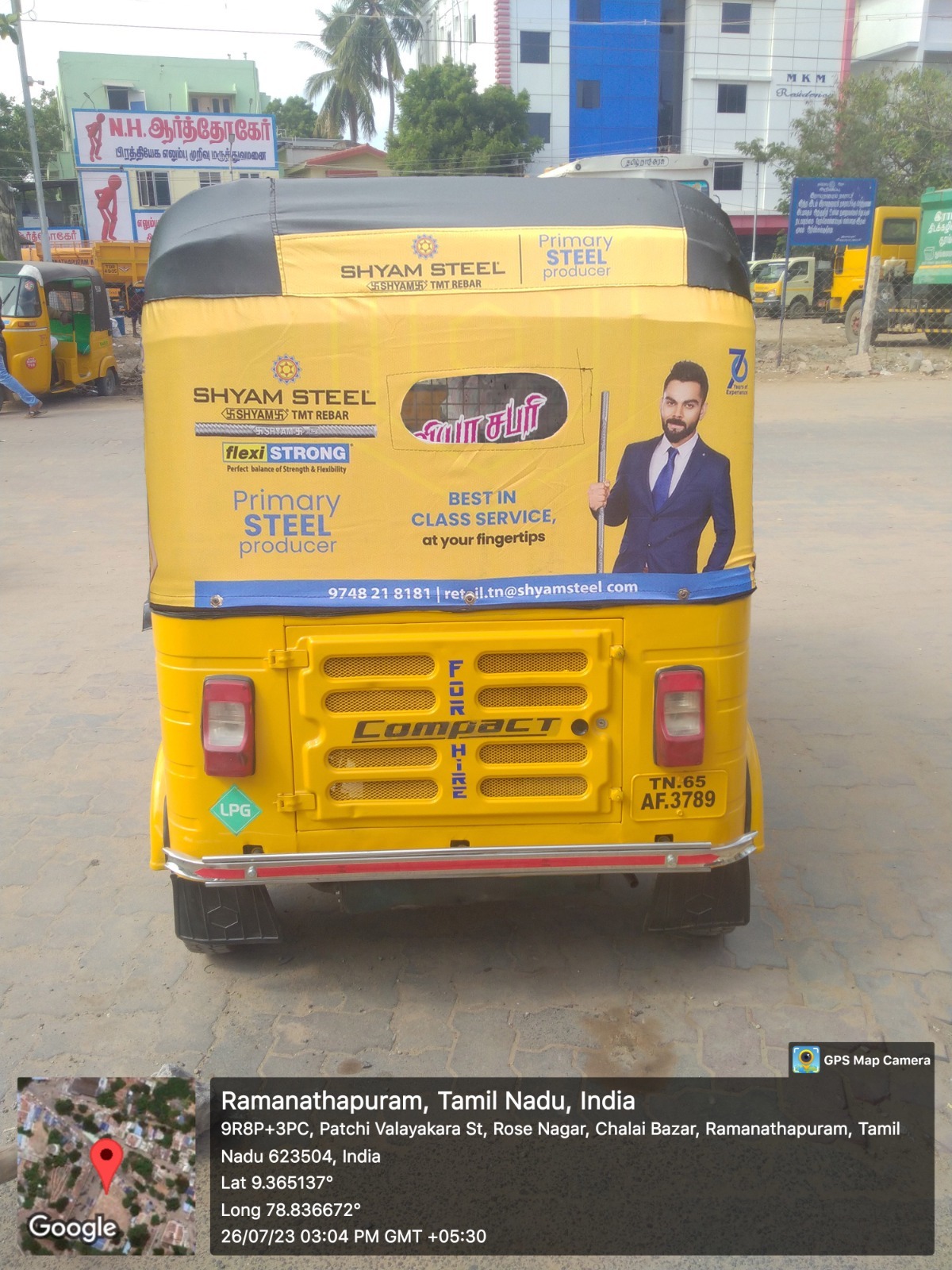
In April 2025, a Bangalore D2C founder ran the same auto branding campaign across four city zones at the same per-vehicle rate. 50 autos in Koramangala, 50 in HSR, 50 in Whitefield, and 50 in Hebbal. Same vinyl. Same creative. Same 30-day window. Four very different ROIs. Whitefield delivered the highest aided recall. Hebbal delivered the lowest cost-per-recall. Koramangala delivered the highest organic share. HSR delivered the most consistent footfall lift at the brand's HSR retail outlet. Same money, four different campaigns. The founder thought he had been overcharged on three of the four. He had not.
Bangalore is not one auto branding market. It is six or seven, and the rate logic, audience density, and regulatory overlay change zone by zone. This guide breaks down the four largest by spend, plus the three smaller zones we run in regularly, with the rate cards and the audience math each one demands.
Bangalore auto fleet at a glance
Karnataka State Transport authority data put the active commercial auto rickshaw fleet in Bengaluru Urban district at roughly 1.6 to 1.8 lakh vehicles in 2025. Of these, our union and depot relationships give us reliable advertising access to roughly 65,000 to 80,000 vehicles distributed across the BBMP urban footprint. The remaining fleet is either privately tied to specific apps, parked at non-active stands, or out of advertising rotation. Headline city-wide rate ranges from ₹480 to ₹650 per vehicle per month, but no single rate applies to the full fleet.
Zone 1: Koramangala
- Standard hood rate: ₹550 to ₹580 per vehicle per month
- Audited daily impressions per vehicle: 9,500 to 12,000
- Active fleet for advertising: ~7,500 vehicles across 80 Feet Road, 5th Block, Forum Mall area, Wipro signal, Sony Signal, and KEB Layout
- Audience: high-intent D2C consumer (25-40 age band, white-collar, Bangalore native plus expat), pedestrian-heavy weekends
- Best-fit categories: D2C food, fashion, beauty, fintech, EdTech, restaurant launches
- Why the rate sits where it does: dense premium consumer traffic, frequent fare turnover, high social-share rate (organic Instagram tag rate is 3-4x suburban zones in our 2025 audits)
Zone 2: HSR Layout
- Standard hood rate: ₹540 to ₹570 per vehicle per month
- Audited daily impressions per vehicle: 8,500 to 11,500
- Active fleet for advertising: ~6,200 vehicles across Sectors 1 to 7, BDA Complex, 27th Main, Agara Lake area, Silk Board feeder routes
- Audience: tech employees (Sectors 1, 2, 7), young professional residents, retail consumer overlap with 27th Main
- Best-fit categories: B2B SaaS demos, tech-product launches, retail outlets at HSR, food delivery, gym chains
- Why the rate sits where it does: tech-leaning audience with high disposable income; less pedestrian footfall than Koramangala, so per-vehicle eyeball count is marginally lower
Zone 3: Indiranagar
- Standard hood rate: ₹580 to ₹620 per vehicle per month
- Audited daily impressions per vehicle: 10,500 to 14,000
- Active fleet for advertising: ~5,800 vehicles across 100 Feet Road, CMH Road, Old Madras Road feeder, Domlur and HAL flyover stretches
- Audience: premium retail and F&B consumer, weekend high-footfall pedestrian, social-media-active 25-45 age band
- Best-fit categories: premium F&B, boutique retail, fitness studios, financial services, lifestyle D2C
- Why the rate sits where it does: 100 Feet Road is one of Bangalore's two highest-CPM consumer corridors. Indiranagar pedestrian density during weekend evenings drives a per-vehicle impression count second only to MG Road / Brigade Road
Zone 4: Whitefield and Sarjapur tech corridor
- Standard hood rate: ₹600 to ₹650 per vehicle per month
- Audited daily impressions per vehicle: 12,000 to 18,000
- Active fleet for advertising: ~9,500 vehicles across ITPL, Marathahalli bridge, EPIP Zone, Sarjapur Junction, Bellandur, Embassy Tech Village exits
- Audience: tech employees aged 25-40, high disposable income, evening tech-park exit dwell, low organic-share rate (audience moves fast, less photography), high search-conversion lift
- Best-fit categories: B2B SaaS, fintech, EdTech (especially upskilling), quick commerce, food delivery, premium home services, real estate within tech corridor radius
- Why the rate sits where it does: longest fares, highest dwell time at signal stops (40-90 seconds at evening peak), tech-park exit captive audience, harsher heat exposure on vinyl
Zone 5: Outer Ring Road (ORR) and Marathahalli
- Standard hood rate: ₹580 to ₹620 per vehicle per month
- Audited daily impressions per vehicle: 11,000 to 16,000
- Active fleet for advertising: ~8,200 vehicles
- Audience overlaps both Whitefield (tech) and Koramangala (consumer); Marathahalli bridge area sees the highest mixed audience footfall in Bangalore
- Best-fit categories: cross-segment campaigns where the brand wants both tech and consumer reach
Zone 6: South Bangalore residential (Jayanagar, BTM, Banashankari, JP Nagar)
- Standard hood rate: ₹520 to ₹560 per vehicle per month
- Audited daily impressions per vehicle: 8,000 to 11,000
- Active fleet for advertising: ~9,800 vehicles
- Audience: family-oriented Bangalore native households, school-run morning peak, household-shopping pattern
- Best-fit categories: education (K-12 schools, coaching), home services, healthcare, FMCG, residential real estate, family-oriented restaurants, religious and cultural events
Zone 7: Peripheral and industrial (Peenya, Hebbal, Yeshwantpur, Electronic City)
- Standard hood rate: ₹480 to ₹520 per vehicle per month
- Audited daily impressions per vehicle: 6,000 to 9,000
- Active fleet for advertising: ~14,500 vehicles
- Audience: industrial workforce (Peenya), bulk warehouse / logistics workers, lower-middle-income commuters; Electronic City has tech-corridor overlap on the Phase 1 stretch
- Best-fit categories: bulk industrial supplies, B2B mid-market, vocational education, two-wheeler service brands, value FMCG
Bangalore auto branding zones compared (2026)
| Zone | Audited daily impressions per auto | Active ad fleet | Best-fit categories | |
|---|---|---|---|---|
| Koramangala | 9,500 to 12,000 | ~7,500 | D2C food, fashion, beauty, fintech, EdTech | |
| HSR Layout | 8,500 to 11,500 | ~6,200 | B2B SaaS, tech launches, food delivery, gyms | |
| Indiranagar | 10,500 to 14,000 | ~5,800 | Premium F&B, boutique retail, lifestyle D2C | |
| Whitefield and Sarjapur | 12,000 to 18,000 | ~9,500 | B2B SaaS, fintech, EdTech, quick commerce | |
| ORR and Marathahalli | 11,000 to 16,000 | ~8,200 | Cross-segment tech plus consumer reach | |
| South residential (Jayanagar, BTM, JP Nagar) | 8,000 to 11,000 | ~9,800 | Education, healthcare, FMCG, real estate | |
| Peripheral and industrial (Peenya, Hebbal, E-City) | 6,000 to 9,000 | ~14,500 | B2B mid-market, vocational education, value FMCG |
Impression data aggregated from 2,400 to 3,000 vehicle-day audits per quarter over 18 months.
Bangalore-specific regulatory note
Auto rickshaws in Bangalore are regulated under the Karnataka Motor Vehicles Department. Commercial advertising on hoods is permitted subject to driver consent and vehicle owner approval. The Karnataka Motor Vehicle Rules require the regulation yellow band, registration number, and driver photograph to remain visible regardless of advertising overlay. BBMP itself does not permit-license per-auto branding (unlike cityscape OOH where BBMP's 2024 OOH byelaws apply), so the regulatory compliance is at the vehicle level rather than the campaign level. Maintain proof of driver consent for each vehicle; in 2025 we saw two competing campaigns get partial removal because no consent register was on file when traffic police asked.
Seasonal overlay
Bangalore weather is gentler on vinyl than most Indian metros, but two windows demand attention. Pre-monsoon (May to early June) sees the highest cheap-vinyl failure rate; insist on 4 mil hot-laminate. October to early December is the best campaign window for new launches because consumer footfall peaks across Koramangala, HSR, and Indiranagar with festival-season retail. February to April sees a 12-15 percent rate softening as agencies clear inventory before the summer slow zone. If your launch window is flexible, target October launches and pre-book in February for cost-efficient sustained campaigns.
Zone-rate quick-reference
- Tech corridor (Whitefield, Sarjapur, Bellandur): ₹600 to ₹650
- Premium central (Indiranagar, MG Road feeder): ₹580 to ₹620
- ORR mixed (Marathahalli, Bellandur outer): ₹580 to ₹620
- South premium consumer (Koramangala, HSR): ₹540 to ₹580
- South residential (Jayanagar, BTM, JP Nagar, Banashankari): ₹520 to ₹560
- Peripheral / industrial (Peenya, Hebbal, Yeshwantpur, Electronic City Phase 2): ₹480 to ₹520
Evidence we lean on
Our Bangalore ops team logs 2,400 to 3,000 vehicle-day audits a quarter across these zones. The audit captures three things: photographic confirmation of vinyl condition, GPS sample of route, and the operator's daily fare-count estimate. The numbers in this guide come from those audits aggregated across 18 months. We do not publish vendor-proprietary data, but we are happy to share zone-level proof per campaign on request when a brand is making a multi-zone allocation decision.
How to allocate a Bangalore multi-zone campaign
Step one: define the audience by category fit per zone, not by zone size. A B2B SaaS brand allocating equally across all seven zones is wasting roughly 35 percent of spend on audiences who do not buy. Step two: weight the zone allocation by audited per-vehicle impressions, not by fleet size. Whitefield 50 vehicles deliver more impressions than Peripheral 70 vehicles. Step three: lock the rate per zone, not per city, in the PO. A vendor offering a flat ₹550 across all zones is either underserving the tech corridor or overcharging the periphery. Step four: audit weekly with photo and GPS proof; ratecard variance only matters if delivery matches plan.
If you want a written zone-allocation plan for a specific budget and category, send us the brief and we will reply with a 6-zone audited-impression weighted plan inside two working days.
Can a single 30-day Bangalore auto campaign cover all 7 zones?
Mechanically yes, strategically rarely. A 200-vehicle campaign spread across 7 zones gives you roughly 28-29 vehicles per zone, which is below the saturation threshold for any single neighborhood. A 200-vehicle campaign concentrated in 2-3 zones at 65-100 vehicles per zone produces measurably higher aided recall in those zones. We recommend spread of 3-4 zones max for single-month campaigns, with category fit driving the picks.
Which Bangalore zone is best for a 100-vehicle launch on a ₹60,000 budget?
South residential zones (Jayanagar, BTM, JP Nagar) at ₹520-560 per vehicle let you book ~110 vehicles within ₹60k. Best-fit if your category is family-oriented (K-12, healthcare, FMCG, residential real estate). For tech-targeted launches at the same budget, drop the vehicle count to 95-100 and run them on tech corridor at ₹600-650. The smaller fleet on the right corridor outperforms the larger fleet on the wrong corridor.
Do Bangalore auto rate cards include GST?
Distribution rates per vehicle quoted by reputable Bangalore agencies are typically pre-GST. The 18 percent GST applies to the agency invoice on top of the per-vehicle rate. A ₹580 per-vehicle quote becomes ₹684.40 grossed up. Always confirm pre-tax versus post-tax framing in writing before comparing two vendor proposals.
How does Whitefield monsoon affect auto branding visibility?
Whitefield routes have lower tree cover than Koramangala or Indiranagar, so peak monsoon (June-August) sees vinyl exposed to direct rain plus higher heat re-cycle when the rain stops. We see 14-18 percent visible vinyl wear by week 6 on Whitefield routes during monsoon vs 8-11 percent in Koramangala on the same vinyl spec. Insist on premium 4 mil hot-laminate and a written replacement reserve if your campaign window crosses monsoon and runs primarily on tech corridor.
What is the smallest Bangalore zone you should book auto branding in?
Anything under 30 vehicles in a single zone is below the perceptual saturation threshold for the audience. We do not recommend booking less than 30 vehicles in any zone unless the campaign is testing zone fit before scale-up. A 100-vehicle campaign split across 7 zones (14 each) reads as scattered to the audience; the same 100 vehicles in 3 zones (33 each) reads as deliberate.
Tags
Quick Answers
Which Bangalore zone gives the best auto branding ROI?
ROI by zone depends on the brand category. D2C and consumer electronics see the highest aided recall in Koramangala, HSR Layout, and Indiranagar (premium consumer commute, dense pedestrian footfall, repeat exposure). Quick-commerce and food-delivery brands see best ROI on tech corridors (Sarjapur, Whitefield, Marathahalli) where fare turnover is highest. Real estate and home services see best ROI in suburban zones (Hebbal, Yelahanka, Electronic City) where target buyers live. Pick zone by audience overlap, not headline rate.
Why do Whitefield and Sarjapur auto rates run higher than Koramangala?
Tech-corridor autos run longer fares with higher dwell times at Bellandur, Marathahalli, and Whitefield signal stops. Audited daily eyeball counts on these stretches are 12,000 to 18,000 per vehicle versus 8,500 to 12,000 in Koramangala. Vendors charge ₹600 to ₹650 to reflect higher impression delivery, plus a vinyl premium because tech-corridor heat exposure is harsher than South Bangalore tree-cover routes.
Are Bangalore peripheral zones (Peenya, Yeshwantpur) worth running auto branding in?
Yes for industrial, B2B, and bulk-supply categories that target factory and warehouse workforces, where Peenya and Yeshwantpur autos serve the daily commute. Yes for budget-tight campaigns at ₹480 to ₹520 per vehicle. No for premium D2C or consumer brands targeting urban affluent audiences. The ₹70 to ₹100 saving per vehicle does not offset the lower aided recall in our 2025 audits across these peripheral zones.
Looking for professional Auto Branding services?
The Mediaverse runs end-to-end auto branding campaigns across India with geo-tagged delivery and transparent, all-inclusive pricing.
Explore our Auto Branding solutionsSummarize this guide with AI
Open this article in your favourite AI assistant
Related Guides
- auto branding rate variance ₹550 vs ₹580
- auto hood vs full-wrap vs back-panel
- complete Bangalore auto branding cost guide
- auto branding ROI measurement
- auto hood visibility science
- advanced auto rickshaw planning
- T-shape vs LED van vs canter at ₹75k
- newspaper insertion at ₹1.9 hidden costs
- auto branding for restaurant and cloud kitchen launches
Written by

The Mediaverse Team
India's Leading Outdoor Advertising Agency
The Mediaverse is a national-level outdoor advertising and integrated marketing organization that provides complete OOH, ATL, BTL, retail, and transit media solutions across India. With years of experience executing high-performance campaigns for brands in FMCG, Real Estate, E-commerce, EdTech, Automotive, Healthcare, and Retail, The Mediaverse combines creativity, data-driven media planning, and flawless on-ground execution. As a full-stack outdoor advertising provider, The Mediaverse offers Auto Branding, Mobile Van Branding, Newspaper Insertion Advertising, Shop Name Board Branding, In-Store Branding, Hoardings, Transit Media, Kiosks, Mall Media, Activations, and all forms of Below-The-Line marketing. Known for its pan-India network, strategic route planning, premium print quality, and Cheqmate™ GPS-based verification, The Mediaverse ensures 100% transparent and result-oriented campaign delivery. The Mediaverse’s editorial team produces deeply researched, SEO-optimized, and generative-engine-friendly content to help businesses understand the power of outdoor advertising and make informed decisions that maximize brand visibility and ROI across urban, suburban, and rural markets.
Related Articles
Auto Back Panel Branding in 2026: The Cheapest Auto Campaign You Can Actually Book
The smallest auto order on our card is 500 back panel stickers at Rs.170 each, or Rs.85,000 before GST, which is Rs.1,10,000 below the hood floor. The slab math at 800 autos, the per-square-inch comparison of the two sticker sizes, and what the hood budget buys in panels.
Minimum Orders Are Per City, Not Per Campaign: What a 10-City Outdoor Rollout Really Floors At (2026)
Every city page publishes its own minimum: 300 autos for hood branding, 500 for back panel stickers, 1,000 no-parking boards, 50,000 insert copies. Multiply by ten cities and a national campaign floors between Rs.4,50,000 and Rs.19,50,000, which decides the shape of the plan before creative does.
Auto Branding for Restaurant and Cloud Kitchen Launches: The Delivery-Radius Zone Playbook (2026)
Auto branding is priced and deployed by zone, which makes it the outdoor format that can be pointed at a restaurant or cloud kitchen's own delivery radius. Published rates, worked launch-campaign totals, and a five-step zone mapping process.